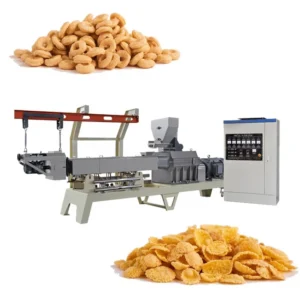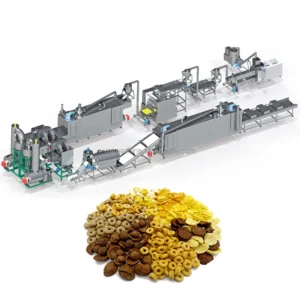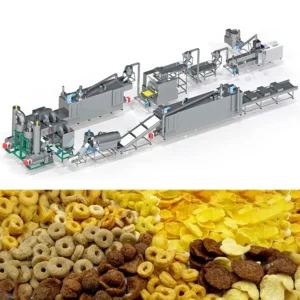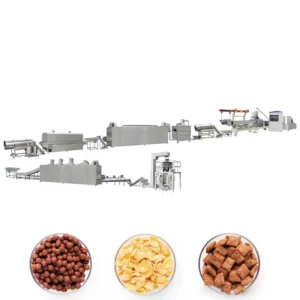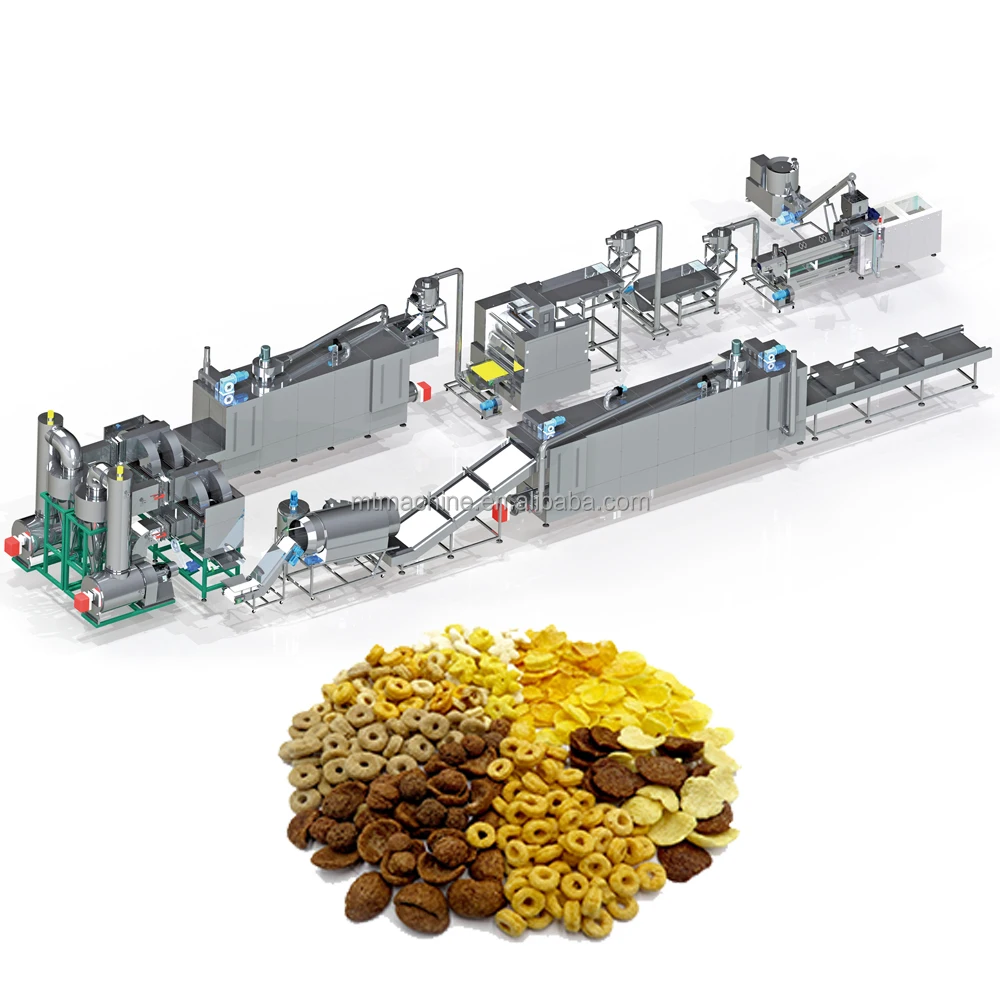


MT75 Corn Flakes Breakfast Cereal Production Line, Twin Screw Extruder, 210 kW Installed Power, PLC Control — engineered as a fully integrated turnkey project where every station from mixing through extrusion, flaking, drying, roasting, coating and packing is throughput-matched under one supplier to eliminate bottlenecks.
- Hydraulic double-roller flaking system with infrared temperature monitoring ensures uniform flake thickness across varying grain moisture levels
- Hot air roasting oven with dual circulating fans and cyclone dust removal delivers precise thermal profiling for natural and sugar-coated formats
- Line layout and capacity calculation provided before order confirmation
- Trial run on your specific grain formulation completed in our testing workshop before shipment
- Screw and die configuration specified to your raw material and target product density
Description
Throughput-Matched Stations — Every section from grain mixing to final packing is balanced to your actual recipe, so no single unit chokes the line when you switch from corn to oat or change flake thickness.
Technical Specifications
| Parameter | Value |
|---|---|
| Model | MT75 |
| Product Type | Corn Flakes Breakfast Cereal Production Line |
| Extruder Type | Twin Screw |
| Installed Power | 210 kW |
| Power Consumption | 150 kW |
| Output Capacity | 300-500 kg/hr (basis not stated in source — confirm raw material, moisture content and product format) |
| Overall Dimensions | 45 x 1.5 x 3.5 m |
| Control System | PLC automated line control |
| Screw Material | Wear-resistant alloy, special treatment |
| Extruder Lubrication | Automatic lubricating and cooling |
| Flaking Machinery | Hydraulic double-roller, separate dual-motor drive, infrared temperature control |
| Dryer Heating Source | Gas or electric (configurable) |
| Roasting Oven | Hot air, conciliation burner, dual circulating fans, cyclone dust removal |
| Coating System | Double tumble sugar melting, elevator, coating drum, spray nozzle |
| Basic Raw Materials | Corn, rice, wheat, oat, barley powder |
Application Suitability
| Application | Material or Output |
|---|---|
| Natural corn flakes for breakfast cereal retail | Corn grits or corn flour, toasted without sugar |
| Sugar-coated corn flakes for supermarket shelf | Corn base with sugar syrup coating and secondary drying |
| Shaped cereal snacks (rings, stars, wheels) | Corn, rice, wheat, oat or barley blends through interchangeable dies |
| Fortified breakfast cereal for institutional supply | Grain powder premix with added vitamin and mineral blends |
| Turnkey cereal plant setup for new entrants | Full line from raw material batching through packing |
Why Nominal Capacity Numbers Mislead Cereal Buyers
A rated output figure means nothing until it is proven on your exact grain blend at your local moisture level.
When buyers compare corn flakes production line turnkey proposals, the first number they see is hourly capacity. I have watched lines stall on the first production day because the corn grits the buyer sourced locally held two percentage points more moisture than the test sample. The extruder barrel temperature profile that worked in our workshop caused the flakes to stick to the flaking rollers, and the entire downstream section sat idle while we recalibrated [NEED_CITE: grain moisture variability and extrusion processing parameters]. A capacity number without a raw material specification attached is not a capacity number — it is a guess.
Matching Every Station to Your Actual Grain Recipe
A corn flakes production line turnkey project is only as strong as its weakest throughput link. If the extruder pushes 400 kg/hr but the dryer is rated for 300 kg/hr on your specific flake thickness, the bottleneck will show up within the first shift. We calculate station-by-station capacity using the buyer’s actual raw material data and the target flake geometry before the layout is finalised, so the mixer, extruder, flaking mill, dryer, roasting oven and coating drum all share the same realistic throughput ceiling.
How the Flaking Stage Decides Your Final Product Quality
The flaking machinery on this line uses a hydraulic double-roller system with separate dual-motor drive, meaning each roller can be adjusted independently for gap and pressure. An infrared sensor monitors roller surface temperature in real time. During a commissioning run in a humid tropical workshop, I found that ambient moisture condensing on the rollers changed the flake release behaviour — the infrared feedback loop caught the temperature drift before it affected flake thickness consistency [NEED_CITE: infrared temperature monitoring in cereal flaking operations]. That level of control keeps flake density within the range your retail customer expects.
Reading the Specs That Actually Matter
The twin-screw extruder’s automatic lubricating and cooling system is not a comfort feature — it directly affects screw barrel life when running high-starch corn formulations that generate substantial internal friction. The installed power of 210 kW and running consumption of 150 kW tell you the motor headroom: roughly 70% load factor under normal corn grits processing, which means the motor is not working at its thermal limit during continuous shifts. The hot air roasting oven runs two separate circulating fans with a cyclone dust removal device, keeping fine particulate out of the recirculating air stream and preventing scorch marks on flakes that would fail visual quality inspection. The PLC control across the full line ensures that a change in extruder screw speed automatically signals the downstream dryer to adjust belt speed and temperature zones, maintaining batch consistency without manual intervention at each station.
What Happens When Stations Are Not Balanced
I was called to a cereal plant in West Africa where the previous supplier had quoted an extruder and a dryer from two separate catalogues without checking throughput compatibility. The dryer could not keep up during sugar-coated runs because the additional moisture from the spraying stage was never factored into the dryer’s evaporation calculation. The plant ran at half speed for three months before they added a second dryer section [NEED_CITE: throughput mismatch in multi-stage food processing lines]. When one supplier provides the complete corn flakes production line turnkey package, that calculation is their responsibility — not yours.
What We Deliver Beyond the Machine List
Every station on this corn flakes line is sourced and configured by a single engineering team, so the layout drawing you receive reflects real throughput data rather than catalogue numbers stitched together. Our in-house testing workshop runs your actual grain formulation before the line ships, generating a trial report with extruder barrel temperatures, screw speed, flaking gap settings and roasting profiles that travel with the machine. The screw and die configuration is documented specifically for your target flake shape and density, not copied from a generic build. Pre-sales consultation covers factory floor layout, utility planning and phased installation sequencing.
Documentation & Verification
- Line layout drawing with station-by-station capacity calculation for your grain recipe
- Trial run report from our testing workshop on your actual corn or oat formulation
- Screw and die configuration record matched to your target flake shape and thickness
- Electrical schematic with voltage, frequency and PLC language confirmed before production
- Factory test record and CE declaration of conformity for customs and compliance
Installation, Commissioning & Support
- Foundation plan reflecting the 45 m line length and utility connection points
- Power supply confirmation for the 210 kW installed load with dedicated circuit specs
- On-site assembly sequence matching your factory access and overhead crane capacity
- First-run parameter tuning using trial report data as the starting baseline
- Operator training covering PLC interface, flaking gap adjustment and roasting profiles
- Wear parts list with screw, die and roller specifications for first reorder cycle
What We Need to Build Your Line Proposal
To prepare a layout and throughput calculation, send us your primary grain material with its typical moisture range, your target daily output in finished product weight, and your factory floor dimensions including ceiling height. Confirm the local voltage and frequency supply, and let us know whether the line will run natural flakes, sugar-coated flakes or both formats. If you have existing upstream milling or downstream packing equipment that the new line must connect to, include those specifications so the integration points are clear from the first proposal [NEED_CITE: industrial equipment procurement specification requirements].
Frequently Asked Questions
Q: How is line capacity verified on my specific raw material before shipment?
A: We run your actual grain formulation through the extruder, flaking mill and dryer in our testing workshop. The trial report records barrel temperatures, screw speed, moisture content, flake thickness and roasting profiles. This data ships with the line and serves as the baseline for on-site commissioning.
Q: Can the layout be customised to fit my existing factory dimensions?
A: Yes. The 45 m overall length is a reference based on the standard configuration. We adjust station spacing, conveyor angles and dryer section count to match your available floor space, ceiling height and existing utility drop points before the layout is finalised for production.
Q: How do you ensure throughput is matched between extruder, dryer, flaking and coating stations?
A: Each station is sized using your raw material data and target product format. We calculate evaporation load for the dryer based on your flake moisture at the extruder exit, and coating drum cycle time based on your sugar syrup application rate. No station is selected from a generic catalogue without this calculation.
Q: What voltage, frequency and PLC language options are confirmed before production?
A: We confirm your local supply voltage, frequency and phase configuration, then match the motor specifications and transformer requirements accordingly. The PLC interface language is set to your operator preference before the control panels are wired, so the line is ready for training on arrival.
Q: What does on-site installation and operator training cover?
A: Our team supervises mechanical assembly, utility connections and first-run production using the trial report parameters as the starting point. Training covers daily PLC operation, flaking roller gap adjustment, roasting oven temperature management, routine screw and die inspection, and the preventive maintenance schedule for the full line.
Related products
-

Small Scale Breakfast Cereal Manufacturing Machine for Corn Flakes Process Line
¥45,000.00 Select options This product has multiple variants. The options may be chosen on the product page -
Automatic Cornflakes Making Machine Corn Flakes Breakfast Cereals Processing Production Line
¥500.00 Select options This product has multiple variants. The options may be chosen on the product page -

Best Price Corn Flakes Making Machine Breakfast Cereals Processing Line with Motor As Core Component
¥19,000.00 Select options This product has multiple variants. The options may be chosen on the product page -
Corn Flakes Machine Breakfast Cereal Corn Flakes Production Line Cornflakes Making Machine
¥85,800.00 Select options This product has multiple variants. The options may be chosen on the product page