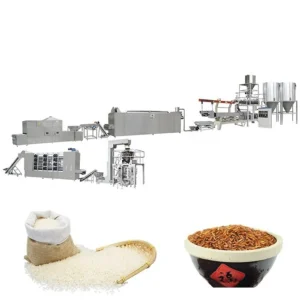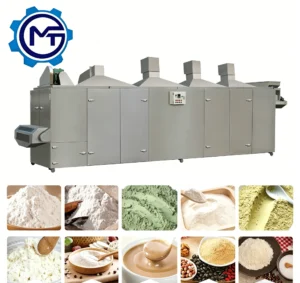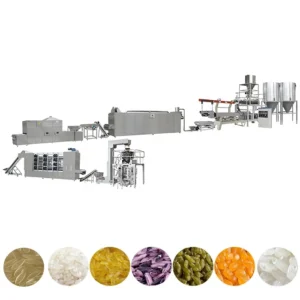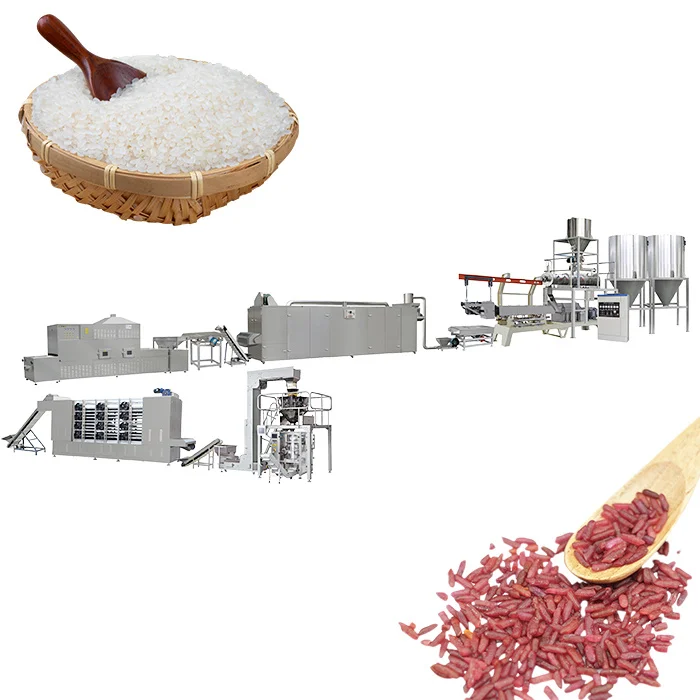


MT65 / MT70 / MT85 / MT75 / MT95 Artificial Fortified Rice Production Line, Twin-Screw Extruder, Electric/Gas Drying, CE & ISO Certified — engineered for whole-line throughput matching from batching through extrusion to packing. Screw configuration and die design are specified to your raw material blend and target kernel density, with circulation drying ensuring consistent moisture. – Trial runs performed on your formulation in our testing workshop before shipment, with full documentation and wear parts support included.
Description
Screw and Die Configuration — every extruder in this line ships with a screw profile and die plate mapped to the buyer’s raw material blend, verified by a trial run before the machine leaves our workshop.
Technical Specifications
| Parameter | Value |
|---|---|
| Model | MT65 / MT70 / MT85 / MT75 / MT95 |
| Product Type | Artificial Fortified Rice Production Line |
| Screw Type | Twin-screw |
| Installed Power | 85 kW (MT65) / 120 kW (MT70) / 235 kW (MT85) / 180 kW (MT75) / 260 kW (MT95) |
| Power Consumption | 60 kW (MT65) / 85 kW (MT70) / 165 kW (MT85) / 135 kW (MT75) / 195 kW (MT95) |
| Capacity | 80–100 kg/h (MT65) / 100–120 kg/h (MT70) / 200–300 kg/h (MT85) / 300–500 kg/h (MT75) / 800–1000 kg/h (MT95) (basis to be confirmed on raw material formulation and moisture content) |
| Overall Dimensions (L×W×H) | 28 × 1.2 × 2.2 m (MT65) / 30 × 1.5 × 2.2 m (MT70) / 34 × 3.5 × 4.3 m (MT85) / 32 × 3.5 × 4.3 m (MT75) / 36 × 3.5 × 4.3 m (MT95) |
| Control System | Frequency speed control, automated |
| Heating System | Electric or gas (dryer) |
| Line Stations | Mixing, Extruding, Vibrating, Low Temperature Drying, Cooling, High Temperature Roasting, Cooling, Packing |
| Dryer Feature | Circulation drying with mesh belt speed controlled by frequency motor |
| Certification | CE, ISO |
| Assembly State | Complete turnkey line |
Application Suitability
| Application | Material or Output |
|---|---|
| Fortified food and nutrition programmes | Vitamin and mineral-enriched rice kernels from broken rice and starch base |
| Broken rice value recovery | Artificial rice extruded from milled broken rice and rice bran |
| Multi-grain specialty rice | Kernel blends using millet, buckwheat, oat, corn, and wheat formulations |
| Infant and nutritional porridge base | Pre-cooked, fast-rehydration rice granules with added micro-nutrients |
Why a Nominal Capacity Figure Can Mislead Your Entire Project
Capacity on a brochure rarely matches what you get when your local raw material hits the barrel.
Many buyers receive a line quoted at a round number, sign the contract, and then spend months trying to reach that output on their actual flour blend. In West Africa I once spent four nights swapping screw elements and die inserts because the local broken rice had a different amylose ratio than the reference sample, and the kernels kept coming out flat and under-expanded. An artificial fortified rice production line turnkey must be validated on the exact formulation the factory will run, not on a generic test recipe. [NEED_CITE: starch gelatinisation behaviour across different rice cultivars]
Barrel Segments and the Temperature Ladder That Controls Gelatinisation
The twin-screw extruder at the heart of this line uses segmented barrels with independent heating zones. Each zone sets a step in the temperature ladder that determines how fully the starch granules swell before the dough reaches the die face. Too low in the metering section, and the vitamin premix stays unevenly dispersed; too high in the cooking section, and the Maillard reaction darkens the kernel beyond market acceptance. Getting the profile right for a millet-buckwheat blend is a different exercise entirely from a pure broken rice formulation.
Die Geometry and Kernel Density
The die plate defines both the cross-section of each kernel and the pressure drop at exit, which directly controls expansion ratio and final density. A nutrition programme that requires the rice to sink and cook in a standard pot needs a different die bore and land length than a quick-cook instant variety that must stay porous after drying. Our testing workshop cuts and trials die inserts against your target kernel weight-per-litre before the extruder ships. [NEED_CITE: expansion ratio and apparent density in extruded rice analogues]
Reading the Spec Sheet for What It Actually Controls
Installed power across the five models runs from 85 kW on the MT65 up to 260 kW on the MT95, which reflects the mechanical energy available for shear inside the barrel rather than just motor headroom. The frequency-controlled screw speed lets operators adjust residence time without changing hardware, so the same machine can shift from a slow-cook fortified kernel to a puffed snack rice with a parameter change. Power consumption figures sit noticeably below installed power, indicating that under normal load the drives are not running at saturation. The dryer uses a mesh belt with its own frequency motor, meaning belt speed and drying time can be tuned independently of extruder output to hold final moisture within the target band.
What Happens When Stations Are Mismatched
A line where the dryer is sized for a lower throughput than the extruder creates a bottleneck that no amount of operator tweaking can solve. Wet kernels pile up on the transfer conveyor, surface moisture causes clumping, and the packing station sees inconsistent weight per bag. Equally, an undersized cooler after the high-temperature roasting stage leaves residual heat in the kernels, which then sweat inside the packaging and invite mould growth in humid climates. [NEED_CITE: moisture migration and shelf stability in extruded cereal products]
Why Buyers Source This Line From One Supplier
Matching throughput across every station — from the batching mixer through the extruder, vibrating separator, low-temperature dryer, cooler, roaster, second cooler, and packing head — is engineered at the layout stage, not patched on site. Screw configuration and die design are specified to the buyer’s raw material and target kernel shape, recorded in the configuration document that ships with the machine. The testing workshop runs your formulation before dispatch, so the trial report tells you what the line will actually produce. Pre-sales consultation through installation, commissioning, and operator training keeps a single engineering team accountable from first drawing to first saleable bag. Twin-screw expertise across pet food, aquatic feed, snacks, cereals, starch, and protein applications means the same team that solved a floating-feed density problem last month can apply that lesson to your rice kernel today.
Documentation & Verification
- Line layout drawing showing station-by-station throughput balance for your capacity tier
- Screw element arrangement and die bore record matched to your raw material formulation
- Trial run report on your actual broken rice or multi-grain blend before shipment
- Electrical schematic confirming voltage, frequency, and control language for your market
- CE declaration of conformity and ISO certificate for customs and regulatory clearance
- Wear parts list with part numbers for screws, dies, and barrel liners
Installation, Commissioning & Support
- Foundation plan based on the MT85 footprint of 34 × 3.5 × 4.3 m and dynamic load points
- Dedicated power circuit sized to the model’s installed power, up to 260 kW for the MT95
- Sectional assembly with bolted barrel segments, allowing replacement without full teardown
- First-run parameter log covering screw speed, barrel temperatures, and dryer belt frequency
- Operator training on die change procedure and screw element inspection intervals
- Spare screw elements and die inserts included per the wear parts list at delivery
What We Need From You to Size the Line
Share your base formulation — whether it is broken rice with a vitamin premix, a millet-buckwheat blend, or a corn-starch mix — along with the target kernel dimensions and cooking behaviour you need in the final pack. Tell us the daily output you plan to sustain, the available floor length and ceiling height, and your local voltage and frequency so the drives and heaters are wound correctly before the machines leave our floor.
Frequently Asked Questions
Q: How do you confirm the line capacity on my specific raw material?
A: We run a trial production on your formulation in our testing workshop before shipment. The trial report records actual throughput, kernel density, and expansion ratio, so the capacity figure you receive is based on your own blend rather than a generic reference recipe.
Q: Can the screw and die be changed for a different kernel shape later?
A: Yes. The twin-screw extruder uses modular screw elements and interchangeable die plates. We record the original configuration and can supply alternative die inserts if you later add a second kernel shape to your product range.
Q: What voltage and control language options are available?
A: Voltage and frequency are confirmed during the specification stage to match your facility supply. The control interface language is set to your operator preference before the PLC is programmed, avoiding on-site rework during commissioning.
Q: Is there a risk of bottleneck between the extruder and the dryer?
A: Every station is sized during the layout phase so that throughput is matched. The dryer mesh belt speed is independently frequency-controlled, allowing fine adjustment to hold final moisture within spec regardless of minor extruder output variation.
Related products
-
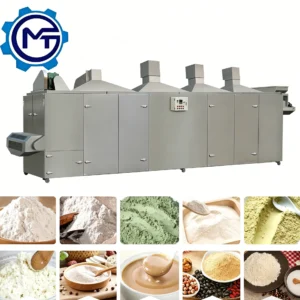
CE Approved MT Brand Organic Baby Rice Nutrition Powder Extrusion Production Line with 500kg/h Capacity and Automatic Grade
¥9,500.00 Add to cart -
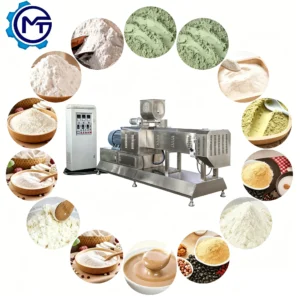
Fully Automatic Fortified Nutrition Powder Baby Food Production Line
¥8,238.27 Select options This product has multiple variants. The options may be chosen on the product page -

Compact Automatic Baby Cereal Nutrition Powder Production Line with 500kg/h Capacity and PLC Control
¥9,500.00 Add to cart -

High Quality Automatic PLC Controlled 500kg/h Twin Screw Extruder Machine for Baby Rice Nutrition Powder
¥8,238.27 Add to cart