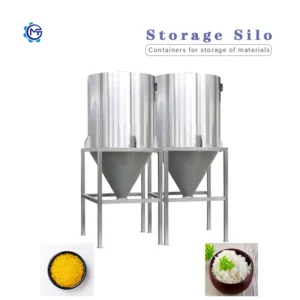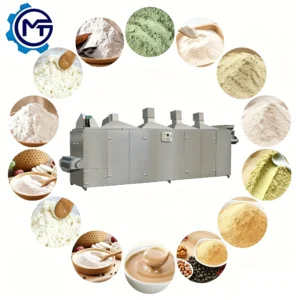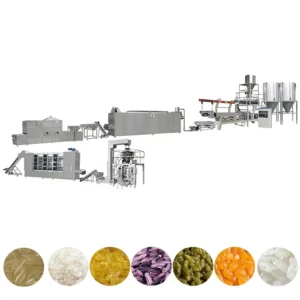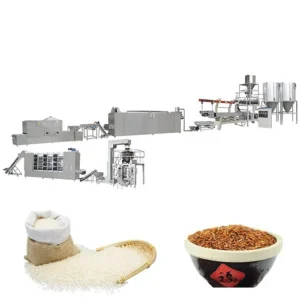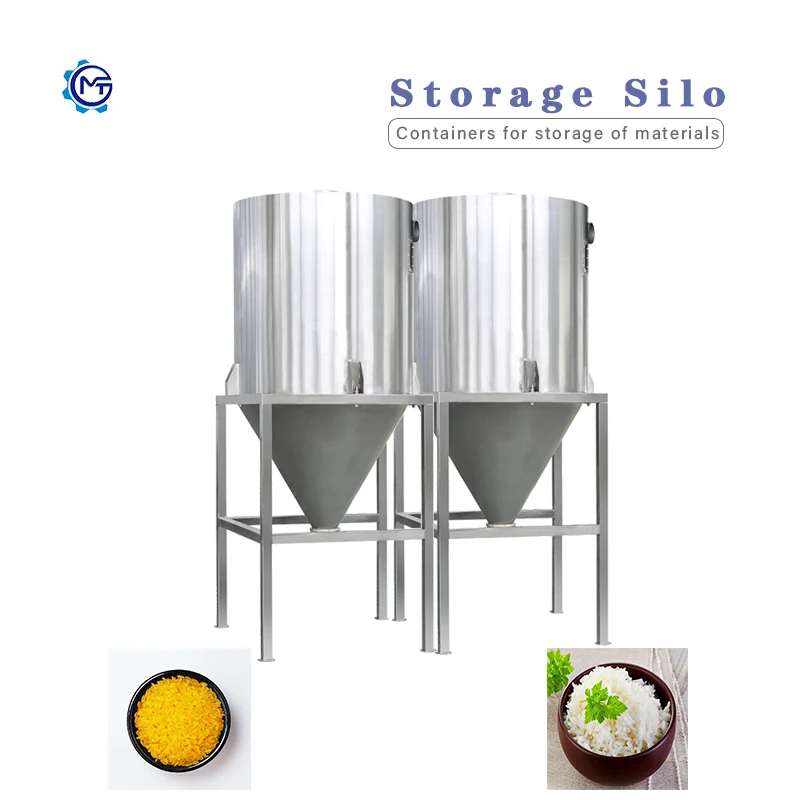
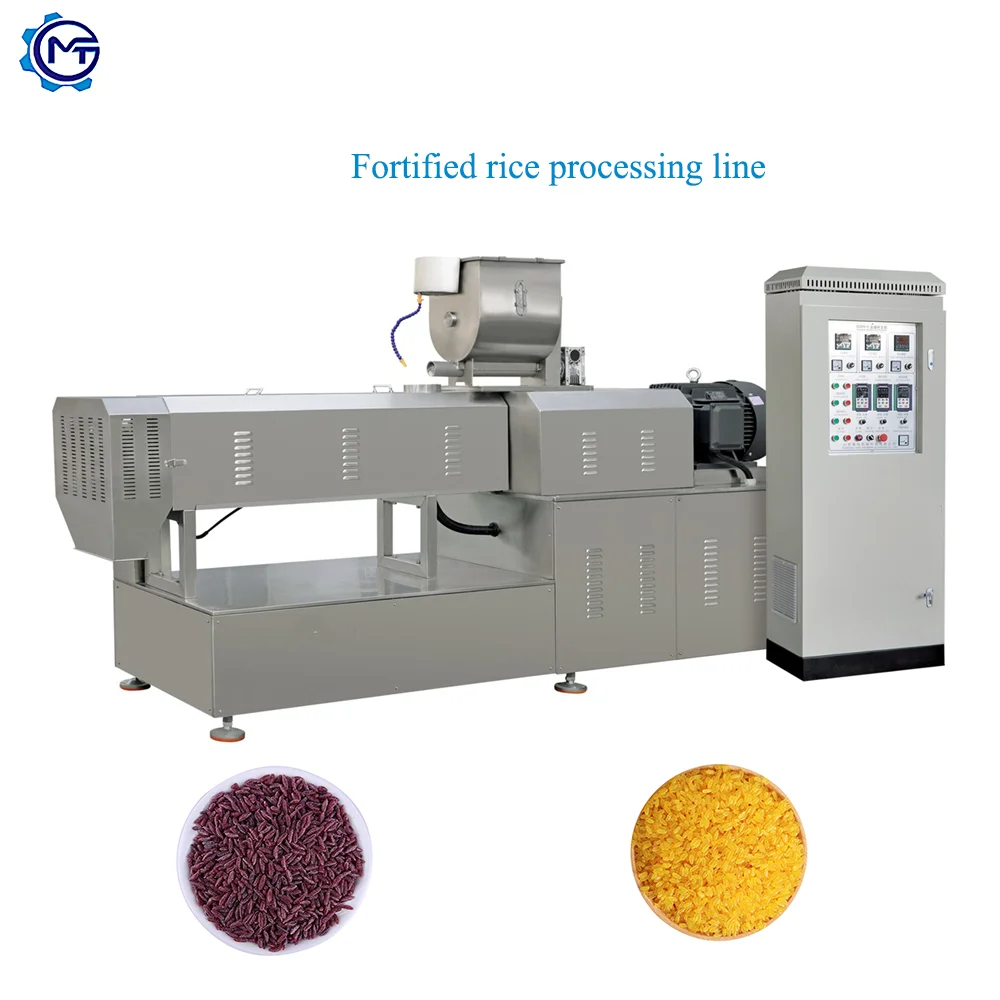
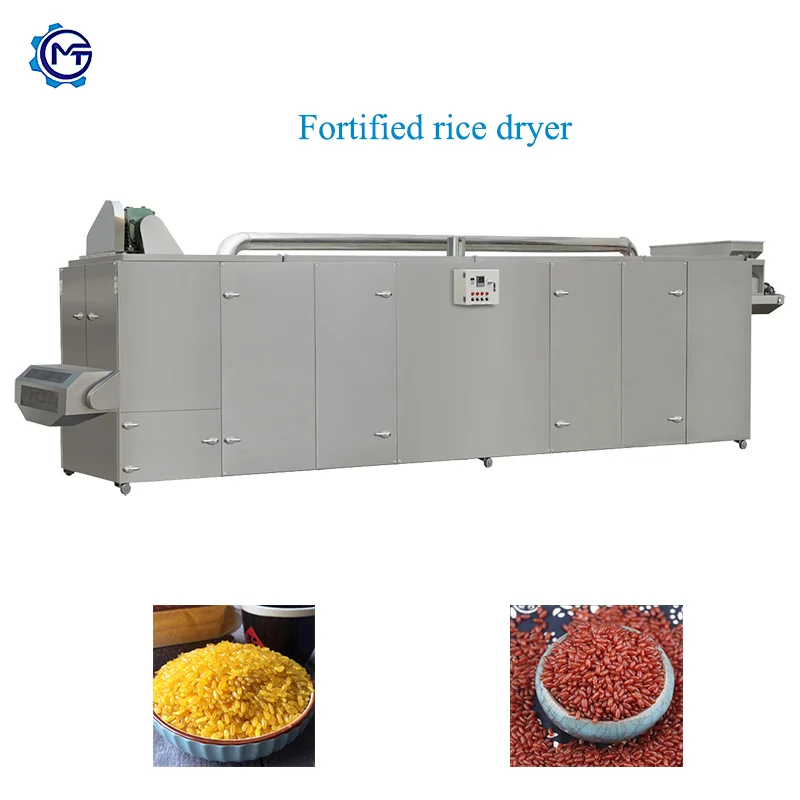
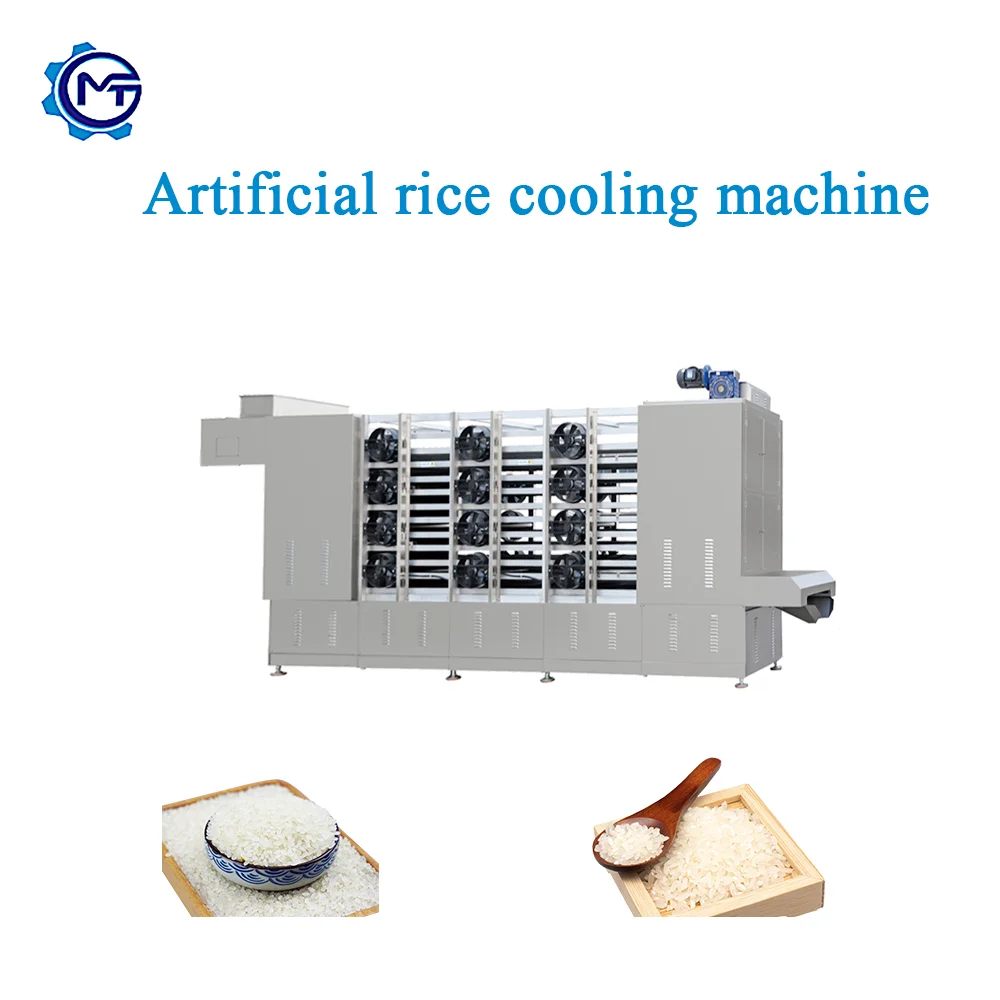
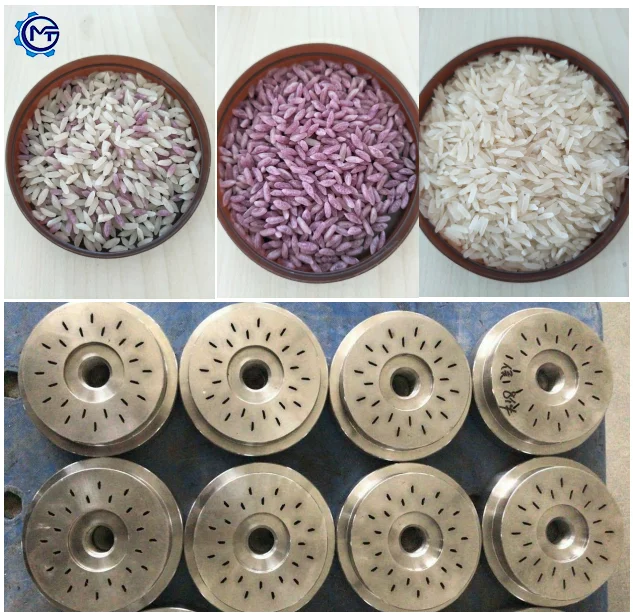
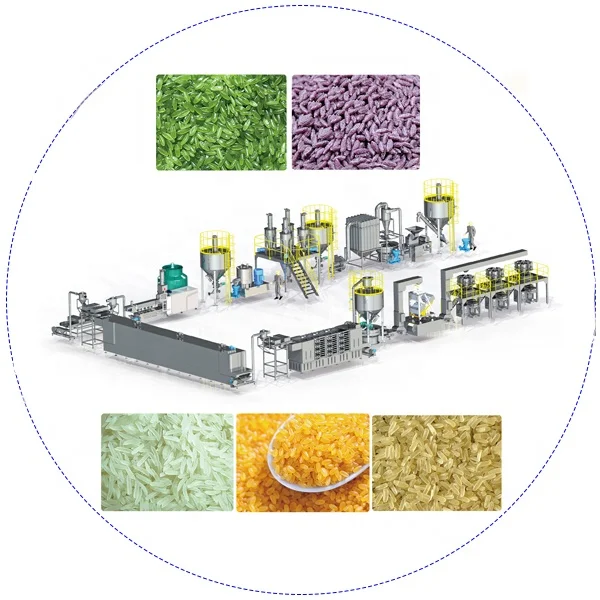
MT65 / MT70 / MT75 / MT85 / MT95 Fortified Rice Production Line turnkey, Twin-screw Extruder — engineered as a single integrated project where mixing, extruding, drying, roasting, and packing stations are throughput-matched to eliminate bottlenecks.
- Full line layout with utility planning, electrical schematic, and voltage confirmation before production
- Trial run on buyer’s actual raw material in the in-house testing workshop before shipment
- Frequency-controlled drying and roasting stations calibrated to the selected extruder model
- On-site installation, commissioning, and operator training included in project scope
Delivered as one turnkey project under a single supplier, so every station from batching to packing is designed to the same capacity target with matched throughput and confirmed control language.
Description
Capacity-Matched Turnkey Design — Every station from batching to packing is engineered to the same throughput target, eliminating the bottlenecks that plague multi-vendor line assemblies.
Technical Specifications
| Parameter | Value |
|---|---|
| Product Type | Fortified and Artificial Rice Production Line |
| Models Available | MT65, MT70, MT75, MT85, MT95 |
| Screw Type | Twin-screw extruder |
| Installed Power | MT65: 85 kW | MT70: 120 kW | MT75: 180 kW | MT85: 235 kW | MT95: 260 kW |
| Power Consumption | MT65: 60 kW | MT70: 85 kW | MT75: 135 kW | MT85: 165 kW | MT95: 195 kW |
| Output Capacity | MT65: 80–100 kg/h (basis not stated in source — confirm raw material formulation and moisture) | MT70: 100–120 kg/h (basis not stated in source) | MT75: 300–500 kg/h (basis not stated in source) | MT85: 200–300 kg/h (basis not stated in source) | MT95: 800–1000 kg/h (basis not stated in source) |
| Overall Dimensions (L×W×H) | MT65: 28×1.2×2.2 m | MT70: 30×1.5×2.2 m | MT75: 32×3.5×4.3 m | MT85: 34×3.5×4.3 m | MT95: 36×3.5×4.3 m |
| Control System | Frequency speed control with high automation; automatic lubricating and cooling system |
| Feeding System | Single or double screw feeding system (selected according to material characteristics) |
| Screw Material | Wear-resistant alloy with special processing technology for extended service life |
| Drying Oven Heating Source | Electric or gas |
| Drying Oven Control | Frequency motor controls mesh belt speed for flexible drying quality adjustment |
| Line Stations | Mixing → Extruding → Vibrating → Low-temperature drying → Cooling → High-temperature roasting → Cooling → Packing |
| Raw Materials | Broken rice, rice, corn, millet, wheat, oats, buckwheat, bean, starch as main ingredient; vitamin and mineral as supplementary ingredient |
| Standards | CE, ISO |
Application Suitability
| Application | Material or Output |
|---|---|
| Fortified rice kernel production | Broken rice and rice flour blended with vitamin and mineral premix |
| Artificial rice from alternative grains | Corn, millet, wheat, oats, buckwheat, and bean flour formulations |
| Nutrition programme supply | Extruded rice kernels with added micronutrients for food aid and institutional feeding |
| Rice bran valorisation | Rice bran and broken rice processed into high-nutritional-value reconstituted rice |
| Starch-based rice analogues | Pure starch and blended starch formulations shaped into rice-like kernels |
Why "Nominal 500 kg/h" Is Not the Number You Should Plan Around
A Fortified Rice Production Line turnkey project only delivers its rated output when every downstream station can absorb what the extruder actually produces on your specific formulation.
The most common failure I see in assembled-from-separate-vendors lines is an extruder pushing material faster than the dryer can handle, or a packing station that cannot keep pace with the roasting output. When a buyer receives a capacity figure quoted on a generic starch blend but runs a high-fibre or high-fat formulation, the extruder itself may not reach that number, and the entire line rhythm collapses. I once worked with a nutrition programme supplier whose previous line was rated at a comfortable margin, yet their actual vitamin-loaded formulation caused the material to stick inside the barrel, cutting real throughput nearly in half. We spent days in our testing workshop adjusting the screw combination and temperature profile before the line could run continuously. That is why every Fortified Rice Production Line turnkey project we deliver starts with a trial run on your actual raw material [NEED_CITE: raw material formulation impact on extruder throughput].
Throughput Matching Across Every Station
The extruder is only one node in the chain. On a Fortified Rice Production Line turnkey project, the vibrating conveyor, low-temperature drying oven, cooling belt, high-temperature roasting unit, and packing station must each handle the same mass flow the extruder delivers. We size each station based on the selected extruder model and the moisture content your formulation requires at each stage. If the dryer cannot reduce moisture fast enough, wet kernels pile up and deform before roasting. If the roasting oven runs too slow, the cooling conveyor starves and packing halts.
Layout Planning and Utility Coordination
A complete line stretches up to 36 metres in length depending on the selected model, and the floor plan must account for material flow, operator access, and utility routing simultaneously. Electrical load, gas supply for the drying and roasting ovens, compressed air for pneumatic gates, and exhaust ventilation all need to be mapped before the first machine is set in place. We provide a line layout and capacity calculation document that shows where every station sits, what utilities it draws, and how the throughput flows from the batching hopper to the final bag [NEED_CITE: industrial food line utility planning standards].
Reading the Specs That Matter for Rice Extrusion
The twin-screw configuration is central to this line because fortified rice formulations contain fine vitamin and mineral powders that require thorough mixing inside the barrel before the starch gelatinises. The screw combination and die design are specified to the buyer’s raw material rather than pulled from a generic template. Frequency speed control on the main drive allows the operator to adjust screw RPM in response to real-time changes in material behaviour, which is especially important when switching between a corn-dominant blend and a buckwheat-heavy formulation. The automatic lubricating and cooling system maintains barrel temperature stability across long production runs, preventing the starch from over-gelatinising in one zone and under-processing in the next. On the drying side, the frequency-controlled mesh belt lets you set residence time independently of the extruder speed, so moisture reduction stays consistent even when the line is ramped up or slowed down. The choice between single or double screw feeding depends on whether your premix contains oily vitamin carriers that tend to bridge in a standard hopper.
The Hidden Cost of Skipping the Trial Run
Buyers who approve a line configuration based solely on a spec sheet and skip the pre-shipment trial often discover formulation problems only after installation. A screw combination that works perfectly on plain rice flour may produce kernels that crack during roasting when the actual formulation includes 3% lipid content from a vitamin A carrier. The cost is not just the wasted raw material — it is the idle crew, the delayed shipment to the end buyer, and the weeks spent reconfiguring screws on a factory floor instead of in a controlled workshop [NEED_CITE: twin-screw extrusion screw configuration and formulation sensitivity].
Why Procurement Through This Turnkey Scope Works
Each Fortified Rice Production Line turnkey project is built around a single line layout that matches throughput at every station, so no vendor finger-pointing occurs when output falls short. The screw combination and die are specified to your raw material after a trial run in our testing workshop, not copied from a generic build. Voltage, frequency, and control panel language are confirmed before production begins, preventing commissioning delays on site. Installation, operator training, and a wear parts programme are included in the project scope, so the line does not hand off to an unprepared crew on day one. Our in-house testing workshop allows us to run your actual formulation and document the results before any equipment leaves the factory.
Documentation & Verification
- Line layout and capacity calculation confirming station-by-station throughput match
- Screw and die configuration record matched to your raw material formulation
- Electrical schematic with voltage, frequency, and control language confirmed before production
- Trial run report on your actual raw material conducted before shipment
- CE declaration of conformity and ISO certificate included with dispatch documents
- Operation and maintenance manual covering every station in the line
Installation, Commissioning & Support
- Floor plan review confirming foundation loads for extruder models up to MT95 at 36 m line length
- Electrical supply verification for installed power up to 260 kW with dedicated circuit planning
- Station-by-station assembly sequence aligned with utility hook-up schedule
- First-run parameter setting covering screw RPM, barrel temperature zones, and dryer belt speed
- Operator training on frequency control interface, automatic lubrication checks, and feeding system selection
- Wear parts list covering screws, dies, and mesh belt segments with recommended replacement intervals
Before You Send an Inquiry
To scope a Fortified Rice Production Line turnkey project accurately, we need your target formulation including the percentage of vitamin and mineral premix, the daily or shift-based production volume you are planning, and the floor space and ceiling height available in your facility. Please also confirm the local voltage and frequency standard, the preferred control panel language, and whether you can ship a sample batch of your raw material for a pre-shipment trial run.
Frequently Asked Questions
Q: How is capacity verified on my specific raw material formulation rather than a generic nominal figure?
A: We run your actual formulation — including your exact vitamin and mineral premix ratios — through the selected extruder model in our testing workshop before shipment. The trial run report documents real throughput, kernel density, and moisture at each station. This verified data, not a generic spec sheet number, becomes the baseline for your line configuration.
Q: How is throughput balanced between the extruder, dryer, and packing station so no station creates a bottleneck?
A: Every station is sized to the same mass flow target based on the extruder trial results. The drying oven residence time, roasting oven capacity, and packing speed are each calculated to match or slightly exceed the extruder’s verified output on your formulation, ensuring continuous flow without material pile-up at any point.
Q: What utility planning is required for the full line at my selected capacity model?
A: We provide a utility map showing electrical load per station (up to 260 kW installed for the MT95), gas requirements for drying and roasting ovens, compressed air points, and exhaust ventilation needs. This document allows your contractor to prepare connections before the equipment arrives on site.
Q: How is voltage, frequency, and control panel language confirmed before production?
A: These parameters are locked during the specification confirmation stage, before manufacturing begins. The electrical schematic is reviewed with your team to ensure compatibility with your local grid standard, and the control interface is set to your preferred language so operators can begin training immediately upon commissioning.
Q: What does the installation and commissioning schedule look like for a complete turnkey line?
A: The schedule is phased: foundation and utility prep, mechanical assembly station by station, electrical and pneumatic hook-up, dry run without material, then production trial with your formulation. Operator training runs in parallel with the production trial, and a wear parts handover closes the commissioning phase [NEED_CITE: typical turnkey food line commissioning phases].
Related products
-
CE Approved MT Brand Organic Baby Rice Nutrition Powder Extrusion Production Line with 500kg/h Capacity and Automatic Grade
¥9,500.00 Add to cart -
Automatic Nutritional Powder Making Machine Safe Rice Cereal for Babies
¥30.00 Select options This product has multiple variants. The options may be chosen on the product page -

High Quality Automatic PLC Controlled 500kg/h Twin Screw Extruder Machine for Baby Rice Nutrition Powder
¥8,238.27 Add to cart -
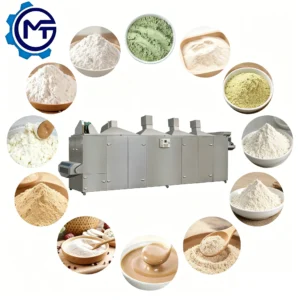
Hygienic Stainless Steel Infant Rice Powder Processing Line Automatic 500kg/h Capacity PLC Controlled
¥9,500.00 Add to cart