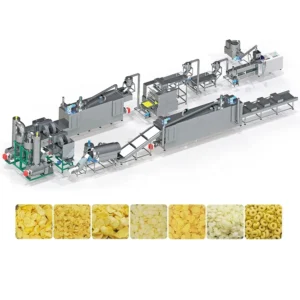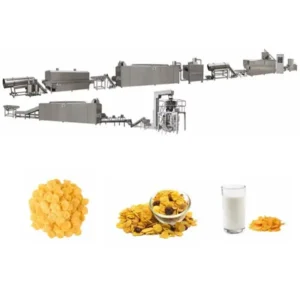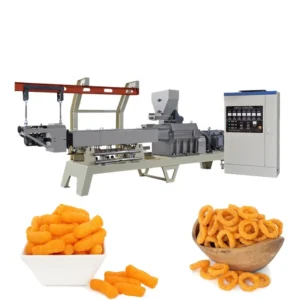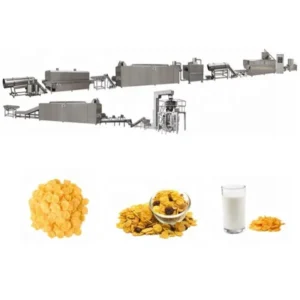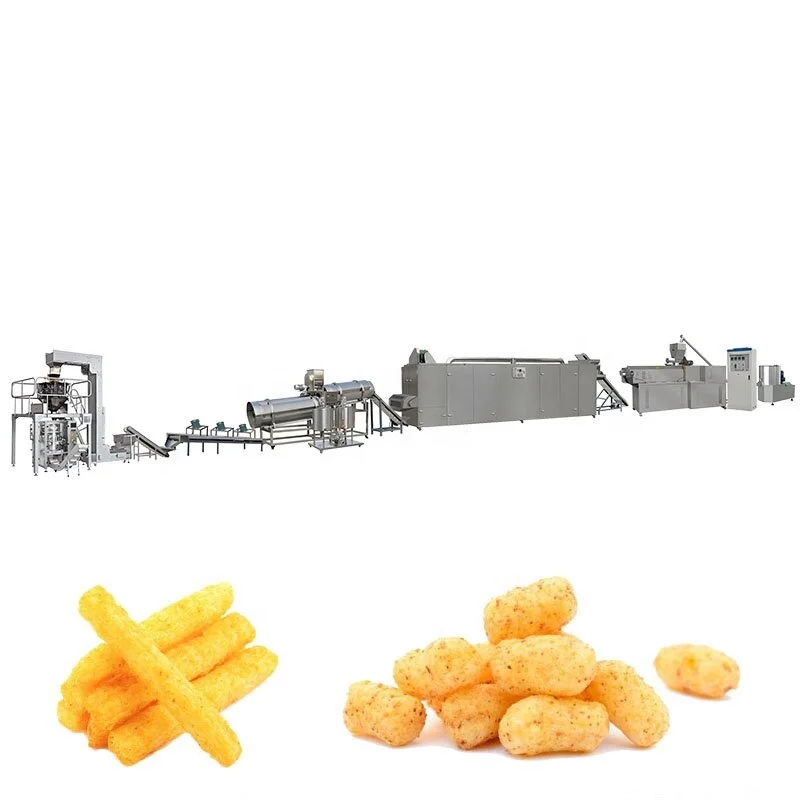
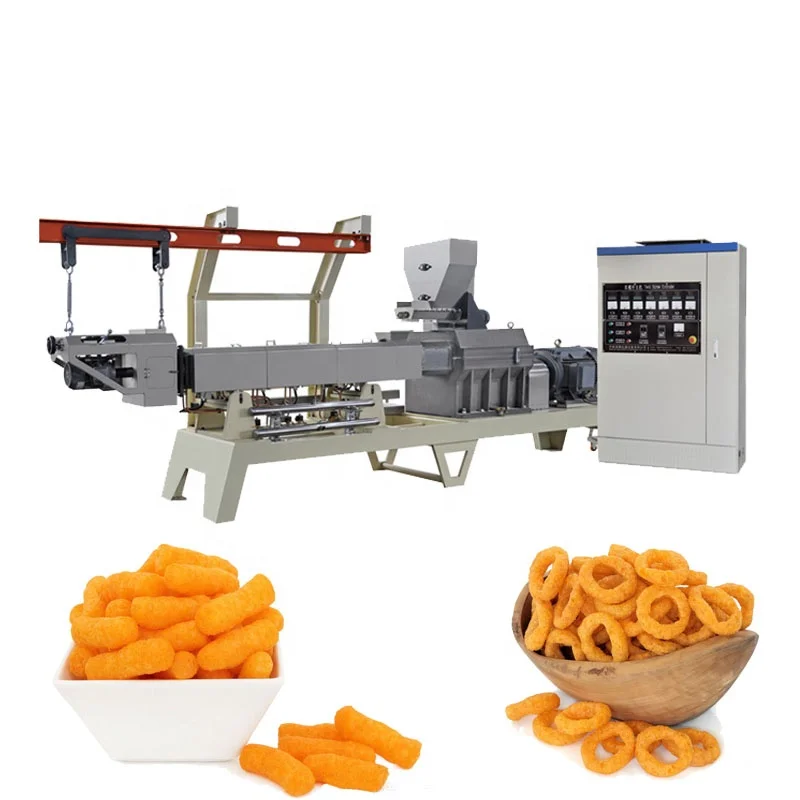


MT70 / MT85 / MT75 Corn Flakes Extruder Production Line, Twin Screw, PLC & MCC Control — configured as a complete turnkey project from batching through extrusion, flaking, hot-air roasting, and packing. Screw configuration and die design are matched to your grain formulation and target flake density, with throughput balanced across every station to eliminate bottlenecks common in multi-vendor assemblies.
- Hydraulic double-roller flaking unit with infrared temperature control for consistent flake thickness
- Hot-air roasting oven with vibrating pan, dual circulating fans, and cyclone dust removal
- Voltage, frequency, and control language confirmed to your market before production begins
Line layout, capacity calculation, and in-house trial run report on your raw material provided before shipment.
Description
Integrated Turnkey Engineering — Throughput calculations for this corn flakes production line start from your specific grain blend and moisture level, ensuring the extruder, flaker, and roaster never bottleneck each other.
Technical Specifications
| Parameter | Value |
|---|---|
| Model | MT70 / MT85 / MT75 |
| Product Type | Corn Flakes Extruder Production Line |
| Screw Type | Twin Screw |
| Installed Power | MT70 160 kW / MT85 190 kW / MT75 210 kW |
| Power Consumption | MT70 120 kW / MT85 140 kW / MT75 150 kW |
| Capacity | MT70 150–200 kg/h (basis to be confirmed) / MT85 300–400 kg/h (basis to be confirmed) / MT75 300–500 kg/h (basis to be confirmed) |
| Overall Dimensions (L×W×H) | MT70 41 × 1.5 × 2.2 m / MT85 43 × 1.5 × 3.2 m / MT75 45 × 1.5 × 3.5 m |
| Flaking Machinery Drive | Double motors for separate roller driving; hydraulic system for double rollers |
| Temperature Control | Infrared sensor for even temperature pipe control |
| Dryer Heating Source | Gas / Electric |
| Roasting Oven | Vibrating pan, high-temperature spraying tubes, dual circulating fans, cyclone dust removal |
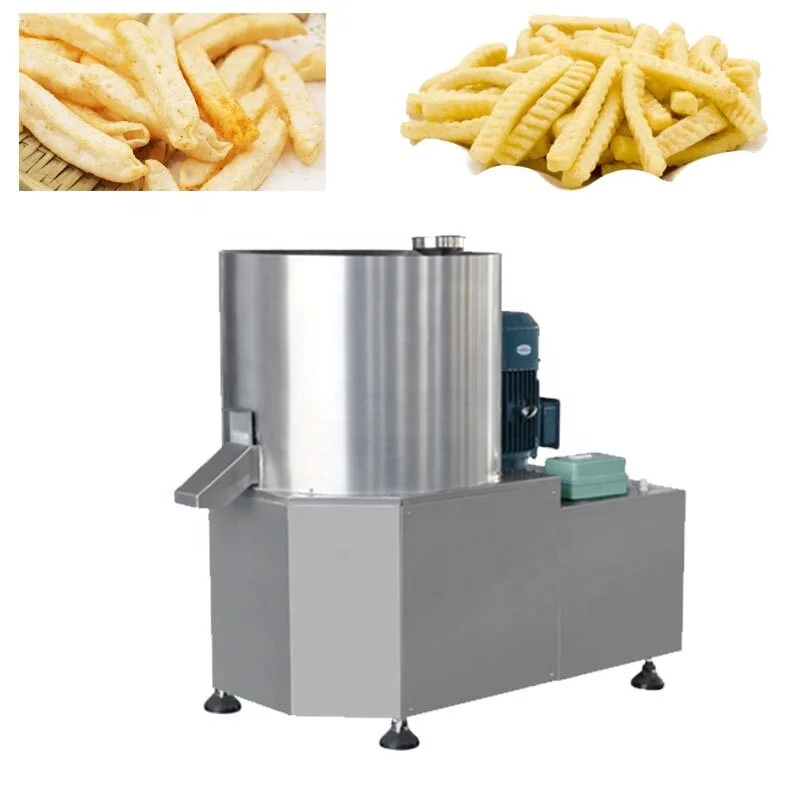
| Coating System | Double tumble for sugar melting, elevator, coating drum, spraying nozzle |
| Control System | PLC control; MCC and PLC available for line |
| Standards | CE, ISO |
Application Suitability
| Application | Material or Output |
|---|---|
| Natural corn flakes | Corn powder |
| Sugar-coated corn flakes | Corn, sugar syrup coating |
| Varied-shape breakfast cereals (balls, tubes, rings, stars) | Rice, wheat, oat, barley, mixed cereal powders |
| Fortified breakfast cereals | Cereal blends with added nutritional premixes |
Why "Nominal Line Capacity" Rarely Matches Actual Output on Your Grain Blend
A quoted throughput only matters when it is proven on the exact flour formulation you intend to run.
Many breakfast cereal projects stall because the extruder was rated on standard corn grits while the factory actually feeds a mixed oat-and-wheat recipe. The flakes come out with uneven density, the roaster produces a mottled colour, and the line stops for days while engineers rework the screw configuration and temperature curve. I have watched a mixed-grain trial on a corn flakes production line turnkey installation where the flaker could not hold consistent thickness because the dough moisture was off by just two percentage points. That kind of mismatch only surfaces when the line is treated as a collection of standalone machines rather than one balanced system [NEED_CITE: impact of raw material moisture on twin-screw extrusion consistency].
How a Turnkey Corn Flakes Production Line Balances Every Station
Designing a corn flakes production line turnkey system means matching the extruder output to the flaker intake, the dryer residence time to the roaster belt speed, and the coating drum volume to the final packing rate. When any station is undersized, the bottleneck forces upstream machines to idle or overfeed. The PLC and MCC architecture here links each stage so that throughput adjustments propagate automatically, preventing partial shutdowns during recipe changes or product changeovers.
Engineering the Screw Configuration Around Your Cereal Recipe
The twin-screw extruder is not a fixed geometry; the screw elements, barrel zones, and die profile are selected after reviewing the buyer’s grain formulation and the target flake density. Starch gelatinisation behaviour differs markedly between pure corn flour and a multi-grain blend, so the barrel temperature profile and moisture injection points must be tuned accordingly. A trial run on the actual raw material in the in-house testing workshop validates expansion rate and dough rheology before the line ships [NEED_CITE: twin-screw extrusion die design principles for breakfast cereals].
Reading the Specs That Actually Determine Flake Quality
The flaking machinery uses double motors for separate roller driving and a hydraulic system to set roller gap pressure, which directly governs flake thickness uniformity. Infrared sensors maintain even temperature across the pipe feeding the rollers, preventing the dough sheet from cooling unevenly and tearing at the edges. The hot-air roasting oven employs a vibrating pan with high-temperature spraying tubes, dual circulating fans, and a cyclone dust removal device; this combination produces the surface blistering that defines a crisp corn flake. Installed power ranges from 160 kW on the MT70 to 210 kW on the MT75, and the corresponding overall line lengths run from 41 m to 45 m, which determines how much floor space and utility infrastructure the project requires.
The Cost of Ignoring Voltage and Control Language Until Shipment Day
I once arrived at a site in South Asia where the roaster’s control panel was locked in a language the operators could not read, and the local frequency mismatch caused the vibrating pan to run at a different oscillation rate than the design intended. The corn flakes broke apart during roasting because the pan vibration was too aggressive. Resolving that required rewiring the drive and reprogramming the PLC, adding weeks of idle capacity. Confirming voltage, frequency, and HMI language before production avoids these failures [NEED_CITE: industrial voltage and frequency standards by export market].
Why Source the Complete Line From One Supplier
Throughput is calculated across every station — mixing, extruding, flaking, drying, roasting, coating, cooling, and packing — so no single machine dictates a ceiling the rest of the line cannot reach. Screw and die configurations are documented against the buyer’s raw material, not copied from a generic build. The in-house testing workshop runs the actual grain formulation before dispatch, generating a trial report that serves as the commissioning baseline. Factory layout is designed around the buyer’s building dimensions, and the complete electrical schematic arrives with voltage and frequency already locked to the local grid. CE and ISO standards apply across the entire line, not just the extruder.
Documentation & Verification
- Line layout and capacity calculation showing throughput balance across all stations from mixer to packer.
- Screw and die configuration record matched to the buyer’s specific grain formulation and target flake density.
- Trial run report on the customer’s actual raw material, performed in the testing workshop before shipment.
- Electrical schematic with voltage, frequency, and PLC language confirmation for the destination market.
- Operation and maintenance manual with wear parts list covering screws, dies, and flaker roller surfaces.
Installation, Commissioning & Support
- Line footprint planning based on the MT70 41 m to MT75 45 m overall length and buyer’s factory ceiling height.
- Power supply verification matching installed power from 160 kW to 210 kW, with dedicated circuit allocation per station.
- Flaker roller gap and hydraulic pressure calibrated on-site to match the trial run report baseline.
- PLC and MCC interface walked through in the confirmed local language during operator training sessions.
- Wear parts stock recommendation covering screws, dies, and roaster spraying tubes for the first maintenance cycle.
What to Prepare Before Requesting a Quotation
To size a corn flakes production line turnkey project accurately, we need your target cereal recipe including the grain types and any nutritional premixes, the intended daily output in kilograms of finished flakes, your factory floor dimensions and clear height, and the local voltage and frequency standard. Let us know whether sugar coating is part of the product spec and whether you need the dryer configured for gas or electric heating.
Frequently Asked Questions
Q: How is line capacity verified against my specific grain formulation and moisture content?
A: Before shipment, your exact raw material blend is run through the twin-screw extruder and flaking unit in our in-house testing workshop. We record the expansion rate, dough moisture, flake thickness, and roaster colour to generate a trial report. That report becomes the baseline for on-site commissioning, so the capacity figure you receive reflects your actual recipe rather than a generic catalog rating.
Q: How do you ensure throughput is balanced between the extruder, flaking unit, dryer, and roaster?
A: Each station is sized against the others using a line layout and capacity calculation document. The PLC and MCC control architecture links extruder feed rate to flaker intake, dryer residence time to roaster belt speed, and coating drum volume to packing rate. This prevents upstream bottlenecks and partial shutdowns during recipe changes or product changeovers.
Q: What is included in the phased installation and commissioning schedule for a complete cereal line?
A: The schedule covers mechanical assembly, utility connection, electrical termination, and control system startup across the 41 m to 45 m line length. We calibrate flaker roller gap and hydraulic pressure against the trial run baseline, then run each station individually before linking them under PLC control. Operator training and wear parts handover complete the commissioning phase.
Q: How are voltage, frequency, and control language confirmed before production begins?
A: During the specification stage we collect your local grid standard and the preferred HMI language. The electrical schematic is drawn with those values locked in, and the PLC program is written in the confirmed language. The roaster drive, vibrating pan motor, and all variable frequency drives are rated for your exact voltage and frequency, eliminating on-site rewiring.
Q: What operator training and wear-parts support is provided after commissioning?
A: Training covers daily startup and shutdown sequences on the PLC interface, flaker roller gap adjustment, roaster temperature profiling, and routine cleaning of the cyclone dust removal device. A wear parts list identifying screws, dies, flaker roller surfaces, and roaster spraying tubes is included in the manual, and initial spares are recommended to cover the first maintenance cycle.
Related products
-
Kelloggs Corn Flakes Breakfast Cereal Normal Making Machine Breakfast Cereal Extruder Production Line
¥30,000.00 Select options This product has multiple variants. The options may be chosen on the product page -

Best Price Corn Flakes Making Machine Breakfast Cereals Processing Line with Motor As Core Component
¥19,000.00 Select options This product has multiple variants. The options may be chosen on the product page -

200kg/h Breakfast Cereal Extruder Making Machine Hot Sale Corn Flake Production Line
¥30,000.00 Select options This product has multiple variants. The options may be chosen on the product page -

MT Cocoa Flour Puffed Breakfast Cereal Production Line-High Large Capacity Multi-Fuel (Steam/Gas/Electric) New Shandong Origin
¥8,000.00 Select options This product has multiple variants. The options may be chosen on the product page