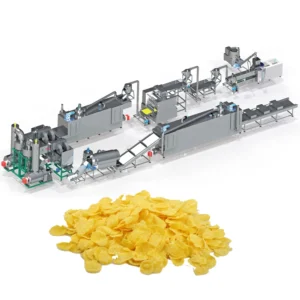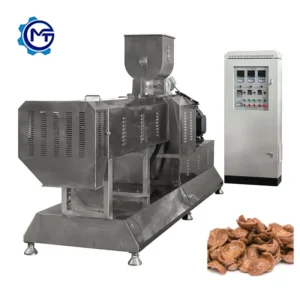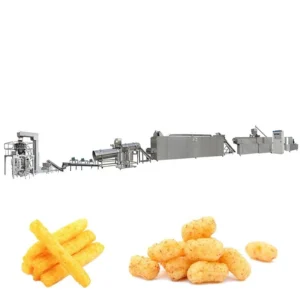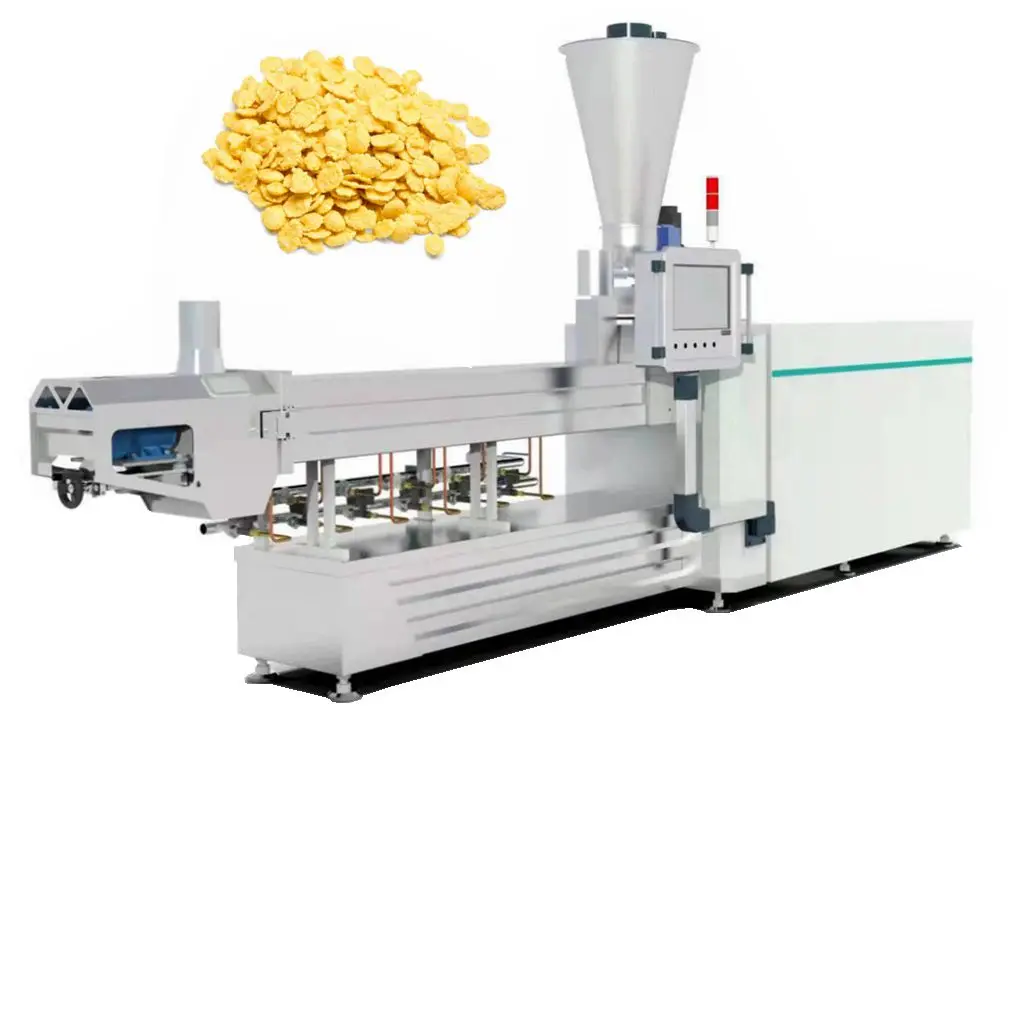


MT-65 / MT-70 / MT-85 / MT-75 Corn Flakes Processing Line, Twin-Screw Extrusion, PLC Control — throughput-matched from mixing to packing under one turnkey supplier. Screw configuration and die design are specified to your raw material and target flake density, with adjustable-gap flaking rollers and hot air roaster up to 400°C ensuring consistent expansion. In-house trial runs on your formulation verify output before shipment, backed by complete layout documentation and on-site commissioning support.
Description
Turnkey Corn Flakes Line Engineering — every station throughput-matched under one supplier so extrusion output never waits on undersized drying or flaking capacity.
Technical Specifications
| Parameter | Value |
|---|---|
| Product Type | Corn Flakes Processing Line |
| Models Available | MT-65 / MT-70 / MT-85 / MT-75 |
| Screw Type | Twin-screw |
| Output Capacity (MT-65) | 120–150 kg/h (basis to be confirmed) |
| Output Capacity (MT-70) | 200–250 kg/h (basis to be confirmed) |
| Output Capacity (MT-85) | 300–400 kg/h (basis to be confirmed) |
| Output Capacity (MT-75) | 400–500 kg/h (basis to be confirmed) |
| Installed Power (MT-65) | 84 kW |
| Installed Power (MT-70) | 132 kW |
| Installed Power (MT-85) | 239 kW |
| Installed Power (MT-75) | 186 kW |
| Real Power Consumption (MT-65) | 59 kW |
| Real Power Consumption (MT-70) | 92 kW |
| Real Power Consumption (MT-85) | 167 kW |
| Real Power Consumption (MT-75) | 140 kW |
| Overall Dimensions (MT-65) | 21000 × 1200 × 2200 mm |
| Overall Dimensions (MT-70) | 23000 × 1500 × 2200 mm |
| Overall Dimensions (MT-85) | 28000 × 3500 × 4300 mm |
| Overall Dimensions (MT-75) | 24000 × 1500 × 2800 mm |
| Control System | PLC centralized control with real-time monitoring, alarm and reminder functions |
| Line Stations | Mixer → Screw Conveyor → Twin Screw Extruder → Air Conveyor → Dryer → Hoister → Flaking Machine → Hot Air Roaster → Flavoring Drum / Sugar Spraying System → Cooling Machine → Packing Machine |
| Flaking Machine Roller Material | Cast iron roller, 45# steel shaft, carbon steel frame |
| Flaking Machine Roller Gap | Adjustable |
| Flaking Machine Cooling | Water cooling system |
| Hot Air Roaster Max Temperature | Up to 400°C |
| Hot Air Roaster Heating Source | Electric or gas |
| Dryer Heating Method | Electric or gas |
| Dryer Layers | Three, five, or seven layer options |
| Dryer Mesh Belt Speed | Adjustable |
| Sugar Spraying System Total Power | 28.75 kW |
| Sugar Spraying System Dimension | 4000 × 1900 × 1880 mm |
| Packing Machine Options | 420 / 520 / 620 / 720 vertical automatic packing machine with combination head weigher |
| Raw Materials | Corn, rice, millets, wheat, oat, barley (powder/flour or grits form) |
| Extruder Design | 3D software design with analogue simulation |
| Standards | CE (certified since 2014), ISO |
Application Suitability
| Application | Material or Output |
|---|---|
| Corn flakes breakfast cereal | Corn grits or corn flour with controlled gelatinisation |
| Coated or sugar-coated corn flakes | Extruded corn flakes with sugar spraying or flavouring drum coating |
| Oatmeal and multigrain flakes | Oat, barley, wheat, or blended grain formulations |
| Puffed cereal products | Cheerios, cocoa flakes, honey rings, loops, corn balls, stars via die changes |
| Fortified breakfast cereal | Vitamin- or mineral-enriched corn, rice, or multigrain base |
When "Rated Capacity" Doesn’t Survive Your Actual Corn Grits
The number on the quote sheet means nothing until the extruder runs your specific formulation.
I watched a breakfast cereal project stall because the buyer ordered a line sized for standard corn grits, then sourced a coarser local grind to cut material costs. The extruder handled it, but the flaking rollers couldn’t compress the pellets uniformly, and moisture inside the roaster wouldn’t drop on schedule. Output dropped to roughly half the quoted rate while half-finished flakes sat on the floor waiting for rework [NEED_CITE: impact of raw material particle size on extrusion throughput]. That is the exact scenario we now prevent by requiring a trial run on your actual corn, oat, or multigrain blend in our testing workshop before any corn flakes production line turnkey order moves to fabrication.
How Station Throughput Is Balanced Before the Line Ships
Every corn flakes production line turnkey project we configure starts with a capacity calculation that walks forward from the mixer, not backward from the packing machine. The twin-screw extruder output sets the pace, and each downstream station — dryer, flaking machine, hot air roaster, coating drum — is sized to absorb that volume without queuing. When the MT-85 model runs at its higher capacity range, the dryer must move to a five- or seven-layer belt configuration and the roaster blower must match the throughput, or the line chokes at the station with the smallest buffer.
Why the Flaking Stage Decides Your Final Product Quality
The cast iron rollers on the flaking machine do more than flatten cooked pellets into recognizable flakes. The adjustable gap between them controls flake thickness, and the integrated water cooling system prevents the rollers from overheating during continuous runs, which would otherwise cause starch to stick and tear the flake surface. Consistent thickness entering the hot air roaster is what lets the 400°C air create the characteristic bubble formation and crisp texture. If flakes arrive at the roaster with uneven thickness, some burn while others stay chewy, and the entire batch fails the bowl-test that cereal buyers use to judge quality [NEED_CITE: flake thickness tolerance for breakfast cereal market acceptance].
Reading the Spec Sheet Against Your Production Reality
The twin-screw extruder in this line uses 3D software-designed screw elements with analogue simulation, meaning the screw configuration is matched to your grain type rather than copied from a generic build. Corn grits, oat flour, and multigrain blends each demand different shear profiles and residence times inside the barrel. The PLC centralized control records process data in real time, so once the correct temperature zones and screw speed are established during commissioning, every subsequent batch replicates those parameters automatically. The installed power ranges from 84 kW on the MT-65 to 239 kW on the MT-85, but real operating consumption sits between 59 kW and 167 kW respectively — the gap matters when you are calculating daily energy costs across a three-shift schedule. Dryer options span three, five, and seven layers with adjustable mesh belt speed, letting you tune drying time to the moisture content your roaster requires downstream. The packing station offers vertical automatic machines in four size classes with combination head weighers, and an optional nitrogen flushing system for extended shelf life requirements.
The Hidden Cost of Assembling Stations from Separate Vendors
When a buyer sources the extruder from one factory and the dryer or roaster from another, nobody is accountable for the throughput gap between them. The flaking machine might arrive with a roller width too narrow for the extruder’s pellet output, forcing the operator to throttle the entire line down. Electrical interfaces between mismatched PLC systems from different manufacturers can take weeks to resolve on site [NEED_CITE: integration delays from multi-vendor food processing lines]. Voltage and control language differences compound the problem when the equipment arrives from different countries. With this line, every station is specified under one supplier, and the electrical schematic, voltage, and control language are confirmed before production begins.
Why Buyers Build Their Cereal Lines Here
The complete line runs from batching through packing under one engineering team, so throughput calculations are verified station by station rather than assumed from individual machine nameplates. The screw configuration and die design are specified to your raw material and target flake shape, not pulled from a generic catalog. Our in-house testing workshop runs your actual corn or grain formulation before shipment, producing a trial run report that confirms capacity and flake quality. Pre-sales consultation covers line layout, utility planning, and phased installation scheduling, with on-site commissioning and operator training included. Wear parts such as screws, dies, and flaking roller sleeves are documented and stocked so the first replacement cycle does not halt production.
Documentation & Verification
- Line layout and capacity calculation showing throughput matching across every station
- Trial run report on your specific corn or grain formulation conducted before dispatch
- Screw and die configuration record matched to your raw material and target flake product
- Electrical schematic with voltage, frequency, and control language confirmed for your market
- CE declaration of conformity and ISO certificate included with shipment documentation
- Wear parts list with replacement intervals for screws, dies, and flaking rollers
Installation, Commissioning & Support
- Foundation and floor space plan based on the selected model dimensions up to 28000 × 3500 × 4300 mm
- Dedicated power circuit sizing for installed loads up to 239 kW with voltage confirmed pre-production
- Line arrives in modular sections for phased installation aligned with your facility readiness schedule
- First-run commissioning includes PLC parameter tuning and real-time alarm threshold configuration
- Operator training covers extruder screw speed, flaking roller gap adjustment, and roaster temperature profiles
- Spare wear parts package includes initial sets of screws, dies, and flaking roller sleeves
What We Need to Size Your Line Correctly
Send us your target grain formulation — corn, oat, multigrain, or a blend — along with the particle size and moisture content of the raw material you plan to source locally. We also need your daily production target, the available floor space and ceiling height in your facility, and the local voltage and frequency standard. If you have existing upstream mixing or downstream packing equipment you want to integrate, include the make and model so we can match throughput at the connection points.
Frequently Asked Questions
Q: How is line capacity verified on my specific raw material before shipment?
A: We run a trial production using your actual corn, oat, or multigrain formulation in our in-house testing workshop. The trial confirms extruder throughput, flake thickness after the rollers, and moisture reduction through the dryer and roaster. A full trial run report with measured output and product samples is provided before the line ships.
Q: How do you ensure throughput is matched between the extruder and downstream stations?
A: Each station is sized during the layout phase based on the extruder’s confirmed output on your formulation. The dryer layer count, roaster blower capacity, flaking roller width, and packing machine speed are all calculated to absorb that volume without creating bottlenecks or requiring operators to throttle the line.
Q: What screw and die configuration is used for corn flakes versus multigrain formulations?
A: Screw element arrangement and barrel temperature zones are adjusted for each grain type because starch gelatinisation behaviour differs between corn, oat, and wheat blends. Die design controls pellet shape entering the flaking machine. The specific configuration is recorded and included in your documentation package.
Q: What voltage, frequency, and control language options are confirmed before production?
A: We confirm your local electrical standard and PLC language preference during the specification phase before the line enters production. The electrical schematic is delivered with the documentation package, and all HMI labels and alarm messages match the agreed language at commissioning.
Q: What installation and training support is included?
A: Our team provides on-site installation supervision, commissioning with parameter tuning, and operator training covering extruder controls, flaking machine adjustment, roaster temperature management, and routine maintenance procedures. Wear parts replacement training is included so your team can handle screw and die changes independently.
Related products
-
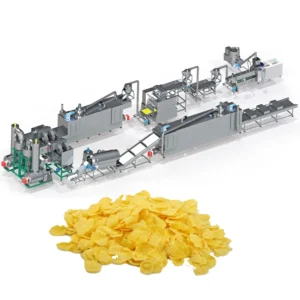
New High Efficiency Electric Corn Flakes Production & Manufacturing Machine
¥7,500.00 Select options This product has multiple variants. The options may be chosen on the product page -
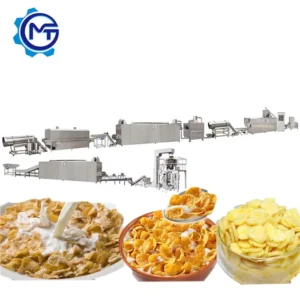
Sweet Corn Flakes Maize Breakfast Cereal Full-automatic Food Grade Stainless Steel Heat Exchanger Mixer Fryer Processing Line
¥8,000.00 Add to cart -
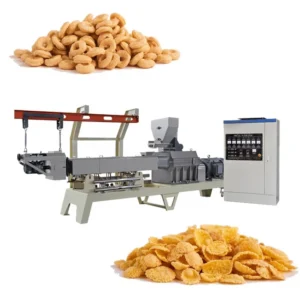
Corn Flakes Machine Breakfast Cereal Corn Flakes Production Line Cornflakes Making Machine
¥85,800.00 Select options This product has multiple variants. The options may be chosen on the product page -
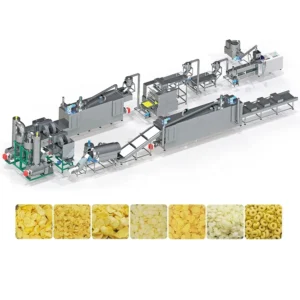
Whole Grain Choco Hoop Crunchy Wheat Cereal Ring Fruit Loops Snacks Extruder Machine /breakfast Cereals Corn Flakes Production
¥48,000.00 Select options This product has multiple variants. The options may be chosen on the product page