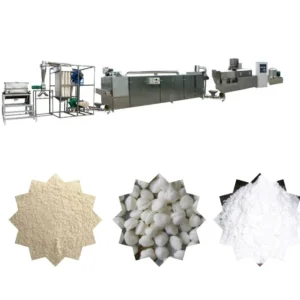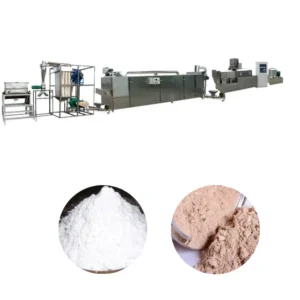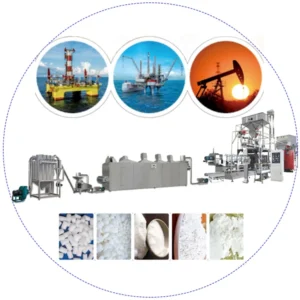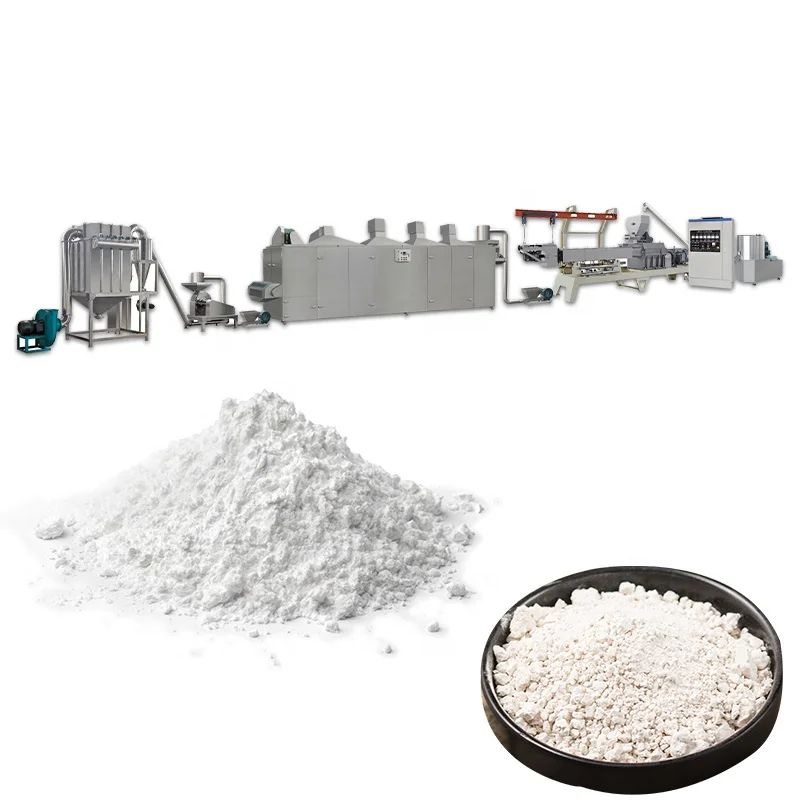


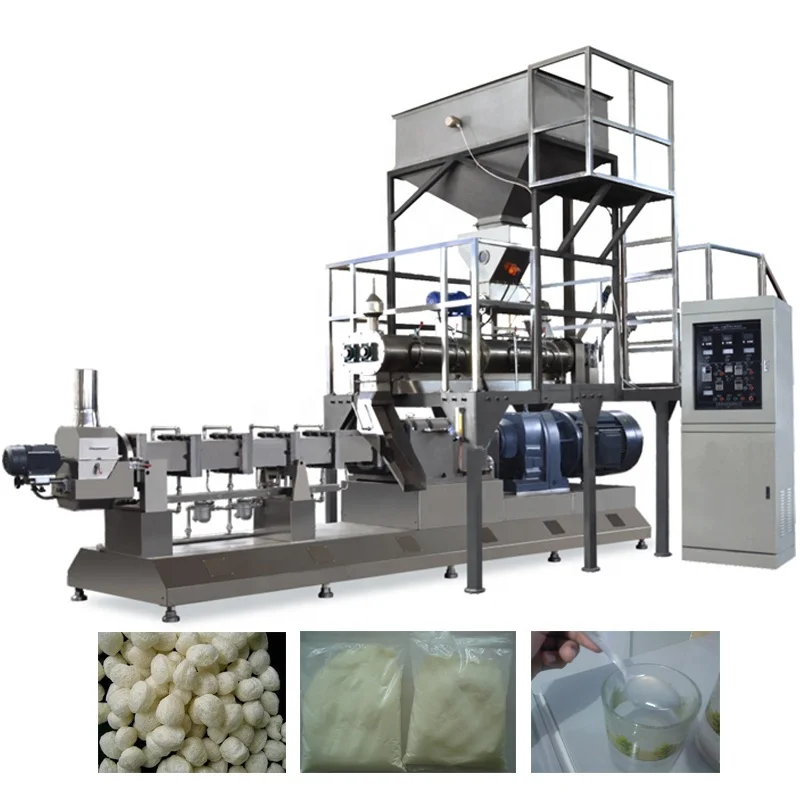

MT70 Modified Starch Processing Line, Twin-Screw, 380V 50Hz — configured as a complete turnkey solution from batching through extrusion, drying, and packing.
- 38CrMo screw material with integrated barrel cooling ensures precise temperature profiling during starch gelatinization
- Screw configuration and die design matched to your raw material and target modification degree
- PLC and MCC automated control maintain consistent expansion and moisture management across the full line
One-supplier layout engineering guarantees throughput matching at every station, eliminating the bottleneck of assembling equipment from separate vendors.
Description
Integrated Line Throughput Matching — We engineer the modified starch processing line turnkey from batching to packing so every station holds the same output on your actual raw material.
Technical Specifications
| Parameter | Value |
|---|---|
| Model | MT70 / MT85 / MT100 |
| Product Type | Modified Starch Processing Line |
| Screw Type | Twin-screw (double-screw extruder) |
| Screw Diameter | 70 mm (MT70) |
| Screw Length | 1520 mm (MT70) |
| Screw Material | 38CrMo |
| Main Motor Power | 30 kW (MT70) |
| Installed Power | 160 kW (MT70); 190 kW (MT85); 210 kW (MT100) |
| Power Consumption | 120 kW (MT70); 140 kW (MT85); 150 kW (MT100) |
| Output Capacity | 150–200 kg/h (MT70); 300–400 kg/h (MT85); 300–500 kg/h (MT100) (basis not stated in source) |
| Overall Dimensions (L×W×H) | 41000×1500×2200 mm (MT70); 43000×1500×3200 mm (MT85); 45000×1500×3500 mm (MT100) |
| Control System | PLC and MCC control |
| Cooling System | Integrated temperature control cooling system |
| Fuel Options | Gas / Diesel / Electricity / Steam |
| Voltage & Frequency | 380V 50Hz Three Phase (customizable to 380V 60Hz, 415V 60Hz, 220V 60Hz) |
| Contact Materials | Food-grade stainless steel |
| Standards | CE, ISO |
| Warranty | 1 year complete warranty with lifetime maintenance |
Application Suitability
| Application | Material or Output |
|---|---|
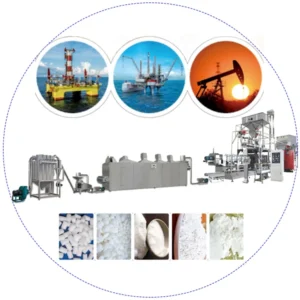
| Oil drilling fluid starch | Native starch modified for viscosity and thermal stability |
| Food-grade modified starch | Corn or wheat flour pregelatinised for instant food bases |
| Textile and paper industry starch | Starch modified for sizing and coating adhesion |
| Nutritional powder bases | Starch gelatinization for infant formula and dietary supplements |
What "300 kg/h Output" Leaves Out About Modified Starch Lines
Capacity figures mean nothing without the raw material recipe and target modification degree.
When a modified starch processing line turnkey is quoted at a nominal throughput, that number is often based on a standard corn starch at a fixed moisture level. In the field, buyers frequently switch to cassava or potato starch mid-production, and the entire thermal profile shifts. Gelatinization drops, expansion becomes inconsistent, and the extruder runs below nameplate capacity while the dryer struggles with unexpected moisture loads. I have seen operators spend days chasing parameters after a recipe change because the screw configuration was set for a different base material [NEED_CITE: starch gelatinization behavior across corn, cassava, and potato substrates]. The throughput matching question must be answered against your actual incoming flour specification, not a generic datasheet row.
Barrel Temperature Profiling Across Gelatinization Zones
The twin-screw extruder in this modified starch processing line uses an integrated temperature control cooling system paired with heating rings to manage each barrel zone independently. Starch gelatinization requires precise thermal staging — too much heat early causes surface crust formation that traps internal moisture; too little heat leaves the granule structure partially intact, reducing functional performance downstream. The 38CrMo screw material maintains dimensional stability under these thermal cycles, which matters when running high-amylose varieties that demand sustained barrel pressures.
Screw Configuration as a Recipe Variable, Not a Fixed Build
Screw elements are arranged to match the buyer’s target modification outcome — whether that means pregelatinisation for cold-water solubility, partial dextrinisation for adhesive applications, or full expansion for drilling fluid viscosity. A configuration designed for oil drilling starch will have different shear staging than one built for food-grade instant thickeners. The die design further controls residence time and expansion ratio at the point of discharge. This specification is confirmed during trial runs before the modified starch processing line turnkey leaves the workshop.
Reading the Power and Dimension Data
The MT70 draws 120 kW during operation against a 160 kW installed peak, a gap that reflects startup load and heater cycling rather than continuous waste [NEED_CITE: motor load profiles in food extrusion systems]. The 41-meter line footprint for the MT70 includes mixing, extrusion, drying, and packing stations in sequence. The drying station length is the variable that most often surprises buyers — achieving target final moisture in pregelatinised starch requires sufficient belt travel time, and a dryer sized only for the extruder’s peak output will bottleneck the line once ambient humidity rises. The PLC and MCC control panel centralises parameter recall, so operators can switch between starch types without rebuilding profiles from scratch each shift.
The Cost of Mismatched Stations Downstream
An extruder that outpaces its dryer forces operators to slow the entire modified starch processing line to prevent wet product from reaching the packing station. This creates false bottlenecks where the extruder runs at partial load, consuming energy without producing saleable output. In humid tropical environments — common across Southeast Asian starch markets — the drying deficit becomes even more pronounced, and product clumping in the packing hopper leads to further downtime. These are not mechanical failures but layout miscalculations that surface only after installation [NEED_CITE: drying capacity requirements for pregelatinised starch in high-humidity production environments].
Why Procurement Through a Single Line Supplier Matters
Throughput is calculated station by station against your specified raw material before the layout is finalised, so the dryer belt width and the packing scale speed are matched to the extruder’s actual output on your flour type. Screw configuration and die selection are documented per product target — if you run both oil drilling starch and food-grade variants, both setups are recorded for rapid changeover. Trial runs using your incoming material take place in the testing workshop before shipment, not as a post-installation experiment. Voltage and frequency are confirmed against your facility supply before production begins, and the electrical schematic reflects your local standard rather than a default setting. CE and ISO documentation accompanies the shipment for customs and regulatory clearance.
Documentation & Verification
- Line layout drawing with capacity calculation matched to your raw material specification
- Screw and die configuration record for your target modification degree and viscosity range
- Trial run report produced on your supplied starch sample before dispatch
- Electrical schematic with voltage, frequency, and control language confirmed for your market
- CE declaration of conformity and ISO certificate included in shipping documentation
- Wear parts list covering screws, dies, and heating rings for first replacement planning
Installation, Commissioning & Support
- Foundation requirements mapped to the 41-meter MT70 line footprint with station-by-station load data
- Power supply planning based on 160 kW installed capacity with dedicated circuit recommendations
- Line arrives in modular sections for staged assembly matching your facility access constraints
- Commissioning includes screw speed, barrel temperature, and dryer belt parameters set on your material
- Operator training covers PLC recipe recall and MCC safety interlock procedures
- Wear parts package includes 38CrMo screw segments and die inserts for initial replacement cycle
Preparing Your Inquiry for an Accurate Line Proposal
To scope a modified starch processing line turnkey accurately, share your base starch type — corn, wheat, cassava, or a blend — along with the target end-use application and any functional specifications your market demands. Include your available floor space with ceiling height clearance, and confirm local voltage and frequency so the electrical design aligns before production. If you have existing upstream milling or downstream packing equipment that the new line must integrate with, note the connection points and throughput expectations.
Frequently Asked Questions
Q: How is line capacity verified against my specific raw material and target starch properties?
A: We run your supplied starch sample through the in-house testing workshop, adjusting screw speed, barrel temperature, and moisture input until the target gelatinization degree and expansion ratio are achieved. The resulting parameters form the basis of the capacity calculation documented in your line layout.
Q: What is the phased installation and commissioning schedule for a full turnkey line?
A: The line arrives in modular sections matching station boundaries. Assembly proceeds from the extruder outward through drying and packing, with utility connections validated at each stage before the next station is brought online. Commissioning concludes with a sustained production run on your material.
Q: How do you ensure throughput matching between extruder, dryer, and packing stations?
A: Each station is sized against the extruder’s verified output on your raw material, not against a generic capacity table. The dryer belt length and packing scale speed are calculated to absorb the full extruder discharge without accumulation or idle time.
Q: What utility planning is required and how is it confirmed before shipment?
A: Power requirements, steam or gas supply for the dryer, and cooling water flow are calculated during layout design. The electrical schematic confirms voltage and frequency against your facility specification, and utility connection diagrams are included in the documentation package before the modified starch processing line turnkey ships.
Q: Is operator training included and how are wear parts supplied for first replacement?
A: On-site training covers PLC operation, recipe changeover, and MCC safety procedures. A wear parts package with 38CrMo screw segments, dies, and heating rings ships with the line so your first replacement cycle does not depend on lead-time ordering.
Related products
-
Pregelatinized Low-Cost Modified Starch Line – High-Efficiency Automated Starch Processing Machine
¥65.00 Select options This product has multiple variants. The options may be chosen on the product page -
Cassava & Pregelatinized Corn Starch Extrusion Equipment – CE Certified Industrial Twin-Screw Modified Starch Line
¥65.00 Select options This product has multiple variants. The options may be chosen on the product page -
Twin-Screw Extrusion Line for Modified Starch. Producing Pregelatinized Adhesive & Food Grade Powder
¥65.00 Select options This product has multiple variants. The options may be chosen on the product page -
Modified and Pregelatinized Starch Processing Equipment – Pregelatinized Corn Cassava Modified Starch Puffing Machine
¥65.00 Select options This product has multiple variants. The options may be chosen on the product page