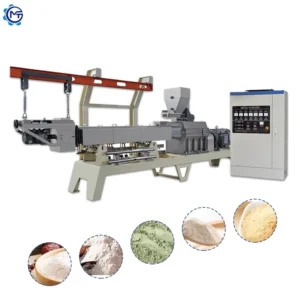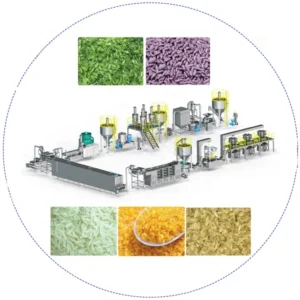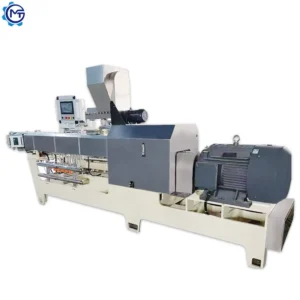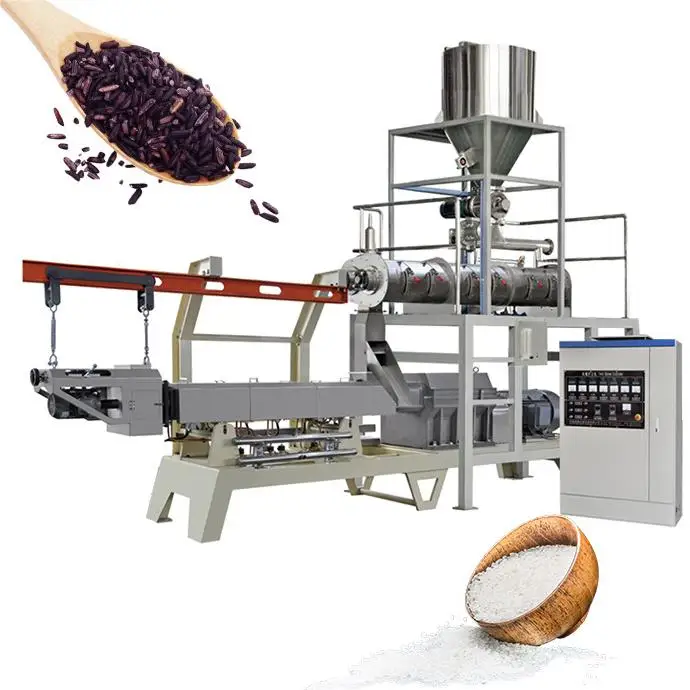
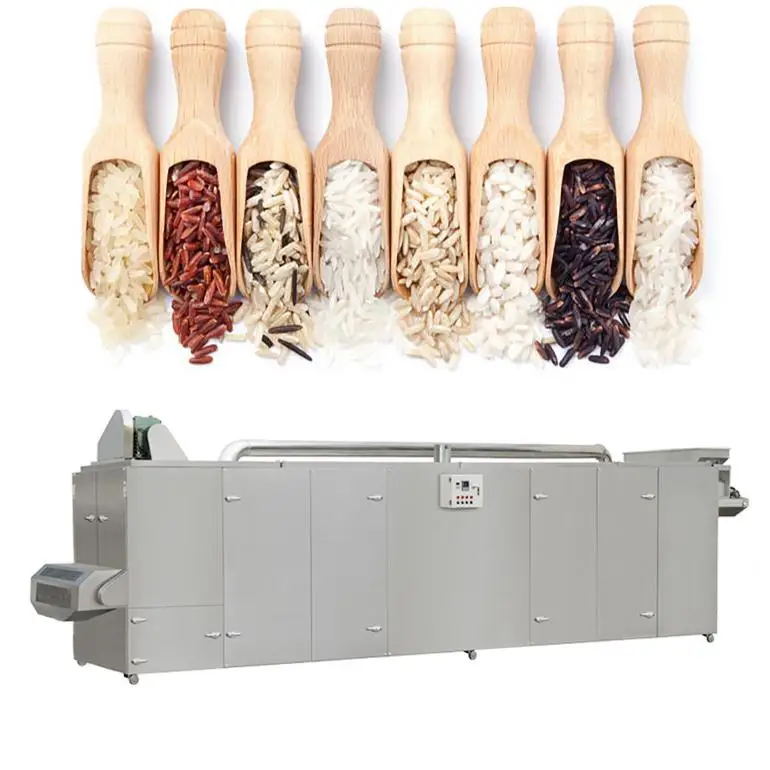
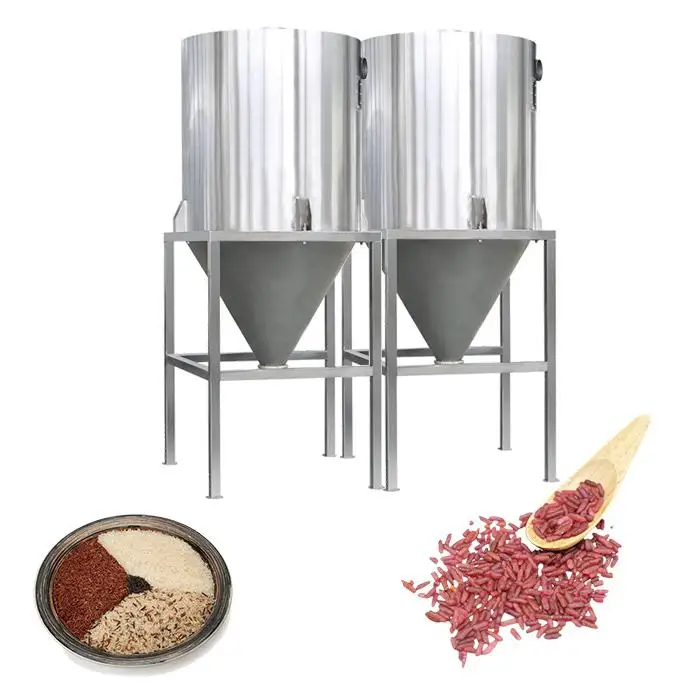
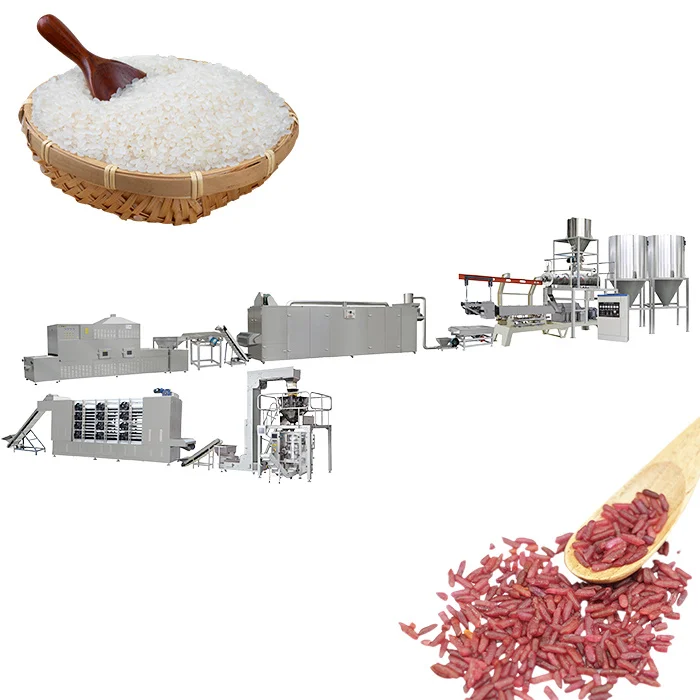


MT95 Nutritional Artificial Rice Production Line, Twin-Screw Extruder, 260 kW Installed Power — configured for fortified rice kernel processing from broken rice, corn and grain blends with added vitamins and minerals.
- Twin-screw extrusion with screw configuration and die design matched to your raw material and target kernel density
- Complete turnkey layout from mixing through extrusion, drying, roasting and packing with throughput balanced at every station
Trial runs on your actual raw material are completed in our testing workshop before shipment, with full line layout and capacity documentation provided.
Description
Turnkey throughput balancing — Every station in this nutritional artificial rice production line is sized against the extruder’s actual output on your grain blend, so the dryer, roaster and packing belt never force the line to run below its tested capacity.
Technical Specifications
| Parameter | Value |
|---|---|
| Product Type | Nutritional Artificial Rice Production Line |
| Available Models | MT65 / MT70 / MT75 / MT85 / MT95 |
| Screw Type | Twin Screw |
| Installed Power | 85 kW (MT65) / 120 kW (MT70) / 180 kW (MT75) / 235 kW (MT85) / 260 kW (MT95) |
| Power Consumption | 60 kW (MT65) / 85 kW (MT70) / 135 kW (MT75) / 165 kW (MT85) / 195 kW (MT95) |
| Output Capacity | 80–100 kg/h (MT65, basis to be confirmed) / 100–120 kg/h (MT70, basis to be confirmed) / 300–500 kg/h (MT75, basis to be confirmed) / 200–300 kg/h (MT85, basis to be confirmed) / 800–1000 kg/h (MT95, basis to be confirmed) |
| Overall Dimensions (L×W×H) | 28 × 1.2 × 2.2 m (MT65) to 36 × 3.5 × 4.3 m (MT95) |
| Control System | Frequency speed control, high automation, PLC / MCC options available |
| Feeding System | Single or double screw feeding, selected by material characteristics |
| Screw Material | Special wear-resistant alloy |
| Lubrication | Automatic lubricating and cooling system |
| Dryer Heating Source | Electric or gas |
| Dryer Feature | Circulation drying with frequency-controlled mesh belt speed |
| Line Stations | Mixing → Extruding → Vibrating → Low Temperature Drying → Cooling → High Temperature Roasting → Cooling → Packing |
| Raw Materials | Broken rice, rice, corn, millet, wheat, oats, buckwheat, bean, starch with vitamin and mineral additives |
| Assembly State | Complete turnkey line |
| Voltage & Frequency | Customized to local supply |
| Standards | CE certified, ISO certified |
Application Suitability
| Application | Material or Output |
|---|---|
| Fortified staple rice for nutrition programmes | Broken rice and rice bran blended with iron, zinc, vitamin A and B-complex micro-nutrients |
| Artificial rice kernel production | Milled rice flour, corn starch and wheat flour reformed into whole-grain-shaped kernels |
| Multi-grain nutritional rice | Millet, buckwheat, oats and bean flour with added mineral premix |
| Institutional food supply contracts | Shelf-stable fortified rice kernels matching the cooking behaviour of natural milled rice |
What "800 kg per Hour" Actually Means on Your Grain Blend
We confirm line capacity on your specific raw material and moisture content during an in-house trial run before the line ships.
Nominal output figures on nutritional artificial rice production line turnkey proposals often come from running a standard reference starch at a controlled moisture level. When a buyer switches to their own broken rice or multi-grain blend, the extruder may not reach that nameplate throughput, or the kernels may exit the die at a density that sinks rather than holds shape through drying. I have seen lines where the extruder could push the quoted volume, but the downstream dryer was spec’d for a lighter product and the mesh belt backed up, forcing the entire line to run at a fraction of the promised rate [NEED_CITE: throughput mismatch between extruder and dryer in grain processing lines]. The only reliable way to verify a capacity claim is to run the buyer’s actual material through the full station sequence and record what comes out the other end.
Screw Configuration and Die Design for Rice Kernel Density
The twin-screw extruder in this nutritional artificial rice production line turnkey system uses a screw configuration and die geometry chosen for the buyer’s target kernel density and cooking behaviour. Broken rice flour behaves very differently from a pure corn starch base inside the barrel — the gelatinisation window shifts, and the shear profile must be adjusted to avoid over-expansion that produces hollow, fragile kernels. Each die orifice is sized so the extruded strand is cut or shaped to match the length-to-diameter ratio of natural milled rice, which matters when the product is blended back into a consumer rice bag.
Throughput Matching Across Every Station
A turnkey line is only as fast as its slowest station. The dryer, roaster, cooling conveyor and packing weigher in this nutritional artificial rice production line are each calculated against the extruder’s proven output on the buyer’s material, not against a generic catalogue figure. Circulation drying with a frequency-controlled mesh belt lets the operator tune residence time so moisture is pulled evenly from every kernel before roasting, preventing case-hardening on the surface while the core remains wet. When throughput is matched correctly, the line holds a steady state without product pile-up between stations [NEED_CITE: importance of station-to-station throughput matching in extrusion-based food lines].
Reading the Specs That Matter for Grain Fortification
Twin-screw extrusion gives the operator independent control over shear, residence time and barrel temperature profile, which is critical when the recipe includes heat-sensitive vitamin premixes that degrade above certain thresholds. The automatic lubricating and cooling system keeps the screw shaft temperature stable during long production runs, reducing the chance of thermal drift that would alter kernel expansion batch to batch. Installed power ranges from 85 kW on the MT65 to 260 kW on the MT95, and actual power consumption sits noticeably lower at 60 kW to 195 kW depending on model and load. Frequency-controlled feeding — single or double screw depending on material flow characteristics — ensures a consistent mass flow rate into the barrel, which directly governs the uniformity of every kernel that leaves the die plate.
The Hidden Cost of a Spec Mismatch
Order a line on catalogue capacity alone and the first production week often reveals the dryer cannot keep up with the extruder on a high-moisture multi-grain blend. Kernels pile on the mesh belt, stick together and must be reworked or scrapped. Voltage and frequency left unconfirmed until the machine arrives on site can mean weeks of idle floor space while a transformer or VFD panel is sourced locally [NEED_CITE: electrical specification mismatches delaying commissioning of imported food machinery]. Control system language set to a default the operators cannot read turns a simple parameter tweak into a call to an overseas support desk.
Why Source This Line Here
Every station from batching to packing is engineered under one supplier, so the throughput calculation that sets the extruder output also sets the dryer belt width, the roaster chamber length and the packing weigher speed — no finger-pointing between vendors when a bottleneck appears. The in-house testing workshop runs the buyer’s actual broken rice or grain blend before shipment, producing a trial run report that documents real output and kernel quality. Screw configuration and die design are recorded per project, not copied from a generic build. Electrical schematics confirm voltage, frequency and control language before production starts, not after the crate is opened. CE and ISO certification supports customs clearance and local regulatory filing across export markets.
Documentation & Verification
- Line layout drawing showing station-by-station throughput calculation for your grain blend
- Trial run report on your actual broken rice or multi-grain material before dispatch
- Screw and die configuration record matched to your target kernel density
- Electrical schematic confirming your local voltage, frequency and control language
- CE declaration of conformity and ISO certificate for import and regulatory filing
- Wear parts list with part numbers for screws, dies and dryer mesh belt segments
Installation, Commissioning & Support
- Foundation plan accounts for the full line footprint, up to 36 m length on the MT95 configuration
- Dedicated power circuit sized to the model’s installed power, up to 260 kW on the MT95
- Equipment shipped in sectioned modules for container loading and on-site reassembly
- First-run commissioning includes screw speed, barrel temperature and dryer belt tuning on your material
- Operator training covers PLC or MCC interface navigation in the confirmed control language
- Spare screw elements, die plates and dryer belt segments supplied with initial shipment
What We Need to Configure Your Line
To prepare an accurate layout and capacity proposal, share the grain or starch base you plan to run, the vitamin and mineral premix ratio, and your target daily output. Confirm the voltage, frequency and phase available at your facility, along with the preferred control panel language. If you have existing upstream milling or downstream packing equipment, provide the model and throughput so the new line can be matched to it. Sending a sample of your raw material allows us to conduct a trial run in the testing workshop and include verified output data in the proposal.
Frequently Asked Questions
Q: How is line capacity verified against my actual raw material and moisture content?
A: We run your grain blend through the extruder and full downstream sequence in our in-house testing workshop before shipment. The trial run report records actual throughput, kernel density and moisture at each station, so the capacity figure in your proposal reflects your material, not a generic starch reference.
Q: How do you match throughput between the extruder, dryer and packing station to avoid bottlenecks?
A: The line layout calculation starts with the extruder’s proven output on your material and sizes every downstream station — dryer belt width, roaster chamber length, cooling conveyor speed and packing weigher rate — to that figure, so no single machine limits overall output.
Q: What voltage, frequency and control language will be confirmed before production starts?
A: Your local supply voltage, frequency and phase are confirmed during the specification stage and recorded on the electrical schematic. Control panel language is set to your preference before the PLC or MCC system is programmed, avoiding commissioning delays on site.
Q: Can I send my raw material for a trial run before the line ships?
A: Yes. Shipping a sample of your broken rice, grain blend or starch base with your premix allows us to test extrusion, drying and roasting parameters in the workshop and provide a documented trial run report before the equipment leaves the factory.
Q: What does on-site installation, commissioning and operator training include?
A: Our engineers supervise module reassembly, connect utilities, run the first production batch on your material and fine-tune screw speed, barrel temperature and dryer belt speed. Operators receive hands-on training on the control interface in the confirmed language, plus a wear parts replacement walkthrough.
Related products
-
Compact Automatic Baby Cereal Nutrition Powder Production Line with 500kg/h Capacity and PLC Control
¥9,500.00 Add to cart -

High Quality Automatic PLC Controlled 500kg/h Twin Screw Extruder Machine for Baby Rice Nutrition Powder
¥8,238.27 Add to cart -
Automatic Nutritional Powder Making Machine Safe Rice Cereal for Babies
¥30.00 Select options This product has multiple variants. The options may be chosen on the product page -

Industrial Automatic 500kg/h Baby Cereal Nutrition Powder Extruder Manufacturing Process Line
¥8,238.27 Add to cart