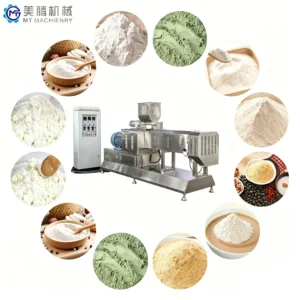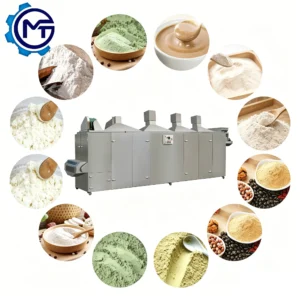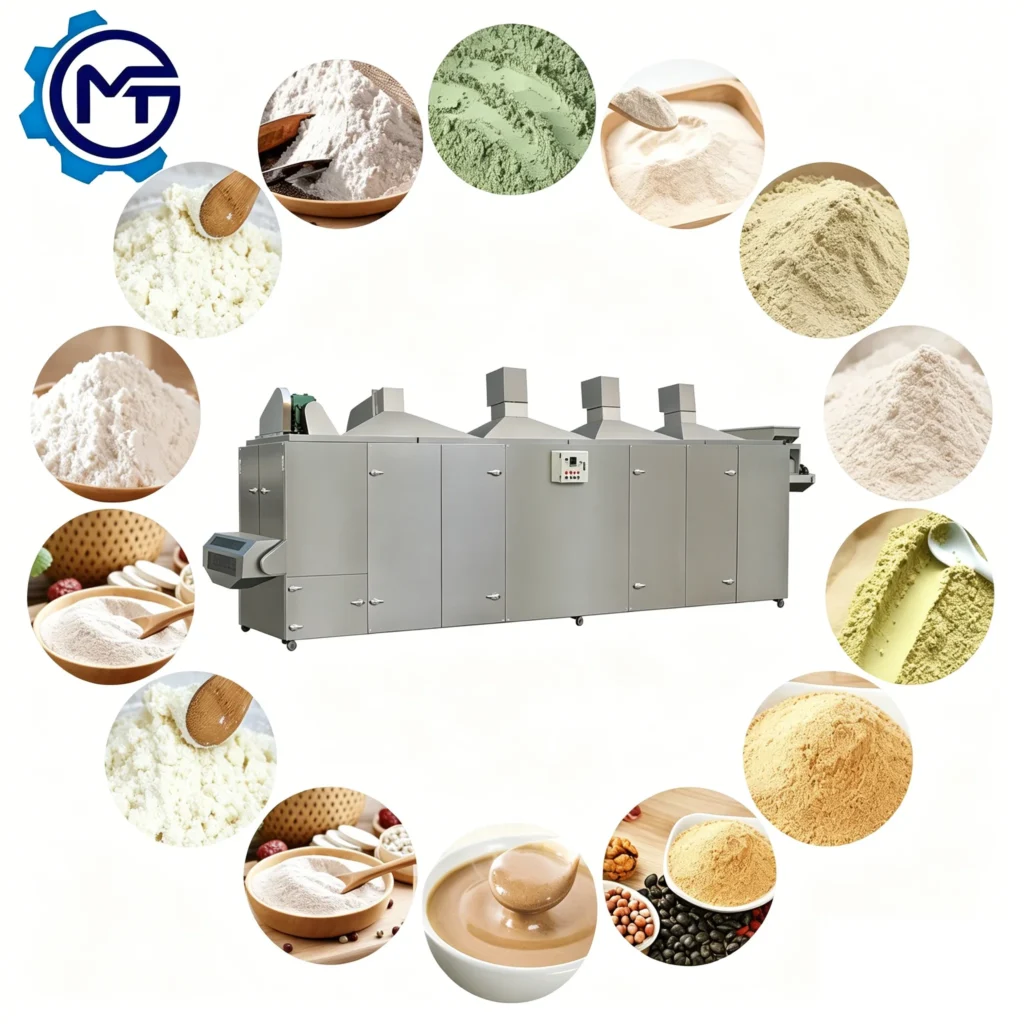
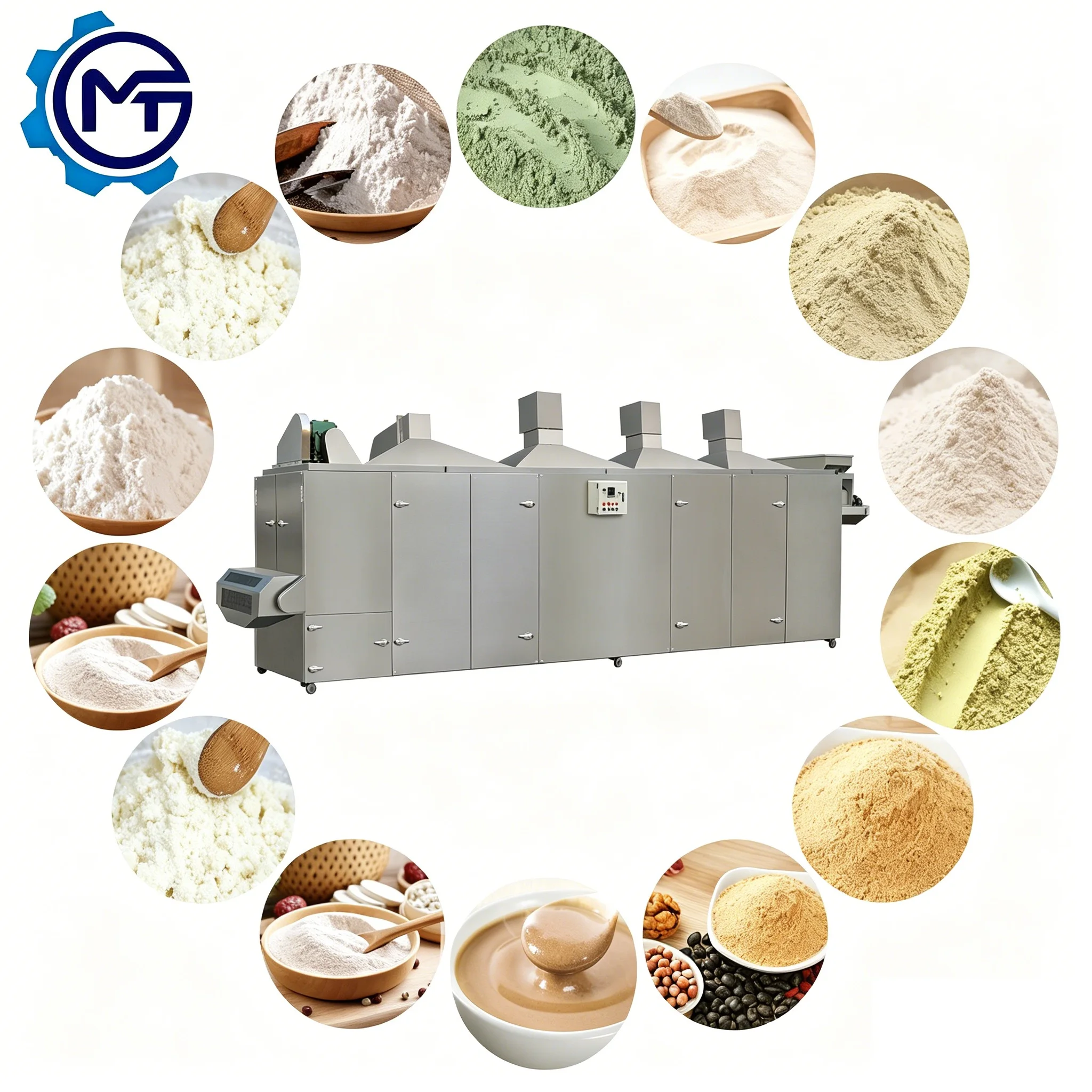


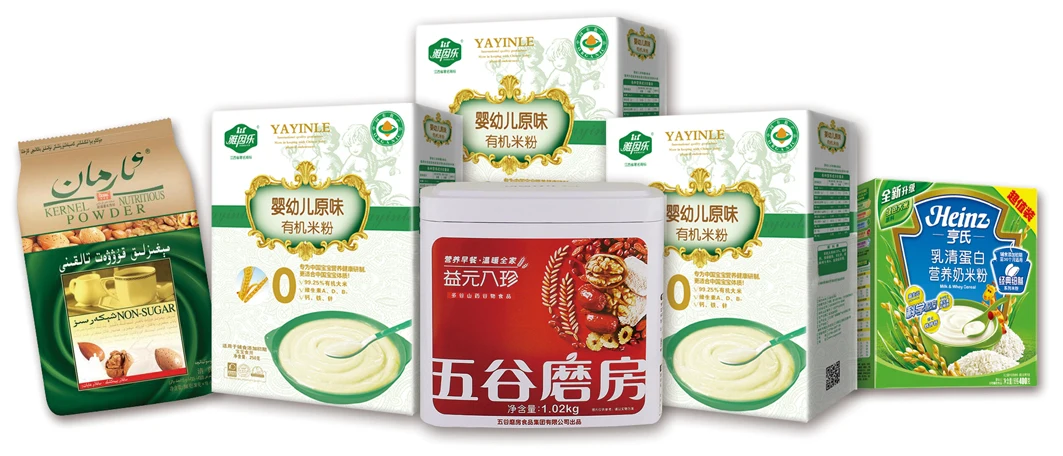

MT65 / MT70 / MT75 / MT85 Nutrition Powder and Baby Rice Powder Processing Line, Twin-Screw Extrusion, PLC Control, 380V 50Hz — configured as a complete turnkey project from batching through extrusion, drying, and pulse grinding.
- Line layout, throughput calculation, and screw/die configuration are matched to your raw material and target powder characteristics
- Multi-layer belt dryer with adjustable temperature and multiple fuel options balances moisture removal to extruder output
- 304 stainless steel food-grade contact materials throughout all product-contact stations
Every station throughput is verified under one supplier, and an in-house trial run on your actual formulation validates capacity before shipment.
Description
Turnkey Line Accountability — every station from mixing to pulse grinding is throughput-matched under one supplier, eliminating the bottleneck risk that comes from assembling a nutritional powder processing line from separate vendors.
Technical Specifications
| Parameter | Value |
|---|---|
| Model | MT65 / MT70 / MT75 / MT85 |
| Product Type | Nutrition Powder and Baby Rice Powder Processing Line |
| Screw Type | Twin-screw |
| Installed Power | 84 kW (MT65) / 160 kW (MT70) / 190 kW (MT75) / 210 kW (MT85) |
| Power Consumption | 59 kW (MT65) / 120 kW (MT70) / 140 kW (MT75) / 150 kW (MT85) |
| Output Capacity | 120–150 kg/h (MT65) / 150–200 kg/h (MT70) / 200–250 kg/h (MT75) / 300–400 kg/h (MT85) (basis to be confirmed) |
| Overall Dimensions (L×W×H) | 20000×1500×2200 mm (MT65) / 21000×1500×2200 mm (MT70) / 23000×1500×3200 mm (MT75) / 25000×1500×3500 mm (MT85) |
| Voltage & Frequency | 380 V, 50 Hz, Three Phase (configurable) |
| Control System | PLC and MCC control available |
| Mixer Material | 304 Stainless Steel (food-grade contact) |
| Mixer Capacity | 20–30 kg/batch / 70–80 kg/batch / 170–180 kg/batch (by capacity tier) |
| Dryer Type | Multi-layer belt dryer (electric / gas / fuel options) |
| Pulse Crusher Power | 11 kW |
| Pulse Crusher Dimensions | 3000×900×2200 mm |
| Assembly State | Complete line (batching through grinding) |
| Standards | CE certified, ISO certified |
Application Suitability
| Application | Material or Output |
|---|---|
| Infant formula and baby rice powder | Rice flour, grain blends with added vitamins and trace elements |
| Nutritional supplement powder | Soy, oat, and multi-grain formulations with protein fortification |
| Modified and pregelatinised starch powder | Cassava, corn, and potato starch bases for functional food use |
| Fortified artificial rice | Grain flour with added micronutrients, extruded and ground to uniform granule size |
| Therapeutic and functional food powder | Specialty grain and protein blends for clinical or institutional nutrition programmes |
Why "Rated Capacity" Means Nothing Without Your Raw Material
A nutritional powder processing line turnkey package must be validated on the buyer’s actual formulation, not quoted on a generic benchmark.
I have watched lines get signed off at a specific hourly output, only to stall when the buyer switches from a standard corn-rice blend to a formulation heavy in whey protein isolate. The bulk density shifts, the moisture absorption curve changes, and suddenly the dryer cannot keep pace with the extruder. The bottleneck is not a machine defect — it is a specification gap. [NEED_CITE: raw material bulk density and moisture absorption in extrusion processing] When the trial run happens in the testing workshop rather than on the factory floor, those gaps surface before the line is crated for shipping.
Station-by-Station Throughput Balancing
A nutritional powder processing line turnkey project succeeds or fails on whether every station can hold pace with the one before it. The mixer batch size must align with the extruder feed rate, the air conveying system must move material faster than the extruder discharges it, and the multi-layer belt dryer must have sufficient belt length and residence time to handle peak output. When these stages are sourced from separate vendors, each one quotes independently, and the integration risk falls on the buyer.
Formulation-Driven Screw and Die Configuration
The twin-screw extruder sits at the centre of the line, and its screw configuration determines how the raw material gelatinises, expands, and ultimately breaks down into powder after grinding. A high-protein infant formula blend behaves differently from a starch-dominant baby rice formulation — the compression ratio, kneading block arrangement, and die aperture all require adjustment. Specifying the screw profile to the buyer’s actual formulation, rather than a default build, is what separates a line that runs on day one from one that needs weeks of on-site recalibration. [NEED_CITE: twin-screw extrusion screw configuration for varying protein and starch ratios]
Reading the Specification Sheet for Production Impact
The installed power range across the MT65 through MT85 models reflects the motor capacity available for different throughput tiers, but power consumption figures show the actual draw during steady-state operation — a useful input for utility planning and transformer sizing. The multi-layer belt dryer offers electric, gas, or fuel heating options, which matters because energy cost and local infrastructure vary significantly between markets; a gas-fired dryer may be preferable where natural gas is inexpensive, while electric heating suits facilities with stable grid supply. The 304 stainless steel contact surfaces throughout the line address food safety compliance and simplify washdown protocols. Pulse crusher capacity and power rating must be cross-referenced against the target fineness of the final powder, as grinding a dense extrudate to infant-formula-grade mesh size demands more energy than producing a coarser nutritional grain powder.
The Cost of Skipping Configuration Verification
When voltage and frequency are assumed rather than confirmed, commissioning delays follow. A 380 V, 50 Hz line shipped to a facility running 440 V, 60 Hz will not start without a transformer swap or motor replacement — and that discovery usually happens after the machines are bolted to the floor. [NEED_CITE: voltage and frequency standards by export market] Similarly, when the control language on the PLC interface does not match the operator team, training stretches from days into weeks, and early production runs suffer from miscommunication errors that look like equipment faults.
Why This Line Is Supplied as One Project
The complete station sequence — mixing, screw conveying, extruding, air conveying, drying, air conveyor, and pulse grinding — is configured under a single supplier, which means throughput calculations are cross-checked at every junction rather than left to the buyer to reconcile. Screw and die profiles are matched to the buyer’s raw material and target powder characteristics before the extruder is built. The in-house testing workshop allows trial runs on the buyer’s actual formulation, generating a production report that validates capacity claims with real data. Pre-sales consultation covers line layout, utility requirements, and phased installation planning. Post-delivery support includes on-site commissioning, operator training, and a documented wear parts list so that screw and die replacements are available when the first changeover is due.
Documentation & Verification
- Line layout drawing with throughput calculation at each station, from mixer batch output to pulse grinder capacity
- Trial run report produced on your specific raw material and formulation before shipment
- Screw and die configuration record matched to your target powder density and fineness
- Electrical schematic with confirmed voltage, frequency, and control language for your facility
- CE declaration of conformity and ISO certificate included in the shipping documentation package
- Operation and maintenance manual with wear parts list and recommended replacement intervals
Installation, Commissioning & Support
- Floor plan and utility connection schedule provided for the full 20–25 m line footprint depending on model tier
- Electrical cabinet and MCC panel configured to your confirmed voltage and frequency before dispatch
- Line arrives as sectional assemblies requiring on-site alignment of conveyor and dryer connections
- Commissioning includes parameter calibration on your raw material with extruder temperature and screw speed adjustment
- Operator training covers PLC interface navigation, mixer batching sequences, and dryer temperature profiling
- Wear parts list with screw elements, die plates, and dryer belt sections identified for first-year procurement
What We Need to Configure Your Line
To build an accurate layout and capacity proposal, share your raw material formulation including the protein, starch, and fat ratios, along with your target powder mesh size and daily production volume. Confirm your facility voltage, frequency, and preferred control language, and let us know whether you need the dryer configured for electric, gas, or fuel heating. If you can send a sample of your raw material, we will run a trial in the testing workshop and return a production report with the quotation.
Frequently Asked Questions
Q: How is throughput verified across all stations to prevent bottlenecks?
A: Each station — mixer, extruder, dryer, and pulse grinder — is calculated against the others during layout design. We run a trial on your raw material in the testing workshop, measuring actual output at every stage. The trial run report documents throughput at each station, confirming that no single point restricts the line before it ships.
Q: Can a trial run be conducted on our specific formulation before shipment?
A: Yes. Send us a representative sample of your raw material blend. We run it through the extruder and downstream equipment in the testing workshop, adjusting screw configuration, barrel temperature, and dryer settings. You receive a trial run report with output data, product samples, and confirmed line parameters.
Q: How are voltage, frequency, and control language confirmed?
A: During the specification phase, we collect your facility power supply details and operator language preference. The electrical schematic, motor ratings, PLC interface, and MCC panel are all configured to match before production begins, so the line powers up correctly during on-site commissioning.
Q: What documentation accompanies the line?
A: The package includes line layout and capacity calculations, screw and die configuration records, electrical schematics, CE declaration, ISO certificate, factory test record, trial run report, and an operation manual with a wear parts list. All documents are provided in your confirmed language before dispatch.
Q: What does the installation and commissioning schedule look like?
A: After delivery, our engineers handle on-site assembly, utility connection verification, and parameter calibration using your raw material. The schedule covers mechanical installation, electrical commissioning, trial production, and operator training, typically spanning several weeks depending on line size and facility readiness.
Related products
-
Full Automatic Complete Baby Food Nutrition Powder Porridge Processing Production Line for Infant Nutrition Factory
¥9,500.00 Add to cart -
CE Approved MT Brand Organic Baby Rice Nutrition Powder Extrusion Production Line with 500kg/h Capacity and Automatic Grade
¥9,500.00 Add to cart -

High Precision Automatic 500kg/h Baby Food Nutrition Powder Rice Extrusion Processing Line
¥9,500.00 Add to cart -
High Precision Automatic 500kg/h Baby Food Nutrition Powder Rice Extrusion Processing Line
¥8,238.27 Add to cart