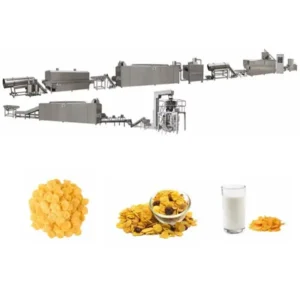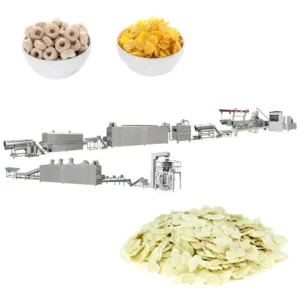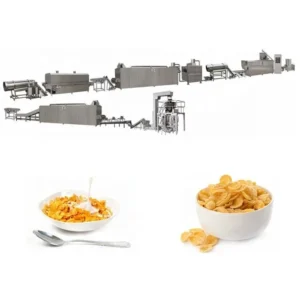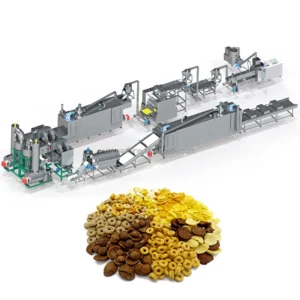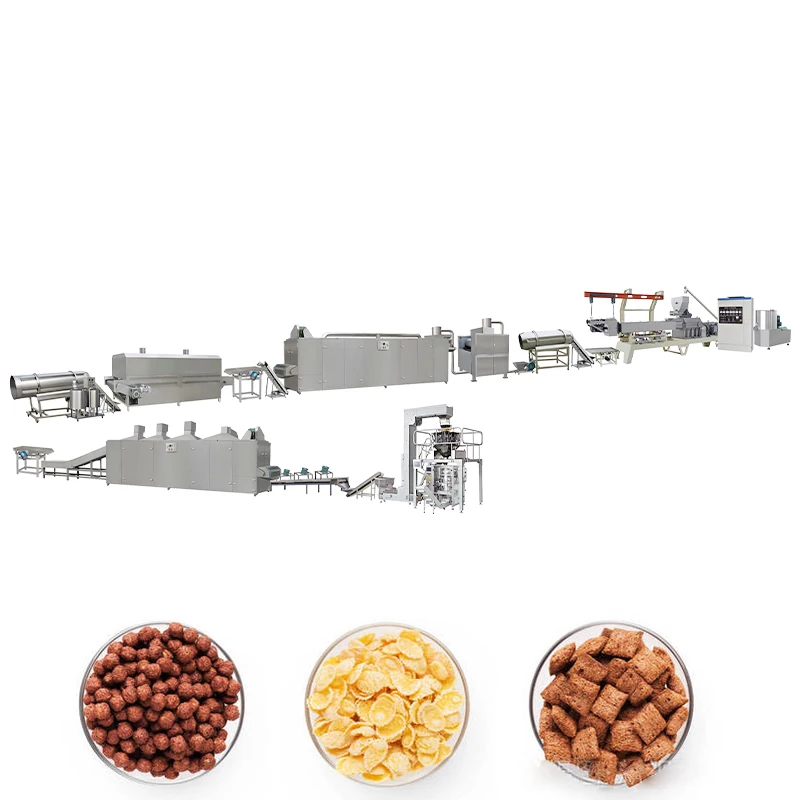


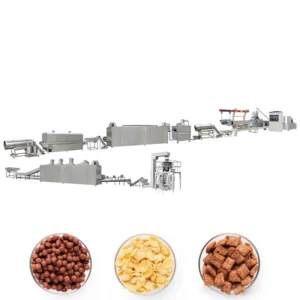
MT-65, MT-70, MT-85, MT-75 Corn Flakes Production Line, Twin Screw, PLC & MCC Control — delivered as one integrated turnkey project from batching to packing. Every station throughput is calculated and balanced against your raw material and target output, with flaking gap, roasting temperature up to 400°C, and drying profile matched across the line. Screw and die configuration specified to your grain formulation.
- In-house trial run on your raw material before shipment, with full documentation package including line layout, capacity calculation, and wear parts list
Description
Integrated Throughput Engineering — every station from mixing to packing is calculated against your target output and raw material behaviour, so the extruder never outruns the dryer or the flaking mill.
Technical Specifications
| Parameter | Value |
|---|---|
| Product Type | Corn Flakes Breakfast Cereal Production Line |
| Available Models | MT-65, MT-70, MT-85, MT-75 |
| Screw Type | Twin Screw |
| Output Capacity (MT-65) | 120–150 kg/h (basis to be confirmed) |
| Output Capacity (MT-70) | 200–250 kg/h (basis to be confirmed) |
| Output Capacity (MT-85) | 300–400 kg/h (basis to be confirmed) |
| Output Capacity (MT-75) | 400–500 kg/h (basis to be confirmed) |
| Installed Power (MT-65 / MT-70 / MT-85 / MT-75) | 84 / 132 / 239 / 186 kW |
| Real Power (MT-65 / MT-70 / MT-85 / MT-75) | 59 / 92 / 167 / 140 kW |
| Overall Dimensions (MT-65) | 21000 × 1200 × 2200 mm |
| Overall Dimensions (MT-70) | 23000 × 1500 × 2200 mm |
| Overall Dimensions (MT-85) | 28000 × 3500 × 4300 mm |
| Overall Dimensions (MT-75) | 24000 × 1500 × 2800 mm |
| Control System | PLC and MCC centralized control, real-time monitoring, alarm, data storage |
| Flaking Machine | Adjustable roller gap, water cooling, cast iron rollers, 45# steel shaft |
| Hot Air Roaster | Up to 400 °C, electric or gas heating, high-pressure blower |
| Dryer | Electric or gas heating, three / five / seven layers, adjustable mesh belt speed |
| Sugar Spraying System | 28.75 kW, Ø600 × 2700 mm roller, 4000 × 1900 × 1800 mm |
| Packing Machine | Vertical automatic with combination head weigher, models 420 / 520 / 620 / 720 |
| Raw Materials | Corn, rice, millets, wheat, oat, barley (powder / flour or grits) |
| Certification | CE |
| Design Method | 3D software design, analogue simulation, computer-tested |
Application Suitability
| Application | Material or Output |
|---|---|
| Plain corn flakes for retail breakfast cereal packs | Corn grits or corn flour |
| Sugar-coated and honey-glazed corn flakes | Corn, rice, or wheat base with syrup coating |
| Multi-grain breakfast flakes | Blends of oat, barley, millet, and rice |
| Fortified nutritional cereal for institutional programmes | Corn or rice flour with vitamin and mineral premix |
| Maize flakes for food service and bulk catering | Coarse or medium corn grits |
Why the Downstream Bottleneck Is the One You Never See Coming
A corn flakes line is only as fast as its slowest station — and that station is almost never the extruder.
I have watched lines where the twin-screw extruder was pushing product at full capacity while the dryer sat three layers short of what the throughput demanded. Half-cooked pellets piled up on the conveyor, cooling unevenly, and by the time they reached the flaking rollers the moisture profile was all wrong. The operator kept slowing the extruder down to let the dryer catch up, which meant the whole corn flakes production line turnkey project was running at a fraction of its nameplate output. Nobody had matched the stations to each other before the machines left the factory [NEED_CITE: throughput matching principles across multi-stage food processing lines].
Mapping Every Station to a Single Throughput Target
The corn flakes production line turnkey approach begins with a capacity calculation that starts at the packing machine and works backward. You define the bag weight, the bags-per-minute target, and the allowable moisture loss through the dryer and roaster, and those numbers tell you exactly how many kilograms per hour the extruder must deliver. Every upstream station — the mixer batch size, the screw conveyor diameter, the air conveyor velocity — is then sized to feed that extruder without surging or starving it.
This is where a single-supplier scope matters. When the mixer, extruder, flaking mill, and dryer come from different vendors, each one quotes their own nominal capacity on their own test material. The gaps between those numbers only show up during commissioning, when the line is already bolted to your floor.
What the Flaking Gap and Roaster Temperature Actually Control
The flaking machine sits between the dryer and the roaster, and it decides the final texture of the flake. The adjustable roller gap sets flake thickness — too thick and the roaster cannot drive moisture out of the centre before the surface scorches; too thin and the flake shatters under the high-pressure blower in the hot air roaster. The water cooling system on the cast iron rollers keeps the gap thermally stable across long runs, because a roller that expands from heat will silently change the thickness by fractions of a millimetre over the course of a shift [NEED_CITE: thermal expansion effects on cereal flaking roller gap consistency].
The roaster itself reaches up to 400 °C, which is the range needed for the rapid surface expansion that creates the characteristic blistered bubble structure on a corn flake. The high-pressure blower ensures even air distribution so that flakes on the edge of the belt receive the same heat exposure as those in the centre. Electric or gas heating is selectable based on the utility infrastructure available at your site.
Reading the Power and Dimension Data Against Your Factory Floor
Installed power and real power tell two different stories. The MT-85, for example, carries 239 kW of installed capacity but draws 167 kW under normal running conditions — the difference accounts for start-up surges and the simultaneous operation of the sugar spraying system at 28.75 kW. When you plan your electrical supply, size the transformer and cabling for the installed figure, but expect the running cost to track closer to the real power value.
The footprint figures — up to 28000 × 3500 × 4300 mm for the MT-85 configuration — include the full line from mixer through packing machine. The height dimension matters in facilities with overhead obstructions or low-clearance roof trusses, especially where the hoister lifts product between the dryer and the flavouring drum. Confirm your available ceiling height before the layout is frozen, because re-routing a conveyor around a structural beam after installation is a costly delay.
The Cost of Skipping the Layout Phase
When a line is assembled from separate equipment orders without a unified layout drawing, the consequences compound. The dryer may arrive with a gas burner specified for a different supply pressure than what your facility provides. The packing machine weigher may be calibrated for a bag size that does not match the flake density the roaster actually produces. Control language on the PLC screen may default to a language your operators cannot read, and changing it after commissioning means flying in a programmer or waiting for a firmware update [NEED_CITE: PLC language configuration and operator interface standards in food machinery].
These are not hypothetical failures. They are the most common reasons a cereal line takes weeks longer to reach stable production than the buyer expected.
Why Sourcing the Full Line From One Scope Changes the Commissioning Outcome
Every station in this corn flakes line is configured under a single engineering scope, which means the screw conveyor output is matched to the extruder intake, the dryer belt width and layer count are matched to the extruder output, and the flaking roller width accommodates the full dryer discharge. The PLC and MCC control system monitors all stations from one interface with real-time alarm and data storage, so a fault at the mixer shows up on the same screen as a temperature deviation at the roaster.
The in-house testing workshop allows trial runs on your actual raw material before shipment. The screw configuration, die design, and flaking gap are adjusted during that trial, and the results are documented in a trial run report that ships with the machines. On-site installation, commissioning, and operator training are included in the project scope, so the engineers who built the line are the ones starting it up in your facility.
Documentation & Verification
- Line layout and capacity calculation showing throughput matched across every station
- Screw and die configuration record tied to your specific raw material and target flake thickness
- Electrical schematic with voltage, frequency, and control language confirmed before production
- Trial run report on your raw material conducted in the testing workshop before dispatch
- CE declaration of conformity, operation and maintenance manual, and wear parts list
Installation, Commissioning & Support
- Foundation and floor space planned around the full line footprint, up to 28000 mm length for the MT-85 layout
- Electrical supply sized to installed power rating, with dedicated circuits for the 28.75 kW sugar spraying system
- Phased assembly sequence from mixer through packing machine, with utility connections verified at each stage
- First-run parameter setting on the PLC including extruder barrel temperature profile and dryer belt speed
- Operator training covering flaking roller gap adjustment, roaster temperature control, and alarm response procedures
- Wear parts list and spare screw and die sets supplied with initial shipment for first replacement cycle
What to Prepare Before Requesting a Line Proposal
To scope a corn flakes production line turnkey project accurately, we need your target raw material — whether corn grits, corn flour, or a multi-grain blend — along with the finished flake specification you sell into your market, including thickness, moisture content, and coating type. Share your available voltage and frequency, the control language your operators require, and the ceiling height and floor space in the designated production area. If you have existing upstream or downstream equipment that must integrate with the new line, provide the model and capacity details so the throughput calculation accounts for those constraints.
Frequently Asked Questions
Q: How is line throughput matched across every station from mixer to packing to prevent bottlenecks?
A: The capacity calculation starts at the packing machine target and works backward through the roaster, flaking machine, dryer, and extruder. Each station is sized so its maximum output slightly exceeds the upstream feed, preventing product accumulation. The PLC monitors real-time throughput at every stage and triggers alarms when any station deviates from the set range.
Q: What is the phased installation and commissioning schedule for a complete turnkey corn flakes line?
A: Installation follows a sequence from raw material handling through to packing, with utility connections verified at each station before the next is assembled. Commissioning begins with single-station dry runs, progresses to wet runs with your raw material, and finishes with a continuous production run at target capacity. Operator training runs parallel to the final commissioning phase.
Q: How are voltage, frequency, and control language confirmed before production to avoid commissioning delays?
A: These specifications are locked during the quotation stage and written into the electrical schematic and PLC programme before manufacturing begins. The factory test verifies that all motors, heaters, and control interfaces operate correctly at the specified voltage and frequency. The control screen language is set and confirmed during the trial run so operators can verify it before the machines ship.
Q: What does the trial run on customer raw material cover, and how does it inform screw and die configuration?
A: The trial run tests your exact raw material through the extruder, dryer, flaking machine, and roaster. Screw configuration and die selection are adjusted until the extrudate reaches the correct expansion and moisture profile. The flaking roller gap is set to achieve your target flake thickness, and the roaster temperature is tuned for the required surface blister and final moisture. All settings are recorded in the trial run report.
Related products
-
Stainless Steel Honey Small Corn Flake Breakfast Cereal Flakes Maker Making Machine Production Plant
¥30,000.00 Add to cart -
New Technical Automatic Cereal Nutritional Powder Instant Porridge Baby Food Making Machine
¥10,000.00 Select options This product has multiple variants. The options may be chosen on the product page -
Cereals Corn Flakes with Sugar Corn Flakes Extrusion Food Machine Breakfast Cereal Production Line
¥23,000.00 Select options This product has multiple variants. The options may be chosen on the product page -
Kelloggs Corn Flakes Breakfast Cereal Normal Making Machine Breakfast Cereal Extruder Production Line
¥30,000.00 Select options This product has multiple variants. The options may be chosen on the product page