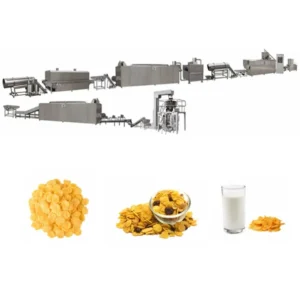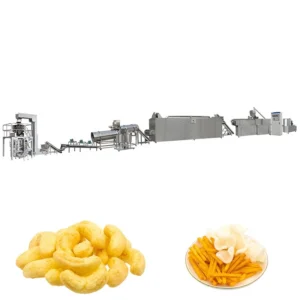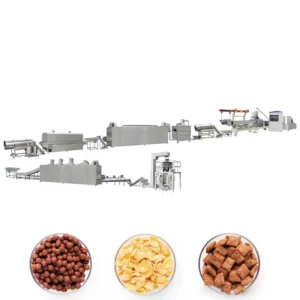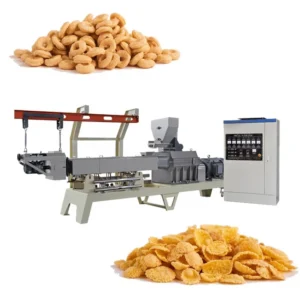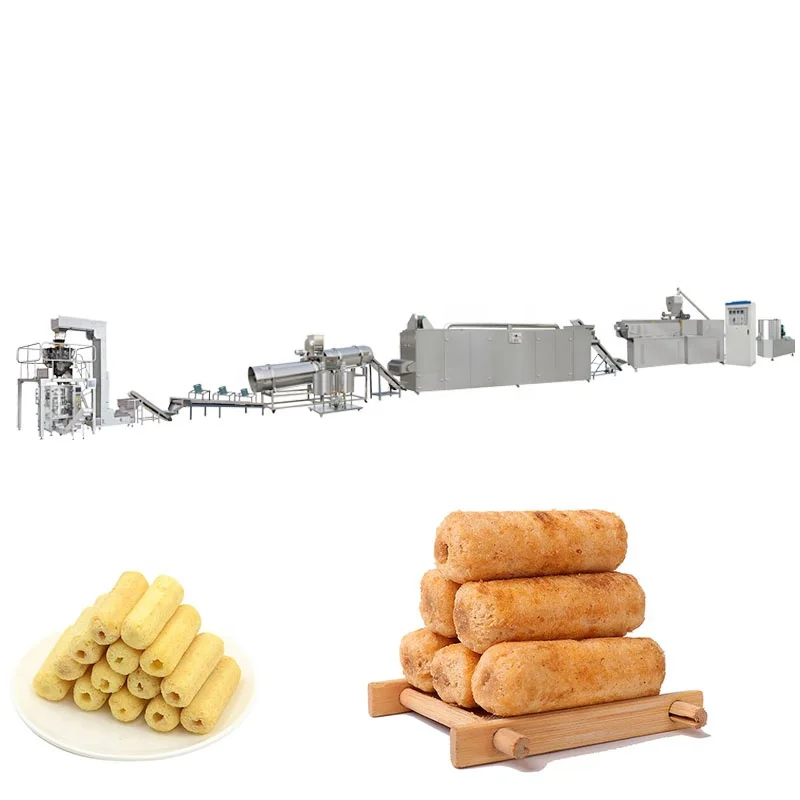


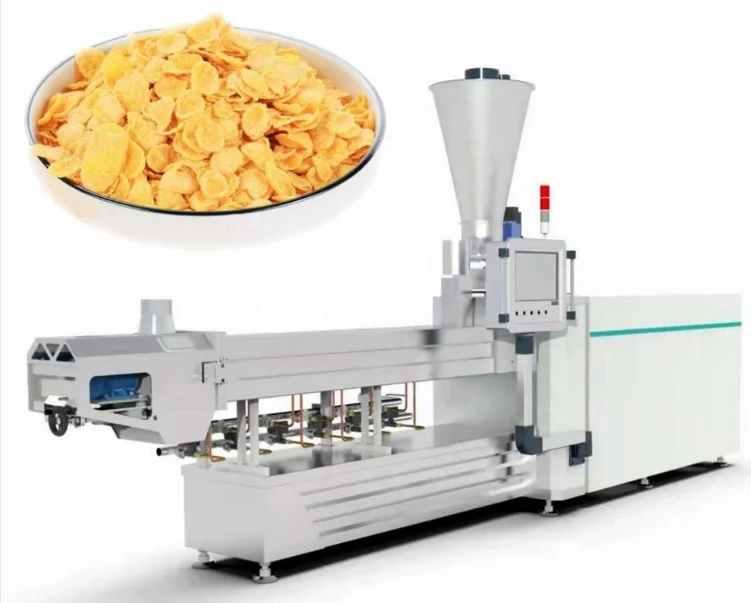
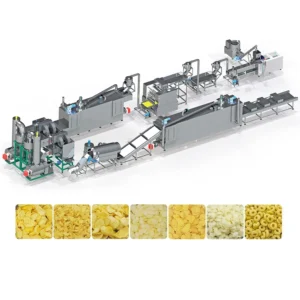
MT70 / MT85 / MT75 Corn Flakes Production Line, Twin-Screw Extruder, PLC Control — engineered as a turnkey system with throughput-matched stations from mixing through extrusion, flaking, drying, roasting, coating and packing.
- Screw and die configuration specified to your grain blend and target flake density, with hydraulic double-roller flaker and infrared temperature monitoring for consistent output
- Hot air roasting oven with dual circulating fans delivers the surface blister and crispness breakfast cereal markets expect
Supported by in-house trial runs on your raw material before shipment, line layout engineering to your factory footprint, and on-site commissioning with operator training.
Description
Throughput-Matched Extrusion Lines — Every station from mixing to packing is calculated together so extruder output, flaker rate, and dryer capacity align with your grain recipe rather than generic benchmarks.
Technical Specifications
| Parameter | Value |
|---|---|
| Product Type | Corn Flakes Production Line |
| Model Options | MT70 / MT85 / MT75 |
| Extruder Type | Twin Screw |
| MT70 Installed Power / Consumption | 160 kW / 120 kW |
| MT85 Installed Power / Consumption | 190 kW / 140 kW |
| MT75 Installed Power / Consumption | 210 kW / 150 kW |
| MT70 Output Capacity | 150–200 kg/hr (basis not stated in source — confirm raw material / moisture / recipe) |
| MT85 Output Capacity | 300–400 kg/hr (basis not stated in source — confirm raw material / moisture / recipe) |
| MT75 Output Capacity | 300–500 kg/hr (basis not stated in source — confirm raw material / moisture / recipe) |
| MT70 Overall Dimensions | 41 × 1.5 × 2.2 m |
| MT85 Overall Dimensions | 43 × 1.5 × 3.2 m |
| MT75 Overall Dimensions | 45 × 1.5 × 3.5 m |
| Screw Feature | Automatic lubricating and cooling function |
| Control System | PLC control system |
| Flaking Machinery Drive | Double motors for separate roller driving; hydraulic system for double rollers |
| Flaking Temperature Control | Infrared sensor for even temperature pipe control |
| Dryer Heating Source | Gas or Electric |
| Roasting Oven | Hot air roasting with conciliation burner, dual circulating fans, cyclone dust removal |
| Coating System | Double tumble for sugar melting, elevator, coating drum, spraying nozzle |
| Line Stations (Natural) | Mixing → Extruding → Flaking → Drying → Hot Air Roasting → Cooling → Packing |
| Line Stations (Sugar Coated) | Mixing → Extruding → Flaking → Drying → Hot Air Roasting → Sugar Spraying → Sugar Coating → Drying → Cooling → Packing |
| Raw Materials | Powder of corn, rice, wheat, oat, barley, etc. |
| Final Product Shapes | Ball, tube, stick, ring, fruit loop, star, wheel, flower, heart (by adjusting extruder mould) |
| Voltage & Frequency | Customized to local voltage (basis to be confirmed) |
| Standards | CE; ISO |
Application Suitability
| Application | Material or Output |
|---|---|
| Natural corn flakes for breakfast cereal retail | Corn powder, maize grits |
| Sugar-coated corn flakes for mass-market breakfast cereal | Corn powder with sugar coating stage |
| Multi-grain breakfast cereal flakes | Rice, wheat, oat, barley powder blends |
| Shaped cereal snacks (ring, fruit loop, star, ball) | Grain powder blends via extruder mould change |
| Grain-based puffed snack formats | Corn, rice, wheat powder with adjusted die and screw profile |
What "300 kg/hr on Paper" Leaves Out About Your corn flakes production line turnkey
Nominal capacity means nothing if the flaker cannot keep pace or the dryer runs out of thermal headroom on your actual corn blend.
I have walked into plants where the extruder was rated for a certain throughput, but the corn flour the buyer actually sourced had a different particle size and moisture content than the trial material the vendor used. The flakes came out dense, the roaster could not achieve the right surface blister, and the packing station sat idle half the shift. That is not a capacity problem — it is a line-matching problem [NEED_CITE: common causes of extrusion line underperformance in grain processing]. When stations are sourced from different vendors and bolted together, nobody owns the gap between the extruder discharge rate and the flaker intake rate. The corn flakes production line turnkey you specify must account for your real raw material, not a laboratory benchmark.
How Extrusion Parameters Define the Flake
The twin screw extruder sits at the center of every corn flakes production line turnkey because it controls gelatinisation. Screw configuration and barrel temperature profile determine how completely the starch in your corn or grain blend cooks before the dough reaches the die. Under-gelatinised dough produces flakes that crack during rolling and taste raw; over-cooked dough loses the structure needed to hold a thin, crisp flake. The automatic lubricating and cooling function on the screw assembly helps maintain consistent barrel conditions across long production runs, reducing the drift that causes batch-to-batch variation in flake texture.
Matching Dryer and Roaster Capacity to Extruder Output
A frequent failure point in cereal lines is the dryer and roasting oven falling behind the extruder. The hot air roasting oven on this line uses dual circulating fans and a cyclone dust removal device to maintain even heat distribution and remove fine particulate before it scorches. The conciliation burner allows precise temperature control so the surface blister — that characteristic raised bubble on a quality corn flake — develops without burning the edges. If the roaster is undersized relative to extruder throughput, flakes queue up on the conveyor, cool unevenly, and arrive at the coating drum at inconsistent moisture levels [NEED_CITE: thermal balance requirements in breakfast cereal drying and roasting stages].
Reading the Spec Sheet for Production Reality
The installed power figures across the MT70, MT85, and MT75 models reflect different throughput tiers, but power alone does not predict output. The screw and die configuration must match your grain blend: a high-oat recipe behaves differently under shear than pure corn grits, requiring different screw element spacing and compression ratios. The flaking machinery uses double motors for separate roller driving and a hydraulic system to set roller gap — this determines flake thickness, and infrared sensors monitor roller temperature to prevent the dough from sticking or tearing. PLC control ties these variables together so operators can store recipe profiles and recall them for repeat batches, which matters when you switch between natural and sugar-coated production on the same line.
The Hidden Cost of Undersized Supporting Stations
When the flaker or dryer is sized to a lower throughput than the extruder, the entire line slows to match the weakest station. Operators end up running the extruder at partial feed to avoid a backlog of cooked dough that cools and hardens before reaching the rollers. The hardened dough jams the flaker, damages the roller surface, and produces uneven flakes that fail quality checks. Downstream, the coating drum receives an inconsistent feed, so sugar distribution is patchy. These problems do not show up in a spec sheet comparison — they appear on the factory floor during the first week of production [NEED_CITE: downstream bottleneck effects in multi-stage food processing lines].
Why Procurement Here Reduces Integration Risk
Every station on this corn flakes production line turnkey is specified by a single supplier, so throughput calculations account for the actual discharge rate of each machine feeding the next. The in-house testing workshop runs your raw material through the extruder and flaker before the line ships, so screw configuration and die design are confirmed against your recipe, not a generic corn flour standard. Voltage, frequency, and PLC language are confirmed during the engineering phase so the control system speaks your operators’ language on day one. Documentation includes the trial run report, screw and die configuration record, and electrical schematic — not just a packing list. CE and ISO compliance is maintained across the line, which simplifies import clearance and local regulatory audit [NEED_CITE: CE machinery directive documentation requirements for food processing equipment].
Documentation & Verification
- Line layout showing throughput matched across mixing, extrusion, flaking, drying, roasting, and packing stations
- Screw and die configuration record specified to your grain blend and target flake density
- Trial run report on your raw material conducted in the testing workshop before shipment
- Electrical schematic with confirmed voltage, frequency, and PLC control language
- Operation and maintenance manual covering all line stations from batching to packing
- CE declaration of conformity and ISO certificate for the complete line
Installation, Commissioning & Support
- Floor space planning based on the selected model dimensions, up to 45 × 1.5 × 3.5 m for the MT75 configuration
- Dedicated power circuit sized to the model installed power, up to 210 kW for the MT75 line
- Equipment arrives in modular sections for staged assembly and utility connection on site
- First-run commissioning includes extruder screw adjustment, flaker roller gap calibration, and roaster temperature profiling
- Operator training covers PLC recipe storage, flaker hydraulic system operation, and dryer gas or electric source switching
- Wear parts list covering screws, dies, and flaker roller components with recommended replacement intervals
What to Include With Your Inquiry
To configure a line that matches your production target, share your raw material specification including grain type, particle size, and typical moisture content. Confirm your local voltage and frequency, the PLC language your operators need, and whether your product is natural flakes, sugar-coated, or a shaped cereal format. If you have existing upstream batching or downstream packing equipment, provide the interface details so the line integrates cleanly.
Frequently Asked Questions
Q: How is line capacity verified against my actual raw material and recipe before shipment?
A: We run your raw material through the extruder, flaker, and dryer in our testing workshop before the line ships. The trial covers screw configuration, die selection, moisture adjustment, and flake thickness to confirm the output meets your product specification. A trial run report documenting the results is included with the shipment.
Q: How do you match extruder output with dryer, flaker and roaster capacity?
A: Each station is calculated based on the extruder discharge rate for your specific recipe. The flaker roller speed, dryer belt length and temperature zones, and roaster fan capacity are all sized so no station creates a backlog. This throughput matching is documented in the line layout and capacity calculation provided before order confirmation.
Q: What voltage, frequency and control language will the PLC system be configured to?
A: Voltage and frequency are confirmed during the engineering phase to match your local supply. The PLC interface language is set to your operators’ preference before shipping. The electrical schematic included in the documentation records all confirmed settings so your maintenance team has a reference from day one.
Q: What screw configuration and die design will be specified for my grain blend?
A: Screw element arrangement and compression ratio are selected based on your grain type, particle size, and target flake density. The die design controls the pellet shape before flaking — whether a standard flake, ring, or fruit loop format. The configuration record is documented and provided with your line so replacements can be ordered accurately.
Q: What does on-site installation, commissioning and operator training include?
A: Our engineers oversee staged assembly, utility connections, and first-run commissioning at your facility. This includes extruder parameter tuning, flaker roller gap calibration, roaster temperature profiling, and PLC recipe setup. Operator training covers daily operation, recipe changeover, and routine maintenance. A commissioning schedule is agreed before shipment so your production start date is planned.
Related products
-
Stainless Steel Honey Small Corn Flake Breakfast Cereal Flakes Maker Making Machine Production Plant
¥30,000.00 Add to cart -
Complete Corn Flakes Production Line Breakfast Cereal Processing Machine Core Motor Component Cornflakes Processing Equipment
¥19,000.00 Select options This product has multiple variants. The options may be chosen on the product page -

200kg/h Breakfast Cereal Extruder Making Machine Hot Sale Corn Flake Production Line
¥30,000.00 Select options This product has multiple variants. The options may be chosen on the product page -
Automatic Commercial Breakfast Wheat Circle Corn Flake Production Line
¥65,000.00 Add to cart