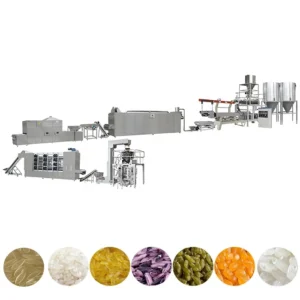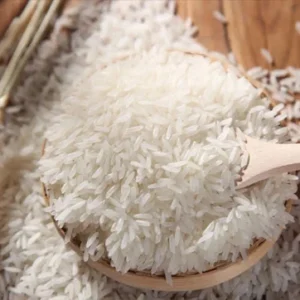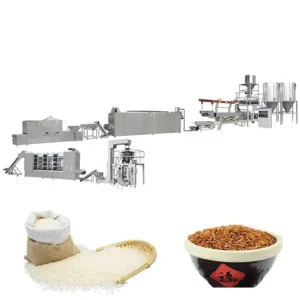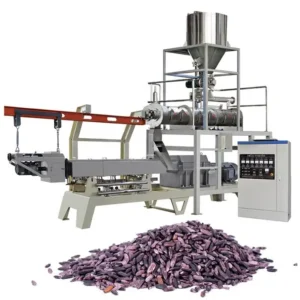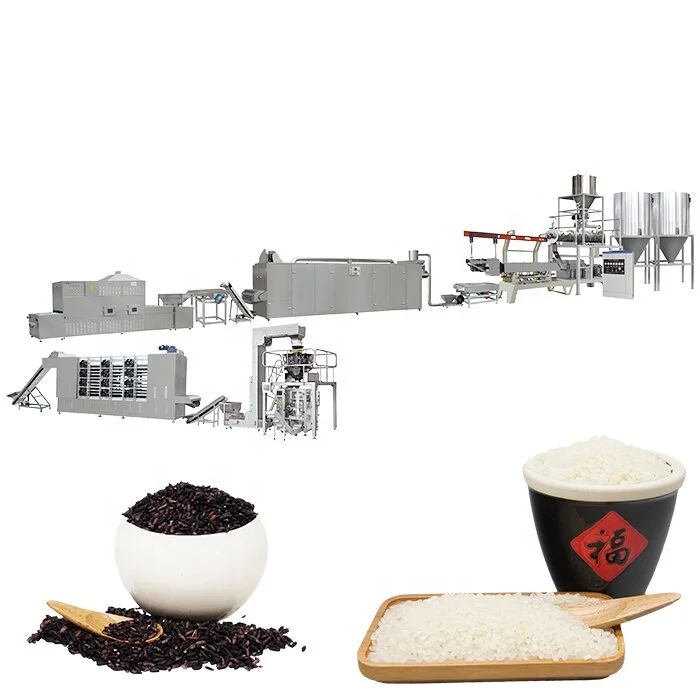


Fortified Rice Extrusion Production Line, Twin-Screw, 200 kg/h Output — complete turnkey system from powder mixing through extrusion, vibrating screen, multi-stage drying, polishing and packing, with frequency-controlled feeder and main drive at 110 kW.
Designed as a whole-line project where throughput is matched across every station — layout, utility planning and phased commissioning ensure no single unit bottlenecks your rated output on the actual rice flour blend you run.
Screw configuration and die design are specified to your raw material, with in-house trial runs completed and documented before shipment so product development starts from day one of installation.
Description
Throughput-Matched Stations — Every section from mixing to packing is sized against your actual rice flour blend, so the line holds its rated rate without one weak link dragging down output.
Technical Specifications
| Parameter | Value |
|---|---|
| Product Type | Fortified Rice Extrusion Production Line |
| Output Capacity | 200 kg/h (basis not stated in source — confirm raw material formulation, moisture content and rice grain dimensions) |
| Extruder Type | Twin-screw |
| Extruder Screw Length | 2500 mm |
| Extruder Main Drive Power | 110 kW, frequency control |
| Extruder Feeder Power | 1.5 kW, frequency control |
| Extruder Cutter Power | 2.2 kW, frequency control |
| Extruder Oil Pump Power | 0.75 kW |
| Mixer Batch Capacity | 130 kg – 150 kg per batch |
| Mixer Power | 15 kW |
| Mixer Tank Thickness | 1.5 mm stainless steel |
| Mixer Dimensions | 1450 × 1550 × 980 mm |
| Vibrating Screen Power | 0.2 kW |
| Vibrating Screen Dimensions | 1700 × 1210 × 740 mm |
| Cooling Dryer Power | 2.2 kW |
| Cooling Dryer Dimensions | 5000 × 1500 × 1900 mm |
| Dryer Heating Type | Electric (gas, diesel or steam options available on request) |
| Control System | Frequency control on extruder and feeder |
| Assembly State | Complete line (mixing, feeding, extrusion, vibrating screen, air conveying, drying, cooling, polishing, storage, packing) |
| Standards | CE, ISO |
Application Suitability
| Application | Material or Output |
|---|---|
| Fortified rice for nutrition programmes | Rice flour blended with micronutrient premix (iron, folic acid, B-vitamins) |
| Artificial rice from broken rice | Broken rice flour or mixed grain starch reformed into uniform grains |
| Grain-based nutritional rice | Corn flour, potato starch, or multi-grain blends with added fortificants |
What "200 kg/h" Actually Depends On for Fortified Rice Extrusion
Capacity is only real when tested against your exact flour blend and moisture level.
A rated number on a brochure rarely survives contact with a buyer’s actual raw material. I have watched rice extrusion lines stall at half their nameplate output the moment the operator switched from standard milled rice flour to a locally sourced blend with higher bran content or variable moisture. The starch gelatinises differently, the dough viscosity changes inside the barrel, and the die pressure drifts until grains come out sticky or misshapen. That is why a fortified rice extrusion production line turnkey must be validated on the buyer’s own formulation before the machines leave the factory [NEED_CITE: starch gelatinisation behaviour across rice varieties].
How Screw Length Shapes Grain Consistency
The 2500 mm screw length gives the material a long residence time inside the barrel. For rice flour blends, this extended path means starch granules absorb moisture and shear energy more evenly before reaching the die. Shorter screws can leave pockets of under-gelatinised dough that produce grains with a chalky core or uneven cooking behaviour. A fortified rice extrusion production line turnkey needs that full-length gelatinisation window to deliver grains that cook and taste like natural rice.
Frequency Control and the Commissioning Advantage
Three independent frequency-controlled drives — on the feeder, the 110 kW main drive, and the 2.2 kW cutter — let the commissioning engineer adjust throughput and cut length without swapping mechanical parts. When a new flour blend arrives at the hopper, the feeder rate can be dialed down while the operator watches grain density at the die face, then ramped back up once the profile stabilises. This flexibility is what makes the difference between a line that runs on day one and one that needs repeated screw reconfigurations [NEED_CITE: variable frequency drive benefits in food extrusion].
Reading the Spec Sheet Like a Process Engineer
The twin-screw design handles the wide formulation range that fortified rice demands — pure rice flour, blends with corn or potato starch, and mixes loaded with mineral premixes. Single-screw extruders struggle when fat or fibre content shifts because they rely on friction feed; the intermeshing twin screws force-feed the material regardless of slip. The 130–150 kg mixer batch capacity pairs with the extruder’s screw volume so that each batch is consumed before the next mix cycle, preventing formulation layering in the feed hopper. Electric heating in the 5000 mm cooling dryer keeps moisture reduction gradual, avoiding the surface cracking that occurs when extruded grains dry too fast. The vibrating screen between extruder and dryer catches fused or oversized grains while a fan cools the product, stopping hot grains from clumping before they enter the belt dryer.
The Bottleneck Nobody Quoted For
One of the most common failures on grain extrusion projects is an extruder that outpaces its own dryer. The grains pile up wet on the belt, stick together, and the operator has to throttle the extruder back, throwing away the capacity the buyer paid for. On a rice line this is worse because partially dried grains deform under their own weight and lose the uniform shape the market expects. That mismatch between extrusion rate and drying throughput turns a promising project into a negotiation about who pays for a larger dryer [NEED_CITE: throughput balancing in extrusion line design].
Why Buyers Source This Line Here
Every station is specified under one supplier, so the mixer output, extruder throughput, and dryer belt speed are calculated together rather than assembled from separate purchase orders. Screw configuration and die design are selected based on the buyer’s raw material test, not copied from a generic build. An in-house testing workshop runs the buyer’s actual rice flour blend before shipment, producing a trial report with grain density, moisture, and dimensional data. Pre-sales layout design, on-site installation, commissioning, and operator training are handled by the same engineering team that built the line.
Documentation & Verification
- Line layout with throughput calculation matched to your rice flour formulation
- Screw and die configuration record specific to your target grain shape
- Trial run report on your raw material with moisture and density data
- Electrical schematic confirming voltage, frequency, and phase for your facility
- CE declaration of conformity and ISO certificate for customs clearance
- Wear parts list with first-replacement screws and dies identified
Installation, Commissioning & Support
- Foundation plan accounts for the 5000 mm dryer footprint and extruder vibration load
- Electrical hook-up confirms 110 kW main drive circuit and total connected load before energisation
- Frequency drives on feeder and cutter calibrated on-site to your flour feed rate
- Commissioning includes grain density and dimension checks against your product specification
- Operator training covers screw wear indicators and die cleaning intervals
- Spare screw elements and die plates stocked against the wear parts list provided
Preparing Your Inquiry
To get a layout that fits your workshop and a capacity figure you can plan around, share your rice flour blend composition, target grain dimensions, and daily production target. Include your facility voltage and frequency so the electrical package is confirmed before production starts. If you can send a sample of your raw material, a trial run in the testing workshop will give you real grain data before the line ships.
Frequently Asked Questions
Q: How is the 200 kg/h capacity verified for my specific rice flour?
A: The capacity figure depends on raw material formulation, moisture content, and grain dimensions. A trial run on your actual flour blend is performed in the testing workshop before shipment. The resulting report records output rate, grain density, and moisture so you see verified numbers, not brochure estimates.
Q: How are screw and die matched to different flour blends?
A: Screw element arrangement and die aperture are configured after reviewing your formulation and target grain shape. High-starch blends need different compression ratios than fibre-enriched mixes. The configuration record is documented so future reorders of wear parts match the original setup.
Q: What electrical details are confirmed before production?
A: Voltage, frequency, phase, and control panel language are confirmed in writing before manufacturing starts. The electrical schematic is then drawn to match your facility supply. This prevents the common delay where a line arrives with the wrong motor rating or an unreadable HMI.
Q: How is throughput balanced between extruder and dryer?
A: Each station’s capacity is calculated from the same production target and raw material data. The dryer belt speed and length are sized so that moisture reduction completes within the extruder’s output rate, preventing wet grain backlog or forced extruder slow-down.
Q: Is a trial run on my raw material done before shipment?
A: Yes. Your flour blend is run through the extruder in the testing workshop. The trial report includes grain density, moisture content, dimensional measurements, and photographs. You review this data before the line is packed for dispatch.
Related products
-
Organic Gluten Free Baby Rice Nutrition Powder Automatic 500kg/h Production Processing Line
¥8,238.27 Add to cart -

New Automatic Nutritional Powder Making Machine for Baby Food Production Line
¥20.00 Select options This product has multiple variants. The options may be chosen on the product page -
Commercial Stainless Steel Baby Rice Powder Grinding Mixing Machine
¥8,238.27 Select options This product has multiple variants. The options may be chosen on the product page -

High Productivity New Condition Safe Healthy and Nutritious Baby Food Meal Replacement Powder Production Line
¥30.00 Select options This product has multiple variants. The options may be chosen on the product page