

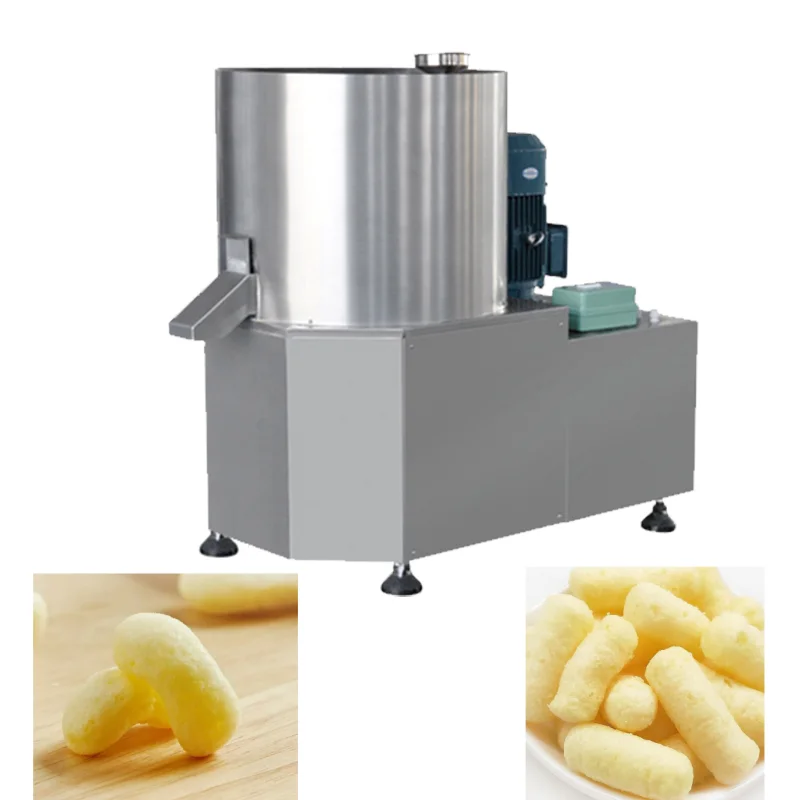
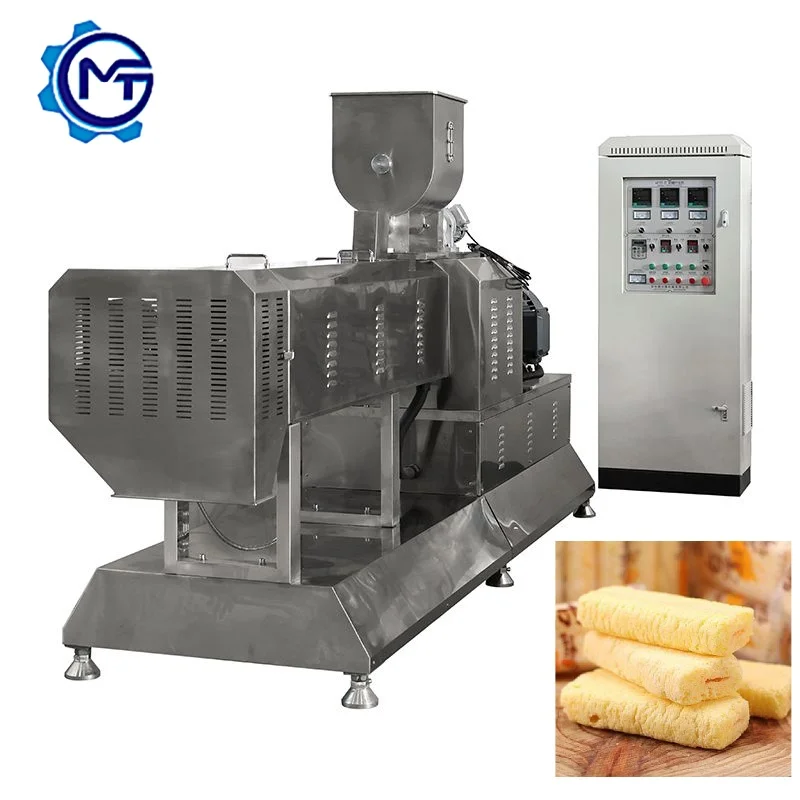

MT65 / MT70 / MT85 / MT100, Twin Screw Extruder Puffed Snack Production Line, Automatic Lubricating and Cooling — configured for puffed corn and grain snacks with interchangeable dies for cheese ball, ring, stick, tube, star and other formats.
- Screw configuration and die design are specified to your raw material and target product shape, controlling expansion, density and texture through matched barrel temperature and moisture profiles.
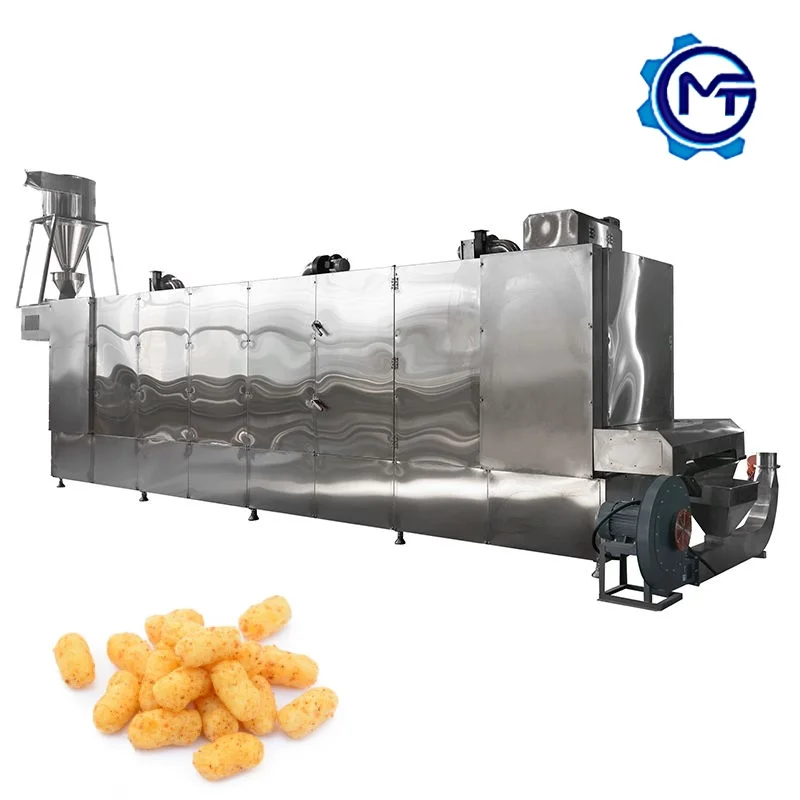
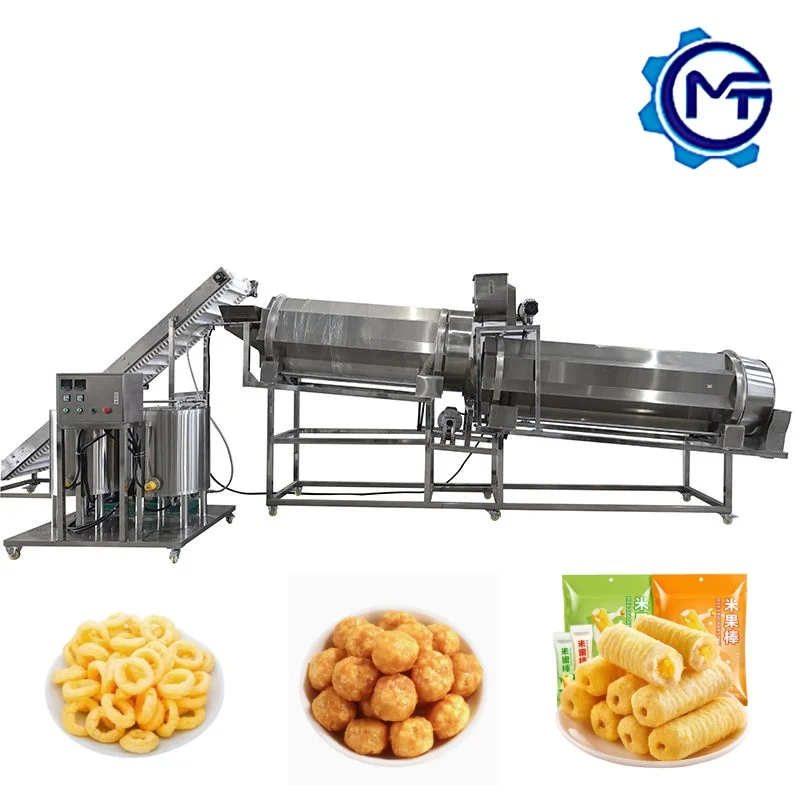
- Downstream drying, double drum flavoring with sugar spray, and packing stations are throughput-matched to the extruder to prevent bottlenecking across the complete line.
Every unit is trialled on your actual flour blend in our testing workshop before shipment, with throughput, screw record and electrical documentation confirmed to your site conditions.
Description
Throughput-Matched Engineering — Every station from batching to packing is sized against the extruder’s actual output on your grain blend, preventing the downstream bottlenecks that stall nominal-capacity lines.
Technical Specifications
| Parameter | Value |
|---|---|
| Product Type | Twin Screw Extruder Puffed Snack Production Line |
| Available Models | MT65, MT70, MT85, MT100 |
| Screw Configuration | Twin screw with automatic lubricating and cooling |
| Control System | Frequency speed controlling system (PLC and MCC availability to be confirmed) |
| MT65 Installed Power | 130 kW (Real Consumption: 95 kW) |
| MT65 Capacity | 120–150 kg/h (basis not stated in source — confirm raw material type, moisture content and die configuration) |
| MT70 Installed Power | 180 kW (Real Consumption: 120 kW) |
| MT70 Capacity | 200–300 kg/h (basis not stated in source — confirm raw material type, moisture content and die configuration) |
| MT85 Installed Power | 220 kW (Real Consumption: 130 kW) |
| MT85 Capacity | 300–500 kg/h (basis not stated in source — confirm raw material type, moisture content and die configuration) |
| MT100 Installed Power | 240 kW (Real Consumption: 160 kW) |
| MT100 Capacity | 600–800 kg/h (basis not stated in source — confirm raw material type, moisture content and die configuration) |
| Dryer Heating Source | Electric, steam, or gas (configurable to local utility conditions) |
| Flavoring System | Double drum flavoring line with sugar melting and spraying nozzle |
| Packing Station | Automatic weighing, sealing, marking, coding; vibration feeding with electronic pad weighing |
| Die Options | Interchangeable dies for cheese ball, tube, stick, ring, fruit loop, star, wheel, flower, heart shapes |
| Core Filling | Available with added core filling machine and cutting machine |
| Standards | CE, ISO |
Application Suitability
| Application | Material or Output |
|---|---|
| Puffed corn and grain snack production | Corn, rice, wheat, oat, and barley flour blends |
| Core-filled extruded snack manufacturing | Grain-based outer shell with cream, chocolate, or fruit paste centers |
| Multi-format snack line operations | Shape changeovers including rings, sticks, balls, and loops via die exchange |
| New product format launches | Snack producers introducing puffed or extruded formats to existing portfolios |
| Capacity expansion projects | Second or third extrusion lines added to existing snack facilities |
Why the Capacity Number on the Quote Is Not the Whole Story
A puffed snack extrusion production line turnkey proposal means little until the throughput is verified on your specific flour blend.
I spent years on the buyer side before moving into equipment supply across the Shandong manufacturing belt. The most frustrating project I ever inherited was a puffed corn stick line that was rated for a certain hourly output on paper but could never reach it once the buyer’s actual corn grits entered the barrel. The moisture content differed slightly, the particle size distribution was off, and the screw configuration had been copied from a generic build [NEED_CITE: common causes of extruder throughput shortfall on unverified raw materials]. The line ran, but it ran slow, and every downstream station sat idle waiting for product that never arrived at the promised rate.
That is why our process starts with a trial run in the testing workshop using your raw material before any puffed snack extrusion production line turnkey system ships. We confirm what the barrel actually produces with your flour, at your moisture level, through your chosen die — and then we size the dryer, flavoring drum, and packing station to that real number, not the catalogue number.
How Screw Geometry Defines Your Snack Texture
The twin screw configuration on every model in this series gives operators direct control over shear intensity and residence time inside the barrel. By adjusting screw element sequencing — forward-conveying, kneading, and reverse-conveying segments — the extrusion engineer sets the degree of starch gelatinisation that determines whether a corn puff exits the die with a light, airy crunch or a denser, harder bite. The automatic lubricating and cooling circuit keeps barrel temperatures stable across long production runs, so the texture you dial in during the first hour is the texture you get in the tenth.
Matching Die Design to Market Expectations
Each die plate is selected against the target snack shape and the expansion ratio your market expects. A ring-shaped snack for the European market may require a different wall thickness and a lower expansion ratio than a cheese ball destined for Southeast Asian retail shelves [NEED_CITE: regional texture and density preferences in extruded snack markets]. The interchangeable die system on this line lets producers switch between formats — cheese ball, tube, stick, ring, fruit loop, star, wheel, flower, heart — without changing the extruder barrel or screw set. For core-filled variants, a dedicated filling machine and cutting unit integrate into the line downstream of the die face, injecting cream or paste into the extrudate before the cutter separates individual pieces.
Reading the Power Figures Beyond the Nameplate
Installed power and real consumption tell two different stories. The MT85, for example, carries a 220 kW installed motor but draws approximately 130 kW during steady-state extrusion. That gap represents the starting torque reserve needed when cold, viscous dough first enters the barrel — a design margin that prevents motor stall during startup and feed interruptions. For factory planners calculating transformer capacity and monthly energy budgets, the real consumption figure is the number that belongs in the utility plan, not the nameplate rating. The frequency speed controlling system allows operators to match screw RPM to the specific grain blend, adjusting throughput and shear without mechanical gear changes.
The Bottleneck That Hides Downstream
An extruder that produces steadily means nothing if the dryer cannot remove moisture fast enough, or the flavoring drum cannot coat every piece before product builds up on the conveyor. I have walked into facilities where the extruder was running at partial capacity because a single-belt dryer could not keep up, and the operator was manually shoveling puffed product off the line to prevent it from going stale on the belt [NEED_CITE: production losses from mismatched downstream capacity in snack lines]. The double drum flavoring line with sugar melting and spray nozzle is sized to handle the extruder’s verified output, and the dryer — configurable to electric, steam, or gas heating — is matched to the moisture removal rate your product requires.
What Makes This Line a Single-Source Build
Every station is sourced from one supplier, which means throughput calculations are done across the entire line rather than at each machine in isolation. The screw and die configuration is specified to your raw material and target product shape, not pulled from a generic library. Before shipment, a trial run on your actual flour blend takes place in the in-house testing workshop, producing a report that confirms real capacity and product quality. Electrical schematics are drawn with your site voltage and frequency confirmed in advance, and control language is verified so your operators face a familiar interface on day one. The puffed snack extrusion production line turnkey approach here means one engineering team owns the layout, the commissioning schedule, and the operator training.
Documentation & Verification
- Line layout drawing with throughput matched across batching, extrusion, drying, flavoring, and packing stations
- Screw and die configuration record specifying element sequence and die geometry to your target snack shape
- Trial run report on your raw material confirming real output and product texture before shipment
- Electrical schematic with site-specific voltage, frequency, and control language confirmed before dispatch
- CE declaration of conformity and ISO certificate included with shipping documentation
- Operation and maintenance manual with wear parts list covering screws, dies, and barrel liners
Installation, Commissioning & Support
- Foundation and utility plan provided, covering the 130–240 kW installed power range across available models
- On-site assembly and barrel alignment completed by factory engineers with twin screw extrusion experience
- First-run parameter setting including screw RPM, barrel temperature profile, and die pressure for your grain blend
- Operator training on die changeover, sugar melting system operation, and automatic lubrication monitoring
- Wear parts inventory list with lead times for screws, die plates, and barrel segments
- Scheduled maintenance intervals documented for dryer heating elements and flavoring drum drive components
What We Need to Configure Your Line
To prepare an accurate layout and capacity calculation, share your primary grain material and its typical moisture content, the snack shape or shapes you intend to produce, and your target hourly output in kilograms. We also need your site voltage and frequency, preferred control language, and whether your facility has access to steam or gas for the dryer. If you are adding this line alongside existing equipment, let us know the upstream and downstream interfaces so the puffed snack extrusion production line turnkey layout integrates cleanly.
Frequently Asked Questions
Q: How is line capacity verified on my specific raw material and what are the test conditions?
A: Before shipment, we run your actual flour blend through the extruder in our in-house testing workshop. The trial records output weight per hour, product density, expansion ratio, and texture under controlled moisture and temperature conditions. You receive a full trial run report, and downstream stations are then confirmed or adjusted against those verified numbers rather than catalogue estimates.
Q: How do I confirm voltage, frequency, and control language before the machine ships?
A: During the specification confirmation stage, we review your site electrical supply details and operator language requirements. An electrical schematic is then produced showing the exact motor ratings, control panel labeling, and HMI language. This document is approved by your engineering team before the line enters final assembly, preventing commissioning delays caused by mismatched power supply or unreadable interface text.
Q: What screw and die configuration will be matched to my target snack shape and density?
A: The screw element sequence — conveying, kneading, and shear sections — is designed around your grain blend’s starch behaviour and the gelatinisation level your product requires. The die plate is selected for your target shape and wall thickness. Both are documented in the configuration record so you have a repeatable baseline for every production run and a reference point when ordering replacement wear parts.
Q: How are downstream stations sized to avoid bottlenecking the extruder?
A: The dryer belt length, airflow volume, and heating capacity are calculated against the moisture removal rate your product demands at the extruder’s verified output. The double drum flavoring line is matched to the same throughput, and the packing station’s weighing speed is set to clear product faster than it arrives. No station is specified from a standalone catalogue figure.
Q: What does on-site installation, commissioning, and operator training include?
A: Our engineers handle mechanical assembly, barrel and screw alignment, utility connections, and first-run parameter tuning on your raw material. Operator training covers die changeover procedures, frequency drive adjustment, automatic lubrication checks, and sugar melting system operation. A wear parts list with reorder references and maintenance intervals is handed over at the end of the commissioning period.
Related products
-

Crunchy Puffed Snack Breakfast Cereal Corn Flakes Making Machine
¥1,000.00 Select options This product has multiple variants. The options may be chosen on the product page -

Stainless Steel Corn Puff Cake Making Machine Corn Snack Food Machines Top Selling Snacks Machine
¥8,560.00 Select options This product has multiple variants. The options may be chosen on the product page -

New Puffed Snack Food Machine Production Line Corn Flake Puff Corn Making Machine Twin Screw Extruder 100-500kg/h Capacity Food
¥8,500.00 Select options This product has multiple variants. The options may be chosen on the product page -

Automatic High Productivity Puffed Corn Snacks Extruder Production Equipment New Condition Puff Snack Food Making Machine
¥11,050.00 Select options This product has multiple variants. The options may be chosen on the product page


