

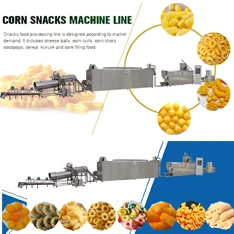
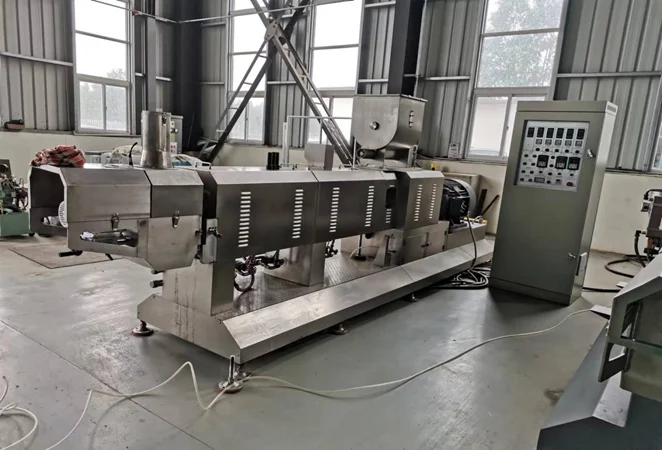
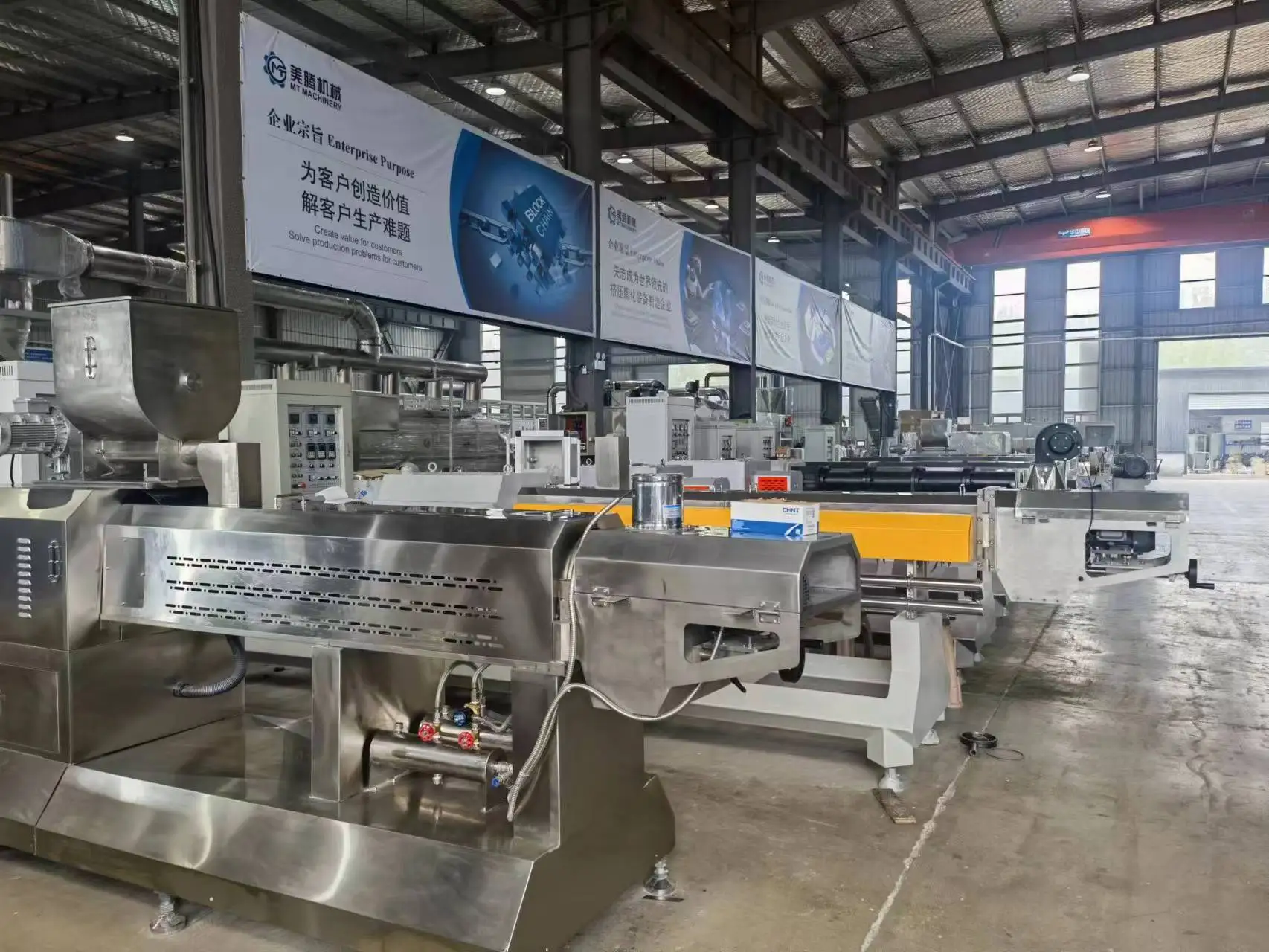
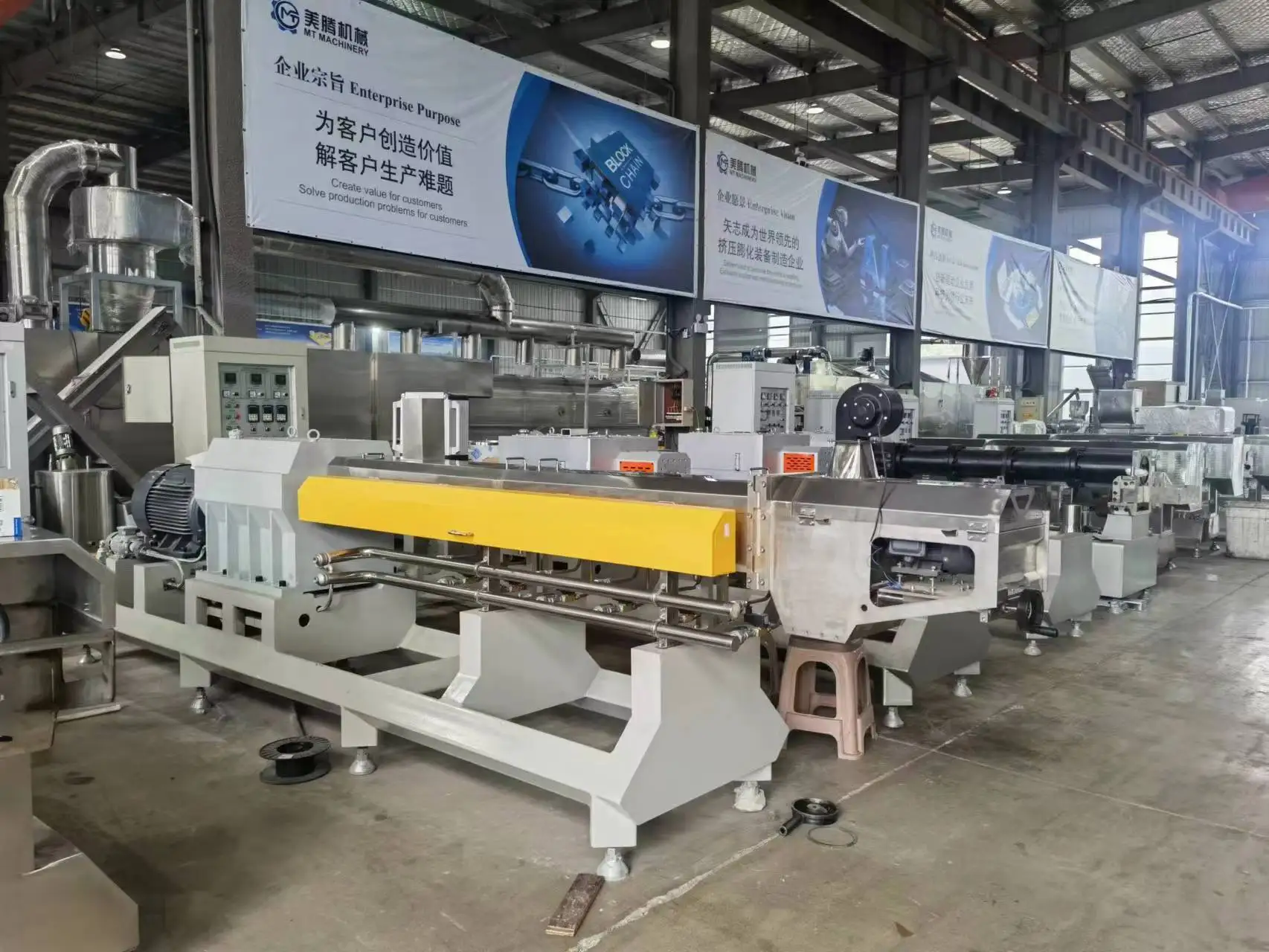
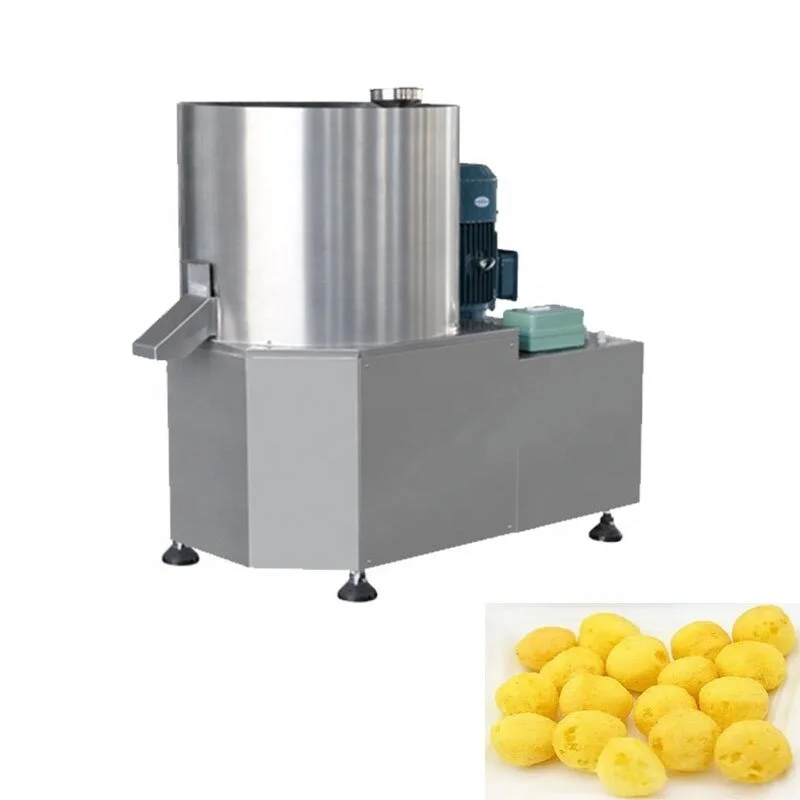
Twin Screw Puffed Snack Extrusion Line, automatic turnkey layout — configured with mixing, extruding, shaping, cutting, drying, and flavoring stations under one supplier.
- Screw configuration and die design specified to your raw material blend and target product density, ensuring expansion and texture match market expectations.
- Dryer length and layer count adjusted to actual extruder output, preventing throughput bottlenecks across the line.
Trial runs on your flour recipe in our testing workshop confirm real capacity and product quality before shipment.
Description
Integrated Throughput Matching — every station from batching to packing is calculated against your raw material so the line sustains its rated output without post-extrusion bottlenecks.
Technical Specifications
| Parameter | Value |
|---|---|
| Product Type | Twin Screw Puffed Snack Extrusion Line |
| Screw Type | Twin-screw (double screw) |
| Line Stations | Mixing, extruding, shaping, cutting, drying, flavoring |
| Control System | Automatic; available with PLC or MCC options |
| Flavoring System | Semi-automatic or automatic; sugar, oil, and powder seasoning |
| Dryer Configuration | Length and layer configurable to product moisture curve |
| Product Shape & Size | Selectable via die configuration |
| Certification | CE, ISO (electronic edition available) |
| Warranty | 24 months, lifetime service |
| Installation | Overseas dispatch of 1–2 engineers; operator training included |
Application Suitability
| Application | Material or Output |
|---|---|
| Puffed corn snacks | Corn grits, corn flour, maize-based blends |
| Puffed rice snacks | Rice flour, rice grits, broken rice |
| Core-filled snacks | Cereal-based outer shell with cream or jam filling |
| Artificial rice | Rice flour, starch blends, fortified grain mixes |
| Fried snacks | Pellet or sheeted dough from cereal raw materials |
| Breakfast cereal formats | Corn flakes, extruded rings, fortified shapes |
Why Rated Capacity Rarely Survives Your Actual Recipe
A line quoted on nominal output only proves what the extruder can push — not what the dryer and flavoring drum can absorb.
When I first started commissioning snack lines in Shandong, the most common failure mode was not the extruder itself. It was the stations downstream. A puffed snack extrusion line might be rated at an attractive hourly tonnage based on standard corn grits, but the buyer’s flour blend absorbs moisture differently, expands less predictably, and exits the die at a density the dryer was never sized to handle. The result is product stacking up on conveyors, inconsistent moisture in the finished bag, and weeks of on-site troubleshooting that could have been avoided. [NEED_CITE: impact of raw material moisture variation on extrusion throughput]
The puffed snack extrusion production line turnkey approach means every station is specified together, so throughput is matched at the design stage rather than corrected after installation.
Station Matching as a Layout Discipline
A puffed snack extrusion line is only as reliable as its slowest station. When the extruder runs at full capacity but the dryer has insufficient residence time, the moisture content in the final product drifts outside the specification the market expects. We calculate each station’s capacity against the specific flour blend, target moisture, and product density before the layout is finalized. This is what separates a line that runs at nameplate output from one that requires constant operator intervention to keep pace.
Raw Material Behavior Drives the Configuration
Different cereal blends gelatinize at different temperatures and shear levels inside the barrel. Rice flour, for instance, requires a different screw configuration and barrel temperature profile than a corn-based mix, even when the target product shape is identical. The puffed snack extrusion production line turnkey configuration accounts for this by specifying screw elements and die geometry to the buyer’s actual recipe, not a generic template. Trial runs in the testing workshop confirm expansion ratio and texture before the line ships. [NEED_CITE: starch gelatinisation temperature ranges for rice versus corn flour]
Reading the Screw and Die Configuration
The twin-screw design gives operators a wider processing window for cereal-based snacks compared to single-screw machines, particularly when recipes include high-fat or high-moisture ingredients. Screw element arrangement — forward-flight, reverse-flight, and kneading block segments — determines residence time and shear intensity inside the barrel. Die aperture and land length control the expansion rate and final product density. Getting these wrong means puffed snacks that collapse after cutting or core-filled products with uneven wall thickness. The control system, available with PLC or MCC options, maintains consistent barrel temperature and screw speed across production runs so that batch-to-batch variation stays within tolerance.
The Cost of Skipping the Trial Run
I worked on a line where the buyer chose to skip pre-shipment testing to save time. Once the equipment was installed overseas, the product came out of the die with the wrong density — too heavy for the market, too dense for the flavoring drum to coat evenly. The buyer spent additional weeks adjusting screw speed, barrel temperature, and die configuration on-site, with engineers making changes that should have been resolved in the workshop before packing. [NEED_CITE: pre-shipment trial run practices in food extrusion equipment supply]
Why This Sourcing Decision Matters for Your Line
Every station from mixing through extrusion to packing comes from one supplier, so throughput is calculated across the entire line rather than assembled from vendors who quote independently. Screw configuration and die design are specified to the buyer’s raw material, not copied from a generic build. The in-house testing workshop runs your actual flour blend before shipment, producing a documented trial run report that confirms real-world output. Electrical schematics confirm voltage, frequency, and control language before production begins, preventing delays during overseas commissioning. Pre-sales layout planning through installation, operator training, and ongoing wear parts supply keeps the line running after the engineers leave.
Documentation & Verification
- Line layout and capacity calculation matching all stations to your target output
- Trial run report on your flour blend confirming texture, density, and throughput
- Screw and die configuration record tied to your product specification
- Electrical schematic with voltage and frequency confirmed before production
- CE declaration of conformity and ISO certificate in electronic edition
- Operation and maintenance manual with wear parts list and packing photographs
Installation, Commissioning & Support
- Layout drawing specifies utility drop points for the twin-screw extruder motor and dryer heating circuits
- Voltage and frequency confirmed per your site supply before electrical panel fabrication
- Line arrives as matched stations with documented assembly sequence for your floor layout
- 1–2 engineers dispatched for first-run commissioning and parameter setting on your recipe
- Operator training covers screw speed, barrel temperature, and die changeover procedures
- Wear parts list identifies screws, dies, and dryer belts with replacement intervals
What to Include in Your Inquiry
To specify the puffed snack extrusion line accurately, provide your raw material type and typical flour blend ratios, target product shape and density, daily or hourly production volume, workshop dimensions including ceiling height, and local voltage and frequency. If you have existing upstream or downstream equipment that must interface with the new line, include those specifications. Let us know if you want a trial run on your raw material before shipment.
Frequently Asked Questions
Q: How is line capacity verified against my specific raw material and recipe before shipment?
A: Your flour blend is run through the extruder and full line in our testing workshop before dispatch. The trial run report documents actual throughput, product density, expansion ratio, and moisture content at each station. Any screw, die, or dryer adjustments needed to meet your specification are made during this stage, not after the line arrives at your facility.
Q: How do you ensure dryer and flavoring station throughput matches the extruder output?
A: Each station is calculated during the layout phase against your target production rate and product moisture curve. The dryer length and layer count are configured to provide sufficient residence time for your recipe, and the flavoring drum capacity is matched so the line runs continuously without product accumulation between stations.
Q: What voltage, frequency, and control language options are confirmed before production?
A: Your site power supply details are collected during the quotation stage. The electrical schematic is prepared with the correct voltage, frequency, and control panel language before fabrication begins. This prevents the common situation where a line arrives overseas and cannot be powered on until panels are rewired or software is reconfigured.
Q: What does the on-site installation and commissioning process involve?
A: One or two engineers are dispatched to your facility to oversee unpacking, station alignment, utility connections, and first-run production on your recipe. Operator training covers daily start-up, parameter adjustment, die changeover, and routine maintenance. A typical commissioning schedule runs from mechanical assembly through trial production and handover.
Q: How are screw and die configurations selected for my target product?
A: The screw element arrangement and die geometry are chosen based on your raw material properties, target expansion ratio, and final product density. The configuration record documents every element position and die dimension so replacements can be ordered with exact specifications when wear parts are due.
Related products
-

New Condition Automatic Corn Puff Snacks Food Extruder Cheese Ball Making Machine Plant
¥100.00 Select options This product has multiple variants. The options may be chosen on the product page -

Puff Corn Extruder Machine Puffed Core Filled Snack Food Production Line Machine
¥8,500.00 Select options This product has multiple variants. The options may be chosen on the product page -

Automatic Corn Crisps Extruder Production Machine for Maize Chips and Corn Sticks New Condition
¥8,000.00 Select options This product has multiple variants. The options may be chosen on the product page -

Corn Puff Processing Line with Mixer Fryer Baking Oven Automatic High Productivity Grain Products Snack Making Machine
¥8,300.00 Select options This product has multiple variants. The options may be chosen on the product page


