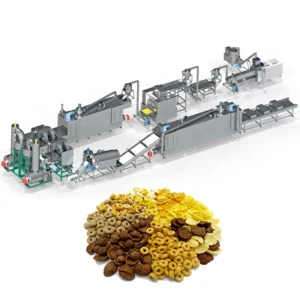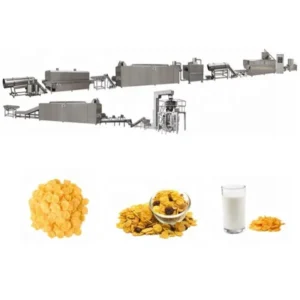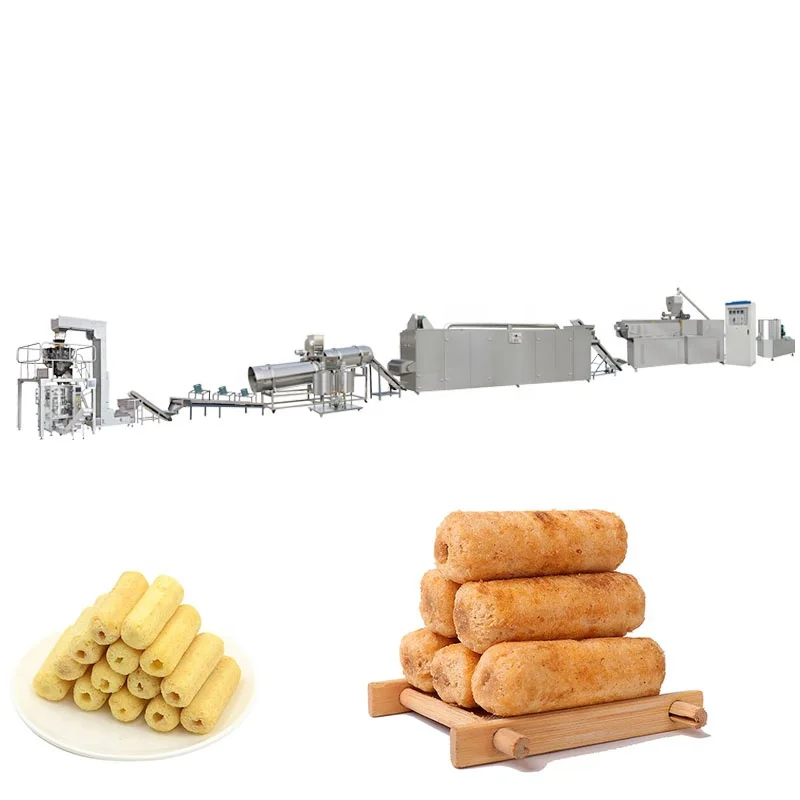


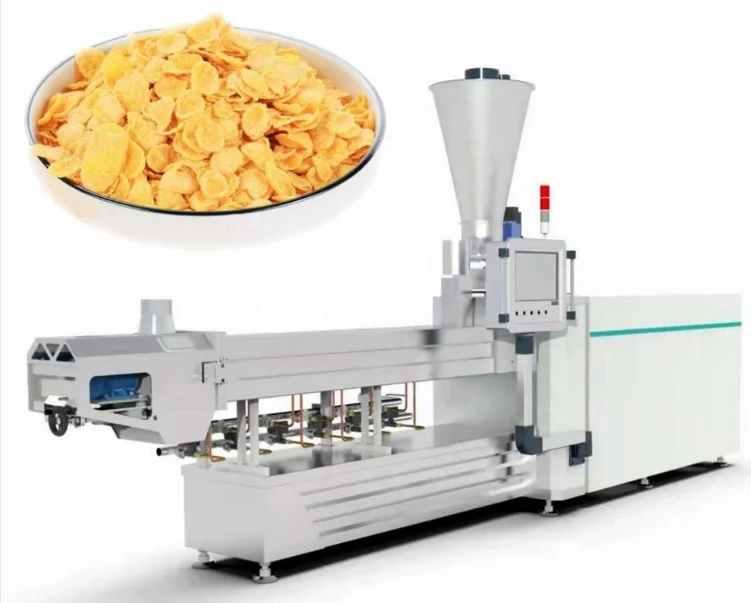
MT75 Corn Flakes Production Line, Twin Screw, PLC Control — configured for natural and sugar-coated breakfast cereal output from corn, rice, wheat, oat, or barley blends. Screw configuration and die design are matched to your raw material and target flake density, with throughput balanced across mixing, extrusion, flaking, roasting, and coating stations. Trial runs on your actual formulation are completed in our testing workshop before shipment, with full layout and capacity documentation provided.
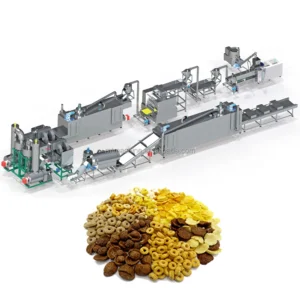
MT75 Corn Flakes Production Line, Twin Screw, PLC Control — configured for natural and sugar-coated breakfast cereal output from corn, rice, wheat, oat, or barley blends. Screw configuration and die design are matched to your raw material and target flake density, with throughput balanced across mixing, extrusion, flaking, roasting, and coating stations. Trial runs on your actual formulation are completed in our testing workshop before shipment, with full layout and capacity documentation provided.
Description
Throughput-Matched Line Engineering — every station from mixing to packing is calculated against the same material basis, preventing the common bottleneck where one machine waits on another.
Technical Specifications
| Parameter | Value |
|---|---|
| Product Type | Corn Flakes Production Line |
| Extruder Unit | MT-75 Twin Screw Extruder |
| Screw Type | Twin Screw |
| Installed Power | 210 kW |
| Power Consumption | 150 kW |
| Output Capacity | 300–500 kg/hr (basis not stated in source — confirm raw material, moisture content, flake thickness) |
| Extruder Capacity | 200–300 kg/hr (basis to be confirmed) |
| Overall Dimensions | 45 × 1.5 × 3.5 m |
| Control System | PLC control with MCC integration |
| Flaking Machinery | Hydraulic double-roller system; dual motors for independent roller drive; infrared temperature sensor control |
| Dryer Heating Source | Gas or electric (configurable) |
| Hot Air Roasting Oven | Vibrating pan, high-temperature spraying tubes, conciliation burner, dual circulating fans, cyclone dust removal |
| Coating System | Double tumble sugar melting, elevator, coating drum, spraying nozzle |
| Production Flow (Natural) | Mixing → Extruding → Flaking → Drying → Hot Air Roasting → Cooling → Packing |
| Production Flow (Sugar Coated) | Mixing → Extruding → Flaking → Drying → Hot Air Roasting → Sugar Spraying → Sugar Coating → Drying → Cooling → Packing |
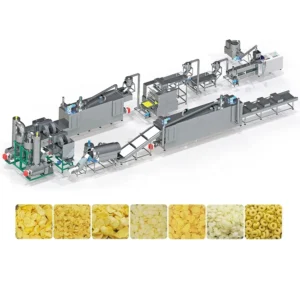
| Final Product Shapes | Ball, tube, stick, ring, fruit loop, star, wheel, flower, heart (via extruder die adjustment) |
| Raw Materials | Corn, rice, wheat, oat, barley powder |
| Certifications | CE, ISO |
Application Suitability
| Application | Material or Output |
|---|---|
| Natural corn flakes for retail breakfast cereal | Corn grits or corn flour base |
| Sugar-coated flakes for food service and retail | Corn, rice, or multi-grain blends with sugar glaze |
| Multi-grain breakfast flakes | Wheat, oat, barley, rice powder combinations |
| Shaped puffed cereal snacks | Corn or rice base with die-specific forming (rings, stars, loops) |
| Fortified breakfast cereal lines | Grain base with added vitamin and mineral premix |
Why "300–500 kg/hr" Means Nothing Without Your Material on the Table
A corn flakes production line turnkey rated at a given throughput on one formulation can lose half its output on another.
I learned this the hard way at a plant in Peru. The client ordered a full extrusion line based on a quoted capacity figure. Their local corn flour carried a different moisture profile than our standard test material. Within the first week, the screw configuration had to be completely reworked, and actual output sat well below what everyone expected. The extruder was not at fault — the material data simply never matched. Since then, I insist on running trial production on the buyer’s actual raw material in our testing workshop before any corn flakes production line turnkey ships. That trial run reveals moisture behavior, gelatinisation response, and flake density characteristics that a spec sheet alone cannot predict [NEED_CITE: starch gelatinisation behavior across corn varieties and moisture levels].
How Throughput Matching Prevents Station-Level Bottlenecks
A corn flakes production line turnkey involves at least eight distinct processing stations. The extruder may handle a given volume per hour, but if the dryer or roasting oven cannot keep pace, the entire line slows to match the weakest link. We calculate every station’s capacity against the same material basis and target flake specification, so the flaking rollers, drying belt, roasting oven, and coating drum all align with the extruder’s real-world output rather than a nominal figure.
The Role of Screw Configuration in Flake Density and Texture
Twin-screw extrusion for corn flakes requires a specific screw profile and barrel temperature sequence to achieve partial gelatinisation without full expansion. The material must exit the die as a dense, half-cooked pellet that the flaking rollers can then press into thin, uniform sheets. If the screw elements generate too much shear, the starch over-gelatinises and the flakes puff instead of flattening [NEED_CITE: twin-screw extrusion screw element selection for partial gelatinisation]. Our testing workshop trials identify the correct screw configuration and die geometry for each buyer’s formulation before the line enters production.
Reading the Spec Sheet Against Your Production Reality
The MT-75 twin screw extruder carries an installed power of 210 kW with operating consumption around 150 kW. Those figures matter when sizing your electrical supply and dedicated circuit breakers — undersized supply lines cause voltage drops that disrupt PLC logic and heating elements mid-run. The flaking machinery uses a hydraulic double-roller system with independent dual motors, which allows each roller to maintain consistent pressure and speed regardless of pellet feed variation. Infrared temperature sensors on the temperature pipes keep the flaking surface within a narrow band, directly influencing final flake thickness and surface integrity. The hot air roasting oven relies on dual circulating fans and a cyclone dust removal device to deliver even surface blistering — the characteristic raised bubbles on a corn flake that signal proper toasting and crispness. Line dimensions of 45 × 1.5 × 3.5 m represent a typical straight-line footprint; actual layout adapts to your factory floor, including L-shaped or U-shaped configurations where ceiling height or column spacing requires it.
What Happens When Configuration Choices Are Skipped
When a corn flakes line ships with a generic screw build rather than one matched to the buyer’s specific corn variety and moisture content, the consequences show up within days. Flakes emerge too thick, too brittle, or with inconsistent blistering after roasting. The coating drum then struggles to apply sugar glaze evenly across irregular surfaces, and packing weight variance increases because flake density drifts outside the target range. These are not defects in the machinery — they are mismatches between the machine’s configuration and the material it was never tuned for [NEED_CITE: impact of raw material moisture variance on extruded cereal quality]. Correcting the problem on-site costs far more in downtime and wasted material than a pre-shipment trial run ever would.
Why Buyers Source This Line from One Supplier
Every station on this corn flakes line — mixing, extruding, flaking, drying, roasting, coating, cooling, packing — comes from a single equipment source, which means throughput calculations, utility connections, and control logic share a common reference point. The PLC control system communicates across the MCC panel to coordinate start-up sequences and emergency stops line-wide. The in-house testing workshop runs your actual corn, rice, or multi-grain blend through the extruder and flaking rollers before shipment, generating a trial report that documents real output and product quality. Screw and die configurations are recorded specifically for your formulation, not pulled from a generic build library. On-site installation includes phased commissioning so each station is validated independently before the full line runs continuously.
Documentation & Verification
- Line layout and station-by-station capacity calculation based on your target flake specification
- Trial run report documenting extruder output and flake quality on your actual raw material
- Screw and die configuration record specific to your corn or multi-grain formulation
- Electrical schematic with confirmed voltage, frequency, and PLC control language for your site
- CE declaration of conformity and ISO certificate for customs and regulatory filing
- Operation and maintenance manual with wear parts list for screws, dies, and roller surfaces
Installation, Commissioning & Support
- Foundation and floor leveling plan matched to the 45 m line footprint and 3.5 m height clearance
- Dedicated electrical circuit sized for 210 kW installed load with confirmed local voltage and frequency
- Extruder barrel and screw assembly verified against trial-run configuration record before first production run
- PLC and MCC panel commissioning with operator language set to your team’s requirement
- Flaking roller pressure and infrared sensor calibration on your actual pellet material during start-up
- Wear parts inventory covering screws, dies, and roller surfaces for the first replacement cycle
Preparing Your Inquiry
To size a corn flakes production line turnkey for your facility, we need your primary grain material and its typical moisture content, your target daily output in finished product weight, and your available factory floor dimensions including ceiling height. Confirming local voltage and frequency at the inquiry stage prevents electrical rework later. If you have existing upstream mixing or downstream packing equipment, share those specifications so the new line integrates without redundant stations.
Frequently Asked Questions
Q: How is line capacity verified on my specific raw material before shipment?
A: We run your actual corn flour, grits, or multi-grain blend through the extruder and flaking station in our in-house testing workshop. The trial produces real flakes that are measured for thickness, density, and roasting response. A full report documents the output rate and product quality achieved on your material, so the capacity figure you receive is verified rather than estimated from a standard formulation.
Q: How do you ensure throughput is matched between extruder, flaking, drying, and coating stations?
A: Each station is sized against the same material basis and target flake specification during the layout phase. The extruder’s real-world output on your formulation determines the required dryer belt length, roasting oven volume, and coating drum capacity. We provide a station-by-station capacity calculation document so you can see exactly where each figure comes from.
Q: What is included in the turnkey scope for layout and installation?
A: The scope covers factory layout design adapted to your floor dimensions, utility connection planning for electrical and gas or steam supply, phased installation with each station validated independently, full-line commissioning with your material, and operator training on the PLC control system. We also confirm voltage, frequency, and control language before production begins.
Q: How are screw configuration and die design selected for my target flake density?
A: Screw element arrangement and die geometry are chosen based on your raw material’s starch content, moisture level, and the flake thickness you need. The goal is partial gelatinisation — enough cooking for the pellet to hold together through flaking without expanding into a puffed shape. Trial runs in our workshop confirm the configuration before the extruder ships.
Q: What documentation comes with the line for regulatory and operational use?
A: You receive a CE declaration of conformity, ISO certificate, factory test record, trial run report on your material, electrical schematic with confirmed voltage details, screw and die configuration record, operation manual, and a wear parts list. These documents support customs clearance, local safety inspections, and your own quality management system.
Related products
-
Corn Flake Making Machine Corn Puffs Making Machine Snack Food Production Line
Price range: ¥500.00 through ¥1,200.00 Select options This product has multiple variants. The options may be chosen on the product page -
New Automatic Cornflakes Making Machine Oats Snack Food Chips Extruder Processing Line
¥30.00 Select options This product has multiple variants. The options may be chosen on the product page -
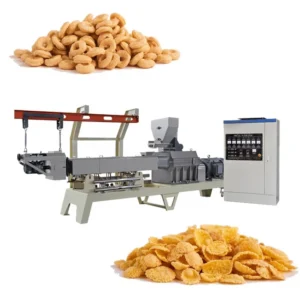
Corn Flakes Machine Breakfast Cereal Corn Flakes Production Line Cornflakes Making Machine
¥85,800.00 Select options This product has multiple variants. The options may be chosen on the product page -
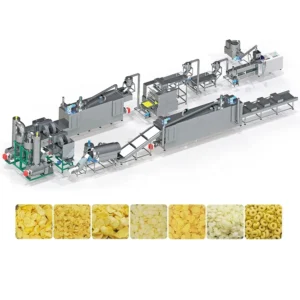
Whole Grain Choco Hoop Crunchy Wheat Cereal Ring Fruit Loops Snacks Extruder Machine /breakfast Cereals Corn Flakes Production
¥48,000.00 Select options This product has multiple variants. The options may be chosen on the product page