

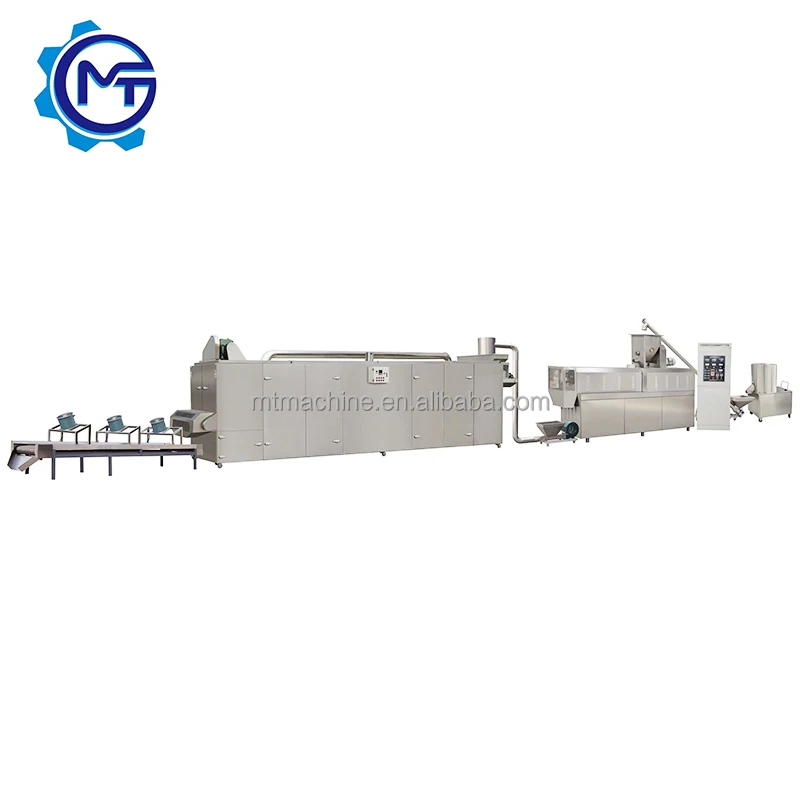
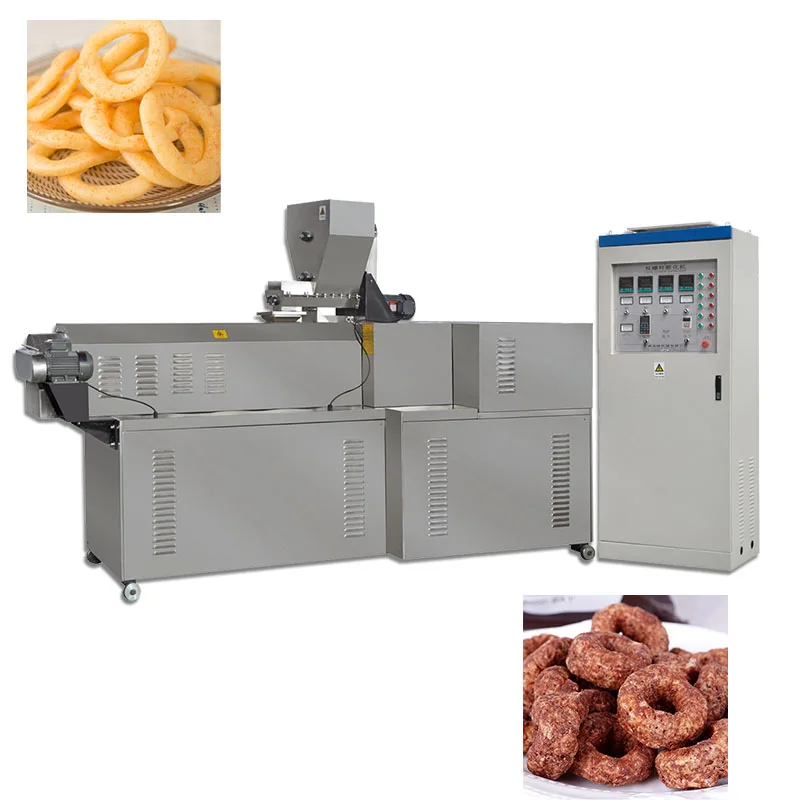
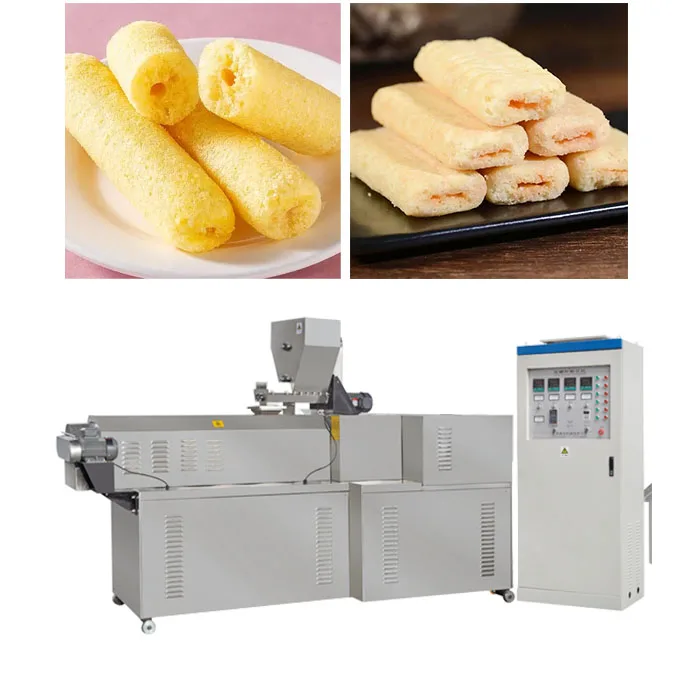
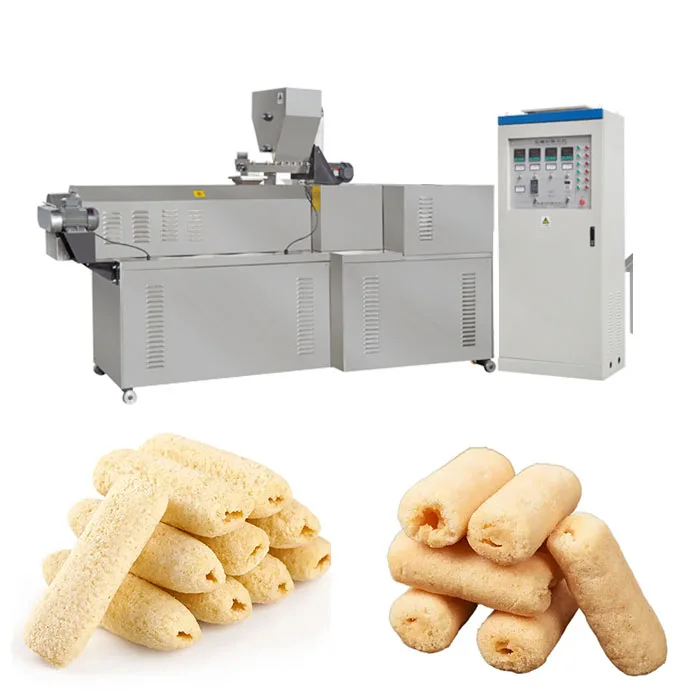
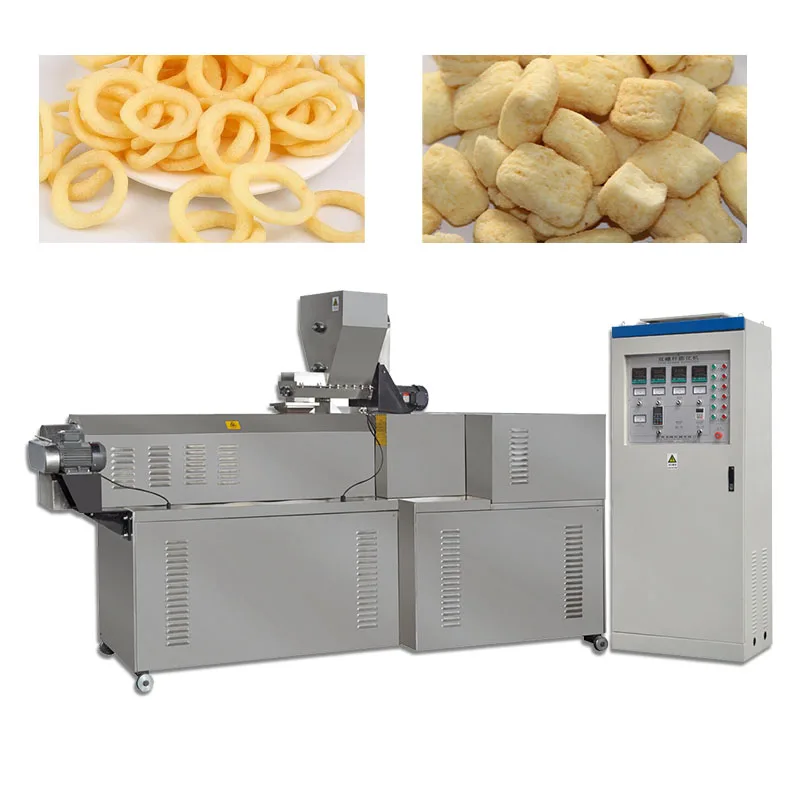
MT65 / MT70 / MT85 Twin-Screw Snack Food Extrusion Line, 120–700 kg/h, CE Certified — engineered for puffed, core-filled, and shaped snacks from corn, rice, or wheat flour. Screw configuration and die design are matched to your raw material and target density, with downstream frying, seasoning, and packing stations throughput-balanced to avoid bottlenecking. In-house trial runs on your formulation are completed before shipment, with full test documentation provided for production validation.
- Modular station layout with customisable voltage and frequency
- Shape flexibility: ball, stick, ring, tube, animal, and filled formats
- Complete line from batching to packing under single-supplier scope
Description
Integrated Throughput Matching — Every station from the mixer to the packing unit is sized against the extruder’s verified output on your grain formulation, so the line runs at its calculated rate without downstream choke points.
Technical Specifications
| Parameter | Value |
|---|---|
| Product Type | Twin-Screw Snack Food Extrusion Line |
| Models Available | MT65 / MT70 / MT85 |
| Screw Type | Twin-screw (Double-screw) |
| Installed Power | 84 kW (MT65) / 132 kW (MT70) / 239 kW (MT85) |
| Output Capacity | 120–150 kg/h (MT65) / 200–250 kg/h (MT70) / 500–700 kg/h (MT85) (basis not stated in source — confirm raw material type, moisture content and product shape) |
| Voltage & Frequency | Three-phase 380V/50Hz; Single-phase 220V/50Hz (customizable to buyer requirement) |
| Overall Dimensions | 21000×1200×2200 mm (MT65) / 23000×1500×2300 mm (MT70) / 28000×3500×2500 mm (MT85) |
| Raw Materials | Corn flour, rice powder, wheat flour, and similar grain-based powders |
| Product Shapes | Ball, stick, wheel, ring, tube, flower, animal shapes (via die/mould change) |
| Core-Filling Capability | Yes — chocolate-filled bar, cream-filled pillow, rice cake, cereal bar, sheet snacks |
| Line Stations | Mixer → Twin-Screw Extruder → Multi-functional Cutting Shaper → Automatic Fryer → Eight-square Seasoner → Packing Machine |
| Automation | One-pass operation from mixing through flavouring |
| Assembly State | Complete line, modular stations |
| Standards | CE (since 2014); ISO certified |
Application Suitability
| Application | Material or Output |
|---|---|
| Puffed corn ball and rice ball production | Corn flour and rice powder at controlled moisture, expanded through twin-screw barrel to spherical die geometry |
| Core-filled snack bars and pillows | Grain-based outer shell with chocolate or cream injection through co-extrusion die |
| Shaped extruded snack formats (stick, ring, tube, flower, animal) | Wheat flour or blended grain powder, formed by interchangeable die plates and cut to length |
| Cereal bars and sheet snacks | Grain slurry extruded and pressed into sheet or bar format before cutting and drying |
What Your Raw Material Tells You About Real Output
A snack food extrusion production line turnkey package only earns its capacity plate when your actual flour blend runs through the barrel at target moisture.
I once watched a line that was spec’d on standard wheat flour get shipped to a buyer whose recipe cut the flour with thirty percent chickpea powder. The expansion collapsed, density went outside the range the market expected, and four days of on-site screw adjustments followed. The problem was not the extruder — it was that nobody tested the buyer’s real blend before the crate was nailed shut. When you evaluate a snack food extrusion production line turnkey proposal, the kg/h figure on the quotation sheet is only meaningful alongside the raw material type, moisture percentage, and die geometry that produced it [NEED_CITE: raw material variability effects on twin-screw extrusion throughput]. Without those three qualifiers, you are comparing a laboratory number against a factory reality that will not match.
Screw Profile and Barrel Zone Matching
The twin-screw configuration on this line allows the screw element sequence — conveying, kneading, and reverse-flight sections — to be rearranged for each product format. A corn ball requiring high expansion needs a different shear history than a cream-filled pillow where the dough must stay dense enough to hold the injection channel open. The barrel temperature zones are set accordingly, and the die plate is matched to the expansion ratio the target shape demands. This is where a snack food extrusion production line turnkey installation either holds its rated consistency or drifts batch to batch.
Why the Fryer and Seasoner Must Track the Extruder
The automatic fryer and eight-square seasoner downstream are not standalone units — their belt speed, oil residence time, and tumbling cycle must be calculated against the extruder’s actual kg/h output on your recipe. An undersized fryer forces the extruder to slow down; an oversized seasoner tumbles half-empty and breaks fragile puffed pieces. On this line, every station is scoped together under one supplier so the throughput balance is documented before fabrication begins [NEED_CITE: downstream station sizing for extrusion line throughput balance].
Reading the Specs That Actually Matter
The installed power spread across the three models — 84 kW, 132 kW, and 239 kW — reflects motor sizing matched to barrel volume and screw torque requirements at each capacity tier. Higher power on the MT85 is not simply "more output"; it provides the torque reserve needed to push viscous, high-protein dough blends through longer screw assemblies without stalling. Overall dimensions scale accordingly: the MT65 footprint at 21000×1200×2200 mm suits a compact workshop, while the MT85 at 28000×3500×2500 mm requires a dedicated bay with overhead clearance for the dryer and cooling conveyor. Voltage customization to your site’s three-phase supply prevents commissioning delays that arise when a standard 380V/50Hz panel arrives at a 440V/60Hz facility.
When the Wrong Die or Screw Sequence Ships
A generic screw build copied from a different product category will extrude something, but the texture and density will miss the buyer’s market specification. Floating feed that sinks, puffed balls that collapse during cooling, core-filled pillows where the cream leaks through the seam — these are not operator errors. They are configuration errors that compound across every hour of production [NEED_CITE: screw configuration impact on extruded snack density and texture]. The cost shows up in rejected batches, customer complaints, and the weeks spent re-engineering a screw profile that should have been correct before the machine left the factory.
Why This Line Is Built as a Single Scope
The MT65, MT70, and MT85 models share a common engineering logic: twin-screw extrusion with matched downstream stations, not a collection of unrelated machines bolted together. The in-house testing workshop runs your actual raw material before shipment, generating a trial report that documents screw configuration, barrel temperatures, and die geometry against your target product. CE and ISO certification is held on file rather than invoked as a sales line. Electrical schematics confirm voltage, frequency, and control language before the panel is wired, so commissioning on your floor begins with parameters already validated.
Documentation & Verification
- Line layout and throughput balance calculation across all stations for your selected model
- Screw and die configuration record matched to your raw material and target snack geometry
- Trial run report on your actual grain blend conducted in the testing workshop before dispatch
- Electrical schematic with voltage, frequency, and control language confirmed to your site specification
- CE declaration of conformity and ISO certificate on file for customs and compliance review
- Operation manual with wear parts list covering screws, dies, and fryer belt components
Installation, Commissioning & Support
- Foundation leveling and utility routing planned around the selected model’s footprint, from MT65’s 21 m length to MT85’s 28 m span
- Dedicated three-phase circuit sized to the model’s installed power — 84 kW, 132 kW, or 239 kW — with confirmed voltage before panel build
- Modular station delivery with sequenced assembly from mixer through packing machine on your floor
- First-run parameter setting using the pre-shipment trial report as the baseline for screw speed, barrel zones, and fryer temperature
- Operator training covering die changeover procedures across ball, stick, ring, and core-filled formats
- Wear parts schedule for screw elements, die plates, and fryer belt sections with replacement intervals noted
What We Need to Size Your Line
Send us the grain flour blend you will actually run — corn, rice, wheat, or a custom mix — along with the moisture percentage your process targets. Tell us which product shapes you plan to produce and whether core-filled formats are in scope. Your facility’s voltage, frequency, and preferred control language let us finalize the electrical package before fabrication begins.
Frequently Asked Questions
Q: How is output capacity verified on my raw material?
A: Each model’s capacity range is confirmed through an in-house trial run using your actual grain blend at your target moisture. The trial report documents screw configuration, barrel temperature profile, die selection, and measured kg/h output so you know what the line produces on your recipe before it ships.
Q: Can the screw and die be configured for my specific product texture?
A: Yes. The twin-screw assembly allows element rearrangement to adjust shear and residence time for your formulation. Die plates are selected or machined to match your target shape, expansion ratio, and density, and the configuration is locked in during the pre-shipment trial.
Q: What does the in-house trial run cover?
A: Your raw material is mixed and extruded on the selected model, then passed through cutting, frying, and seasoning stations. You receive a test report with measured throughput, product density, expansion data, and photographs of the finished snack in your target format before shipment is authorized.
Q: How are downstream stations sized against the extruder?
A: The fryer capacity, seasoner drum volume, and packing speed are calculated from the extruder’s verified output on your recipe. This prevents bottlenecks where one station forces the entire line to run below its rated throughput.
Q: What electrical and control details are confirmed before production?
A: Voltage, frequency, phase configuration, and control language are documented in the electrical schematic before the panel is wired. This ensures the line matches your facility’s utility supply and that operators can read the interface in their working language from day one.
Related products
-

Puffed Snack Food Machine Snack Food Machine Puffed Snack Machine
¥11,050.00 Select options This product has multiple variants. The options may be chosen on the product page -

Crunchy Puffed Snack Breakfast Cereal Corn Flakes Making Machine
¥1,000.00 Select options This product has multiple variants. The options may be chosen on the product page -

Sweet Puffed Rice Making Machine Stainless Steel Extruded Puff Snacks Ball Food Produce Machinery
¥7,580.00 Select options This product has multiple variants. The options may be chosen on the product page -

Fully automatic puff snack processing line
¥8,500.00 Select options This product has multiple variants. The options may be chosen on the product page


