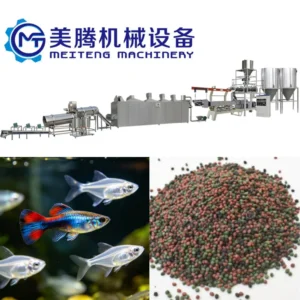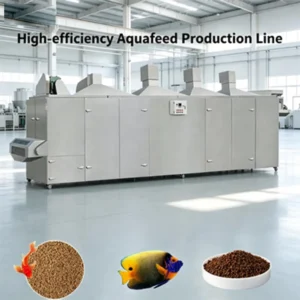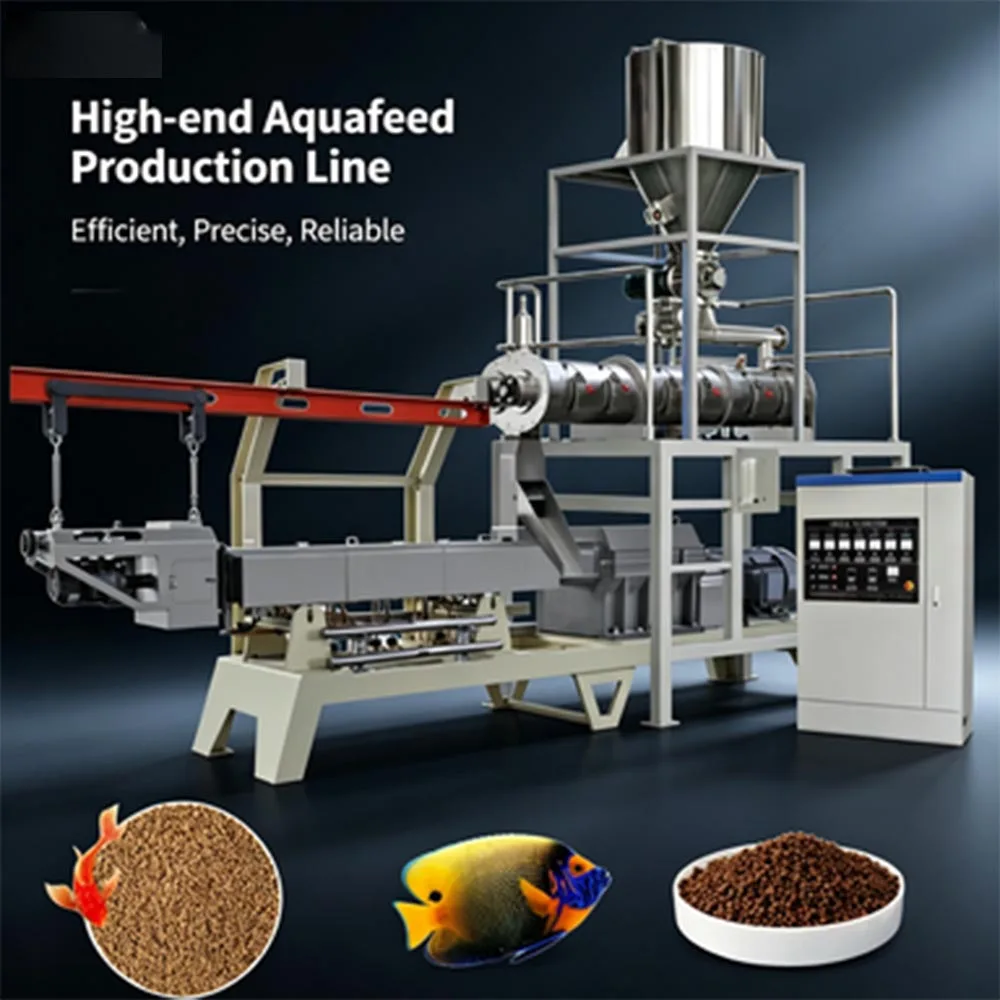


Twin Screw Fish Feed Extruder Production Line, Intelligent PLC Control, Food-Grade 304 Stainless Steel — engineered for floating and sinking aquatic pellet production with fully matched throughput across mixing, extrusion, drying, and seasoning stations. High temperature and high pressure twin-screw extrusion ensures complete starch gelatinisation, producing uniform density pellets with smooth surface and adjustable buoyancy to meet species-specific breeding requirements. Pellet size and hardness are modified through screw configuration and die design matched to your raw material formulation.
Every station in this turnkey line is capacity-balanced under one supplier, eliminating bottlenecks from mismatched dryer or coating throughput. An in-house trial run on your actual raw material is conducted before shipment, verifying output stability and pellet specification.
Description
Turnkey Line Engineering — Every station from raw material batching to finished pellet packing is throughput-matched so the slowest link never throttles your target output.
Technical Specifications
| Parameter | Value |
|---|---|
| Product Type | Twin Screw Fish Feed Extruder Production Line |
| Screw Configuration | Twin screw |
| Control System | Intelligent PLC automatic control system |
| Contact Material | Food-grade 304 stainless steel |
| Machine Body | Food-grade 304 stainless steel |
| Output Capacity | Large stable processing capacity for medium to large-scale production (basis to be confirmed) |
| Production Mode | Full continuous automatic production |
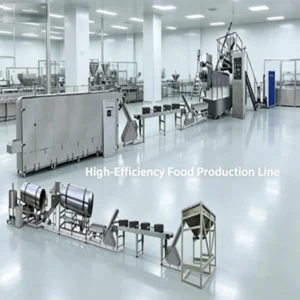
| Line Stations | Raw material mixer, extruder, dryer, seasoning coating machine, vibrating sieve, conveyor equipment |
| Pellet Adjustability | Size, hardness, and buoyancy adjustable |
| Extrusion Process | High temperature and high pressure for full raw material ripening |
| Operating Duty | Long time uninterrupted operation |
| Maintenance Design | Quick replacement of vulnerable parts, convenient daily cleaning |
| Assembly State | Complete matched production configuration |
| Certification | CE, ISO |
Application Suitability
| Application | Material or Output |
|---|---|
| Floating fish feed pellets | Fish meal, soybean meal, corn powder, compound additives |
| Sinking aquatic feed pellets | Adjusted formulation and screw speed for negative buoyancy |
| Koi and goldfish feed | Colored pellet variants with controlled density |
| Tropical fish feed | Small-diameter extruded pellets with high protein content |
| Freshwater aquaculture feed | Species-specific pellet size and buoyancy profiles |
When "Nominal Capacity" Doesn’t Match Your Raw Material
A fish feed extruder production line turnkey rated at a certain output on paper can underperform significantly once your actual formulation hits the barrel. The line only produces what the slowest station allows.
I learned this the hard way early in my career. A Middle East aquaculture client ordered a floating feed line where the extruder and dryer were correctly sized, but the seasoning drum had been specified at the lowest-cost option. When buoyant pellets arrived at the coating stage faster than the small drum could tumble them, material backed up and the entire line stopped. Two days of production lost while we shipped a replacement unit. Since then, I calculate the takt time at every station before any line leaves the workshop. The extruder barrel, dryer belt length, and seasoning drum diameter must all pass product at the same rate [NEED_CITE: line throughput balancing principles in continuous food processing].
Screw Geometry and Starch Gelatinisation in Aquatic Pellets
The twin-screw configuration generates the shear and residence time needed to fully gelatinise starch from corn powder and soybean meal inside the barrel. This gelatinisation is what gives floating pellets their internal cell structure and buoyancy. A fish feed extruder production line turnkey that skips proper screw element sequencing will produce pellets that crack during drying or sink unexpectedly in the pond. Die selection further determines whether pellets exit with a smooth surface or a textured finish that holds coating oil more effectively.
Balancing Dryer Residence Time Against Extruder Output
Floating pellets leave the extruder at high moisture and must spend a defined period on the dryer belt to reach safe storage levels. If the dryer is undersized relative to extruder throughput, pellets exit with residual moisture that invites mold during bagging. An oversized dryer wastes thermal energy and floor space. The correct calculation starts from the extruder discharge rate, target final moisture, and the specific heat required for the pellet diameter being produced [NEED_CITE: drying curve requirements for extruded aquatic feed]. This is why the dryer specification must follow the extruder selection, never precede it.
Reading the Specification Sheet Beyond Headline Numbers
The intelligent PLC automatic control system maintains barrel temperature zones within a narrow band, which directly affects pellet density uniformity batch after batch. Food-grade 304 stainless steel contact parts resist corrosion from fish meal oils and acidic additives that would degrade carbon steel surfaces within months. High temperature and high pressure extrusion ensures complete ripening of raw materials, eliminating anti-nutritional factors in soybean meal that can harm fish growth. The quick-replacement design for vulnerable parts such as screw tips and die plates means routine maintenance windows stay measured in hours rather than shifts, keeping continuous production schedules intact.
What Happens When Stations Are Mismatched
A seasoning drum that cannot keep pace with extruder discharge causes pellet accumulation on the conveyor, leading to oil pooling and inconsistent coating coverage. An undersized vibrating sieve allows broken fragments into the bagging station, triggering customer rejections. When the dryer belt speed is not synchronised with extruder output, pellets either over-dry and shatter or under-dry and spoil. These failures never show up on a quotation that lists only the extruder’s nominal capacity [NEED_CITE: bottleneck analysis in continuous extrusion lines].
Why This Line Is Configured as One Integrated Project
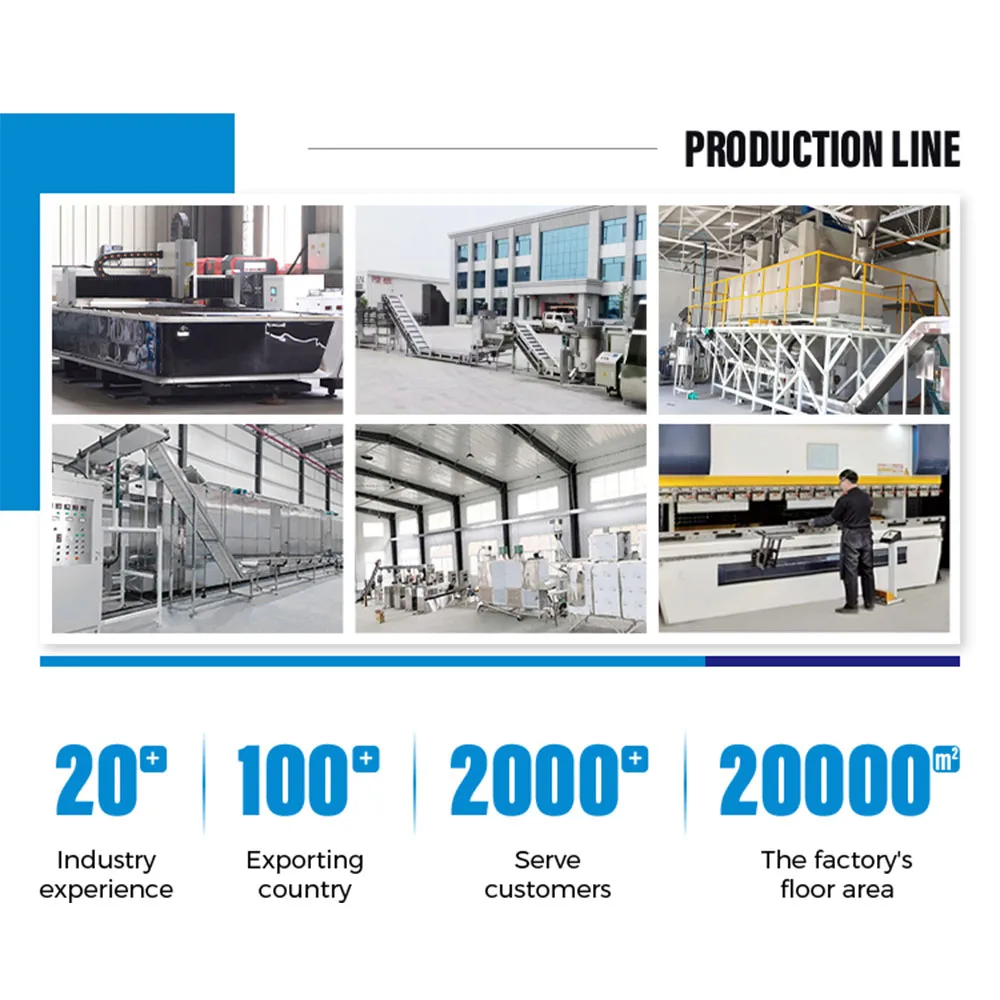
Every station — mixer, extruder, dryer, seasoning drum, vibrating sieve, conveyor — is sized against the same throughput target so no single unit constrains the others. Screw configuration and die design are selected after reviewing your specific raw material formulation, not copied from a generic template. The in-house testing workshop runs your actual ingredients through the extruder before shipment, generating a trial report that documents pellet density, expansion ratio, and buoyancy. Electrical schematics confirm voltage and frequency compatibility with your facility before the control cabinet is wired. Pre-sales engineering through on-site commissioning and operator training keeps the same technical team responsible from first inquiry to first production run.
Documentation & Verification
- Line layout drawing with throughput calculation across every station
- Screw and die configuration record matched to your raw material
- Trial run report on your formulation before dispatch
- Electrical schematic with confirmed voltage and frequency
- Factory test record documenting continuous run performance
- Operation and maintenance manual with wear parts list
Installation, Commissioning & Support
- Foundation plan specifying load points for the extruder and dryer frames
- Dedicated electrical circuits sized to the PLC-controlled motor loads
- Modular station delivery allowing phased assembly in low-clearance workshops
- First-run parameter logging for barrel temperature, screw speed, and dryer belt rate
- Operator training on die changeover and screw element replacement procedures
- Wear parts inventory list covering screw tips, die plates, and dryer belt sections
Preparing Your Inquiry
To configure a line that matches your actual production environment, share your raw material formulation including protein and starch percentages, target pellet diameter range, and whether you need floating, sinking, or both formats. Specify your available workshop dimensions and local voltage and frequency standards so the electrical design aligns before fabrication. If you have existing upstream mixers or downstream packing equipment, note their throughput so the new line integrates without redundant capacity.
Frequently Asked Questions
Q: How is the line capacity verified against my specific raw material formulation and target pellet size?
A: We run your actual raw material through the extruder in our in-house testing workshop before shipment. The trial report documents achieved throughput, pellet density, expansion ratio, and buoyancy at your target diameter, giving you verified output data rather than a generic catalogue figure.
Q: Can the screw configuration and die design produce both floating and sinking pellets on the same line?
A: Yes. Floating pellets require high expansion achieved through specific screw element sequencing and die geometry, while sinking pellets need denser compression. Both configurations can be accommodated with interchangeable screw profiles and die plates supplied as part of the initial tooling set.
Q: How is throughput balanced between the extruder, dryer, and seasoning drum to prevent bottlenecks?
A: Each station is sized from the extruder discharge rate forward. The dryer belt length and airflow are calculated to handle the exact moisture removal load, and the seasoning drum diameter and rotation speed are matched so pellets flow continuously without accumulation at any transfer point.
Q: Is a trial run on my raw material conducted before shipment, and what does the report cover?
A: Every line undergoes a production trial using your supplied formulation. The report records barrel temperature profiles, screw speed settings, pellet dimensional measurements, buoyancy test results, and moisture content at the dryer exit, providing a baseline recipe you can replicate during commissioning at your facility.
Related products
-
Premium Pet Food Processing Equipment Dog Cat Feed Making Machine
¥9,500.00 Select options This product has multiple variants. The options may be chosen on the product page -
MT70 100-200kg/h Dog & Cat Pet Food Processing Line with 380V 50Hz Three Phase Power
¥35,000.00 Select options This product has multiple variants. The options may be chosen on the product page -
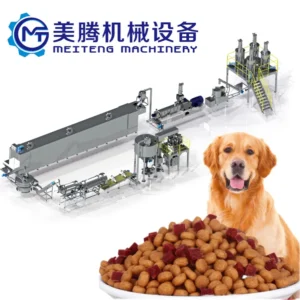
High Capacity Pet Food Extrusion Production Line Suitable for Dog. Cat. Bird. Fish and Cattle Feed
¥9,500.00 Select options This product has multiple variants. The options may be chosen on the product page -
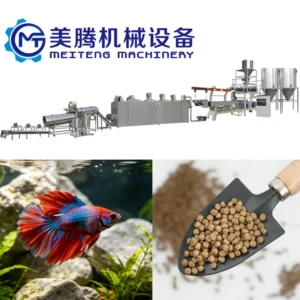
1.0-1.2t/h High Capacity Multi-Species Fish Feed Processing Line to Produce Fish Food
¥45,000.00 Select options This product has multiple variants. The options may be chosen on the product page