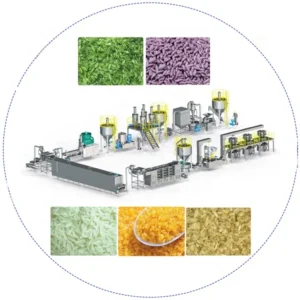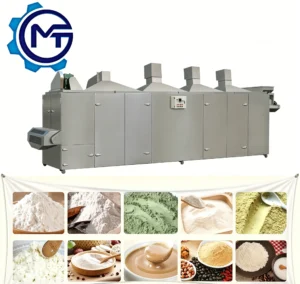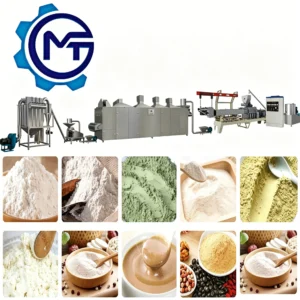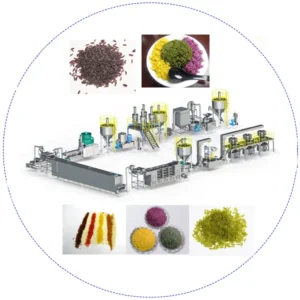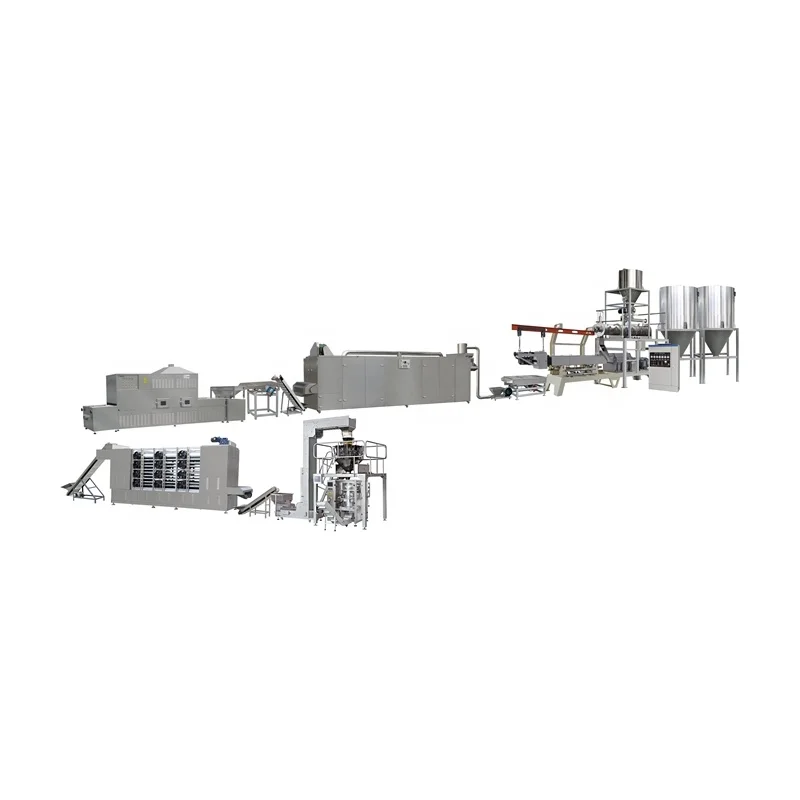
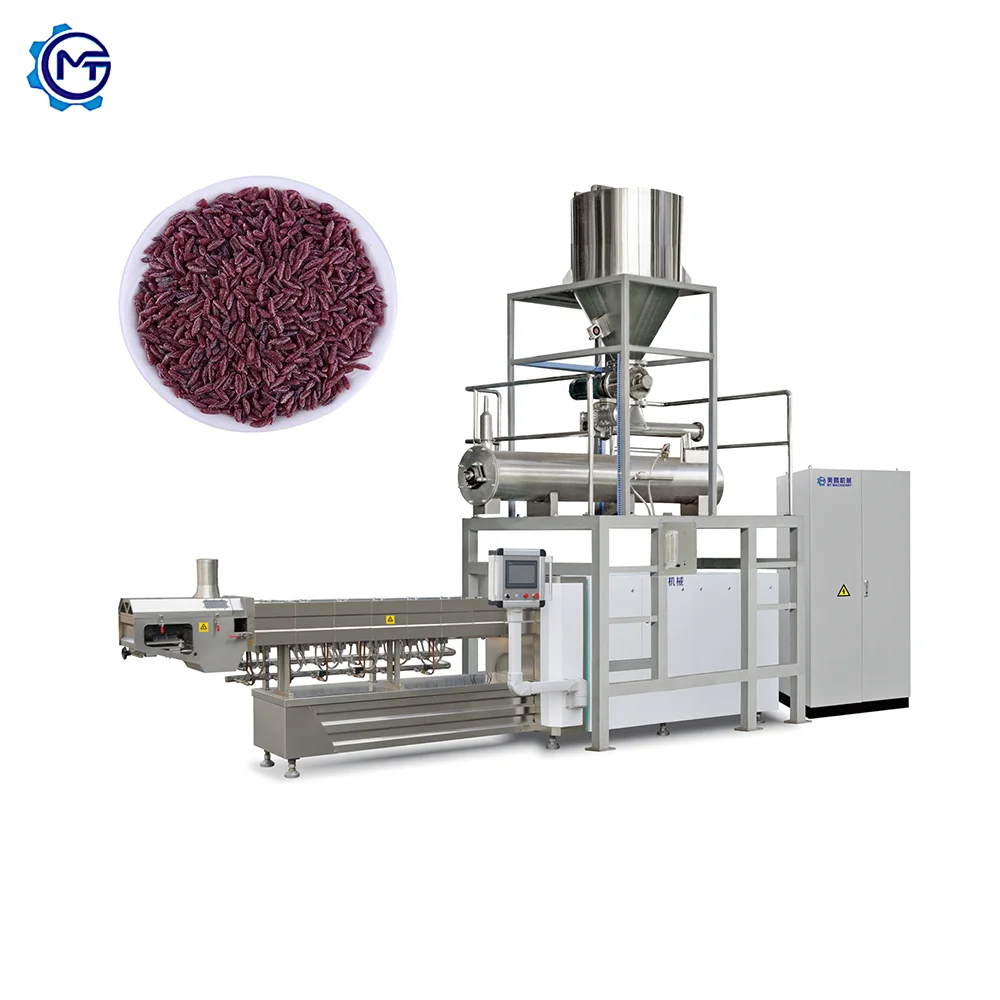


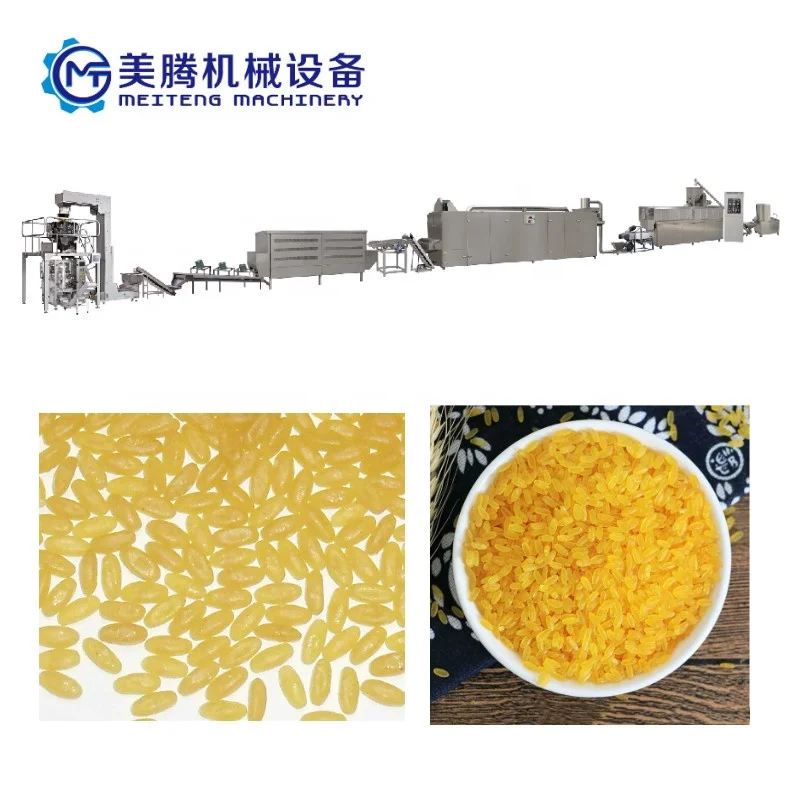

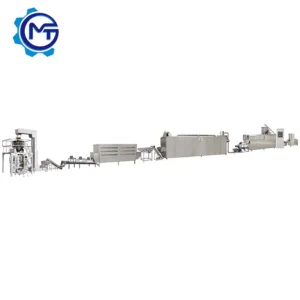
MT65 / MT70 / MT85 / MT75 / MT95 Fortified Rice Kernel Production Line, Twin-Screw Extruder, Circulation Drying Oven — configured as a complete turnkey project from mixing through extrusion, low-temperature drying, cooling, high-temperature roasting and packing. Screw and die design matched to your raw material formulation and target kernel density, with throughput calculated across every station to eliminate bottlenecks. Single or double screw feeding ensures stable material flow based on ingredient characteristics.
- Trial runs on your actual raw material conducted in our testing workshop before shipment, with full documentation including line layout, capacity calculation and electrical schematic provided for your review.
Description
Integrated Line Throughput Matching — every station from mixing to packing is sized against the extruder’s actual output on your specific grain formulation, preventing the bottlenecks that arise when a line is assembled from standalone vendors.
Technical Specifications
| Parameter | Value |
|---|---|
| Product Type | Fortified Rice Kernel Production Line |
| Model Options | MT65 / MT70 / MT85 / MT75 / MT95 |
| Extruder Type | Twin-screw |
| Line Stations | Mixing, Extruding, Vibrating, Low Temperature Drying, Cooling, High Temperature Roasting, Cooling, Packing |
| Raw Material Compatibility | Broken rice, rice, corn, millet, wheat, oats, buckwheat, bean, starch base; vitamin and mineral additives |
| Final Product | Artificial rice, fortified rice kernels |
| Feeding System | Single or double screw feeding system matched to material flow characteristics |
| Screw Material | Special wear-resistant alloy |
| Lubrication | Automatic lubricating system |
| Extruder Cooling | Integrated cooling system |
| Drying Oven Heating Source | Electric or gas (configurable) |
| Drying Oven Control | Circulation drying process with frequency motor controlling mesh belt speed |
| Control System | Frequency speed controlling (PLC / MCC options available — confirm requirement) |
| MT65 Capacity | 80–100 kg/h (basis not stated in source — confirm raw material formulation and moisture content) |
| MT65 Power | Installed 85 kW / Consumption 60 kW |
| MT65 Dimensions | 28 × 1.2 × 2.2 m |
| MT70 Capacity | 100–120 kg/h (basis not stated in source — confirm raw material formulation and moisture content) |
| MT70 Power | Installed 120 kW / Consumption 85 kW |
| MT70 Dimensions | 30 × 1.5 × 2.2 m |
| MT85 Capacity | 200–300 kg/h (basis not stated in source — confirm raw material formulation and moisture content) |
| MT85 Power | Installed 235 kW / Consumption 165 kW |
| MT85 Dimensions | 34 × 3.5 × 4.3 m |
| MT75 Capacity | 300–500 kg/h (basis not stated in source — confirm raw material formulation and moisture content) |
| MT75 Power | Installed 180 kW / Consumption 135 kW |
| MT75 Dimensions | 32 × 3.5 × 4.3 m |
| MT95 Capacity | 800–1000 kg/h (basis not stated in source — confirm raw material formulation and moisture content) |
| MT95 Power | Installed 260 kW / Consumption 195 kW |
| MT95 Dimensions | 36 × 3.5 × 4.3 m |
| Voltage & Frequency | Configurable to local supply (confirm before production) |
| Certification | CE, ISO |
| Packing | Plastic bubble film with wooden case for spare parts; fumigation package and certificate available |
Application Suitability
| Application | Material or Output |
|---|---|
| Fortified rice kernel manufacturing | Broken rice and rice flour blended with vitamin and mineral premix |
| Artificial rice production | Corn, millet, wheat, oats and buckwheat with starch binder |
| Nutrition programme supply | Grain-based kernels formulated to meet micronutrient specifications |
| Instant rice manufacturing | Pre-gelatinised starch and bean flour blends for rapid rehydration |
| Value-added grain processing | Mixed cereal formulations incorporating oat, buckwheat and legume flours |
Why a Nominal Capacity Figure Can Mislead Your Entire Project Plan
A capacity number without a material basis is a guess, not an engineering commitment.
When sourcing a fortified rice kernel production line turnkey, the most common frustration I encounter is a buyer who received a quotation stating a line capacity based on standard white rice flour, only to discover during commissioning that their actual formulation — often involving pre-gelatinised starch, bean flour, or high-fibre bran additions — behaves entirely differently inside the barrel. The extruder may run, but the output falls short and the kernel density drifts outside specification [NEED_CITE: extrusion behaviour variation across grain starch compositions]. This is not a machine defect; it is a specification gap that should have been addressed before the line was built.
Matching Barrel Shear to Your Grain Formulation
The twin-screw extruder at the heart of this fortified rice kernel production line turnkey is configured with screw elements and die geometry selected against your specific raw material blend. Different starch sources — broken rice, corn, buckwheat, bean flour — gelatinise at different temperatures and respond differently to shear. A screw profile that produces clean, uniform kernels on pure rice flour may generate excessive fines or uneven expansion when the formulation shifts toward oat or legume content.
Throughput Alignment Across Every Downstream Station
The dryer, cooler and roasting stations are each sized to handle the extruder’s actual throughput rather than a catalogue maximum. A circulation drying oven with frequency-controlled mesh belt speed allows the drying profile to be adjusted to the kernel moisture content exiting the die. When the extruder output and the dryer capacity are misaligned, kernels either accumulate on the belt or pass through under-dried, creating a bottleneck that no amount of extruder speed adjustment can resolve [NEED_CITE: throughput matching principles in continuous food processing lines].
Reading the Specification Sheet Against Your Production Reality
The five extruder models — MT65 through MT95 — span from pilot-scale development to full production volumes. The critical step is selecting the model not by its maximum catalogue capacity, but by the capacity it delivers on your exact formulation at your target moisture content. Installed power and consumption figures differ significantly across the range, and the physical footprint shifts from a compact 28-metre line to a 36-metre installation requiring substantial floor space and utility planning. The single or double screw feeding system is chosen based on whether your premix includes fine vitamin powders that require controlled volumetric dosing versus free-flowing grain flours.
What Happens When the Feeding System Is Specified Wrong
An under-sized feeding system starves the extruder barrel, causing surging output and inconsistent kernel weight. An over-sized system floods the barrel, increasing motor load and accelerating screw wear. On formulations with sticky pre-gelatinised starch or hygroscopic vitamin premix, a single screw feeder may bridge or rat-hole inside the hopper, requiring a double screw configuration with agitation to maintain steady material flow [NEED_CITE: powder flow behaviour in volumetric feeding systems].
What You Receive Before the Line Leaves the Factory
Every fortified rice kernel production line turnkey ships with documentation that ties the machine configuration directly to your project requirements. Rather than generic manuals, the paperwork package addresses the specific decisions made during your line’s engineering phase.
- Line layout and capacity calculation showing throughput at each station matched to your target output
- Screw and die configuration record specifying element arrangement for your grain formulation
- Trial run report produced on your raw material in the in-house testing workshop before shipment
- Electrical schematic with voltage, frequency and control language confirmed for your facility
- Operation and maintenance manual with wear parts list specific to your extruder model
Installation, Commissioning & Support
- Foundation and utility planning based on the installed power requirement of your selected model (85 kW to 260 kW)
- Voltage and frequency configuration verified against your local supply before electrical panel assembly
- Phased mechanical assembly across line stations with alignment checks between extruder, dryer and cooling conveyors
- First-run parameter setting including barrel temperature profile, screw speed and mesh belt drying time
- Operator training covering screw and die changeover, automatic lubrication system checks and frequency drive adjustment
- Wear parts supply programme for screws, dies and feeding system components based on your production schedule
What We Need to Configure Your Line Accurately
Provide your raw material formulation including the ratio of base grain to starch binder and vitamin premix, along with your target kernel size, density and daily production volume. Confirm your facility voltage, frequency and available floor space including ceiling height for the drying and roasting sections. If you have existing upstream milling or downstream packing equipment, share the interface specifications so the line can be integrated without modification.
Frequently Asked Questions
Q: How is line capacity verified against my specific raw material formulation?
A: We run a trial in our testing workshop using your actual raw material blend, measuring kernel output rate, density and expansion against your target specification. The results are documented in a trial run report that accompanies your shipment, so you can verify the numbers before the line arrives at your facility.
Q: How do you match throughput between the extruder, dryer and downstream stations?
A: Each station is calculated against the extruder’s verified output on your formulation rather than a catalogue maximum. The drying oven mesh belt speed is frequency-controlled to adjust residence time, and the cooling and roasting sections are sized to handle the confirmed throughput without accumulation or starvation.
Q: What is the process for voltage, frequency and control language confirmation?
A: Before production begins, we confirm your local electrical supply specification and the preferred language for the control interface. The electrical schematic is drawn to match, and the control panel is assembled and tested at those settings before the line is packed for shipment.
Q: Can I run a trial on my own raw material before the line ships?
A: Yes. Our in-house testing workshop runs your exact formulation through the configured extruder and records output capacity, kernel characteristics and processing parameters. This trial run is standard procedure, not an optional add-on, and the full report is included in your documentation package.
Q: What does on-site installation and commissioning include for a turnkey project?
A: Our engineers handle mechanical assembly, utility connection, first-run parameter tuning and operator training at your facility. This covers extruder start-up, dryer and roaster calibration, feeding system adjustment and wear part replacement procedures specific to your line configuration.
Related products
-

Full Automatic Complete Baby Food Nutrition Powder Porridge Processing Production Line for Infant Nutrition Factory
¥9,500.00 Add to cart -
Industrial Instant Corn Paste Production Line Nutritional Powder Processing Equipment Meal Replacement Nutrition Powder Machine
¥65.00 Select options This product has multiple variants. The options may be chosen on the product page -

High Quality Automatic PLC Controlled 500kg/h Twin Screw Extruder Machine for Baby Rice Nutrition Powder
¥8,238.27 Add to cart -
Automatic Nutritional Powder Making Machine Safe Rice Cereal for Babies
¥30.00 Select options This product has multiple variants. The options may be chosen on the product page