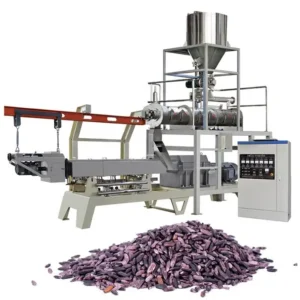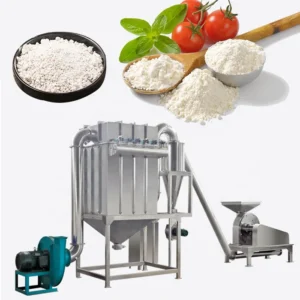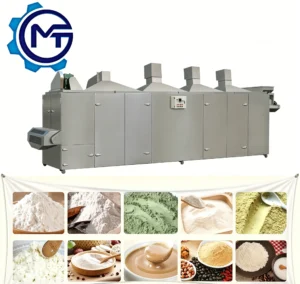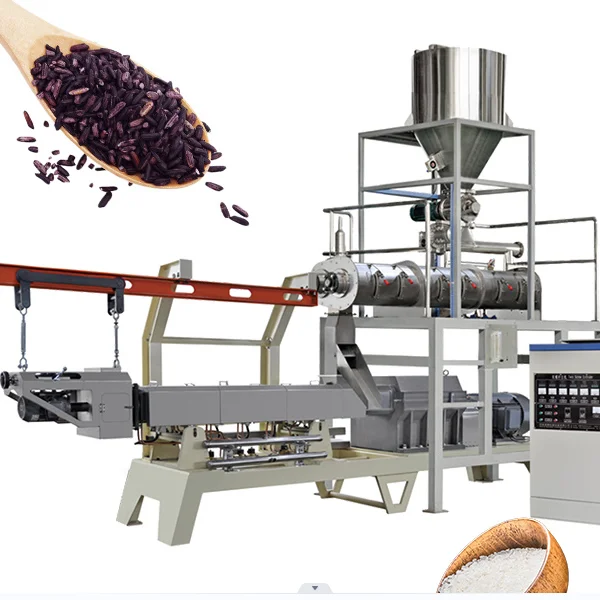

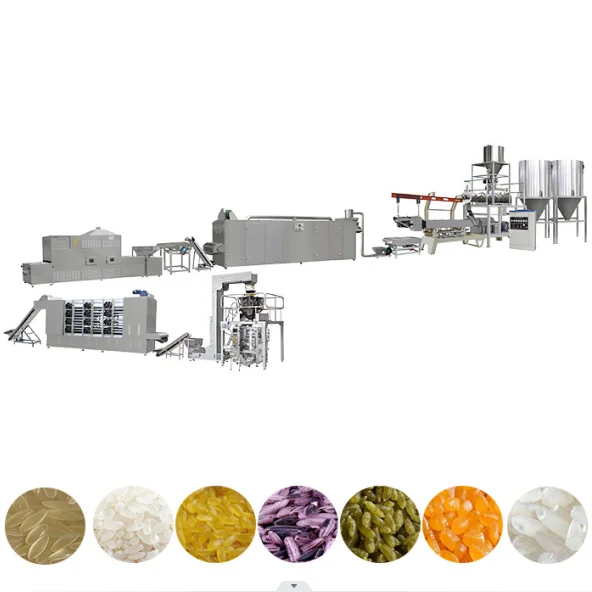
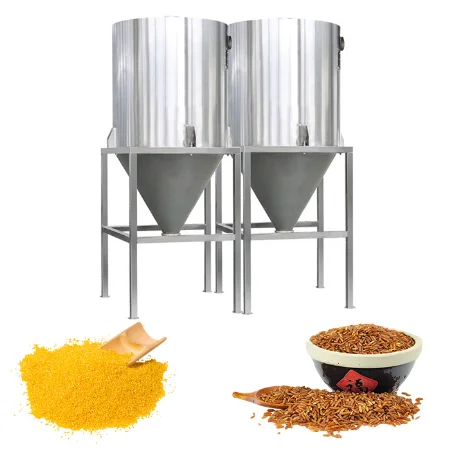

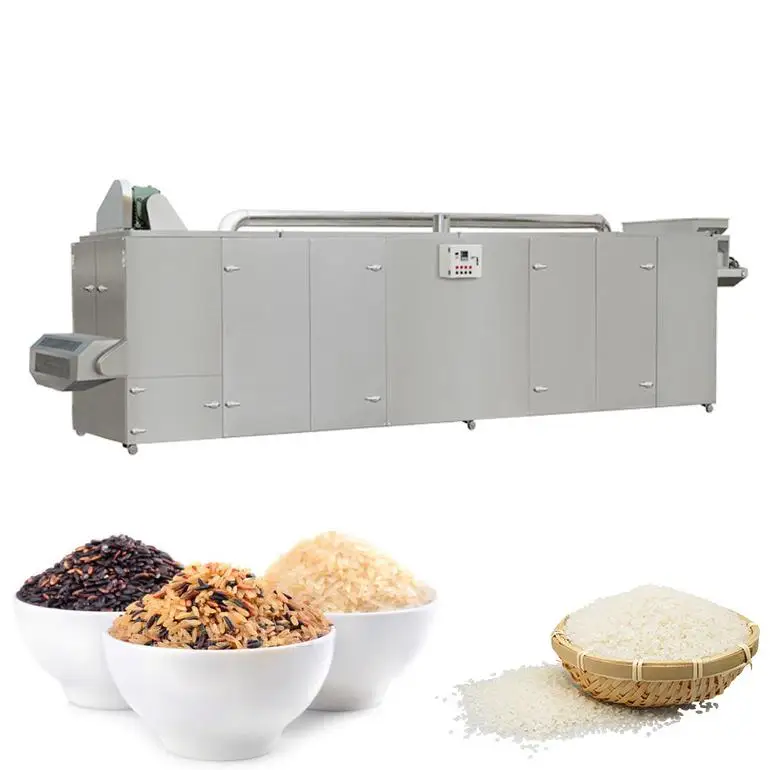
MT65 Fortified Rice Processing Line, Twin-screw Extruder, PLC & MCC Control — engineered as a complete turnkey project from batching through extrusion, drying and packing. Screw configuration and die design are matched to your grain formulation and target kernel density, with throughput calculated across every station to eliminate bottlenecks. Five capacity tiers available with frequency-controlled drying and automated parameter management.
-
In-house trial runs on your raw material validate output before shipment
-
Line layout and capacity documentation provided for throughput matching
-
On-site installation, commissioning and operator training included
MT65 Fortified Rice Processing Line, Twin-screw Extruder, PLC & MCC Control — engineered as a complete turnkey project from batching through extrusion, drying and packing. Screw configuration and die design are matched to your grain formulation and target kernel density, with throughput calculated across every station to eliminate bottlenecks. Five capacity tiers available with frequency-controlled drying and automated parameter management. -
In-house trial runs on your raw material validate output before shipment
-
Line layout and capacity documentation provided for throughput matching
-
On-site installation, commissioning and operator training included
Description
Throughput-matched turnkey engineering — every station from batching through extrusion, drying and packing is sized against the same raw material data so the line runs at its stated rate without bottlenecks.
Technical Specifications
| Parameter | Value |
|---|---|
| Product Type | Fortified Rice Processing Line |
| Models Available | MT65 / MT70 / MT85 / MT75 / MT95 |
| Screw Type | Twin-screw |
| Feeding System | Single or double screw feeding (selected by material) |
| Installed Power (MT65 / MT70 / MT85) | 85 kW / 120 kW / 235 kW |
| Installed Power (MT75 / MT95) | 180 kW / 260 kW |
| Power Consumption (MT65 / MT70 / MT85) | 60 kW / 85 kW / 165 kW |
| Power Consumption (MT75 / MT95) | 135 kW / 195 kW |
| Capacity (MT65) | 80–100 kg/h (basis to be confirmed with raw material formulation and moisture content) |
| Capacity (MT70) | 100–120 kg/h (basis to be confirmed with raw material formulation and moisture content) |
| Capacity (MT85) | 200–300 kg/h (basis to be confirmed with raw material formulation and moisture content) |
| Capacity (MT75) | 300–500 kg/h (basis to be confirmed with raw material formulation and moisture content) |
| Capacity (MT95) | 800–1000 kg/h (basis to be confirmed with raw material formulation and moisture content) |
| Overall Dimensions (MT65 / MT70) | 28 × 1.2 × 2.2 m / 30 × 1.5 × 2.2 m |
| Overall Dimensions (MT85 / MT75 / MT95) | 34 × 3.5 × 4.3 m / 32 × 3.5 × 4.3 m / 36 × 3.5 × 4.3 m |
| Speed Control | Frequency inverter (variable speed) |
| Control System | PLC and MCC control |
| Screw Material | Special wear-resistant alloy |
| Lubrication | Automatic lubricating system |
| Cooling | Integrated cooling system for extruder |
| Drying Oven Heating Source | Electric or gas |
| Drying Method | Circulation drying with mesh belt, frequency motor speed control |
| Line Stations | Mixing → Extruding → Vibrating → Low temperature drying → Cooling → High temperature roasting → Cooling → Packing |
| Standards | CE, ISO |
Application Suitability
| Application | Material or Output |
|---|---|
| Fortified food and nutrition programme suppliers | Rice flour and grain blends with vitamin and mineral additives for institutional and aid-market rice kernels |
| Rice millers converting by-products | Broken rice and rice bran reprocessed into value-added fortified kernels |
| Retail and foodservice artificial rice production | Rice, corn, millet, wheat, oats, buckwheat and bean blends shaped into reconstituted rice grains |
| Infant and nutritional formula integration | Fortified rice kernels blended with starch and micro-nutrient premixes for specialized dietary products |
Why Nominal Capacity Figures Mislead Fortified Rice Buyers
A rated output means nothing until it is validated against your exact grain blend, moisture level and vitamin premix ratio.
I spent years on the service side before moving into sales, mostly running between food processing plants across the Yangtze River Delta. The most common scene after a nutritional line was handed over: the customer loaded their own rice flour formulation, and suddenly screw speed, feed rate and barrel temperatures all had to be scrapped and reworked. Two or three weeks of downtime waiting for process re-validation [NEED_CITE: typical commissioning delays when extrusion lines are not tested on buyer-specific raw materials]. A fortified rice production line turnkey should never ship without a documented trial on the actual material it will run. That gap between brochure capacity and real-world throughput is where most project budgets quietly bleed.
How a Fortified Rice Production Line Turnkey Is Laid Out
A complete line moves through mixing, extruding, vibrating, low temperature drying, cooling, high temperature roasting, a second cooling stage and packing. Each station must be sized so that the extruder output does not pile up ahead of the dryer or starve the packing station. The twin-screw extruder sits at the centre, where screw configuration and die geometry are set to match the specific grain formulation and the target kernel density.
Matching Dryer and Roaster Throughput to Extruder Output
The circulation drying oven uses a mesh belt with frequency-controlled motor speed, meaning belt travel can be adjusted so that kernel residence time inside the oven matches the moisture reduction required. If the extruder runs at the upper end of its range, the dryer belt must move correspondingly faster while maintaining the low-temperature profile that prevents kernel cracking. Downstream, the high-temperature roasting stage adds another variable: too short a roast leaves the kernel under-gelatinised, too long and surface scorching ruins appearance [NEED_CITE: starch gelatinisation thresholds in rice-based extrusion]. Getting these three stages to track together is the core engineering task of any fortified rice production line turnkey project.
Reading the Spec Sheet for Real Production Impact
Five model tiers — MT65 through MT95 — span from small-batch nutritional programmes to large-scale food aid contracts, and choosing the right tier depends on both daily output targets and available floor space. The twin-screw design allows operators to adjust screw elements and die inserts when switching between a pure rice flour recipe and a blend loaded with oat or buckwheat, each of which behaves differently under shear and heat. Frequency inverter speed control across the line means every motor — from the feeder through the extruder screws to the dryer belt — can be dialed independently, giving the process engineer room to fine-tune without swapping hardware. PLC and MCC control centralises these adjustments into a single interface, so batch-to-batch consistency depends on stored recipes rather than operator memory. The integrated extruder cooling system and automatic lubrication reduce unplanned stops during long production runs [NEED_CITE: twin-screw extrusion wear behaviour under continuous grain processing duty].
The Hidden Cost of Mismatched Line Components
When an extruder is sourced from one vendor and the dryer from another, throughput numbers rarely align. The extruder may push out kernel at a rate the dryer cannot handle, forcing the operator to throttle back and run below rated capacity. I have walked into plants where the packing station sat idle for minutes at a time waiting for cooled product, while the extruder upstream was deliberately starved to avoid flooding the oven. These imbalances do not show up in any single machine’s spec sheet [NEED_CITE: line integration risks when equipment is sourced from multiple vendors]. On a fortified rice production line turnkey, every station must be calculated together before the first drawing is released.
What Separates This Build from Assembled Lines
Every station from the batching mixer to the packing conveyor is specified under one supplier, so throughput calculations use the same material assumptions end to end. Screw configuration and die design are not copied from a generic template; they are set based on the buyer’s grain formulation and target kernel specification. Before shipment, the line runs a trial on the buyer’s actual raw material in an in-house testing workshop, producing a documented report rather than leaving process development to the installation phase. Twin-screw expertise covers not only rice but also the grain blends, starch bases and protein additives that nutrition programmes require. Pre-sales engineering, on-site installation, commissioning and ongoing maintenance follow the same team from first inquiry through steady-state production.
Documentation & Verification
- Line layout and capacity calculation showing matched throughput between extruder, dryer and packing stations
- Trial run report on buyer’s actual grain blend and moisture content before dispatch
- Screw and die configuration record specifying the build matched to buyer’s formulation
- Electrical schematic with voltage and frequency confirmed for the target installation site
- CE declaration of conformity and ISO certificate included with shipping documents
- Operation and maintenance manual with wear parts list and replacement intervals
Installation, Commissioning & Support
- Foundation and floor space planning based on line dimensions up to 36 × 3.5 × 4.3 m for the MT95 configuration
- Dedicated power circuit sized to installed power requirements up to 260 kW with confirmed voltage and frequency
- Phased mechanical assembly and electrical termination across mixing, extrusion, drying, roasting and packing stations
- First-run parameter setting on PLC and MCC interface using stored recipe from the in-house trial
- Operator training covering screw speed, feeder rate, dryer belt frequency and roasting temperature adjustment
- Wear parts supply schedule for screws, dies and mesh belt sections with recommended replacement intervals
What We Need from You to Build an Accurate Proposal
Send the exact grain blend you plan to run — including ratios of rice, broken rice, starch, vitamin premix and any secondary grains — along with the target moisture content of the finished kernel. Tell us your daily production target and available shift pattern so we can match the correct model tier. Confirm your factory voltage, frequency and preferred control language, and share a floor plan with ceiling height so we can draft the layout before quotation.
Frequently Asked Questions
Q: How is line capacity verified against my specific grain blend and moisture content?
A: Before the line ships, we run your actual raw material in our in-house testing workshop. Screw speed, feed rate, barrel temperatures and dryer settings are all recorded against your grain formulation. The trial run report becomes the baseline for commissioning, so process development does not start from zero on your factory floor.
Q: How do you match dryer and cooling capacity to extruder output?
A: Each station is sized using the same throughput calculation. The circulation drying oven belt speed and heating capacity are selected so that the dryer can handle the extruder’s rated output at your target moisture reduction. The cooling and roasting stages are matched to the same rate, preventing product buildup at any point.
Q: What does the installation and commissioning schedule look like?
A: Installation follows a phased sequence: mechanical positioning of each station, electrical termination, utility connection and then individual station testing before full-line commissioning. The schedule accounts for the line length — up to 36 metres for the largest configuration — and includes operator training on the PLC and MCC control system.
Q: Can the line be configured for my factory’s voltage and frequency?
A: Yes. Voltage, frequency and control language are confirmed before production begins. The electrical schematic is prepared to match your site supply, and the PLC interface is set to your preferred language so operators can navigate recipes and alarms without translation delays at startup.
Q: What operator training and maintenance support is included?
A: On-site training covers daily operation, recipe changes, screw and die cleaning, and fault response through the PLC interface. A wear parts list is provided with recommended replacement intervals for screws, dies and dryer belt sections. Ongoing maintenance support is available through the same engineering team that handled commissioning.
Related products
-
500kg/h Automatic PLC Controlled Nutrition Baby Food Extruder Machine for Rice Cereal Processing
¥9,500.00 Add to cart -
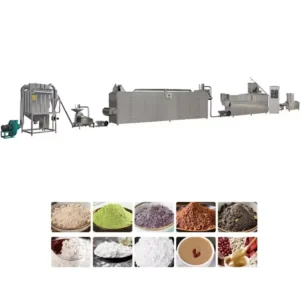
Healthy Baby Food Production Line Nutritional Powder Equipment for Baby Food Supplements for Flour Processing Machinery
¥8,500.00 Select options This product has multiple variants. The options may be chosen on the product page -

High Precision Automatic 500kg/h Baby Food Nutrition Powder Rice Extrusion Processing Line
¥9,500.00 Add to cart -

Automatic Instant Powder Production Line Nutritional Powder Extruder Machine
¥10,000.00 Select options This product has multiple variants. The options may be chosen on the product page