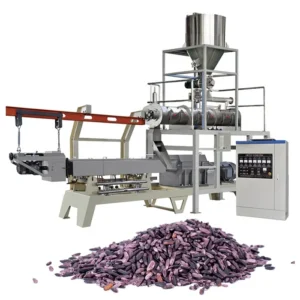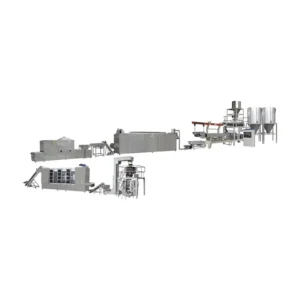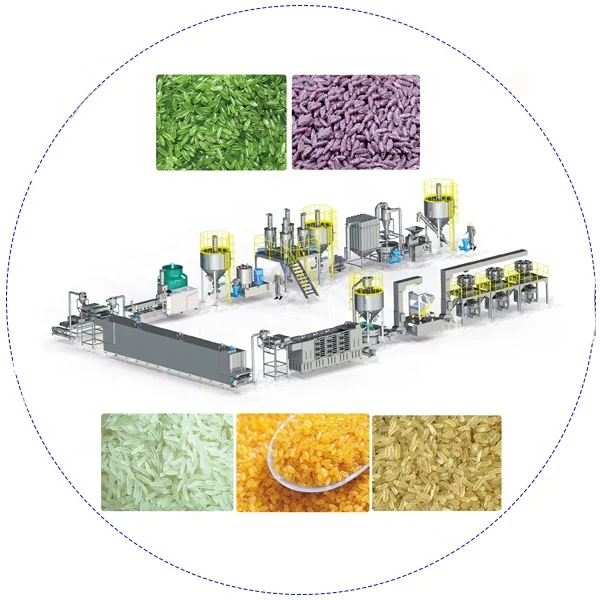


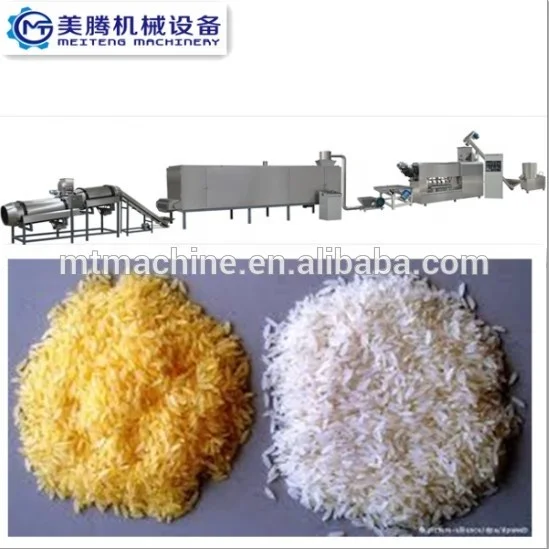

Fortified Artificial Rice Extrusion Line, Twin Screw, 110 kW Main Motor — engineered as a complete turnkey project from batching through extrusion, drying, and cooling, with throughput balanced across every station. Co-rotating twin-screw design with 2500 mm screw length ensures thorough starch gelatinisation and consistent grain density, while sectional screw modules allow precise configuration for vitamin and mineral premix formulations.
- Frequency-controlled drives on extruder, feeder, and cutter for accurate process adjustment
- Drying options include electric, gas, diesel, or steam heating to match site utilities
- Line layout, screw configuration record, and trial run report on customer raw material provided before shipment
Description
Single-supplier line integration — Every station from batching through cooling is throughput-matched under one engineering scope, eliminating the handoff gaps that stall commissioning on multi-vendor nutrition lines.
Technical Specifications
| Parameter | Value |
|---|---|
| Product Type | Fortified Artificial Rice Extrusion Line |
| Extruder Type | Co-rotating twin-screw, sectional modules |
| Main Motor Power | 110 kW (frequency control) |
| Feeder Motor Power | 1.5 kW (frequency control) |
| Cutting Motor Power | 2.2 kW (frequency control) |
| Oil Pump Power | 0.75 kW |
| Screw Length | 2500 mm |
| Mixing Machine Power | 15 kW |
| Mixing Batch Capacity | 130–150 kg/batch |
| Mixing Tank Thickness | 1.5 mm stainless steel |
| Mixing Machine Dimensions | 1450 × 1550 × 980 mm |
| Vibrating Screen Power | 0.2 kW |
| Vibrating Screen Dimensions | 1700 × 1210 × 740 mm |
| Cooling Dryer Power | 2.2 kW |
| Cooling Dryer Dimensions | 5000 × 1500 × 1900 mm |
| Cooling Dryer Belt Width | 1 m (source value — verify against manufacturer catalog) |
| Dryer Heating Type | Electric (gas / diesel / steam available on request) |
| Control System | Frequency control on extruder, feeder, and cutter |
| Output Capacity | 500 kg/h (basis not stated in source — confirm raw material blend, moisture content, and rice grain size) |
| Certification | CE |
Application Suitability
| Application | Material or Output |
|---|---|
| Micronutrient-enriched rice for institutional feeding programmes | Rice powder and corn powder base with vitamin-mineral premix |
| Artificial rice from grain flour blends | Rice flour, corn flour, and fortified starch blends |
| Breakfast grain diversification | Extruded grain kernels from milled cereal inputs |
| Nutrition intervention and food aid projects | Fortified rice analogues meeting WFP-style specifications |
What "500 kg/h" Actually Means on a Fortified Rice Line
Nominal capacity figures are meaningless unless tied to the buyer’s specific raw material formulation and target grain density.
I have watched lines ship with a rated output on standard rice flour, only for the buyer to switch to a high-fiber multigrain blend on day one of commissioning. Gelatinisation drops, throughput falls, and the extruder motor amps spike past nameplate. The extruder, dryer, and cooler were each sized for the original figure, so the bottleneck cascades downstream. A fortified rice production line turnkey project succeeds or fails on whether every station was calculated against the actual recipe, not a catalog default [NEED_CITE: starch gelatinisation behaviour across varying fiber and protein levels in extruded grain products].
Screw Configuration That Follows the Recipe
The co-rotating twin-screw extruder in this line uses sectional modules, meaning flighting elements can be rearranged along the 2500 mm barrel to match the shear and residence-time profile a specific premix demands. Forward-transport sections, kneading blocks, and reverse-flight elements are sequenced based on the raw material blend.
This modularity is what separates a generic build from a line that holds its output when the buyer introduces a new micronutrient premix or shifts from a pure rice base to a corn-rice composite. The screw configuration record is documented before the machine leaves the factory, so future recipe changes have a known baseline to work from.
Drying and Cooling Sized to the Extruder, Not Guesswork
The low-temperature dryer and the 5000 mm cooling belt are specified to handle the moisture load and thermal profile exiting the die. Electric heating is standard, with gas, diesel, or steam offered as options depending on the buyer’s utility infrastructure.
When dryer capacity lags behind extruder output, partially dried rice kernels accumulate ahead of the cooling stage, causing surface cracking and inconsistent density. The vibrating screen between extrusion and drying removes fines and undersized pieces so that only dimensionally uniform kernels enter the dryer, maintaining airflow consistency across the belt [NEED_CITE: moisture removal rates and kernel integrity in extruded rice drying].
Reading the Specs That Matter
The 110 kW main motor with frequency control gives the extruder enough torque to push high-viscosity fortified dough through the die while allowing speed adjustment as formulations change. The 2500 mm screw length provides sufficient residence time for complete starch gelatinisation, which is the factor that determines whether the final rice kernel holds its shape during cooking.
The mixing stage runs on a 15 kW motor with 130–150 kg batch capacity, meaning blend uniformity is established before material reaches the extruder feeder. Stainless steel contact surfaces at 1.5 mm tank thickness resist corrosion from acidic mineral premixes. Frequency control on the feeder (1.5 kW) and cutter (2.2 kW) keeps feed rate and cut length synchronized with screw speed, which directly governs grain size consistency.
When Undersized Stations Become a Production Ceiling
A line where the dryer belt is too short for the extruder’s moisture output forces the operator to slow the screw to avoid sending wet kernels to packing. The rated capacity becomes a theoretical number that the floor never reaches.
Similarly, if the cooling belt cannot bring kernel temperature down before bagging, condensation inside the package leads to clumping and shelf-life failures. These mismatches rarely surface during factory acceptance tests run on simple recipes; they appear weeks after the buyer starts running their actual production blend [NEED_CITE: thermal load matching between extrusion output and downstream drying capacity].
Why Engineers Specify This Line Under One Scope
Throughput calculations across mixing, extrusion, drying, and cooling are performed together, so no single station becomes the constraint that governs the entire line’s real output.
Screw and die combinations are selected based on the buyer’s submitted raw material sample and target grain specification, not pulled from a generic library. The in-house testing workshop runs the buyer’s actual formulation before shipment, generating a trial report that documents achievable output and process settings. Pre-sales consultation, layout engineering, on-site installation, and operator training remain under one supplier’s responsibility, which compresses the blame-shifting that typically delays resolution on multi-vendor projects.
Documentation & Verification
- Line layout and capacity calculation confirming throughput balance at each station
- Screw and die configuration record matched to buyer’s raw material formulation
- Trial run report on customer-supplied premix conducted before shipment
- Electrical schematic with voltage and frequency confirmed for destination market
- CE declaration of conformity for the complete assembled line
- Wear parts list covering screws, dies, and cutter blades
Installation, Commissioning & Support
- Foundation plan accounts for the 5000 mm cooling dryer length and extruder footprint
- Dedicated power circuit specified for the 110 kW extruder motor and heating load
- Stations arrive modular; assembly sequence documented in the installation manual
- First-run parameter settings validated against the pre-shipment trial report
- Operator training covers screw speed, feeder rate, and dryer temperature coordination
- Spare screw elements and die plates shipped with initial order to cover first replacement cycle
Before You Request a Quote
Provide the raw material formulation including base flours, premix composition, and target moisture content at the extruder inlet. Share the destination market voltage and frequency standards, along with the control language your operators require. If your facility has height restrictions or existing upstream milling equipment, include those dimensions so the layout can be drafted to fit [NEED_CITE: industrial voltage and frequency standards across African and South Asian markets].
Frequently Asked Questions
Q: How is the 500 kg/h capacity verified, and on which raw material blend?
A: The stated figure is a reference value that must be confirmed against the buyer’s actual formulation, moisture level, and target grain size. We conduct a trial run in our testing workshop using your supplied raw materials and document the verified output, process parameters, and grain quality in the trial report before shipment.
Q: How are screw and die configurations matched to our vitamin-mineral premix?
A: Sectional screw modules are arranged along the 2500 mm barrel based on the shear, mixing, and residence-time requirements of your specific blend. Die geometry is selected to produce the target grain shape and density. The configuration record is documented so future recipe adjustments have a known baseline.
Q: What voltage, frequency, and control language are confirmed before commissioning?
A: The electrical schematic is prepared after confirming your local power supply standards and operator language preference. This is finalized before production begins, not after arrival, so that motor ratings, heating elements, and control interface match your facility from the first power-on.
Q: Can we see a trial run on our raw material before shipment?
A: Yes. We require a sample of your actual raw material blend and run it through the extruder in our in-house testing workshop. The trial report covers output rate, motor load, grain density, and gelatinisation quality, giving you verified data before the line ships.
Q: How is drying and cooling matched to prevent bottlenecks?
A: The dryer and the 5000 mm cooling belt are sized based on the moisture load and thermal profile calculated from the extruder’s verified output on your recipe. The vibrating screen removes fines before drying to maintain uniform airflow across the belt.
Related products
-

High Quality Automatic PLC Controlled 500kg/h Twin Screw Extruder Machine for Baby Rice Nutrition Powder
¥8,238.27 Add to cart -

Automatic Instant Powder Production Line Nutritional Powder Extruder Machine
¥10,000.00 Select options This product has multiple variants. The options may be chosen on the product page -
High Productivity New Condition Nutritious Baby Food Meal Replacement Powder Production Line
¥30.00 Select options This product has multiple variants. The options may be chosen on the product page -

High Precision Automatic 500kg/h Baby Food Nutrition Powder Rice Extrusion Processing Line
¥8,238.27 Add to cart