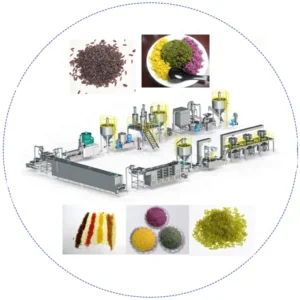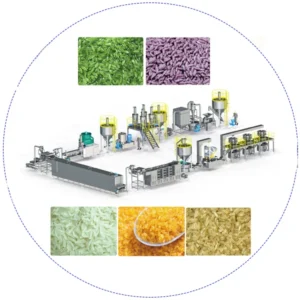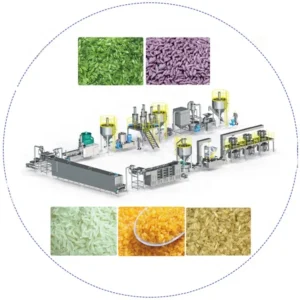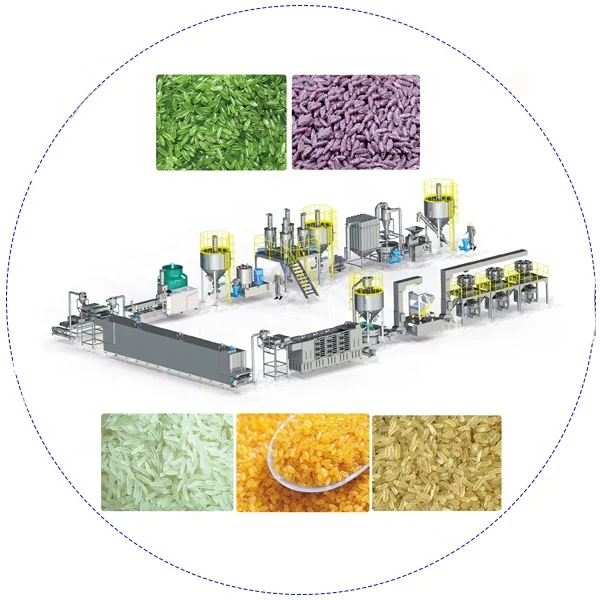


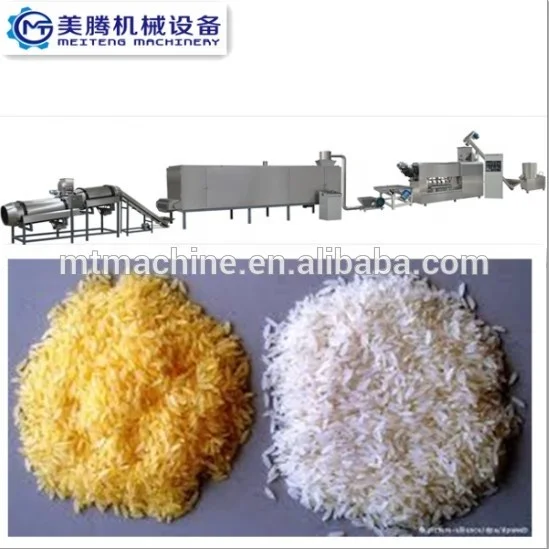

Fortified Rice Production Line, Twin-Screw Extrusion, 300–500 kg/h Output Capacity, CE Certified — configured as a complete turnkey project from batching through extrusion to packing, with throughput matched across every station.
- Co-rotating twin-screw extruder with sectional screw modules handles transport, mixing, cooking and forming in one continuous process
- Frequency-controlled drives on feeder, extruder and cutter ensure stable throughput and consistent cut length
- Low-temperature dryer with selectable heating medium and dedicated cooling dryer prevent moisture re-absorption before packing
- Designed for fortified rice, artificial rice and micronutrient-enriched staple production from rice flour and corn flour formulations
Layout, capacity calculation and screw configuration are specified to your raw material, with an in-house trial run on your formulation before shipment.
Description
Turnkey Integration Expertise — Every station in this fortified rice production line is sized to a single validated throughput, ensuring the mixing, extrusion, drying and cooling capacities are balanced to your actual raw material formulation rather than assembled from mismatched vendors.
Technical Specifications
| Parameter | Value |
|---|---|
| Product Type | Fortified Artificial Rice Processing Line |
| Extruder Type | Twin-screw, co-rotating |
| Extruder Output Capacity | 300–500 kg/h (basis not stated in source — confirm raw material formulation and moisture content) |
| Screw Length | 2500 mm |
| Extruder Main Motor Power | 110 kW (frequency control) |
| Feeder Power | 1.5 kW (frequency control) |
| Cutter Power | 2.2 kW (frequency control) |
| Oil Pump Power | 0.75 kW |
| Mixing Machine Power | 15 kW |
| Mixing Machine Capacity | 130–150 kg/batch (basis not stated in source — confirm raw material density and moisture) |
| Mixing Machine Dimensions | 1450 × 1550 × 980 mm |
| Mixing Tank Thickness | 1.5 mm |
| Stainless Steel Cover Thickness | 1.2 mm |
| Vibrating Screen Power | 0.2 kW |
| Vibrating Screen Dimensions | 1700 × 1210 × 740 mm |
| Cooling Dryer Power | 2.2 kW |
| Cooling Dryer Dimensions | 5000 × 1500 × 1900 mm |
| Dryer Heating Type | Electric heating (gas / diesel / steam available on request) |
| Control System | Frequency-controlled drives across feeder, extruder and cutter |
| Line Stations | Mixing → Twin-screw extrusion → Vibrating screen → Low temperature dryer → Cooling dryer |
| Certification | CE |
Application Suitability
| Application | Material or Output |
|---|---|
| Fortified rice for government and NGO nutritional programmes | Rice flour, corn flour, vitamin and mineral premix |
| Artificial rice from broken rice and grain by-products | Crushed rice flour, corn powder, binding agents |
| Micronutrient-enriched staple rice for institutional supply | Rice powder base with iron, zinc, folic acid and B-vitamin additives |
| Value-added rice products for cereal and grain processors | Blended rice and corn flour with custom nutrient profiles |
What "300–500 kg/h" Actually Means for Fortified Rice
Capacity figures are meaningless unless tied to a specific raw material formulation, moisture level and die configuration.
When a buyer sources a fortified rice production line based on a nameplate output number, the first commissioning week often reveals that the real throughput falls well short. The reason is almost always formulation-dependent: rice flour blended with corn powder and a vitamin premix behaves very differently under shear and heat than plain rice flour at standard moisture. Viscosity changes, barrel pressure shifts, and the extruder either surges or starves. I have seen lines stall at nearly half their quoted rate because the screw configuration was copied from a generic build rather than matched to the buyer’s actual recipe. The twin-screw extruder in this line uses sectional co-rotating modules precisely to address this — transport, mixing, cooking and forming zones are rearranged based on trial runs [NEED_CITE: twin-screw extrusion process design for starch-based products].
Screw Configuration Dictates Product Density and Grain Integrity
The twin-screw extruder at the centre of this artificial rice processing line uses a 2500 mm screw length with sectional, co-rotating modules. Each section — feed transport, liquid injection, high-shear cooking, de-gassing and metering — can be rearranged to match how your specific blend of rice flour, corn powder and micronutrient premix responds to heat and shear. This is what separates a line that produces intact, rice-shaped kernels with consistent density from one that generates excess fines or collapses after drying. The frequency-controlled feeder and cutter work together to hold cut-length steady, so every kernel leaving the die face matches the target geometry before it even enters the dryer.
Drying and Cooling Stations Sized to the Extruder, Not Picked from a Catalogue
The low-temperature dryer and downstream cooling dryer are not standalone add-ons selected by nominal airflow. Their belt width, residence time and thermal capacity are calculated against the extruder’s validated output so that moist, freshly extruded rice kernels never pile up waiting for dryer space. The heating medium — electric, gas, diesel or steam — is selected to match the utility infrastructure at the installation site. The dedicated cooling dryer downstream prevents a problem that catches many producers off guard: warm kernels packed too early re-absorb moisture from ambient air, leading to clumping or microbial risk inside the bag [NEED_CITE: moisture reabsorption in extruded food products during cooling].
Reading the Specs That Actually Matter
The 110 kW main motor with frequency control gives the extruder enough torque to handle high-viscosity doughs where corn flour content is significant, while still allowing speed adjustment for lighter rice-dominant formulations. The 15 kW mixer handles 130–150 kg per batch, which aligns with continuous extruder feeding when cycle times are staggered properly. The 0.2 kW vibrating screen sits between extrusion and drying to remove fines and oversize pieces before they enter the thermal zones, improving dryer efficiency and final product uniformity. Frequency control on the feeder, extruder and cutter means all three stations track the same speed reference, which is essential for maintaining kernel weight consistency across long production runs.
The Hidden Cost of a Mismatched Line
When the dryer capacity lags behind the extruder output, the entire fortified rice production line bottlenecks at the thermal stage. Kernels queue on the belt, over-dry on the outside while staying wet inside, and crack during cooling. The vibrating screen then rejects a larger share of broken pieces, pushing actual saleable output well below the extruder’s nameplate figure. I have walked into plants where the extruder was running fine but the dryer was the original smaller unit from a previous line layout — the result was constant shutdowns to clear the belt and a reject rate that made the whole operation unprofitable. These problems do not show up in a quotation; they appear three weeks after installation [NEED_CITE: extrusion line throughput balancing and bottleneck diagnosis].
Why Source This Line Here
Every station — mixer, twin-screw extruder, vibrating screen, dryer and cooler — is specified under one supplier, so throughput calculations are cross-checked before the line ships rather than reconciled on the factory floor. Screw and die configurations are set after trial runs using your actual rice flour and corn flour blend in our in-house testing workshop, not copied from a generic template. The line layout and capacity calculation account for your target moisture content and kernel density, not just a theoretical maximum. Electrical schematics confirm voltage, frequency and control language for the destination market before production begins. CE-certified construction with food-grade contact materials throughout ensures compliance documentation is ready for import and inspection.
Documentation & Verification
- Line layout and capacity calculation matched to your rice flour formulation and target moisture
- Screw and die configuration record specifying module arrangement for your kernel shape and density
- Trial run report on your supplied raw material conducted in the testing workshop before shipment
- Electrical schematic with voltage, frequency and control language confirmed for destination market
- CE declaration of conformity and ISO certificate included with shipping documentation
Installation, Commissioning & Support
- Foundation and utility planning based on the 110 kW extruder motor and dryer heating load requirements
- Dedicated electrical circuit specification for the frequency-controlled drives across feeder, extruder and cutter
- Multi-station assembly sequence from mixer through cooling dryer with alignment and belt tension checks
- First-run parameter setting for barrel temperature profile, screw speed and cutter timing on your raw material
- Operator training covering screw module changes, die cleaning and dryer temperature adjustment procedures
- Wear parts list with reorder specifications for screw segments, die plates and cutter blades
Preparing Your Line Inquiry
To configure a fortified rice production line that holds its rated throughput on your actual recipe, we need to understand your raw material formulation — specifically the ratio of rice flour to corn flour, any binding agents, and the micronutrient premix composition. Your target daily output and available workshop floor area with ceiling height determine the dryer length and line layout. Confirming the local voltage, frequency and preferred control language early avoids rewiring or reprogramming delays during commissioning. If you have an existing upstream batching system or downstream packing line, share the interface specifications so the new stations integrate without throughput gaps.
Frequently Asked Questions
Q: How is the 300–500 kg/h output validated for this fortified rice production line?
A: The output range is a starting reference that must be validated against your specific rice flour and corn flour ratio, premix loading and target moisture content. We conduct trial runs in our testing workshop using your actual raw material to confirm the achievable throughput, and the screw and die configuration is adjusted until the line holds a stable rate on your formulation before shipment.
Q: What voltage, frequency and control language are confirmed before the line ships?
A: We confirm your site voltage, frequency and preferred HMI language during the specification stage and lock these into the electrical schematic before production. This ensures the frequency-controlled drives on the feeder, extruder and cutter are wired correctly and the operator interface reads in your team’s language from day one of commissioning.
Q: Can the dryer heating type be changed to match our plant utility?
A: Yes. The low-temperature dryer is available with electric heating as standard, and gas, diesel or steam heating can be specified to match your existing plant infrastructure. The selection is finalised during the line layout phase so that thermal capacity and utility connections are designed into the installation plan from the start.
Q: How are the dryer and cooler matched to the extruder to prevent bottlenecks?
A: Dryer belt width, residence time and thermal capacity are calculated against the validated extruder output on your formulation, not selected independently. The downstream cooling dryer is sized to handle the same mass flow, preventing warm kernels from queuing or re-absorbing moisture before packing.
Q: Is a trial run performed on our own rice flour formulation before shipment?
A: Yes. We run your supplied raw material through the twin-screw extruder in our in-house testing workshop and document the results in a trial run report. This confirms screw configuration, die selection, barrel temperature profile and achievable throughput before the line is disassembled for shipping.
Related products
-

Hygienic Stainless Steel Infant Rice Powder Processing Line Automatic 500kg/h Capacity PLC Controlled
¥9,500.00 Add to cart -
Healthy Baby Food Production Line Nutritional Powder Equipment for Baby Food Supplements for Flour Processing Machinery
¥8,500.00 Select options This product has multiple variants. The options may be chosen on the product page -

Automatic Iron Fortified Baby Rice Cereal Nutrition Powder Making Machine 500kg/h PLC Controlled
¥8,238.27 Add to cart -

High Precision Automatic 500kg/h Baby Food Nutrition Powder Rice Extrusion Processing Line
¥9,500.00 Add to cart