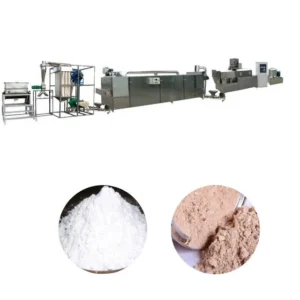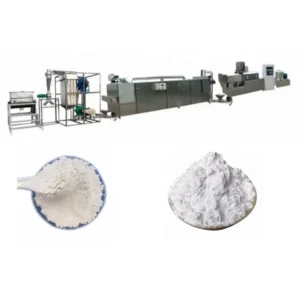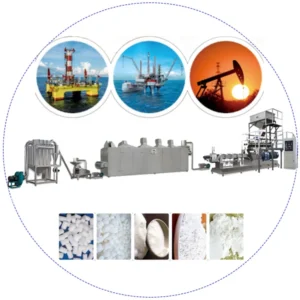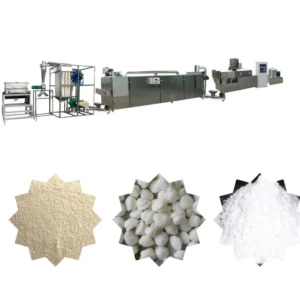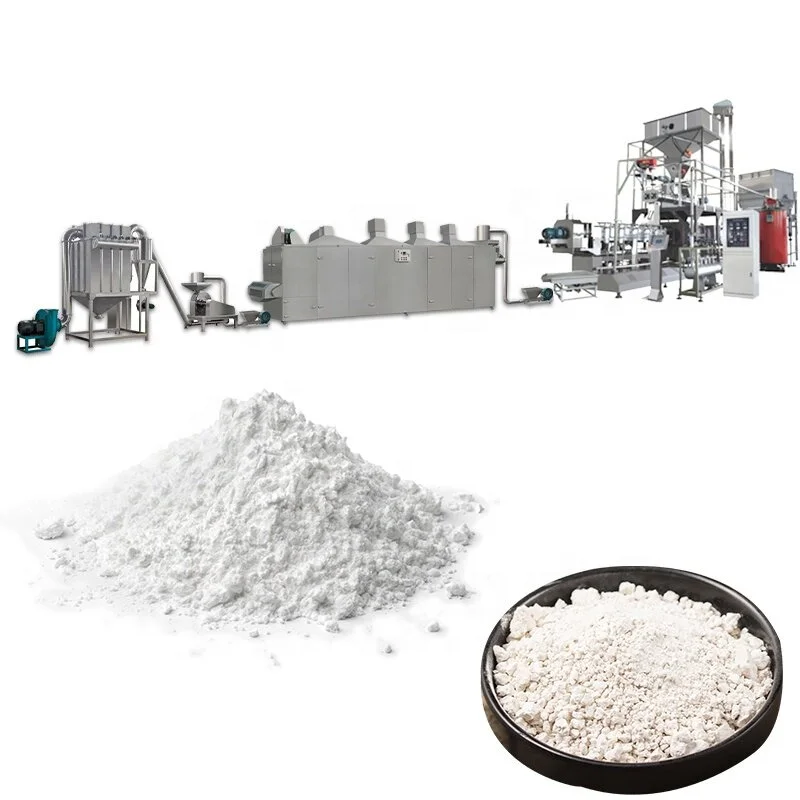


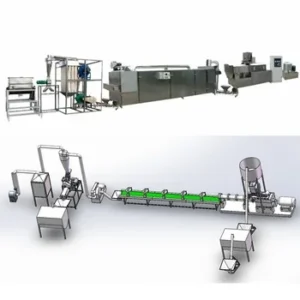
Modified Starch Processing Line, PLC Touchscreen Control, Twin-Screw Self-Cleaning Extruder, SUS304/316 Contact Parts — covering feeding, mixing, reaction, extrusion, drying and packaging under one automated system.
The line layout and screw configuration are specified to your starch variety and target modification degree, with segmented barrel temperature zones controlling reaction conditions for pregelatinized, cross-linked, oxidized and cationic variants.
- In-house trial runs on your raw material validate capacity and product specification before shipment
- Throughput matched across every station to eliminate bottleneck risk from separate-vendor assembly
- Electrical schematics and PLC language confirmed to destination site before production begins
Description
Single-Supplier Accountability — every station from batching to packaging is throughput-matched under one engineering team, eliminating the finger-pointing that happens when a modified starch line is assembled from separate vendors.
Technical Specifications
| Parameter | Value |
|---|---|
| Product Type | Modified Starch Processing Line |
| Extruder Type | Twin-screw, self-cleaning, high-torque |
| Barrel Temperature Control | Segmented zones with independent heating and cooling |
| Contact Material | SUS304/316 stainless steel, food-grade |
| Control System | PLC touchscreen, full-line automated from feeding to packaging |
| Raw Material Compatibility | Corn starch, potato starch, tapioca starch, wheat starch |
| Product Range | Pregelatinized, cross-linked, oxidized, cationic starch |
| Line Stations | Feeding, mixing, reaction, extrusion, drying, packaging |
| Output Capacity | Customizable (basis not stated in source — confirm raw material type, moisture content, target modification degree) |
| Modification Rate | High conversion (specific percentage basis not stated in source) |
| Assembly State | Complete integrated line |
| Certification | CE, ISO |
Application Suitability
| Application | Material or Output |
|---|---|
| Paper and textile sizing agents | Cross-linked starch from corn or potato base |
| Oil drilling fluid additives | Cationic starch from tapioca or wheat starch |
| Instant food and soup thickeners | Pregelatinized starch with controlled cold-water solubility |
| Construction material binders | Oxidized starch for adhesives and gypsum board |
| Pharmaceutical tablet excipients | Pregelatinized starch with tight viscosity specification |
Why "Rated Capacity" Fails on Real Starch Feedstock
Every modified starch processing line turnkey project we commission starts with the same question: what is your actual raw material and target modification degree? A line quoted on nominal throughput using generic corn starch often cannot hold that output when the buyer switches to tapioca or wheat starch with different gelatinization temperatures and shear sensitivity. Capacity must be validated on your specific feedstock before the line ships.
I spent weeks in a Bogotá plant where a competitor’s line was installed with screw profiles copied from a standard pregelatinized starch build. The customer was running tapioca starch for cross-linked grades, and the reaction zone temperature curve was completely wrong — viscosity targets were missed on every batch. The extruder had to be reconfigured from the barrel heating zones to the screw element sequence before the line could produce sellable product [NEED_CITE: starch gelatinization temperature differences across corn, potato, and tapioca varieties]. That failure could have been caught with a trial run on the customer’s actual raw material before the equipment left the factory.
Screw Configuration Determines Reaction Chemistry
The twin-screw extruder is the reaction vessel in a modified starch processing line turnkey setup. Screw element sequence, kneading block angle, and barrel zone segmentation together define the shear profile and residence time distribution inside the barrel. Pregelatinized starch requires a gentler thermal profile with controlled moisture addition to achieve full gelatinization without degrading the polymer chain. Cross-linked and cationic variants demand higher shear and precise reagent metering at specific barrel zones. Each starch variant — corn, potato, tapioca, wheat — responds differently to the same screw configuration, which is why the screw and die design must be specified to the buyer’s raw material rather than pulled from a generic build.
Throughput Matching Across Every Line Station
A modified starch line is only as fast as its slowest station. The reaction and extrusion segment may run at a steady rate, but if the dryer cannot remove moisture fast enough to reach the target final specification, product backs up and the entire line slows. Similarly, if the packaging station cannot handle the dried output rate, the dryer must be throttled back. In our turnkey projects, throughput calculations are performed across feeding, mixing, reaction, extrusion, drying, and packing as a single system. Each station is sized so that no segment becomes the bottleneck under the buyer’s specific production conditions [NEED_CITE: throughput balancing methodology for continuous food and starch processing lines].
Barrel Zones, Moisture, and Modification Degree
Segmented barrel temperature control allows the process engineer to create distinct thermal environments along the screw length. In a pregelatinized starch run, the first zones handle hydration and initial swelling, the middle zones drive full gelatinization, and the final zones control expansion and moisture reduction before the die. For oxidized starch, reagent injection points and barrel temperature must be coordinated so the oxidation reaction completes within the residence time available. The PLC touchscreen stores these temperature profiles by product recipe, enabling repeatable batch-to-batch output when the operator switches between starch grades or modification targets. SUS304/316 stainless steel contact surfaces prevent corrosion from the chemical reagents used in cross-linking and cationization reactions, maintaining hygiene standards required for food-grade and pharmaceutical-grade starch output.
The Hidden Cost of a Generic Screw Build
When an extruder arrives with screw elements chosen for a different starch type, the consequences compound through the entire production run. Wrong kneading block angles produce incomplete reaction, leaving unmodified starch granules that fail downstream viscosity tests. Incorrect die design causes uneven expansion, leading to particle size variation that forces the milling station to work harder and generate more fines. The buyer ends up running the line below rated throughput while troubleshooting product quality, burning through raw material on batches that cannot be sold [NEED_CITE: common commissioning failures in starch extrusion installations]. These problems are not visible in a factory acceptance test run on generic corn starch — they only appear when the buyer’s actual feedstock enters the hopper.
Engineering and Delivery Built Around Your Feedstock
Our in-house testing workshop runs your specific starch variety through the configured extruder before shipment, generating a trial run report that documents actual throughput, modification rate, and product specification against your target. The screw configuration and die design are recorded and matched to your raw material, not copied from a catalog build. Full-line PLC automation covers every station from feeding to packaging under one control architecture, so recipe changes for different starch grades propagate across all segments without manual coordination at each machine. Electrical schematics are prepared with your site voltage, frequency, and preferred PLC language confirmed before production begins, avoiding commissioning delays caused by mismatched power supply or untranslated interfaces. Every line ships with a documented layout showing throughput calculations for each station against your stated capacity target and raw material parameters.
Documentation & Verification
- Line layout and capacity calculation matched to your starch variety and modification target
- Screw configuration and die design record specified to your raw material
- Trial run report on customer starch conducted in testing workshop before shipment
- Electrical schematic with confirmed voltage, frequency, and PLC language
- Operation and maintenance manual with wear parts list and replacement schedule
- CE declaration of conformity and ISO certification documentation
Installation, Commissioning & Support
- Foundation and utility planning based on the complete line footprint and dryer heat load
- Dedicated electrical circuit sized to the extruder motor power and dryer heating demand
- Segmented barrel zones calibrated on-site to match the trial run temperature profile
- PLC touchscreen parameter sets loaded for each target starch modification recipe
- Operator training covering screw element inspection and self-cleaning cycle procedures
- Spare screw elements and die plates stocked based on the wear parts list provided at shipment
What We Need to Specify Your Line
To configure a modified starch processing line turnkey project, provide your base starch type (corn, potato, tapioca, or wheat), the target modification (pregelatinized, cross-linked, oxidized, or cationic), and your daily production target with moisture content at inlet and outlet. Share your site voltage, frequency, and preferred control language. If you have existing upstream mixing or downstream packaging equipment, send the interface specifications so throughput matching can account for those stations.
Frequently Asked Questions
Q: How is line capacity verified against my starch type and modification target?
A: Before shipment, your raw starch is run through the configured twin-screw extruder in our testing workshop. The trial documents actual output rate, modification degree, and product viscosity against your specification. Screw elements, barrel temperature profile, and die geometry are adjusted during this trial until targets are met, and the validated configuration is recorded and shipped with the line.
Q: How is throughput matched between reaction, extrusion, drying, and packing?
A: Each station is sized during the layout phase based on your target output and raw material parameters. The dryer capacity is calculated against the moisture removal rate required by your specific starch modification, and the packaging station is selected to handle the dried product flow. The PLC control system coordinates start-up and speed across all stations to prevent material accumulation at any point.
Q: What screw and barrel profile is used for pregelatinized versus cationic starch?
A: Pregelatinized starch runs with a gentler kneading block sequence and controlled moisture injection to achieve full granule swelling without chain degradation. Cationic starch requires higher shear zones and precise reagent metering points along the barrel. Both profiles are stored as recipes in the PLC touchscreen so operators can switch between products without manual screw reconfiguration.
Q: What voltage and control language options are confirmed before production?
A: Your site voltage, frequency, and phase configuration are confirmed during the specification stage and reflected in the electrical schematic. The PLC touchscreen interface is programmed in your preferred language before the control panel is assembled. This prevents commissioning delays that occur when power supply or operator interface mismatches are discovered after installation.
Related products
-
Big Capacity Modified Starch Production Line Making Machine
¥30.00 Select options This product has multiple variants. The options may be chosen on the product page -
Modified Starch Production Line Modified Starch Processing Line Modified Starch Extruder
¥8,580.00 Select options This product has multiple variants. The options may be chosen on the product page -
Modified and Pregelatinized Starch Processing Equipment – Pregelatinized Corn Cassava Modified Starch Puffing Machine
¥65.00 Select options This product has multiple variants. The options may be chosen on the product page -
2025 New Design Modified Starch Big Capacity Industrial Use Food Additives Core Components Motor Bearing
¥50.00 Select options This product has multiple variants. The options may be chosen on the product page