
- Backed by in-house trial runs on customer raw material before shipment, full line throughput matching across every station, and pre-confirmed voltage and control specifications.
Description
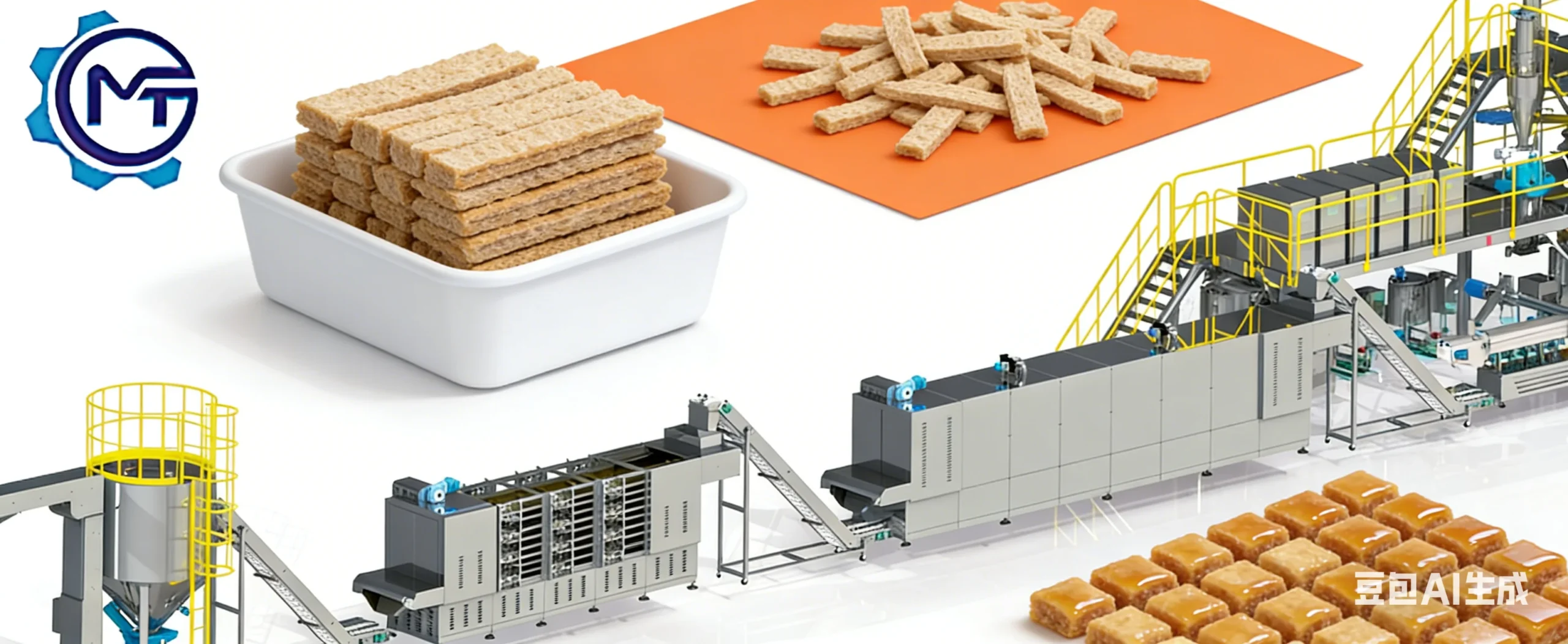
Integrated Extrusion Line Engineering — every station from the vertical mixer to the cooling conveyor is sized against the same output target, eliminating the mismatched throughput that stalls partial-vendor builds.
Technical Specifications
| Parameter | Value |
|---|---|
| Product Type | Soy Protein Vegetarian Meat Processing Line |
| Installed Power | 84 kW |
| Power Consumption | 59 kW |
| Output Capacity | 100–150 kg/h (basis not stated in source — confirm raw material formulation and moisture content) |
| Overall Dimensions | 40,000 × 1,200 × 2,200 mm |
| Screw Configuration | Twin Screw |
| Extruder Screw Length Options | 1,050 mm / 1,520 mm |
| Extruder Main Motor Power Options | 22 kW / 30 kW / 45 kW |
| Extruder Rotary Cutting Motor | 0.75 kW |
| Extruder Feeding Motor | 0.75 kW |
| Extruder Pump Motor | 0.37 kW |
| Extruder Heating Power Options | 10 kW / 14 kW |
| Mixer Type | Vertical Mixing Machine |
| Mixer Contact Material | Stainless Steel 304 |
| Mixer Power Options | 4 kW / 7.5 kW / 15 kW |
| Mixer Capacity Options | 20–30 kg / 70–80 kg / 170–180 kg |
| Dryer Drive | Double Pitch Roller Chain Drive |
| Dryer Energy Options | Fuel / Gas / Electricity |
| Dryer Control | Adjustable temperature and retention time |
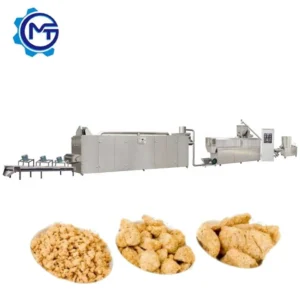
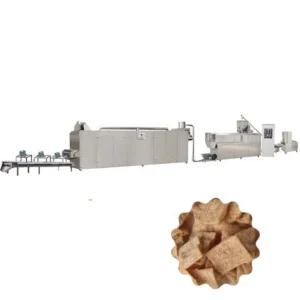
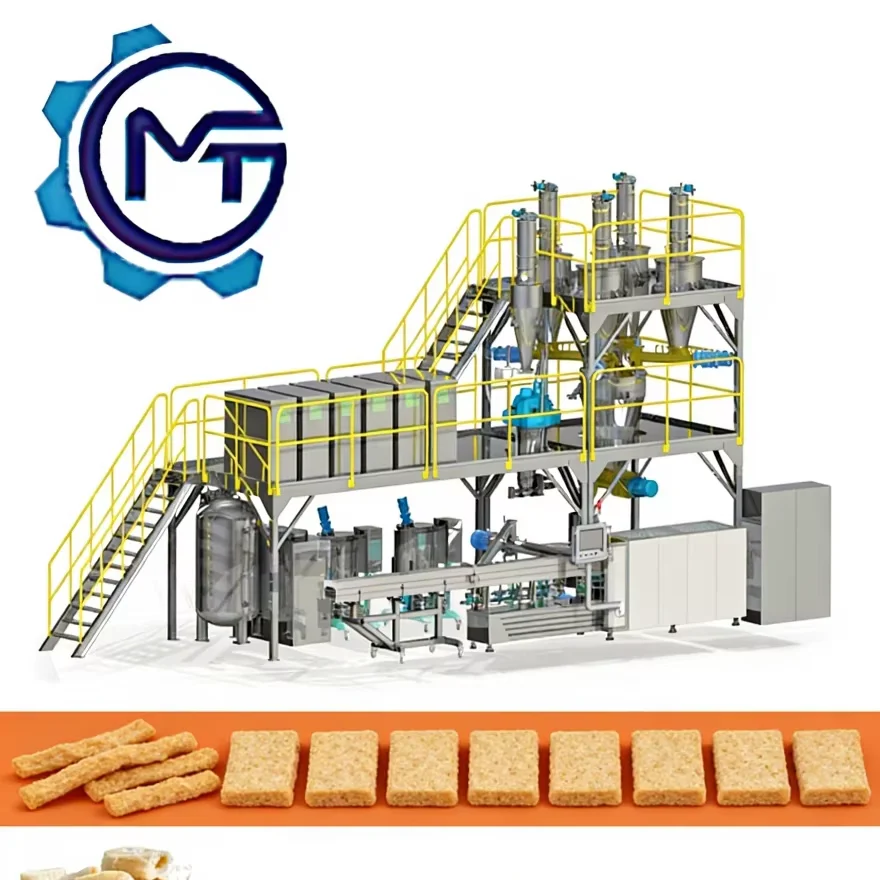
| Line Sequence | Mixer → Screw Conveyor → Twin Screw Extruder → Air Conveyor → Multi-layer Dryer → Cooling Machine |
| Conformity | CE (declared since 2014) |
Application Suitability
| Application | Material or Output |
|---|---|
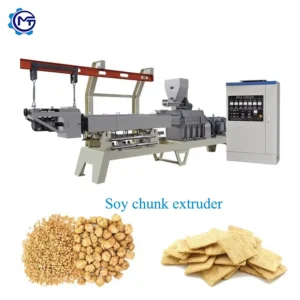
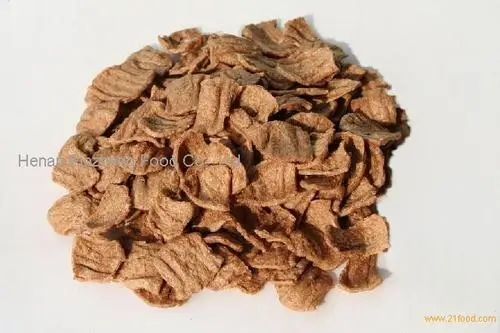
| Texturized Vegetable Protein (TVP / TSP) | Defatted soya flour, low-temperature soya flakes |
| Soy Nuggets and Chunks | Soya protein concentrate blended with starch binders |
| Meat Analogue Bases for Frozen Foods | Soybean dregs, peanut dregs mixed with functional protein |
| Vegetarian Snack and Fast-Food Ingredients | High-protein formulations requiring fibrous bite structure |
What "Rated Capacity" Leaves Out About Plant Based Meat Processing
A line quoted on a test flour will not hold that same output on the buyer’s actual defatted meal.
When a plant based meat processing line turnkey project is evaluated only by the number on the quotation sheet, the real variables — fiber content, particle size, moisture absorption rate of the local raw material — are left out of the equation. I spent years commissioning lines across Latin America, and the most expensive delays always started with a mismatch between the trial material and the production feedstock. In Peru, a twin-screw setup ran cleanly on our workshop soy flour, but when the buyer switched to a higher-fiber defatted soybean meal, the extruder could not build enough shear in the barrel, and the entire first day’s run came out as powder instead of structured fiber [NEED_CITE: raw material fiber content impact on extrusion shear]. Locking the raw material specification before the screw profile is finalized is the only way to make the capacity number mean something on the factory floor.
Throughput Matching Across Every Station
A complete plant based meat processing line turnkey project lives or dies on whether the dryer can keep up with the extruder. If the twin-screw unit pushes 150 kg/h of textured protein but the multi-layer dryer only has the belt area and thermal capacity for 100 kg/h, product piles up, moisture stays trapped, and the fibrous structure collapses before cooling even begins. This line is configured so the mixer batch size, extruder feed rate, dryer retention time, and cooling conveyor speed are all calculated against one target output before the layout is drawn.
Screw Configuration Dictates the Final Texture
The twin-screw extruder is available with screw lengths of 1,050 mm or 1,520 mm, and that choice directly determines residence time inside the barrel. A longer screw gives the protein more time under controlled shear and heat, which is necessary when working with low-temperature soya flakes that need thorough gelatinisation to form a fibrous, meat-like bite. The die design is then matched to the target format — whether the buyer needs coarse chunks, fine TVP granules, or dense nuggets — so the expansion and density stay within what the end market expects [NEED_CITE: die geometry effect on extrudate expansion ratio].
Reading the Power and Heating Specs
The extruder main motor is selectable at 22 kW, 30 kW, or 45 kW. Higher motor power delivers greater shear force inside the barrel, which becomes critical when processing high-protein formulations that resist plasticisation. The heating system options of 10 kW or 14 kW control the barrel temperature profile across multiple zones; precise zone heating is what allows the operator to manage starch gelatinisation and protein denaturation independently. The mixer, available in three capacity tiers from 20 kg to 180 kg with Stainless Steel 304 contact surfaces, ensures that each batch enters the extruder at a consistent moisture level, which is the foundation of repeatable texture across production runs.
The Hidden Cost of Skipping the Trial Run
When a line ships without a factory trial on the buyer’s actual formulation, the first week on site becomes an expensive experiment. Screw elements are swapped, die plates are re-cut, and dryer temperatures are guessed at while raw material goes to waste. I have watched entire commissioning schedules slip by days because the extruder was tuned for one protein source and the factory floor was running another. Every day of lost output on a high-capacity soy protein line compounds quickly when downstream freezing and packaging contracts are already scheduled [NEED_CITE: commissioning delay costs in food extrusion projects].
Why Source This Line as a Single Project
The line is engineered under one supplier from batching through cooling, so throughput calculations are not handed off between separate vendors who each size their station with a safety margin that creates a bottleneck elsewhere. Screw profiles and die plates are specified against the buyer’s raw material and target product format before the extruder is built. An in-house testing workshop runs trial production on the customer’s actual formulation before the line is crated for shipment. Electrical schematics are confirmed for the destination site’s voltage and frequency before the control panel is wired. Documentation covers every stage — from layout drawings through factory test records — so the contractor or factory owner has one accountable source from installation through ongoing maintenance.
Documentation & Verification
- Line layout and capacity calculation confirming matched throughput across mixer, extruder, dryer, and cooling stations
- Screw and die configuration record tied to the buyer’s specific raw material and product format
- Factory trial run report on customer-supplied raw material conducted before shipment
- Electrical schematic with voltage, frequency, and control language confirmed for destination site
- CE Declaration of Conformity and ISO certificate included with shipping documentation
Installation, Commissioning & Support
- Foundation plan based on 40,000 × 1,200 × 2,200 mm overall footprint and equipment weight distribution
- Dedicated circuit planning for 84 kW installed power with extruder main motor up to 45 kW
- Assembled and wired modular stations arriving as matched sections to reduce on-site build time
- First-run parameter setting on buyer’s raw material with screw speed, barrel temperature, and dryer retention time calibrated
- Operator training covering vertical mixer batch sequencing and multi-layer dryer temperature adjustment
- Wear parts list covering screws, dies, and cutter blades with replacement supply schedule
Preparing Your Project Inquiry
To move from a general capacity figure to a confirmed line layout, the most useful information you can provide at the inquiry stage is the exact raw material formulation — including protein content, fiber percentage, and moisture level — along with the target product format such as nuggets, chunks, or fine granules. Local voltage and frequency standards, available energy sources for the dryer (fuel, gas, or electricity), and the daily production target will allow the line to be specified as a complete, matched system. If you have existing upstream or downstream equipment that this line needs to integrate with, sharing those interface details early prevents layout revisions later.
Frequently Asked Questions
Q: How is line capacity verified on the buyer’s actual raw material before shipment?
A: The buyer sends a representative batch of their formulation — defatted soya flour, soya flakes, or a custom blend — to the in-house testing workshop. The twin-screw extruder is fitted with the specified screw profile and die, and a trial run is conducted. Output rate, product texture, moisture content, and fiber structure are recorded in a trial run report that ships with the line.
Q: How are screw configuration and die design selected for different TVP or nugget formats?
A: The screw elements are arranged along the 1,050 mm or 1,520 mm shaft to control shear intensity and residence time based on the protein content and desired fiber structure. The die plate aperture shape and size are then chosen to produce the target expansion ratio — larger openings for coarse chunks, smaller ones for fine TVP granules — so density matches what the end market expects.
Q: What voltage, frequency, and control language options are confirmed before commissioning?
A: Before the control panel is wired, the buyer confirms the site voltage and frequency — whether 380V/50Hz, 440V/60Hz, or another local standard — and the preferred language for the operator interface. The electrical schematic is then drawn to match, preventing the commissioning delays that happen when a panel arrives configured for a different grid standard.
Q: How is throughput matched between the extruder, dryer, and cooling stations?
A: Each station is sized during the layout phase against the same target output. The extruder feed rate, multi-layer dryer belt area and retention time, and cooling conveyor speed are all calculated so that product flows continuously without accumulation at any transfer point, which protects the fiber structure from collapsing under its own weight.
Q: What spare wear parts are included and how is replacement supply managed?
A: The shipment includes a wear parts list identifying screws, die plates, and cutter blades with expected service intervals. Initial replacement sets can be included in the first shipment, and subsequent orders are fulfilled against the recorded screw and die configuration so that replacement parts match the original tooling exactly.
Related products
-
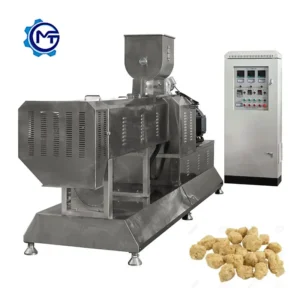
Soy Bean Meat Protein Production Line Machine Multi-functional Extruder for Soy Protein Food
¥8,650.00 Select options This product has multiple variants. The options may be chosen on the product page -
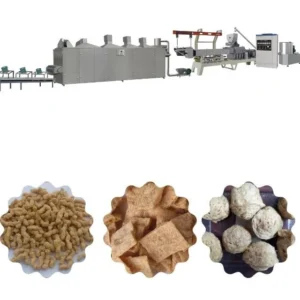
High Productivity Single Screw Extruder Machine New Condition Textured Soya Meat & Soy Protein Like Meat Making Machine
Price range: ¥20.00 through ¥30.00 Select options This product has multiple variants. The options may be chosen on the product page -
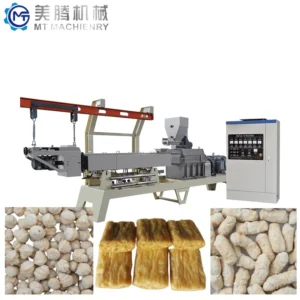
Small Multifunctional Textured Soy Protein Machine – Soy Protein Production Line – Vegetarian Meat Processing Equipment
¥65.00 Select options This product has multiple variants. The options may be chosen on the product page -
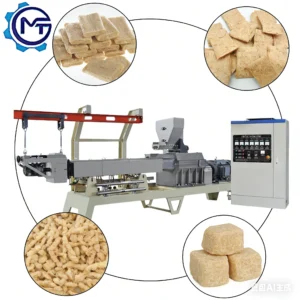
Twin Screw Extruder for Textured Vegetable Protein (TVP)
¥9,500.00 Select options This product has multiple variants. The options may be chosen on the product page