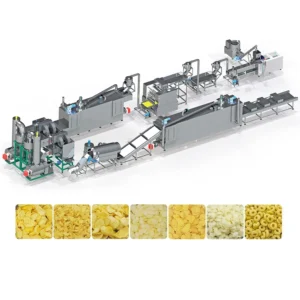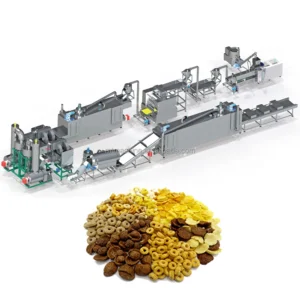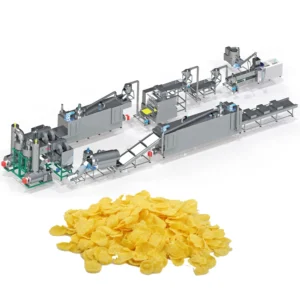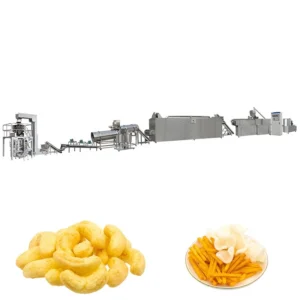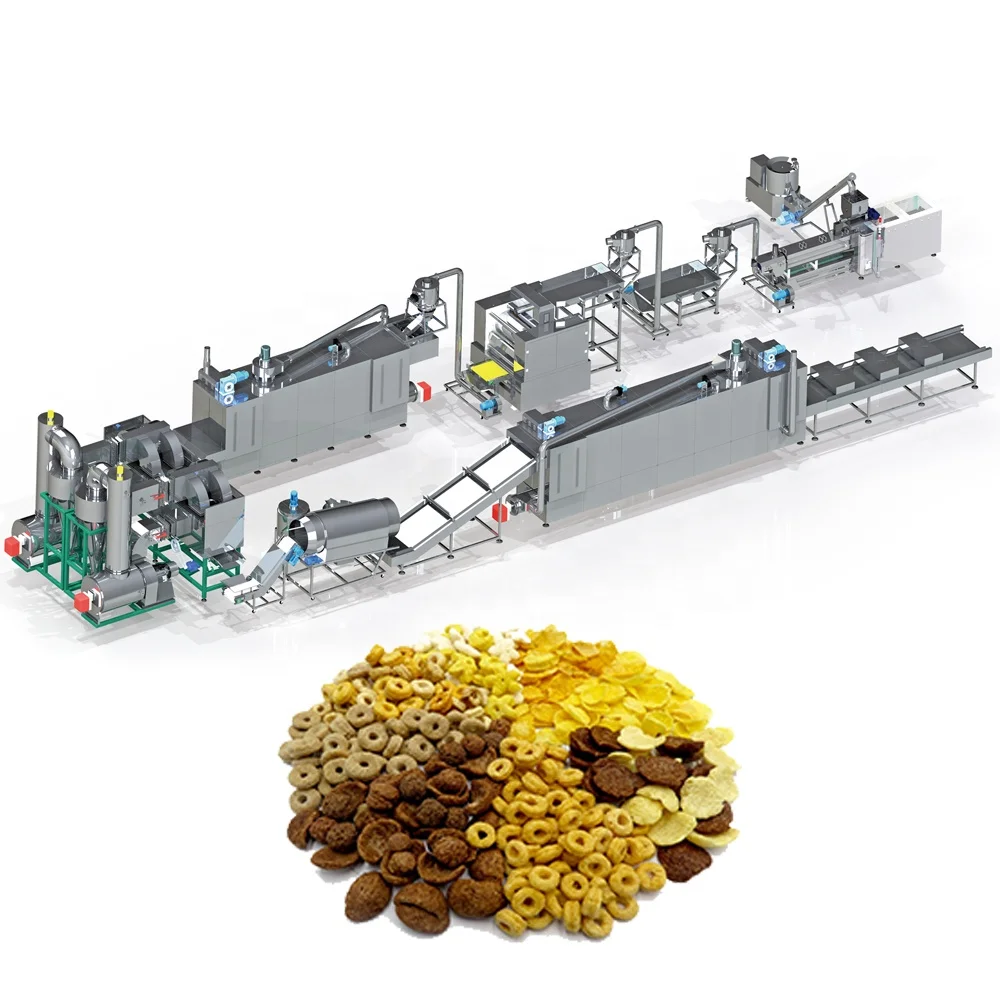



Corn Flakes Production Line, Twin-Screw Extrusion, Gas-Fired Oven, PLC Control — designed for complete breakfast cereal processing from mixing to packing.
- Twin-screw extruder with sectional co-rotating modules ensures precise starch gelatinization and de-gassing
- Adjustable flaking roller gap with dedicated cooling system maintains consistent flake thickness
- Throughput-matched stations eliminate bottlenecks across extrusion, drying, and coating
Factory trial runs on your raw material verify capacity before shipment.1
Description
Integrated Turnkey Line Engineering — Every station in this corn flakes production line is throughput-matched and factory-trialed on your exact flour blend before dispatch, avoiding the mismatched capacities that occur when sourcing mixing, extrusion, flaking, and drying from separate vendors.
Technical Specifications
| Parameter | Value |
|---|---|
| Product Type | Corn Flakes Production Line |
| Extruder Model | MT-65 Twin Screw (co-rotating, sectional screw modules) |
| Line Configuration | Mixer → Screw Elevator → Extruder → Elevator → Dryer → Elevator → Coating → Vibrating Spreader → Elevator → Dryer → Cooling Conveyor |
| Mixer Output | 10–30 kg/load (basis to be confirmed for continuous throughput) |
| Mixer Power / Tank Size | 4 kW / φ600 × 500 mm |
| Flaking Machine Roller Size | 510 × 310 × 1050 mm |
| Flaking Machine Power | 16.12 kW |
| High-temperature Oven Dimensions | 4.5 × 1.4 × 1.8 m |
| High-temperature Oven Power / Heating | 3.75 kW / Gas, both-side baking |
| Sugar Spraying System Power | 28.75 kW |
| Sugar Spraying System Components | Conveyor, melting tank, temperature-keeping roller |
| Voltage & Frequency | Customizable (e.g., 3ph 380V 50Hz, 3ph 415V 60Hz) |
| Standards | CE |
Application Suitability
| Application | Material or Output |
|---|---|
| Corn flakes from maize flour | Standard and degerminated corn grits |
| Multi-grain flaked cereal | Blends of corn, rice, and oat powders |
| Sugar- or honey-coated cereal | Coated breakfast flakes with syrup application |
| Fortified breakfast cereal | Vitamin-enriched grain blends |
| Shaped extruded cereal | Rings, balls, stars, sticks via interchangeable moulds |
What "Nominal Capacity" Leaves Out on a Corn Flakes Line
A rated output only matters when measured against your specific raw material.
I remember shipping a line to a buyer who specified a target capacity based on fine corn flour. When they ran coarse corn grits locally, the extruder couldn’t achieve the same gelatinization degree, and the flakes disintegrated in milk. The actual output was barely half of what they expected. A corn flakes production line turnkey project must be validated against the exact material the buyer intends to run, not a generic benchmark [NEED_CITE: raw material particle size impact on twin-screw extrusion throughput].
Screw Configuration and Gelatinization Control
The twin-screw extruder uses sectional, co-rotating screw modules rather than a fixed, single-piece screw. This allows the screw profile to be rearranged depending on whether the buyer is running pure corn, a multi-grain blend, or a starch-heavy recipe. Proper gelatinization requires precise control over residence time and shear within the barrel, and modular screws make it possible to tune those variables rather than accept a generic build.
Flaking Roller Precision and Cooling
Consistent flake thickness depends on the adjustable gap between the flaking rollers and a dedicated cooling system that prevents the half-cooked pellet from sticking or smearing. The 510 × 310 × 1050 mm roller assembly maintains surface temperature stability during continuous runs. Without active cooling, the roller surface heats up from friction, causing uneven compression and flakes that vary from batch to batch [NEED_CITE: flaking roller temperature control in breakfast cereal processing].
Oven Uniformity and Coating Integration
The gas-fired, both-side baking oven provides uniform heat distribution across the conveyor width, which is critical for achieving the crispness that breakfast cereal markets expect. Downstream, the sugar spraying system uses a temperature-keeping roller to maintain syrup viscosity, ensuring that honey or sugar coatings distribute evenly rather than pooling or crystallizing on the flake surface.
Interpreting the Key Specifications
The MT-65 extruder operates with co-rotating twin screws, which is necessary for corn flakes because the dough requires high-shear mixing and de-gassing before forming into pellets. The barrel temperature profile must be matched to the starch gelatinization point of the grain blend, and sectional screw modules allow the manufacturer to adjust the compression ratio. The flaking machine’s 16.12 kW power rating drives the large-diameter rollers with enough torque to compress warm pellets into thin, uniform flakes without fracturing them. On the coating side, the 28.75 kW sugar spraying system includes a melting tank and temperature-keeping roller, which matters because syrup viscosity changes rapidly with temperature drops — inconsistent viscosity leads to over-coated clusters or under-coated flakes that fail the crunch test.
The Hidden Cost of Mismatched Station Capacity
When a buyer sources the extruder, dryer, and coating drum from different vendors, the throughput of each station rarely aligns. A corn flakes production line turnkey project assembled this way often results in the extruder running at full capacity while the dryer becomes a bottleneck, forcing the entire line to slow down. The oven might be sized for a different belt speed, leaving flakes under-baked or over-dried. These imbalances are not apparent until the line is running in the buyer’s facility, at which point the cost of correction is substantial [NEED_CITE: throughput matching in multi-station food processing lines].
Why Procure This Line Here
Every station — from the 4 kW flour mixer through the twin-screw extruder, the gas-fired oven, and the sugar spraying system — is configured under a single supplier, meaning throughput calculations account for the entire chain rather than individual machines. The screw and die configuration is specified to the buyer’s raw material and target flake density, not copied from a generic catalogue. Before shipment, the complete line undergoes a trial run in the in-house testing workshop using the buyer’s actual flour blend, producing a documented test report. Electrical schematics and voltage settings are confirmed against the buyer’s facility power supply before production begins. Spare screw modules, dies, and roller surfaces are catalogued and available for dispatch when the first replacement cycle is due.
Documentation & Verification
- Line layout and capacity calculation matched to your grain blend and target flake density
- Screw and die configuration record specified to your product, not a generic template
- Trial run report on your raw material from the in-house testing workshop
- Electrical schematic and voltage confirmation aligned to your plant’s power supply
- Operation and maintenance manual covering all stations from mixer to cooling conveyor
Installation, Commissioning & Support
- Foundation planning based on the 4.5 m oven and full line footprint requirements
- Voltage and frequency confirmation for the customizable 3-phase supply before wiring begins
- On-site assembly and alignment of the flaking machine roller gap to specification
- First-run parameter setting for barrel temperature profile and screw speed
- Operator training covering screw module replacement and coating system maintenance
- Wear parts list including screw modules, dies, and flaking roller surfaces
Preparing Your Inquiry
To move forward with a corn flakes production line turnkey project, provide the specific grain flour or blend you intend to process, your target daily output, and your facility’s voltage and frequency standard. Include your workshop dimensions and ceiling height so the layout can be planned before production. If you require a trial run on your material before shipment, specify the recipe and expected flake thickness.
Frequently Asked Questions
Q: How is the line capacity verified on my specific raw material?
A: Before the line ships, a trial run is conducted in the testing workshop using your exact flour blend. The resulting test report documents the achievable throughput, gelatinization degree, and flake quality. This ensures the capacity figure is based on your material, not a generic benchmark.
Q: Can voltage, frequency, and control language match my plant’s standard?
A: The electrical system is customizable — options include 3-phase 380V at 50Hz, 415V at 60Hz, and other configurations. Voltage and frequency are confirmed during the specification stage, and control panel labeling can be set to your preferred operating language before dispatch.
Q: How is throughput matched between the extruder, flaker, and oven?
A: Each station is sized as part of a single line calculation. The extruder output, flaking machine roller speed, and oven belt speed are coordinated so that no station creates a bottleneck. This matching is documented in the line layout and capacity calculation provided before order confirmation.
Q: What spare wear parts are supplied, and how are replacements handled?
A: The wear parts list includes screw modules, extruder dies, and flaking roller surfaces. These are catalogued by specification, and replacements can be dispatched based on the configuration record held for your line, ensuring compatibility without requiring new measurements.
Related products
-
Automatic 500kg/h Corn Flakes Making Machine New Condition High Productivity Sweet Breakfast Cereal Processing Line From Factory
¥8,500.00 Select options This product has multiple variants. The options may be chosen on the product page -
Cereals Corn Flakes with Sugar Corn Flakes Extrusion Food Machine Breakfast Cereal Production Line
¥23,000.00 Select options This product has multiple variants. The options may be chosen on the product page -
Sweet Corn Flakes Maize Breakfast Cereal Full-automatic Food Grade Stainless Steel Heat Exchanger Mixer Fryer Processing Line
¥8,000.00 Add to cart -

MT Cocoa Flour Puffed Breakfast Cereal Production Line-High Large Capacity Multi-Fuel (Steam/Gas/Electric) New Shandong Origin
¥8,000.00 Select options This product has multiple variants. The options may be chosen on the product page