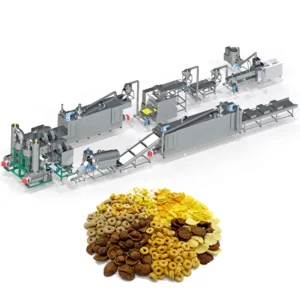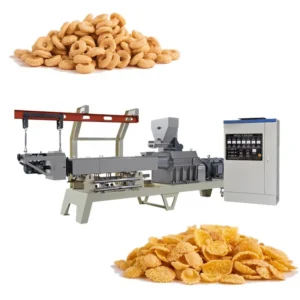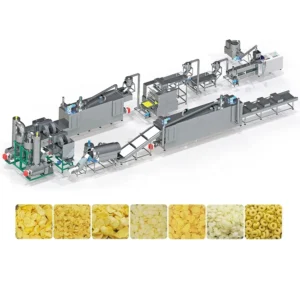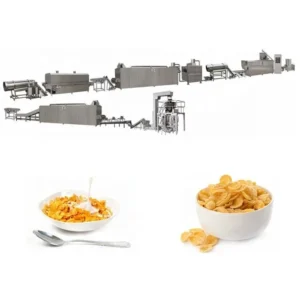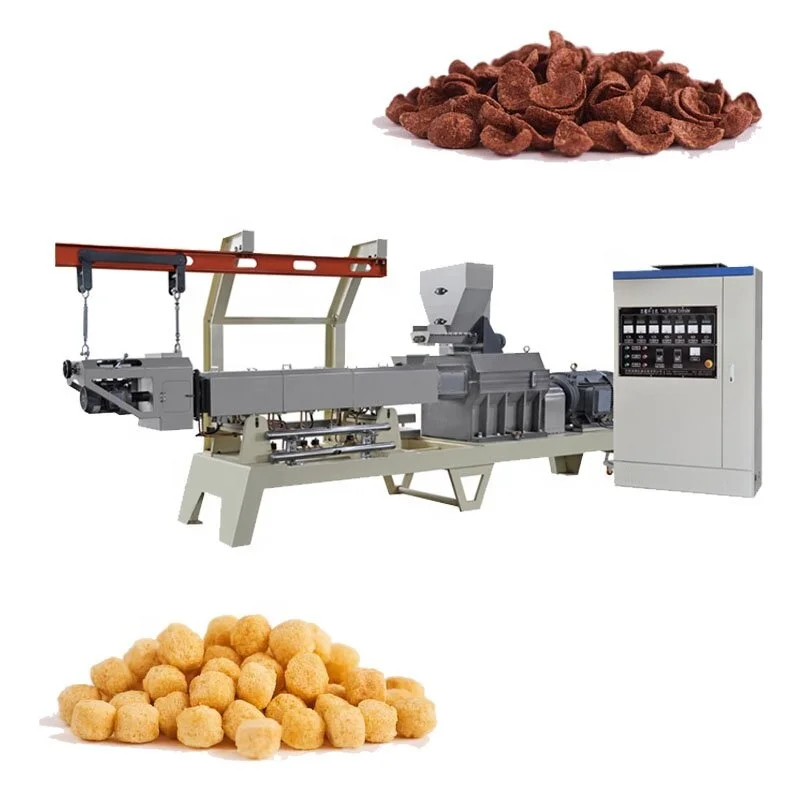
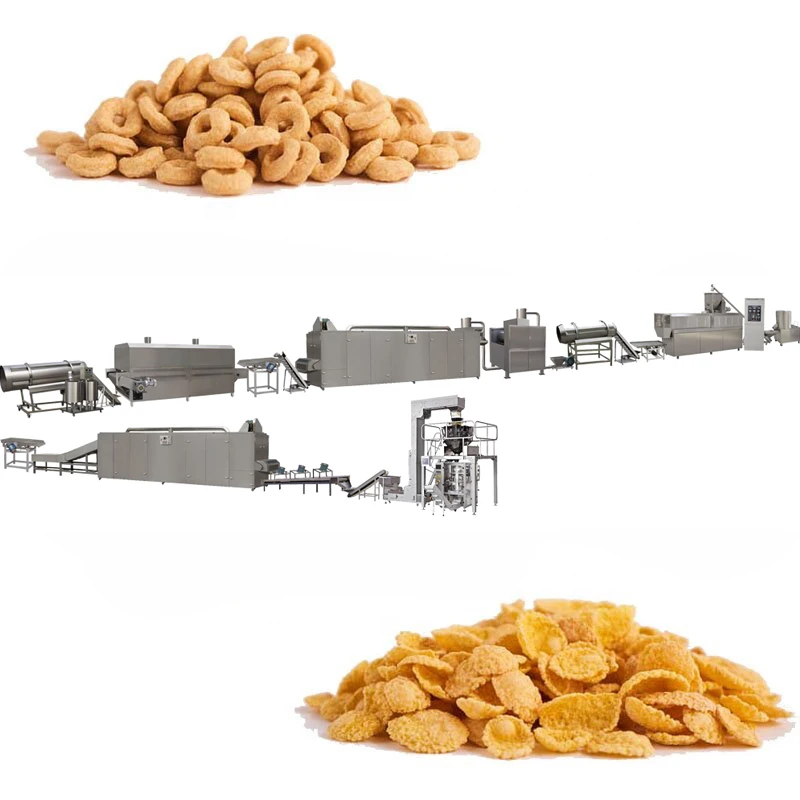
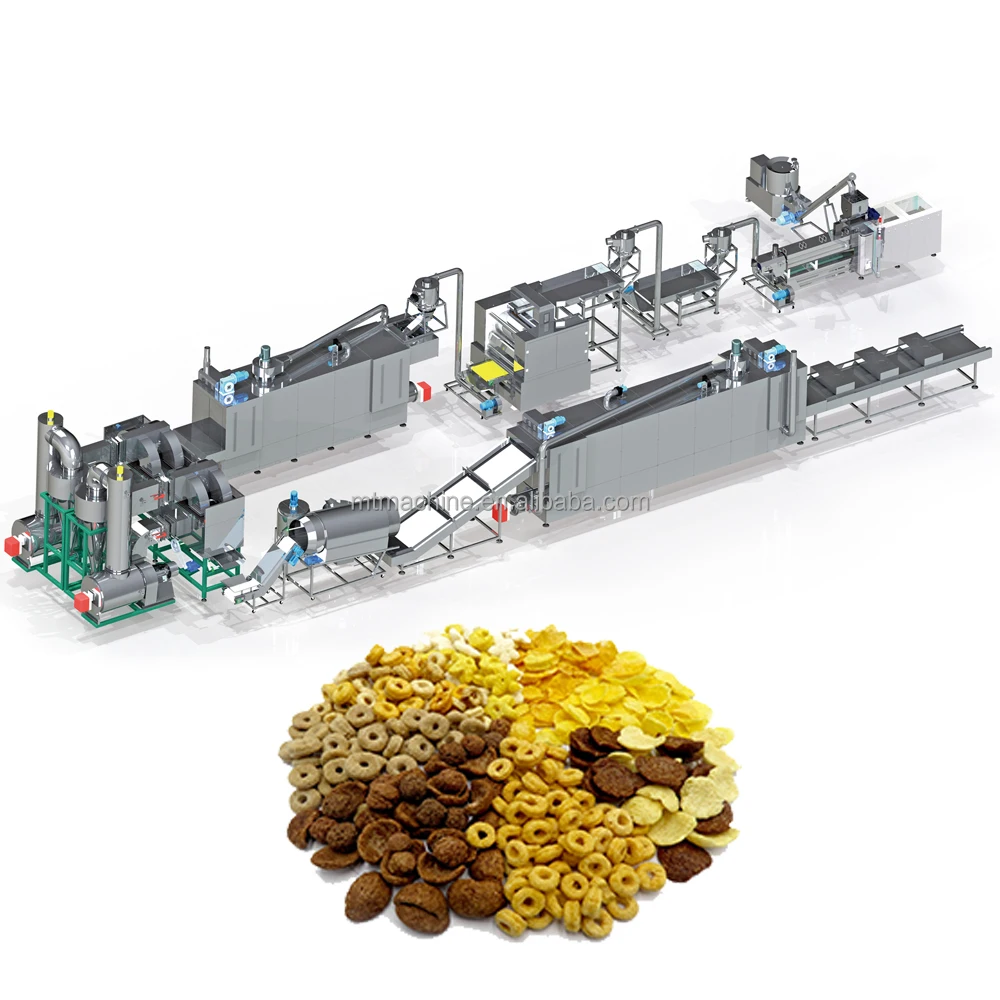


MT70 Corn Flakes Production Line, Twin-Screw Extruder, PLC & MCC Control — engineered as a complete turnkey project from batching through extruding, flaking, roasting, coating and packing. Screw configuration and die design are matched to your specific corn blend, moisture content and target flake density, with throughput balanced across every station to eliminate bottlenecks. Line layout is customised to your factory dimensions, and a trial run on your raw material is completed in our testing workshop before shipment.
Description
Integrated Line Engineering — Every station from mixing to packing is throughput-matched on this corn flakes production line turnkey, eliminating the bottleneck risk of assembling from separate vendors.
Technical Specifications
| Parameter | Value |
|---|---|
| Product Type | Corn Flakes Production Line |
| Model | MT70 (also available in MT85 and MT75 variants) |
| Extruder Type | Twin Screw |
| Installed Power | 160 kW (MT70); 190 kW (MT85); 210 kW (MT75) |
| Power Consumption | 120 kW (MT70); 140 kW (MT85); 150 kW (MT75) |
| Output Capacity | 150-200 kg/h (MT70); 300-400 kg/h (MT85); 300-500 kg/h (MT75) (basis not stated in source — confirm raw material, moisture content and flake thickness) |
| Overall Dimensions | 41 × 1.5 × 2.2 m (MT70); 43 × 1.5 × 3.2 m (MT85); 45 × 1.5 × 3.5 m (MT75) |
| Control System | PLC and MCC |
| Flaking Machine | Hydraulic double-roller system with separate dual motors and infrared temperature sensing |
| Dryer Heating Source | Gas or Electric (configurable) |
| Roasting Oven | Vibrating pan, conciliation burner, dual circulating fans, cyclone dust removal |
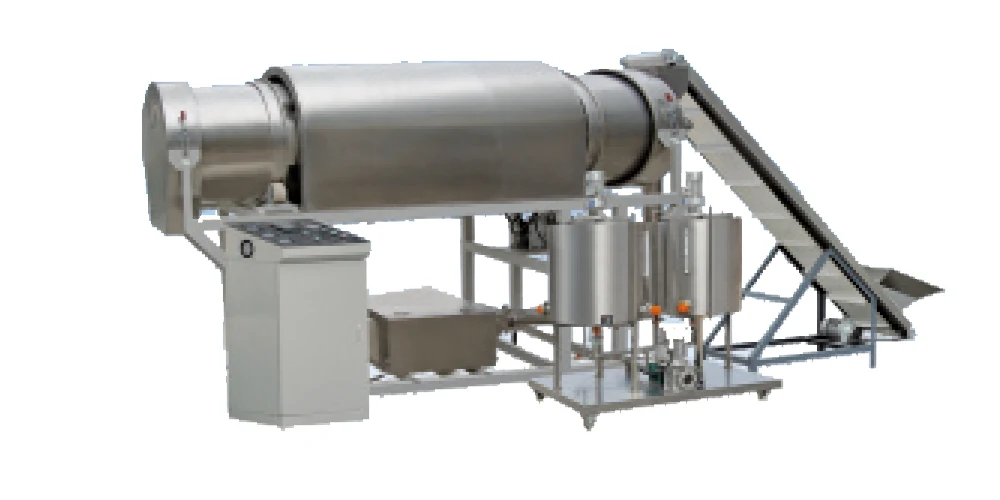
| Coating System | Double tumble melting drum, elevator, coating drum, spraying nozzle |
| Basic Raw Materials | Corn, rice, wheat, oat, barley powder |
| Certifications | CE; ISO |
Application Suitability
| Application | Material or Output |
|---|---|
| Natural corn flakes production | Corn grits and corn flour blends |
| Sugar-coated breakfast cereal | Corn, rice, or multi-grain flakes with sugar or honey coating |
| Multi-grain flaked cereal | Wheat, oat, barley, and rice powder formulations |
| Shaped extruded cereal formats | Ball, tube, ring, star, wheel, and flower shapes via interchangeable dies |
| Fortified nutrition cereal | Vitamin- and mineral-enriched grain blends for institutional programmes |
| Turnkey cereal plant projects | Full line from batching through packing for new or expanding facilities |
What Nominal Capacity Figures Leave Out About Cereal Lines
Line capacity is only meaningful when stated against a specific raw material, moisture content, and target flake thickness.
A cereal extruder quoted at a nominal hourly output often cannot sustain that rate on the buyer’s actual corn blend. The starch gelatinisation window, dough viscosity, and flaking behaviour all shift with raw material composition. When throughput at the extruder exceeds what the dryer or roasting oven can handle, flakes pile up on the conveyor, absorb ambient moisture, and lose the crispness the market demands. This mismatch is the most common reason a corn flakes production line turnkey project fails to meet expectations after commissioning [NEED_CITE: cereal extrusion throughput and downstream matching requirements].
How the Twin-Screw Extruder Handles Variable Grain Blends
The MT70 line uses a twin-screw extruder with an automatic lubricating and cooling system across the barrel sections. This configuration manages the shear and thermal profile needed for starch gelatinisation in corn, rice, and multi-grain formulations. Screw segments are arranged to control residence time and dough conditioning before the material reaches the die. Consistent gelatinisation at this stage determines whether the downstream flaker can produce uniform thickness without cracking or uneven edges.
From Extrusion Through Flaking to Roasting
The flaking station uses a hydraulic double-roller system driven by separate motors, with an infrared sensor monitoring temperature across the roller surface. This setup maintains even flake density, which directly affects how the product behaves in the hot air roasting oven. The roasting oven’s dual circulating fans and cyclone dust removal ensure that heat distribution across the vibrating pan produces the surface blistering and crispness that define a quality corn flake [NEED_CITE: flake density and roasting profile in breakfast cereal processing].
Screw Configuration and Die Design for Flake Geometry
The extruder’s screw arrangement and die aperture determine the pellet shape and size before flaking. For corn flakes, a specific die produces the cylindrical pellet that the flaker compresses into the characteristic thin sheet. The screw surface treatment resists wear from abrasive grain particles over extended production runs. When raw material changes — switching from corn to an oat-blend, for example — the screw configuration and barrel temperature profile must be adjusted to maintain the correct dough viscosity and expansion behaviour. The PLC control system stores these parameter sets, enabling batch-to-batch repeatability across different product formulations.
The Cost of Ignoring Throughput Matching Between Stations
An extruder that outpaces the dryer creates a queue of wet pellets waiting to be flaked and dried. Those pellets cool, stiffen, and resist uniform compression, producing flakes with internal fractures that shatter during roasting and packing. The roasting oven, in turn, cannot apply even surface blistering to a flake with inconsistent moisture content. The result is a final product that fails the density and bowl-life specification the buyer’s market requires, with no single vendor accountable for the mismatch [NEED_CITE: breakfast cereal line throughput mismatch failure modes].
Why This Line Is Engineered as a Single Project
Every station on this corn flakes production line turnkey is sized so that output from the extruder matches the capacity of the flaker, dryer, roasting oven, and coating drum. The line layout is configured to your factory dimensions and ceiling height before production begins. An in-house testing workshop runs your specific raw material through the extruder and flaker before shipment, confirming flake density and roasting behaviour. Electrical schematics are confirmed against your local voltage and frequency supply. The PLC and MCC control system is programmed in your operator’s language before the line leaves the factory.
Documentation & Verification
- Line layout and capacity calculation matching your factory footprint and throughput target
- Screw and die configuration record specified to your raw material and flake density requirement
- Electrical schematic with voltage and frequency confirmation for your local supply
- Trial run report on your raw material conducted before shipment
- CE declaration of conformity and ISO certificate for import compliance
- Operation and maintenance manual with wear parts list for first-year planning
Installation, Commissioning & Support
- Foundation and utility planning based on the 41 m line length and 160 kW installed power requirement
- Electrical connections verified against confirmed voltage and frequency before motor start-up
- PLC and MCC control system commissioned with parameter sets for each raw material formulation
- Operator training covering screw configuration changes, flaker roller adjustment, and roasting oven tuning
- Wear parts list including screws and dies stocked for first-year production continuity
- Ongoing maintenance support covering hydraulic system servicing and infrared sensor calibration
What We Need to Configure Your Line
To specify the correct extruder variant, flaker capacity, and dryer configuration for your corn flakes production line turnkey, we need your target raw material blend and its moisture range, your daily output requirement, and your available factory floor dimensions with ceiling height. Please also confirm your local voltage and frequency supply, the preferred control language for your operators, and whether you require sugar-coated output alongside natural flakes.
Frequently Asked Questions
Q: How is line capacity verified against my specific corn blend and target flake thickness?
A: We run your actual raw material through the extruder and flaker in our in-house testing workshop before shipment. The trial run confirms gelatinisation behaviour, pellet consistency, and flake density against your market specification. The results are documented in a trial run report, so product development is completed at the factory rather than deferred to post-installation.
Q: How do you prevent bottlenecks between the extruder, flaker, and dryer?
A: Each station is throughput-matched during the layout and engineering phase. The extruder output rate, flaker roller speed, dryer belt capacity, and roasting oven residence time are all calculated against the same raw material and moisture profile. This prevents wet pellets from queuing between stations and compromising flake quality.
Q: Can the line layout fit within my existing factory footprint and ceiling constraints?
A: Yes. The line layout is designed around your factory dimensions during the proposal stage. The MT70 variant requires approximately 41 m in length with a 2.2 m height profile, and the layout is adjusted to your available space, utility connection points, and material flow direction before any equipment enters production.
Q: What operator training is included, and which wear parts should I stock?
A: Training covers PLC operation, screw configuration changes, flaker roller gap adjustment, and roasting oven parameter tuning. A wear parts list is provided specifying screws, dies, and roller surfaces recommended for your first year of production based on your raw material abrasiveness and planned shift schedule.
Related products
-
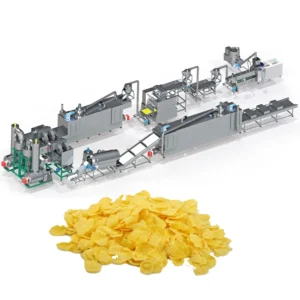
New High Efficiency Electric Corn Flakes Production & Manufacturing Machine
¥7,500.00 Select options This product has multiple variants. The options may be chosen on the product page -
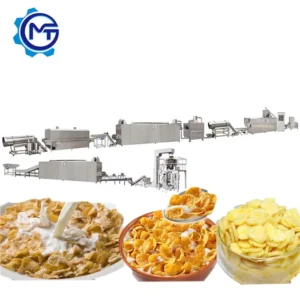
Sweet Corn Flakes Maize Breakfast Cereal Full-automatic Food Grade Stainless Steel Heat Exchanger Mixer Fryer Processing Line
¥8,000.00 Add to cart -
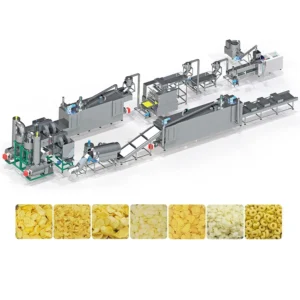
Automatic Cornflakes Making Machine Corn Flakes Breakfast Cereals Processing Production Line
¥500.00 Select options This product has multiple variants. The options may be chosen on the product page -
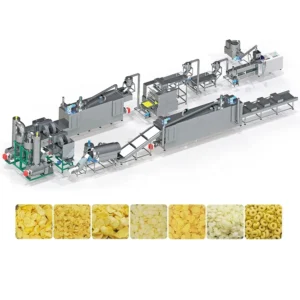
Whole Grain Choco Hoop Crunchy Wheat Cereal Ring Fruit Loops Snacks Extruder Machine /breakfast Cereals Corn Flakes Production
¥48,000.00 Select options This product has multiple variants. The options may be chosen on the product page