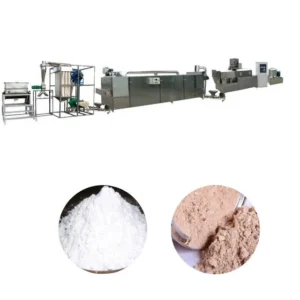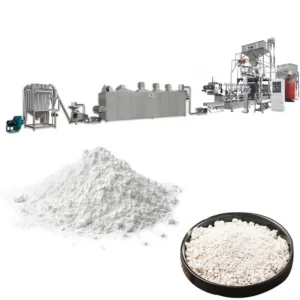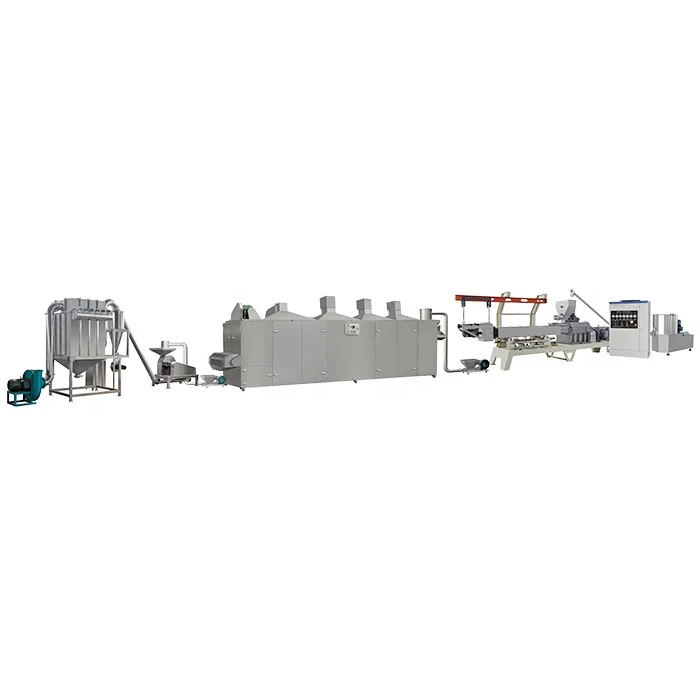


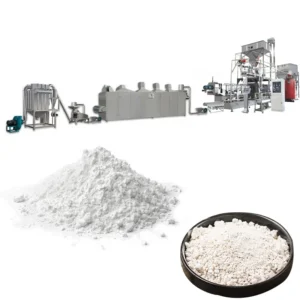
MT70 / MT85 / MT75 Modified Starch Extrusion Production Line, Twin-screw, 380V/50Hz — configured as one integrated turnkey project with matched throughput from batching to grinding.
- 7-zone barrel heating with integrated cooling for precise gelatinisation temperature control across potato, cassava, corn and wheat starch
- Screw configuration and die design specified to raw material and target modification level
- PLC and MCC control across all stations with dryer fuel flexibility (gas, diesel, electricity, steam)
Trial runs conducted on buyer’s actual raw material in the in-house testing workshop before shipment, with line layout and capacity calculation documents provided for complete utility planning.
Description
Integrated Turnkey Layout — Every station from mixing to pulse grinding is throughput-matched under one supplier, so a modified starch processing line turnkey project avoids the bottleneck traps that emerge when extruders, dryers and grinders are sourced from separate vendors.
Technical Specifications
| Parameter | Value |
|---|---|
| Product Type | Modified Starch Extrusion Production Line |
| Model | MT70 / MT85 / MT75 |
| Screw Type | Twin-screw |
| Screw Diameter | 70 mm (MT70) |
| Screw Material | 38CrMoAl |
| Installed Power | 160 kW (MT70) / 190 kW (MT85) / 210 kW (MT75) |
| Power Consumption | 120 kW (MT70) / 140 kW (MT85) / 150 kW (MT75) |
| Output Capacity | 150–200 kg/h (MT70, basis not stated in source — confirm raw material type and moisture content) / 300–400 kg/h (MT85, basis not stated in source) / 300–500 kg/h (MT75, basis not stated in source) |
| Barrel Heating | Electric heating rings, 7 zones × 2 kW (MT70) |
| Barrel Cooling | Integrated cooling system for temperature control |
| Control System | PLC and MCC |
| Voltage & Frequency | 380V / 50Hz / 3-Phase (configurable to 380V/60Hz, 415V/60Hz, 220V/60Hz) |
| Overall Dimensions (L×W×H) | 41000×1500×2200 mm (MT70) / 43000×1500×3200 mm (MT85) / 45000×1500×3500 mm (MT75) |
| Mixer Capacity | 20–30 kg/batch (MT70) / 70–80 kg/batch (MT85) / 170–180 kg/batch (MT75) |
| Mixer Power | 4 kW / 7.5 kW / 15 kW |
| Mixer Material | 201 SS / 304 SS |
| Dryer Type | 5-layer (gas / diesel / electric / steam options) |
| Dryer Speed Control | Inverter controlled |
| Food Contact Material | Food-grade stainless steel (except PVC conveyors) |
| Assembly State | Complete line, pre-assembled modules |
| Standards | CE, ISO |
Application Suitability
| Application | Material or Output |
|---|---|
| Pre-gelatinised starch for food processing | Potato, cassava, corn and wheat flour — thickeners, stabilizers, binders |
| Modified starch for textile sizing | Corn and wheat starch with controlled viscosity and film-forming properties |
| Modified starch for paper making | Cassava and corn starch with adjusted gelling and binding characteristics |
| Modified starch for building materials and casting | Corn and wheat starch with denaturation treatment for adhesion and setting |
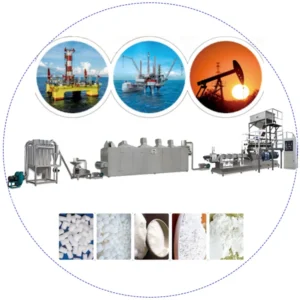
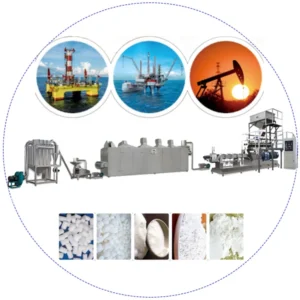
| Modified starch for oil drilling | Cassava and corn starch with molecular weight adjustment for fluid loss control |
Why "Rated Capacity" Means Nothing Without the Raw Material Context
A modified starch processing line turnkey is only as fast as its slowest matched station on your actual starch source.
I have seen lines quoted at a nominal hourly output that collapsed the moment the buyer fed in cassava starch instead of the corn grits used during the supplier’s benchmark test. Gelatinisation temperature, moisture absorption rate and expansion behaviour differ sharply between starch sources, and an extruder screw configuration set for one will choke or under-cook another [NEED_CITE: starch gelatinisation temperature ranges by botanical source]. When the extruder pushes out material faster than the dryer can handle, semi-gelatinised clumps accumulate at the transfer point and the entire line stalls. That is not a capacity problem — it is a throughput-matching failure that should have been caught before the machines left the factory floor.
How Gelatinisation Control Defines Your Modified Starch Output
Twin-screw extrusion gives operators independent command over shear force, residence time and barrel temperature across seven distinct heating zones. For cassava starch, which gelatinises at a lower temperature threshold than corn or wheat, the barrel cooling system prevents overshooting into dextrinisation, which would alter viscosity and defeat the modification target. The screw configuration and die design are specified to the buyer’s exact starch source and desired degree of denaturation, not pulled from a generic build library. This is what separates a production-grade modified starch processing line turnkey from a catalog extruder bolted onto mismatched downstream equipment.
Matching Mixer Batch Rate to Extruder Feed and Dryer Residence Time
A mixer that discharges 170 kg batches into an extruder rated for a lower continuous throughput creates surge-and-starve cycles that destabilise gelatinisation consistency. The dryer, in turn, must hold material long enough at the correct temperature to reduce moisture to a level where the pulse grinder can produce uniform particle size without smearing. Every station on this line is sized so that batch timing, continuous extrusion rate and dryer belt speed form one uninterrupted flow. When a buyer sources the extruder from one vendor and the dryer from another, that flow calculation is nobody’s responsibility [NEED_CITE: throughput matching principles in continuous food processing lines].
What the Barrel Zones and Screw Profile Actually Do to Starch Molecules
The seven heating zones along the barrel allow a graduated temperature ramp — typically starting lower to hydrate the starch granules before the high-shear sections break down crystalline structure and achieve gelatinisation. The 38CrMoAl screw material resists the abrasive wear that raw starch imposes over extended production runs, maintaining tight clearances between screw flights and barrel wall. Die design controls the pressure drop at the exit, which directly determines expansion ratio and the density of the extrudate entering the dryer. Inverter-controlled dryer speed then sets residence time, allowing operators to dial in final moisture content for the target application, whether that is a fast-hydrating pre-gelatinised flour or a high-viscosity industrial binder.
What Happens When Downstream Stations Are Undersized
A colleague once watched a buyer’s independently sourced modified starch line back up within the first hour because the dryer could not keep pace with the extruder output. Semi-cooked starch mass piled up at the extruder discharge, hardened around the die face, and forced a full shutdown for manual cleaning. The grinder downstream was rated for a coarser particle size than the product specification demanded, so even after the dryer issue was resolved, the final powder failed the buyer’s mesh-size requirement. These are not defects — they are integration failures that no single machine warranty will cover [NEED_CITE: integration risks in multi-vendor food processing lines].
Why Buyers Source This Line from One Supplier
The layout and capacity calculation document maps throughput at every transfer point, so you can verify before shipment that mixer cycle time, extruder output and dryer capacity are aligned. Screw configuration and die design are recorded specifically for your starch source and target modification level, not copied from a standard template. The in-house testing workshop runs your actual raw material through the extruder before dispatch, producing a trial run report that confirms gelatinisation degree and output on your material. Voltage, frequency and PLC control language are confirmed to your facility’s power supply before production begins. CE and ISO documentation ships with the line for customs and regulatory compliance in your market.
Documentation & Verification
- Line layout and capacity calculation showing throughput matching across all stations for your starch source
- Screw and die configuration record specified to your raw material and target modification level
- Trial run report on your actual cassava, potato, corn or wheat starch conducted before shipment
- Electrical schematic with voltage, frequency and control language confirmed to your facility
- CE declaration of conformity and ISO certificate for customs and regulatory clearance
- Operation and maintenance manual with wear parts list for screw, die and barrel components
Installation, Commissioning & Support
- Foundation plan sized to the line’s 41–45 metre length and 2200–3500 mm height clearance requirement
- Dedicated electrical circuit planned around 160–210 kW installed power and confirmed voltage specification
- Pre-assembled modules positioned and connected on-site per the phased installation schedule
- First-run parameter setting for barrel zone temperatures, screw speed and dryer residence time on your material
- Operator training covering PLC interface navigation, start-up sequence and emergency shutdown procedures
- Wear parts inventory list for 38CrMoAl screws, dies and barrel liners with recommended replacement intervals
Before You Request a Quotation
Send the specific starch source you will process — cassava, potato, corn or wheat — along with the target modification outcome such as pre-gelatinisation, viscosity range or industrial application. Confirm your local voltage and frequency, the available fuel type for the dryer, and the floor space and ceiling height in your workshop. If you have existing upstream batching or downstream packing equipment, share the interface details so the modified starch processing line turnkey can be configured to connect without bottlenecks.
Frequently Asked Questions
Q: How is the output capacity of a modified starch processing line turnkey verified before delivery?
A: The in-house testing workshop runs a trial production using your actual starch source — cassava, potato, corn or wheat — at the moisture content you specify. The resulting trial run report documents achieved throughput, gelatinisation degree and product characteristics on your material, not on a generic benchmark starch.
Q: How do you prevent one station from bottlenecking the rest of the line?
A: Mixer batch rate, twin-screw extruder continuous output, dryer belt speed and pulse grinder capacity are all calculated together during the line layout phase. The capacity calculation document shows the matched throughput at every transfer point so no single station accumulates surplus or starves the next.
Q: Can the screw configuration handle different starch sources on the same line?
A: Screw profile, die geometry and barrel temperature zones are specified to your primary starch source and target modification level. If you plan to switch between sources such as cassava and corn, the screw configuration record can include an alternative setup, and the PLC stores separate temperature and speed profiles for each.
Q: What utility inputs does the complete line require at the installation site?
A: The line needs a three-phase power supply matching the confirmed voltage and frequency, a dryer fuel source selected from gas, diesel, electricity or steam, compressed air for pneumatic controls and water for the barrel cooling circuit. The layout document details the connection points and consumption rates for your workshop planning.
Q: What does the commissioning schedule look like for a full turnkey installation?
A: Installation follows a phased plan covering module positioning, utility connections, electrical termination and control system boot-up. Commissioning includes parameter setting on your raw material, throughput verification against the capacity calculation, and operator training on the PLC interface, safety procedures and wear part replacement.
Related products
-
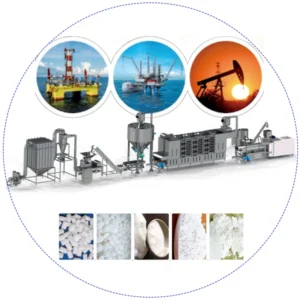
Big Capacity Modified Starch Production Line Making Machine
¥30.00 Select options This product has multiple variants. The options may be chosen on the product page -
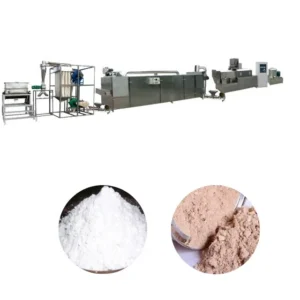
Big Capacity Modified Starch Industrial Use and Food Additives
¥50.00 Select options This product has multiple variants. The options may be chosen on the product page -
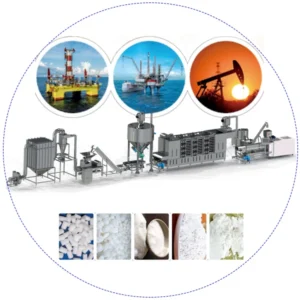
Modified Starch Production Line for Industrial Drilling Twin Screw Extruder Large Output Modified Starch Manufacturing Machine
¥50.00 Select options This product has multiple variants. The options may be chosen on the product page -
API Standard Pregelatinized Starch Line for Oilfield Drilling Fluid. High Yield Modified Starch Equipment
¥65.00 Select options This product has multiple variants. The options may be chosen on the product page