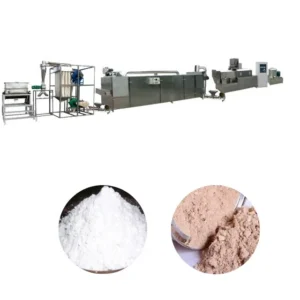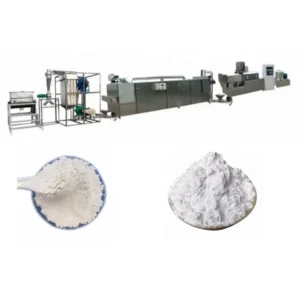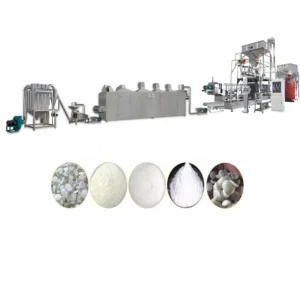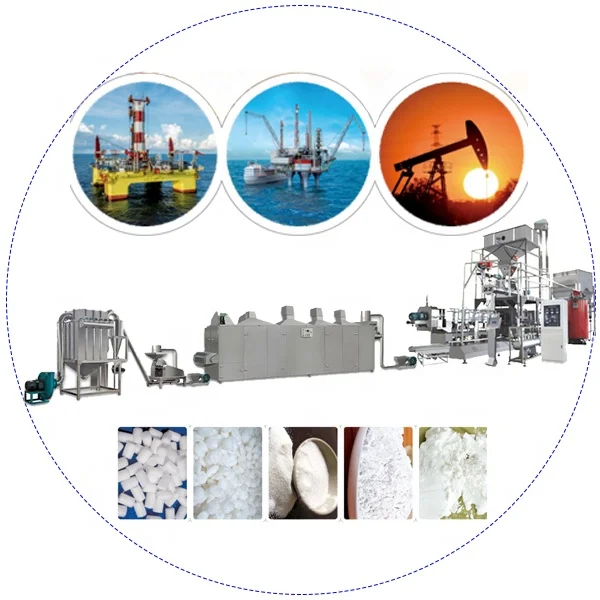

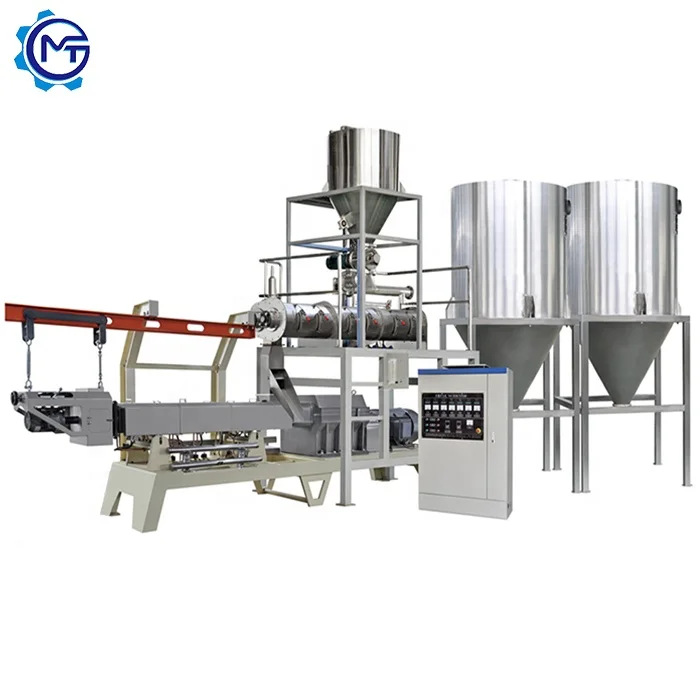
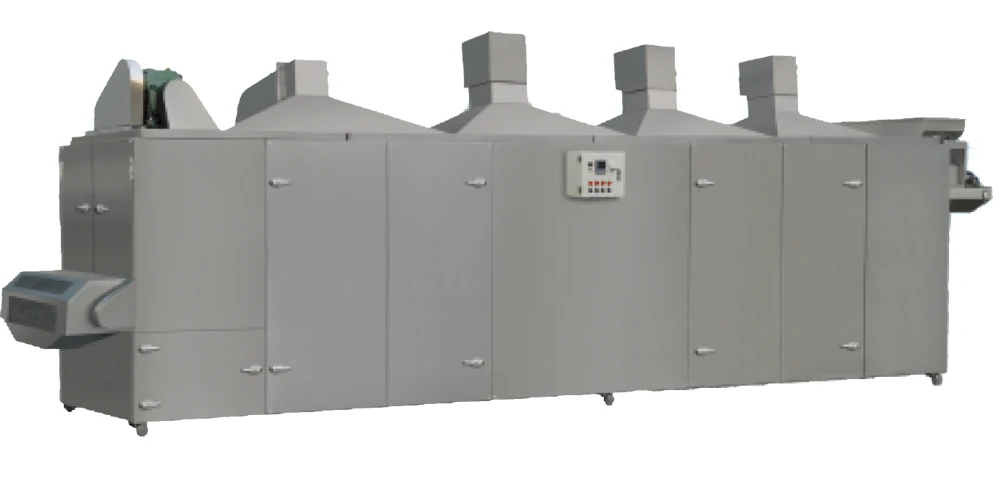


Modified Starch Processing Line, Twin Screw Extruder, 45-200 kW, PLC Control — turnkey configuration from batching through extrusion, cooling, and pulse grinding with cyclone discharge.
- Screw geometry and barrel temperature profile specified to your starch source — tapioca, corn, wheat, or rice — and target gelatinisation degree
- Line-wide throughput matched across every station under one supplier, eliminating bottlenecks from separately sourced equipment
- Voltage customizable to 380V/50Hz, 415V/60Hz, or 220V/60Hz tri-phase; electrical schematic confirmed before production
Pre-shipment trial runs on your raw material in our testing workshop validate actual capacity and product quality before the line leaves the factory.
Description
Complete Line Engineering — Throughput matched across every station from batching to packing, avoiding the bottlenecks that occur when extruders, dryers and grinders are sourced separately.
Technical Specifications
| Parameter | Value |
|---|---|
| Product Type | Modified Starch Processing Line |
| Extruder Type | Twin-screw extruder |
| Main Drive Power | 45–200 kW |
| Output Capacity | 100–1500 kg/h (basis not stated in source — depends on starch source, moisture content, modification degree) |
| Line Weight | 1000–5000 kg (whole line range, confirm against final layout) |
| Voltage & Frequency | 220–440 V, tri-phase (configurable to 380V/50Hz, 415V/60Hz, 220V/60Hz) |
| Control System | PLC with MCC integration |
| Contact Material | Food-grade stainless steel (PVC belts on selected conveyors) |
| Fuel Options | Gas, diesel, electricity, steam (confirm at quotation) |
| Assembly State | Complete line, turnkey |
Application Suitability
| Application | Material or Output |
|---|---|
| Food-grade modified starch for sauces, bakery and instant noodles | Corn starch, wheat flour, tapioca starch |
| Modified starch for oil drilling fluids | Tapioca starch, corn starch with cross-linking additives |
| Modified starch for paper-making sizing | Corn starch, wheat flour |
| Pregelatinised starch for nutrition and fortified food programmes | Rice flour, corn starch, soybean flour |
| Industrial starch modification with blended grain flours | Rice, corn, tapioca, soybean and other grain flours |
What "100–1500 kg/h" Actually Means for Your Modified Starch Processing Line Turnkey
Capacity figures on paper mean nothing until your specific flour runs through the screws.
Early on I quoted a 304 stainless steel modified tapioca starch line at nameplate capacity. The buyer’s cassava flour ran wetter than our test sample, and on day one output was barely half of what was promised. Since then I always pull a raw material spec sheet and run a trial on their actual flour before locking the screw and dryer configuration. A modified starch processing line turnkey only performs when every parameter is validated against the material that will actually feed the hopper. [NEED_CITE: starch gelatinisation temperature variance across tapioca corn and wheat sources]
Screw Geometry Matched to Starch Source
Different starches behave differently under shear and heat. Tapioca starch gelatinises at a lower temperature than corn starch, so the barrel heating profile and screw pitch must account for that difference. A generic screw configuration copied from a standard build will produce inconsistent modification degrees across batches. On this modified starch processing line turnkey, screw elements and die geometry are specified to the buyer’s exact raw material and target application, whether that is food-grade thickening or industrial drilling mud viscosity.
Integrated Cooling and Grinding for Particle Control
After extrusion, the modified starch must cool uniformly before grinding to preserve the structural change achieved in the barrel. The cooling conveyor uses a low-noise air knife design that reduces surface moisture without shocking the starch granule. The pulse grinder downstream discharges through a cyclone with a dust collector, keeping particle size distribution tight and the workshop environment clean. These stations are engineered as one system rather than bolted on after the fact. [NEED_CITE: particle size distribution requirements for modified starch in food and industrial applications]
Reading the Specs That Matter
The 45–200 kW drive range covers small-batch specialty production through continuous high-volume output, but motor selection depends on screw length-to-diameter ratio and the shear energy your target modification requires. Voltage configurability from 220V to 440V across 50Hz and 60Hz is not optional for export lines — specifying the wrong frequency means the motor runs at the wrong speed and the barrel temperature profile drifts. The PLC control system coordinates every station from batching through packing, so a change in extruder screw speed automatically adjusts conveyor speed and grinder feed rate to maintain consistent residence time and output quality.
The Cost of Mismatched Line Stations
When an extruder is sourced from one vendor and the dryer or grinder from another, throughput rarely aligns. The extruder may produce material faster than the cooling conveyor can handle, causing starch to pile up and degrade before grinding. Or the grinder may be undersized for the actual output, creating a bottleneck that forces the entire line to run below capacity. These mismatches show up on day one of production, not during the quotation stage. [NEED_CITE: throughput mismatch consequences in multi-vendor food processing lines]
Why Source the Entire Line from One Supplier
Every station on this modified starch processing line turnkey is sized against the others during layout design, so the extruder output, cooling conveyor speed and grinder capacity are calculated as one system. Screw configuration and die design are recorded specifically for your raw material, not copied from a generic template. The in-house testing workshop runs your actual flour before shipment, producing a trial report that becomes the baseline for commissioning. Documentation covers line layout with capacity calculation, electrical schematics with your confirmed voltage, and a wear parts list so replacements are available when first needed. Pre-sales consultation continues through installation, commissioning and operator training at your site.
Documentation & Verification
- Line layout and capacity calculation matched to your starch source and target modification degree
- Screw and die configuration record specific to your raw material formulation
- Trial run report on customer-supplied flour conducted before shipment
- Electrical schematic with confirmed voltage, frequency and control language
- CE declaration of conformity and ISO certificate included with dispatch
Installation, Commissioning & Support
- Foundation plan accounts for full line weight range up to 5000 kg and vibration isolation at the extruder station
- Dedicated electrical circuit sized to the confirmed main drive power up to 200 kW
- Line arrives in modular sections for staged assembly inside your workshop
- First production run uses trial report parameters as the commissioning baseline
- Operator training covers PLC interface navigation and screw configuration changeover
- Wear parts list specifies screw elements, die plates and grinder screens with replacement intervals
What to Share for an Accurate Quotation
To configure a modified starch processing line turnkey that actually performs at the quoted capacity, share your raw material type and its moisture content, the target modification degree, and whether the end use is food-grade or industrial. Include your plant voltage and frequency, available floor space and ceiling height, and any existing upstream or downstream equipment the line must connect to. If you can send a sample of your flour, a trial run in the testing workshop will confirm screw and dryer settings before production begins.
Frequently Asked Questions
Q: How is actual output capacity verified before shipment?
A: The 100–1500 kg/h range depends entirely on your starch source, moisture content and modification degree. Before we finalise the configuration, you send a sample of your actual raw material and we run it through the extruder in our testing workshop. The resulting trial report documents achievable throughput and becomes the commissioning baseline.
Q: How do you match screw configuration to different starch types?
A: Tapioca, corn, wheat and rice starch each have different gelatinisation temperatures and shear sensitivity. We select screw element geometry, barrel temperature zones and die design based on your specific flour and target modification degree, rather than applying a generic build that may produce the wrong texture or density.
Q: What voltage and frequency options are available?
A: The line is configurable across 220–440V tri-phase at 50Hz or 60Hz, covering standards such as 380V/50Hz and 415V/60Hz. Voltage and frequency must be confirmed before production so that motors, heaters and the PLC are all rated correctly for your plant.
Q: How are throughput rates matched between line stations?
A: As a single-supplier turnkey project, extruder output, cooling conveyor speed and grinder capacity are engineered together during layout design. No station is independently sourced, so material flow stays balanced and bottlenecks are eliminated before the line ships.
Q: Can I see a trial run before the line is delivered?
A: Yes. Buyers are invited to send raw material for a trial run in our in-house testing workshop. The workshop produces a run report documenting screw speed, temperature profile, moisture adjustment and output rate, so product development begins at the factory rather than after installation.
Related products
-
High-Efficiency Customizable Modified Starch Production Line – Automatic Corn Pellet Adhesive Making Equipment
¥65.00 Select options This product has multiple variants. The options may be chosen on the product page -
Pregelatinized Low-Cost Modified Starch Line – High-Efficiency Automated Starch Processing Machine
¥65.00 Select options This product has multiple variants. The options may be chosen on the product page -
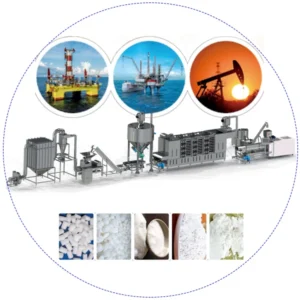
Modified Starch Production Line for Industrial Drilling Twin Screw Extruder Large Output Modified Starch Manufacturing Machine
¥50.00 Select options This product has multiple variants. The options may be chosen on the product page -
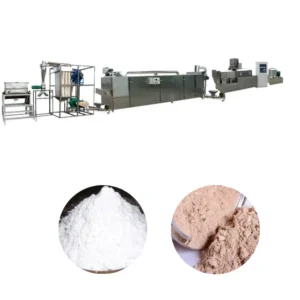
Modified Starch Production Line Modified Starch Processing Line Modified Starch Extruder
¥8,580.00 Select options This product has multiple variants. The options may be chosen on the product page