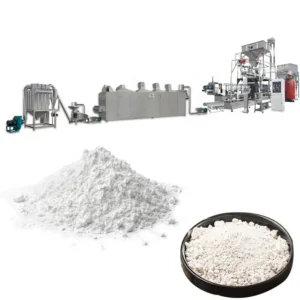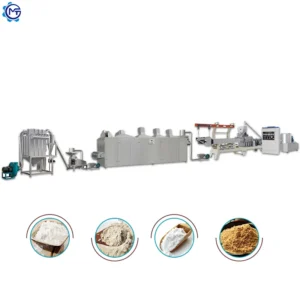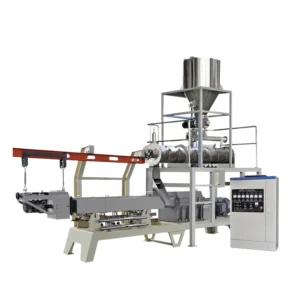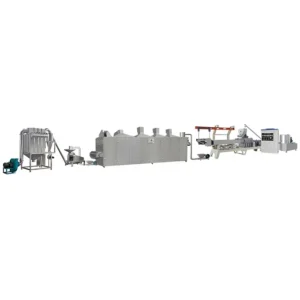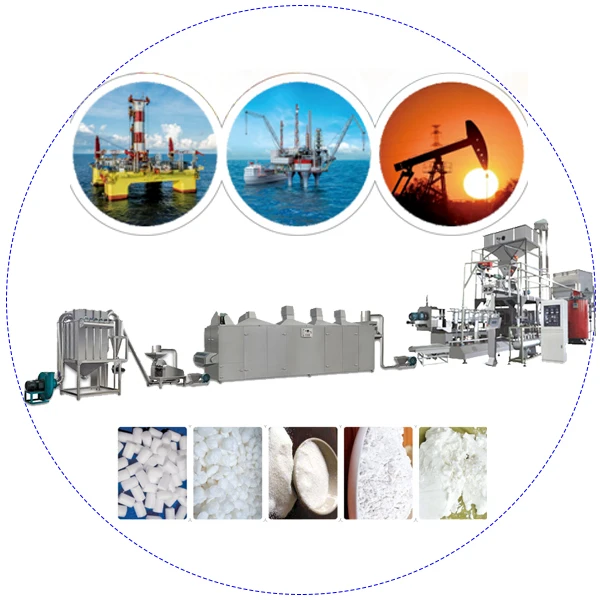
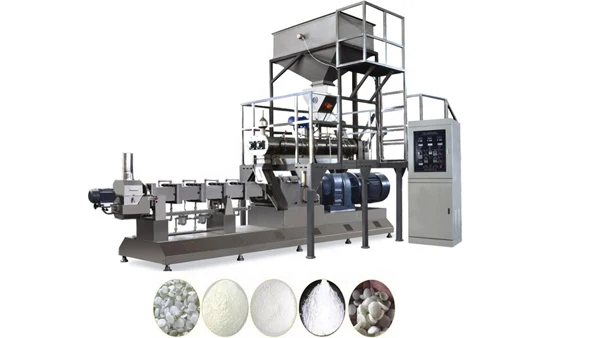


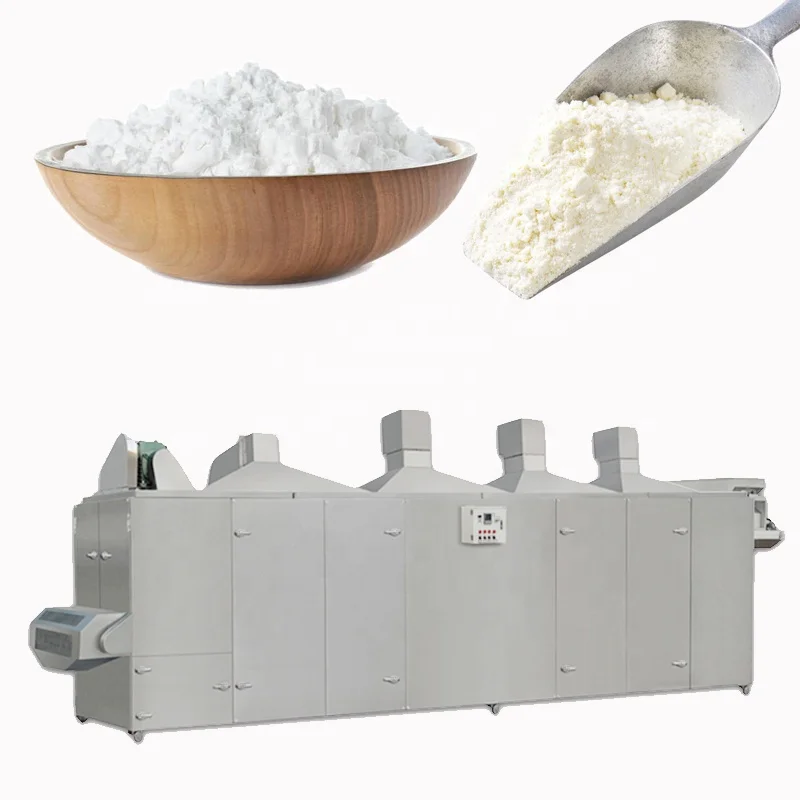
Modified Starch Processing Line, Twin-Screw Extruder, 80–500 kg/h Output, PLC Control — engineered as a turnkey project from batching through extrusion, drying, conditioning and grinding. Every station is throughput-matched to the buyer’s starch source and target gelatinisation degree, with voltage, frequency and energy source confirmed before production. Line layout, screw and die configuration, and utility planning delivered under one supplier with on-site commissioning and operator training.
Description
Integrated Line Throughput Matching — every station from batching to grinding is sized to the buyer’s starch source and target gelatinisation degree, not pulled from a generic catalogue.
Technical Specifications
| Parameter | Value |
|---|---|
| Product Type | Modified and Pregelatinized Starch Processing Line |
| Line Configuration | Mixer → Screw Conveyor → Twin Screw Extruder → Shift → Air Conveyor → Dryer → Air Conveyor → Conditioning → Conveyor → Grinder |
| Extruder Type | Twin-screw extruder |
| Output Capacity | 80–500 kg/h (basis not stated in source — confirm raw material type, moisture content and degree of gelatinisation) |
| Raw Materials | Wheat flour, corn starch, potato starch, cassava starch |
| Contact Material | Food grade stainless steel 304 |
| Frame Material | Stainless steel 201 |
| Voltage & Frequency | Three-phase 380V/50Hz; Single-phase 220V/50Hz (customisable to local supply) |
| Energy Source Options | Electricity, gas, diesel, steam |
| Electrical Power (electricity-heated) | Approx. 100 kW (rated or peak not specified in source) |
| Electrical Power (gas/diesel-heated) | Approx. 50–60 kW (rated or peak not specified in source) |
| Mixer Motor | 4.0 kW |
| Mixer Dimensions (L×W×H) | 1.2 × 0.9 × 1.4 m |
| Mixer Batch Output | 3.0–4.0 kg per batch (basis not stated in source — confirm moisture addition and raw material density) |
| Screw Conveyor Motor | 1.1 kW |
| Screw Conveyor Dimensions (L×W×H) | 2.5 × 0.6 × 2.3 m |
| Screw Conveyor Output | 0–150 kg/h (basis not stated in source — confirm material bulk density and moisture) |
| Motor Brand | Siemens (made in China) or equivalent Chinese top brand |
| Inverter Brand | Delixi or Delta |
| Key Features | CE certified, ISO certified, complete turnkey line from batching through grinding, food-grade contact materials |
Application Suitability
| Application | Material or Output |
|---|---|
| Modified starch for food processing additives | Corn starch, wheat flour with target viscosity and swelling power |
| Pregelatinized starch for instant food bases | Potato starch, cassava starch requiring cold-water solubility |
| Industrial starch for paper and textile sizing | Corn and wheat starch processed to specified gelatinisation degree |
| Binders and thickeners for pharmaceutical excipients | Purified starch sources with controlled moisture and particle size |
Why the Starch Source Matters More Than the Nameplate Capacity
A modified starch processing line turnkey rated at nominal throughput means nothing if the screw profile and barrel zones are not configured for your specific raw material and target modification level.
I have watched buyers sign off on a line based on a capacity figure, only to discover during commissioning that the extruder cannot maintain that output on their actual cassava or potato starch. The starch granule size, amylose-to-amylopectin ratio, and native moisture content all shift the shear and heat transfer behaviour inside the barrel [NEED_CITE: starch granule morphology and extrusion shear requirements]. When the screw configuration is copied from a generic corn starch build, gelatinisation degree drops, viscosity targets are missed, and entire batches go to waste. This modified starch processing line turnkey is configured only after the buyer supplies a raw material composition report and target product specification.
Matching Barrel Zones to Starch Gelatinisation Behaviour
Different starch sources demand different barrel temperature profiles and screw element sequences. Corn starch, with its relatively uniform granule size, tolerates a standard compression ratio and heating curve. Cassava starch, by contrast, gelatinises at a lower onset temperature and requires gentler shear to avoid molecular degradation that reduces final paste viscosity. The twin-screw extruder in this modified starch processing line turnkey is configured with modular screw elements and independently controlled barrel heating zones to match the thermal and mechanical profile of the buyer’s chosen raw material.
Throughput Matching Across Every Station in the Line
An extruder that outputs material faster than the dryer can remove moisture creates a bottleneck that forces the entire line to slow down. The mixer batch cycle, screw conveyor feed rate, dryer residence time, conditioning dwell, and grinder throughput are all calculated against the same target output and material moisture curve [NEED_CITE: throughput balancing methodology for continuous food processing lines]. This eliminates the situation where one station idles while another is overwhelmed, which is the most common reason a line never reaches its quoted capacity in actual production.
What the Power and Utility Figures Mean for Your Facility
The electricity-heated configuration draws approximately 100 kW, while gas or diesel-heated options reduce electrical demand to approximately 50–60 kW. This difference determines whether a facility needs a dedicated high-capacity transformer or can operate on existing supply infrastructure. The 4.0 kW mixer motor and 1.1 kW screw conveyor motor are sized for continuous duty at the specified batch and feed rates. Voltage and frequency are confirmed against the buyer’s site supply — typically three-phase 380V/50Hz or single-phase 220V/50Hz — before production begins, preventing commissioning delays caused by incompatible electrical systems [NEED_CITE: industrial voltage and frequency standards by export market]. Food-grade stainless steel 304 contact surfaces ensure compliance with food safety requirements across the processing path.
The Hidden Cost of Skipping the Trial Run
Buyers who approve shipment without a trial run on their own raw material are essentially paying for the product development phase to happen on their factory floor, on their time, with their material waste. When gelatinisation degree, expansion ratio, or final particle size do not match specification after installation, the line sits idle while screw configurations, die selections, and dryer temperatures are adjusted through trial and error. In modified starch production, where viscosity and cold-water solubility are contractually specified to downstream customers, a failed first run can mean rejected shipments and lost supply agreements [NEED_CITE: quality rejection costs in industrial starch supply chains].
Why Procure This Line from One Supplier
The line layout and capacity calculation are produced as a single document covering every station, so throughput matching is verified on paper before fabrication begins. Screw and die configuration is selected specifically for the buyer’s starch source — corn, cassava, wheat, or potato — and documented in the configuration record. Electrical schematics with confirmed voltage and frequency are issued before production, not discovered at commissioning. A trial run on the buyer’s actual raw material is conducted in the testing workshop, generating a report that shows gelatinisation degree and product characteristics before the line ships. CE and ISO certification covers the complete line, not just individual machines.
Documentation & Verification
- Line layout and capacity calculation matched to your starch type and target gelatinisation degree
- Screw and die configuration record specific to your raw material composition report
- Electrical schematic with voltage and frequency confirmation issued before fabrication
- Trial run report on customer-supplied starch showing viscosity and expansion data
- CE declaration of conformity and ISO certificate covering the complete line
- Operation and maintenance manual with wear parts list for extruder screws and dies
Installation, Commissioning & Support
- Foundation and floor space planning based on the full line footprint from mixer through grinder
- Dedicated electrical circuit design for the 100 kW electricity-heated or 50–60 kW gas-heated configuration
- On-site assembly and alignment of twin-screw extruder, dryer, and conditioning stations
- First-run parameter setting including barrel temperatures, screw speed, and dryer residence time
- Operator training covering screw configuration changes for different starch sources
- Wear parts inventory recommendation for screws, dies, and conveyor components
Before You Send an Inquiry
To provide a line configuration that actually matches your production target, we need your raw material type and composition report including amylose content and native moisture, your target gelatinisation degree or viscosity specification for the finished starch, your site voltage and frequency, and your available floor space and ceiling height. If you are replacing an existing single-station extruder, details on your current dryer and grinder capacity help us size the remaining stations correctly.
Frequently Asked Questions
Q: How is line capacity verified against the buyer’s specific starch raw material and target gelatinisation degree?
A: The buyer supplies a raw material composition report. We calculate throughput for each station — mixer cycle, extruder output, dryer residence time, grinder capacity — based on that material’s bulk density, moisture behaviour, and the target gelatinisation level. A trial run on the buyer’s actual starch is conducted in our testing workshop before shipment, and the results are documented in a test report.
Q: How are extruder, dryer, and conditioning station throughputs matched to avoid bottlenecks?
A: Each station is sized against the same target output figure and material moisture curve. The extruder output rate determines the required dryer belt area and airflow, and the conditioning station dwell time is calculated to bring moisture to the level the grinder requires. This matching is documented in the line layout before fabrication begins.
Q: What utility and voltage confirmations are required before production begins?
A: We need the buyer’s site voltage, frequency, and phase configuration, along with available energy source — electricity, gas, diesel, or steam. Electrical schematics are drawn and confirmed against these values before fabrication, so the control cabinet and heating systems arrive compatible with the facility’s supply infrastructure.
Q: How is screw and die configuration selected for corn, cassava, wheat, or potato starch?
A: Each starch source has a different granule size, gelatinisation onset temperature, and shear sensitivity. Screw element sequence, compression ratio, and die geometry are selected based on the buyer’s specific raw material report and target product characteristics such as viscosity, swelling power, and particle size after grinding.
Q: What is included in on-site installation, commissioning, and operator training?
A: Our engineers oversee assembly of every station from mixer to grinder, set barrel temperature profiles and screw speeds for the buyer’s starch source, run initial production batches, and train operators on configuration changes for different raw materials and routine wear part replacement procedures.
Related products
-
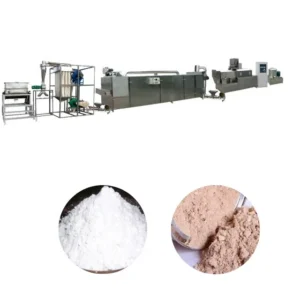
Modified Starch Production Line Industrial Drilling Twin Screw Extruder 304 Stainless Steel High Efficiency Flour Mill CE
¥50.00 Select options This product has multiple variants. The options may be chosen on the product page -
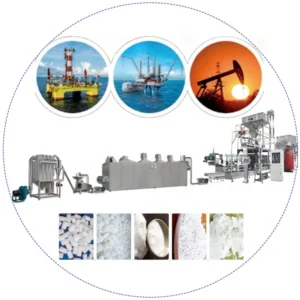
Automatic Modified Tapioca Starch Production Line 304 Stainless Steel Flour Mill and Bakery Machine
¥30.00 Select options This product has multiple variants. The options may be chosen on the product page -
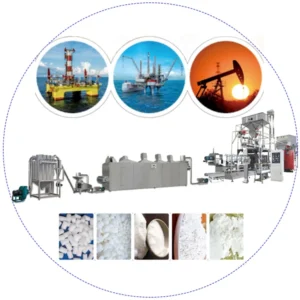
New Automatic Modified Starch Puffing Production Line – Long Service Life Pregelatinized Starch Equipment
¥65.00 Select options This product has multiple variants. The options may be chosen on the product page -
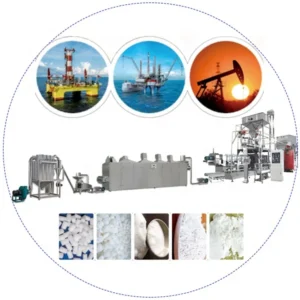
Pre-gelatinized Starch Production Line – Modified Starch Integrated Puffing Equipment
¥65.00 Select options This product has multiple variants. The options may be chosen on the product page