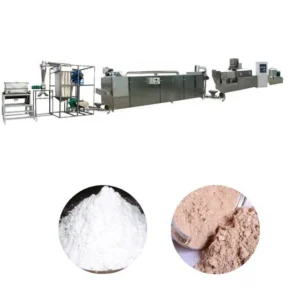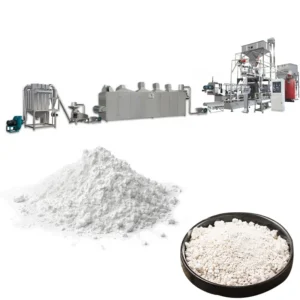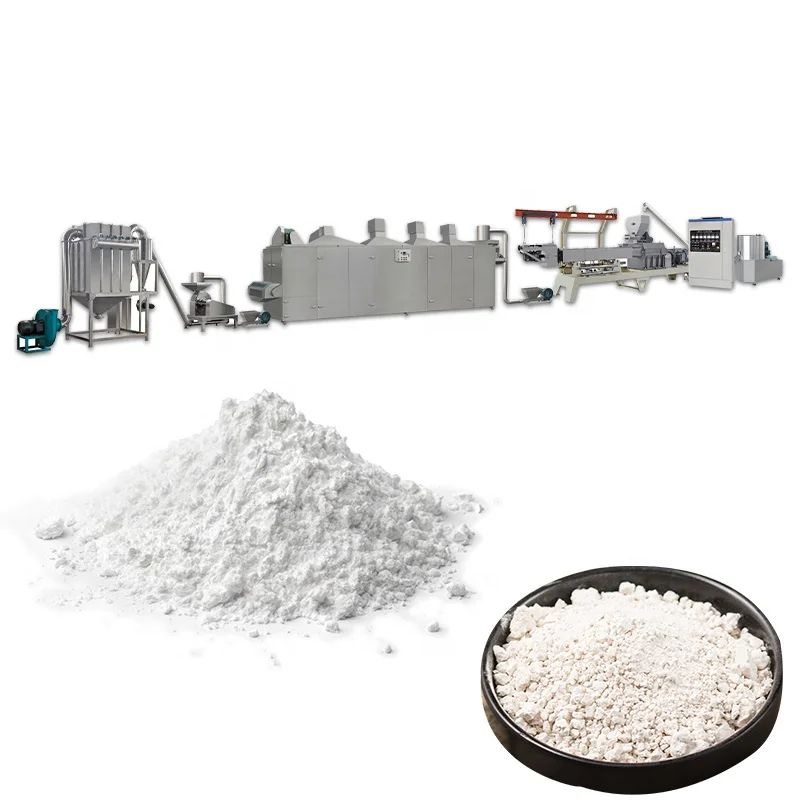


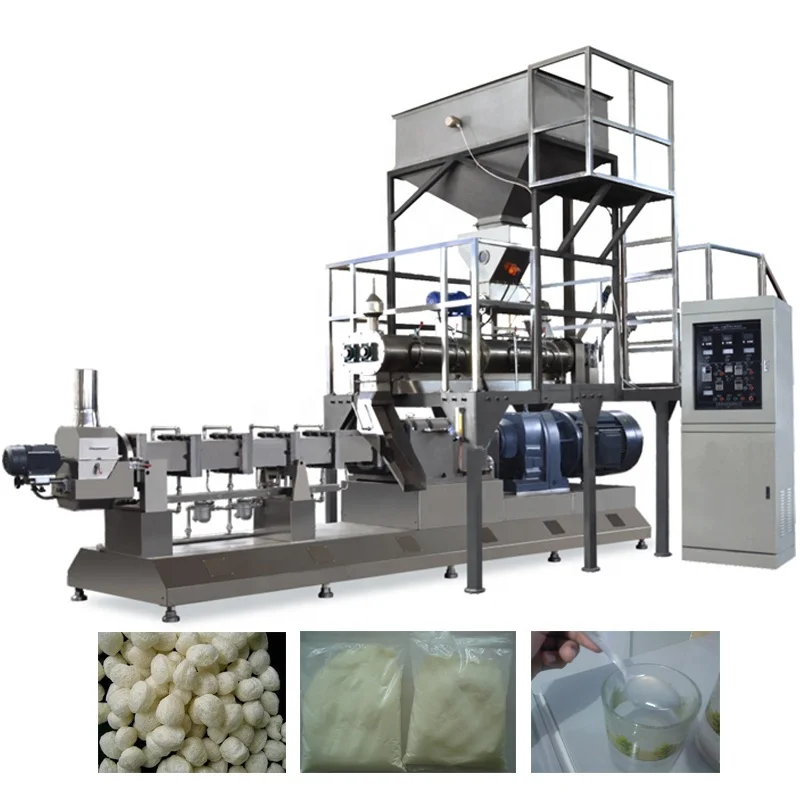

MT70 / MT85 / MT100 Modified Starch Processing Line, Twin-Screw Extruder, PLC & MCC Control — engineered as a complete turnkey project from batching through extrusion to drying and packing.
- Screw configuration and die design specified to your raw material and target gelatinisation degree
- Dryer capacity matched to extruder output, with gas, diesel, electricity, or steam fuel options
- Line layout and throughput calculated across every station before production begins
In-house trial runs on your actual raw material validate product specification before shipment, reducing on-site commissioning risk.
Description
Screw and Die Precision — Every screw element and die plate is configured after running your specific starch source in our testing workshop, not copied from a generic build sheet.
Technical Specifications
| Parameter | Value |
|---|---|
| Product Type | Modified Starch Processing Line |
| Models Available | MT70, MT85, MT100 |
| Extruder Type | Twin-screw |
| Screw Material | 38CrMo |
| Installed Power | 160 kW (MT70); 190 kW (MT85); 210 kW (MT100) |
| Power Consumption | 120 kW (MT70); 140 kW (MT85); 150 kW (MT100) |
| Output Capacity | 150–200 kg/h (MT70); 300–400 kg/h (MT85); 300–500 kg/h (MT100) (basis not stated in source — raw material type, moisture content, and modification degree to be confirmed) |
| Overall Dimensions (L×W×H) | 41,000×1,500×2,200 mm (MT70); 43,000×1,500×3,200 mm (MT85); 45,000×1,500×3,500 mm (MT100) |
| Voltage & Frequency | 380 V, 50 Hz, Three Phase (configurable to 380 V/60 Hz, 415 V/60 Hz, 220 V/60 Hz) |
| Control System | PLC and MCC |
| Dryer Fuel Options | Gas, diesel, electricity, steam (confirmed at quotation stage) |
| Contact Materials | Food-grade stainless steel (PVC on select conveyors) |
| Certifications | CE, ISO |
Application Suitability
| Application | Material or Output |
|---|---|
| Pregelatinised starch for food thickening | Corn starch, wheat starch, tapioca starch |
| Modified starch for textile sizing | Corn starch, potato starch |
| Modified starch for papermaking | Corn starch, wheat starch |
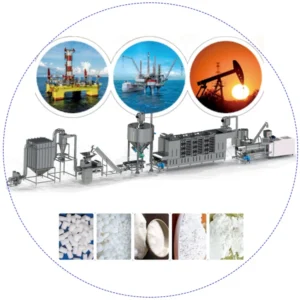
| Pregelatinised starch for oil drilling fluids | Corn starch with target gelatinisation degree |
| Functional starch for infant formula and nutrition | Corn starch, wheat starch with tight viscosity tolerances |
Why Rated Capacity Means Nothing Without the Raw Material Context
The kg/h figure on the nameplate only holds if the starch source, moisture content, and target modification degree match the assumptions behind it.
When a modified starch processing line turnkey is quoted on a nominal output, that number almost always rests on a standard reference material — typically a common corn or tapioca starch at a specific moisture level. Switch to a high-amylose corn starch or a waxy maize variety and the viscosity curve shifts entirely. The extruder may still run, but the gelatinisation degree and expansion behaviour will fall outside specification, forcing on-site parameter adjustments that can stretch commissioning into a multi-week exercise [NEED_CITE: starch gelatinisation behaviour across amylose ratios]. This is why the capacity figures in the table above carry a basis-to-be-confirmed note: they are starting points for line sizing, not guaranteed outputs until your actual raw material has been tested.
Barrel Zone Control and Starch Gelatinisation
A twin-screw extruder processes starch through distinct barrel zones where temperature, moisture, and shear are managed independently. For modified starch production, the gelatinisation window is narrow — too little thermal input leaves native crystallinity intact, while excessive shear degrades the polymer chain and drops viscosity below the target range. The PLC and MCC control system on this modified starch processing line turnkey manages barrel temperature profiles across all zones, allowing operators to dial in the precise thermal history the material requires.
Matching Dryer Throughput to Extruder Output
The extruder is only one station in the line. If the dryer cannot remove moisture at the rate the extruder delivers wet product, material backs up and the entire line chokes. Each model tier — MT70, MT85, and MT100 — is paired with a dryer whose evaporation capacity is calculated against the extruder’s output range and the specific moisture reduction required for the target starch product [NEED_CITE: dryer sizing methodology for starch extrusion lines]. Fuel options including gas, diesel, electricity, and steam allow the dryer to be configured around the utility infrastructure available at the buyer’s facility.
Reading the Specifications Beyond the Nameplate
The 38CrMo screw material is selected for its wear resistance against abrasive starch granules under sustained thermal cycling, which directly affects how long the screw profile holds its geometry before replacement is needed. The three model tiers scale in installed power from 160 kW to 210 kW and in overall line length from 41 metres to 45 metres, reflecting the additional barrel length and downstream equipment footprint required at higher throughput targets. The voltage configurability across 380 V/50 Hz, 415 V/60 Hz, and 220 V/60 Hz addresses the reality that export markets run different supply standards, and confirming this before production prevents a situation where the motor and heating elements arrive mismatched to the facility panel [NEED_CITE: voltage and frequency standards by export market].
The Cost of Skipping a Pre-Shipment Trial Run
Arriving on site to discover that the screw combination does not produce the required viscosity curve means rewriting the entire process parameter set while the buyer’s raw material is being consumed in failed batches. Commissioning stretches from days into weeks, operator training happens under pressure, and confidence in the line erodes before steady production begins [NEED_CITE: commissioning delays caused by untested screw configurations]. A trial run in the supplier’s testing workshop on the buyer’s actual starch source eliminates this risk by locking in the screw and die configuration before the machines ship.
What Distinguishes This Supply Approach
Every station in the modified starch processing line turnkey — from batching through extrusion to drying and packing — is sourced and engineered under one supplier, so throughput is balanced across the line rather than assembled from separate vendors with mismatched capacities. The screw configuration and die design are specified to the buyer’s raw material and target modification degree, not pulled from a standard build. An in-house testing workshop allows trial runs on the customer’s actual starch before shipment, producing a trial run report that documents the validated screw combination and barrel profile. The PLC and MCC control system is configured with the buyer’s voltage, frequency, and preferred operational language confirmed before production starts. Documentation covering line layout, capacity calculation, electrical schematics, and wear parts lists is provided as a complete package rather than assembled piecemeal.
Documentation & Verification
- Line layout and capacity calculation confirming throughput balance across every station
- Screw and die configuration record matched to your specific starch source and target viscosity
- Trial run report on your actual raw material conducted in the testing workshop before dispatch
- Electrical schematic with voltage and frequency confirmed to your facility supply standard
- Operation and maintenance manual covering all stations from batching to packing
- Wear parts list identifying screw elements, dies, and seals with replacement intervals
Installation, Commissioning & Support
- Floor space planning based on the 41–45 metre line length and 1.5 metre width across model tiers
- Dedicated power circuit sized to the 160–210 kW installed power requirement of the selected model
- Dryer fuel connection configured to the confirmed gas, diesel, electricity, or steam supply at your facility
- On-site parameter validation against the trial run report to confirm gelatinisation degree and output specification
- Operator training covering PLC interface navigation, barrel zone temperature adjustment, and screw changeover procedure
- Wear parts inventory recommendation based on the 38CrMo screw element and die plate consumption rates
Preparing Your Line Enquiry
To move from a general capacity range to a confirmed line configuration, the key inputs are your specific starch source and its amylose content, the target modification degree and viscosity specification, and your facility’s voltage and frequency standard. If you have an existing upstream milling system or downstream packing line, noting the interface points helps ensure the batching and cooling stations are specified to match. Sending a sample of your raw material for a testing workshop trial run is the most direct way to lock in the screw and die configuration before the quotation is finalised.
Frequently Asked Questions
Q: How is the output capacity of the modified starch processing line turnkey verified before quotation?
A: The capacity figures in the specification table are based on reference conditions that vary by starch source and moisture content. Verification happens through a trial run in the testing workshop using your actual raw material, which confirms the achievable throughput at your target modification degree and documents the result in a trial run report before the line is finalised.
Q: How are screw configuration and barrel zones selected for a specific starch type?
A: The screw element arrangement and barrel temperature profile are designed around the gelatinisation behaviour of your starch source, including its amylose ratio and moisture content. The testing workshop trial run validates that the selected configuration achieves the target viscosity and expansion before the screw combination is locked in for production.
Q: How is dryer capacity matched to the extruder to prevent line bottlenecks?
A: The dryer evaporation rate is calculated against the extruder output range and the moisture reduction required for your specific starch product. Fuel type is confirmed at quotation stage so the dryer is sized to the utility supply available at your facility, ensuring continuous material flow through the line.
Q: What electrical details are confirmed before production begins?
A: Voltage, frequency, and control language are confirmed during the specification stage to match your facility’s electrical supply standard. The electrical schematic is provided as part of the documentation package, and the PLC and MCC control system is configured accordingly before the machines enter production.
Related products
-
Automatic Modified Starch Making Machine Oil Drilling Starch Processing Production Line
¥30.00 Select options This product has multiple variants. The options may be chosen on the product page -
Pre-gelatinized Starch Production Line – Modified Starch Integrated Puffing Equipment
¥65.00 Select options This product has multiple variants. The options may be chosen on the product page -
Modified Starch Production Line for Industrial Drilling Twin Screw Extruder Large Output Modified Starch Manufacturing Machine
¥50.00 Select options This product has multiple variants. The options may be chosen on the product page -
Automatic 304 Stainless Steel Modified Corn Starch Making Machine TWIN SCREW 500kg/h Capacity Starch Processing Production Line
¥50.00 Select options This product has multiple variants. The options may be chosen on the product page