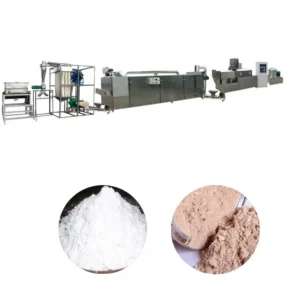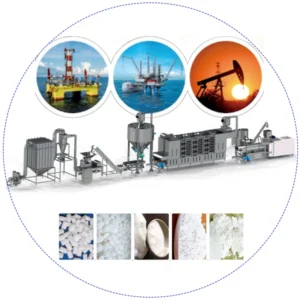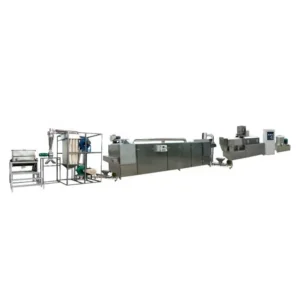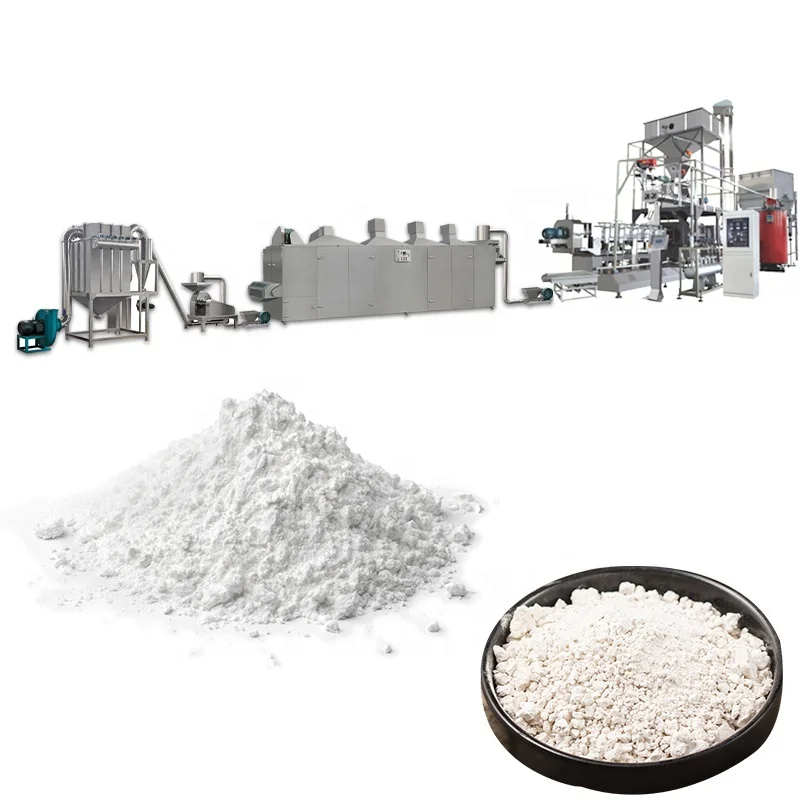

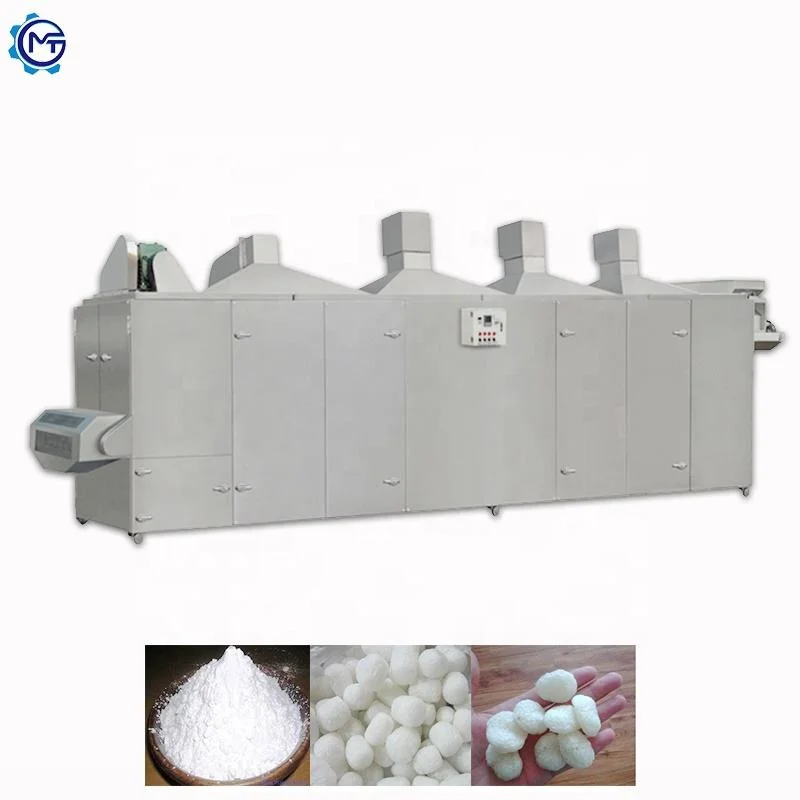
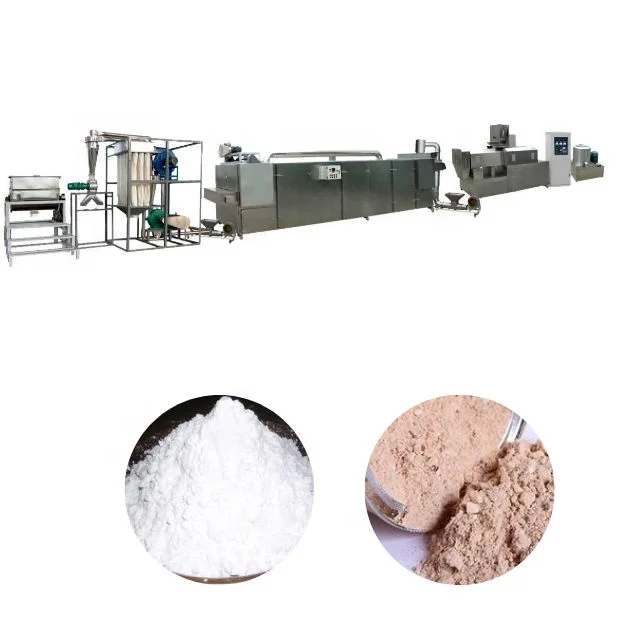

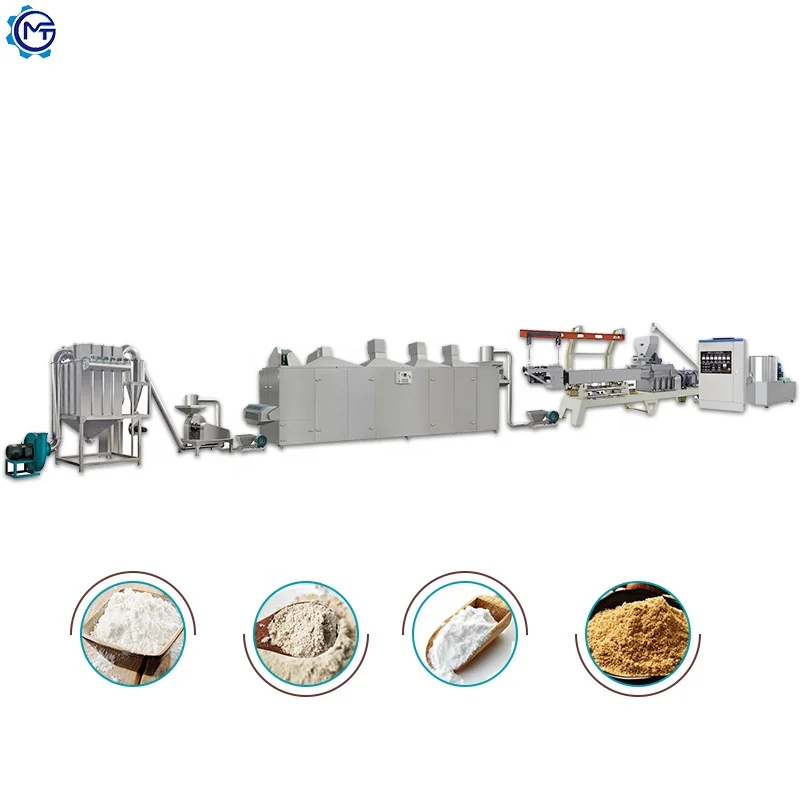
MT75 / MT70 / MT70C Twin Screw Modified Starch Production Line, 120–300 kW Installed Power, Multi-layer Oven & Pulse Grinder — engineered as a complete turnkey project from flour mixing through extrusion, drying, grinding to packing. Throughput is matched across every station so the extruder, dryer and grinder keep pace without bottlenecks, with screw and die configuration specified to your starch feedstock.
- Line capacity depends on raw material type and moisture content — confirm basis with engineering before order
- In-house trial runs on your actual cassava, corn or tapioca starch validate product quality before shipment
Description
Matched Throughput Across Every Station — A modified starch production line is only as fast as its bottleneck, which is why the MT75, MT70, and MT70C extruders are specified alongside multi-layer dryers and pulse grinders whose capacities align with extrusion output rather than being assembled from mismatched vendor quotes.
Technical Specifications
| Parameter | Value |
|---|---|
| Product Type | Twin Screw Modified Starch Production Line |
| Models Available | MT70, MT75, MT70C |
| Screw Type | Twin Screw |
| Capacity (MT75) | 200–250 kg/h (basis not stated in source — confirm raw material type and moisture content) |
| Installed Power (MT75) | 180 kW |
| Power Consumption (MT75) | 135 kW |
| Overall Dimensions (MT75) | 32,000 × 3,500 × 4,300 mm |
| Capacity (MT70) | 100–150 kg/h (basis not stated in source — confirm raw material type and moisture content) |
| Installed Power (MT70) | 120 kW |
| Power Consumption (MT70) | 120 kW |
| Overall Dimensions (MT70) | 30,000 × 1,500 × 2,200 mm |
| Capacity (MT70C) | 250–300 kg/h (basis not stated in source — confirm raw material type and moisture content) |
| Installed Power (MT70C) | 150 kW |
| Power Consumption (MT70C) | 125 kW |
| Overall Dimensions (MT70C) | 34,000 × 3,500 × 4,300 mm |
| Extruder Drive | Frequency conversion speed regulation on feeding, driving, and rotary cutting |
| Mixer Power Options | 4 kW / 7.5 kW / 15 kW |
| Mixer Capacity Options | 20–30 kg/batch / 70–80 kg/batch / 170–180 kg/batch |
| Mixer Contact Material | 201 Stainless Steel or 304 Stainless Steel |
| Pulse Grinder Drive Motor | 15 kW |
| Pulse Grinder Mesh | 100–120 mesh |
| Pulse Grinder Dedusting | Integrated dedusting system to minimize dust emission |
| Dryer Type | Multi-layer oven with double pitch roller chain, round-trip drying path |
| Voltage (Mixer) | 380 V, 50 Hz, Three Phase (full-line voltage to be confirmed for target market) |
| Standards | CE (line-level declaration to be confirmed) |
Application Suitability
| Application | Material or Output |
|---|---|
| Pre-gelatinized starch production | Corn starch, cassava starch, potato starch |
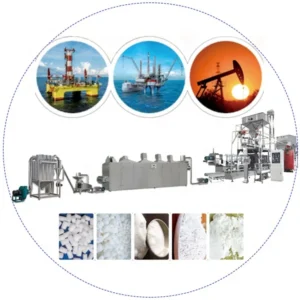
| Oil drilling starch processing | Maize starch, tapioca starch |
| Nutritional powder manufacturing | Baby rice powder, sesame paste, soybean powder |
| Food additive and industrial starch | Modified starch from corn, cassava, or potato feedstocks |
What "Rated Capacity" Hides When Starch Chemistry Varies
A modified starch production line turnkey will only hold its nameplate output if the screw configuration and temperature profile match the exact gelatinisation behaviour of your raw material.
I once watched a starch line in South America sit idle for two weeks because the factory trial used ordinary cassava starch while the customer ran high-amylose corn starch on site. The gelatinisation temperature gap meant the finished viscosity never reached specification. The entire screw combination and barrel heating curve had to be rebuilt from scratch. That is the kind of mismatch a capacity figure alone will never warn you about [NEED_CITE: starch gelatinisation temperature variance across feedstocks].
When buyers request a Modified Starch Production Line Turnkey, the first document I ask for is the raw material assay report — amylose content, moisture percentage, and particle size distribution. Without those, any quoted throughput is an assumption, not a commitment.
Barrel Zones and the Gelatinisation Window
Different starch sources demand different thermal histories. Cassava starch gelatinises at a lower temperature range than corn starch, and potato starch sits somewhere in between. The twin screw extruder in this line allows independent barrel zone heating so that the temperature profile can be shaped around the specific feedstock. Frequency conversion speed regulation on the feeding and driving systems gives operators control over residence time, which directly affects the degree of starch modification achieved in each pass.
Dryer Sizing and Moisture Uniformity
A multi-layer oven with a double pitch roller chain and round-trip drying path means the product travels a longer effective distance within a smaller footprint. This matters for pre-gelatinized starch because uneven moisture removal can cause partial re-crystallisation, which degrades the cold-water swelling property that downstream customers rely on. The dryer must be sized so its evaporation rate keeps pace with the extruder output — otherwise wet product backs up and the line stalls.
Why Grinder Mesh Matters Downstream
The pulse grinder in this line produces powder in the 100–120 mesh range, which is the standard fineness for most pre-gelatinized starch and nutritional powder applications. Finer mesh increases surface area and improves dispersibility in cold water, but it also raises grinding energy and slows throughput. The integrated dedusting system captures airborne fines that would otherwise settle on the packaging station and contaminate sealed bags [NEED_CITE: industrial powder dust emission standards in food processing facilities].
Capacity Tiers and Footprint Planning
The three model tiers — MT70, MT75, and MT70C — span different capacity ranges and plant footprints. The MT70 measures 30 meters in length, the MT75 extends to 32 meters, and the MT70C reaches 34 meters. Choosing the right tier depends not only on daily output targets but also on available workshop length and ceiling height, especially where the multi-layer oven requires vertical clearance for maintenance access.
The Cost of Skipping a Pre-Shipment Trial
When an extruder arrives on site without a prior trial on the buyer’s actual starch, commissioning becomes product development. Operators experiment with moisture addition, screw speed, and barrel temperatures while burning raw material and missing delivery deadlines. A line that should start producing saleable output within days instead takes weeks to stabilise. That delay compounds when the local electrical supply differs from the voltage assumed at the factory [NEED_CITE: voltage and frequency standards by export market].
Why Buy the Whole Line from One Source
Throughput matching across every station is the reason a single-supplier turnkey project outperforms a line assembled from separate vendors. The mixer batch size, extruder output, dryer evaporation rate, grinder capacity, and packaging speed are all calculated together so no station constrains another. Screw configuration and die design are specified to the buyer’s raw material and target product before production begins. An in-house testing workshop runs trial batches on the customer’s actual starch before the machines ship. The complete line layout, electrical schematics, and utility plan arrive as one package rather than a stack of unrelated manuals. Installation, commissioning, and operator training are handled by one team that knows every connection point.
Documentation & Verification
- Line layout drawing showing throughput calculation across mixer, extruder, dryer, grinder, and packer
- Screw and die configuration record matched to your starch type and target viscosity
- Factory trial run report on your raw material before dispatch
- Electrical schematic with voltage, frequency, and control language confirmed for your market
- CE declaration of conformity covering the full line assembly
- Operation and maintenance manual with wear parts list and replacement intervals
Installation, Commissioning & Support
- Foundation requirements mapped to the MT75 footprint of 32,000 × 3,500 mm and total installed power of 180 kW
- Dedicated three-phase power circuit at confirmed voltage and frequency for each station’s motor load
- Equipment shipped in modular sections for reassembly and alignment on site
- First-run parameter setting for barrel temperature, screw speed, and dryer dwell time on your starch
- Operator training covering mixer loading sequence, extruder controls, and pulse grinder mesh adjustment
- Wear parts inventory covering screws, dies, and grinder screens with reorder part numbers documented
What to Include in Your Inquiry
Provide the specific starch type you will process — corn, cassava, potato, or tapioca — along with the amylose content and moisture level from your supplier’s assay report. State the target product specification such as required viscosity or gelatinisation degree, your daily output target, and the available workshop length and ceiling height. Confirm the local voltage and frequency at your facility so the motor and control specifications can be locked before production.
Frequently Asked Questions
Q: How is line capacity calculated and what assumptions does it depend on?
A: Capacity depends on the raw material type, its moisture content, and the target product specification. Corn starch, cassava starch, and potato starch each behave differently inside the extruder barrel, affecting residence time and output rate. We calculate throughput only after reviewing your material assay report and confirming the degree of modification required.
Q: How do you prevent throughput bottlenecks between stations?
A: Every station — mixer, extruder, multi-layer oven, pulse grinder, and packaging machine — is selected so its rated capacity meets or slightly exceeds the extruder output. The line layout drawing includes a station-by-station throughput calculation so you can verify the match before the order is placed.
Q: Can we run a trial on our specific starch before shipment?
A: Yes. The factory testing workshop accepts customer-supplied raw material for trial runs. We document screw speed, barrel temperature profile, moisture addition rate, and finished product viscosity in a trial report that ships with the equipment.
Q: What electrical confirmations are needed before production starts?
A: We require the voltage, frequency, and phase specification at your facility, along with the preferred control panel language. This ensures motors, heaters, and frequency converters are built to match your local supply and that operators can read the interface without translation delays.
Q: What does the installation and commissioning schedule look like?
A: Installation is phased to match your workshop readiness — foundation and utilities first, then equipment placement, electrical connection, and dry-run testing. Commissioning includes parameter tuning on your starch and on-site operator training covering daily start-up, shutdown, and routine maintenance procedures.
Related products
-
Automatic Industrial Adhesive Starch Modification Production Line – Pre-Gelatinization Extrusion Equipment
¥65.00 Select options This product has multiple variants. The options may be chosen on the product page -
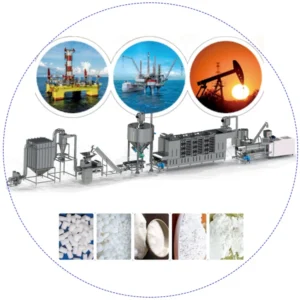
Automatic 304 Stainless Steel Modified Corn Starch Making Machine TWIN SCREW 500kg/h Capacity Starch Processing Production Line
¥50.00 Select options This product has multiple variants. The options may be chosen on the product page -
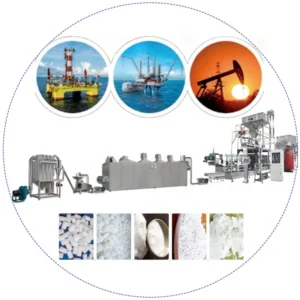
Automatic Modified Tapioca Starch Production Line 304 Stainless Steel Flour Mill and Bakery Machine
¥30.00 Select options This product has multiple variants. The options may be chosen on the product page -
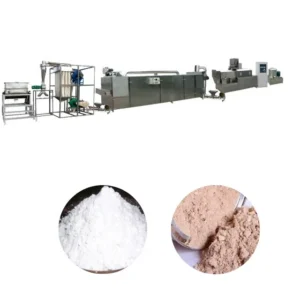
Modified Starch Production Line Industrial Drilling Twin Screw Extruder 304 Stainless Steel High Efficiency Flour Mill CE
¥50.00 Select options This product has multiple variants. The options may be chosen on the product page