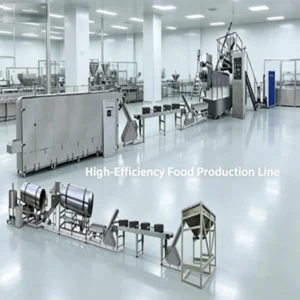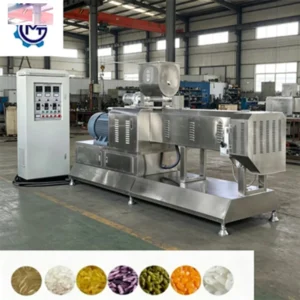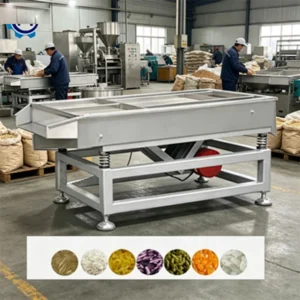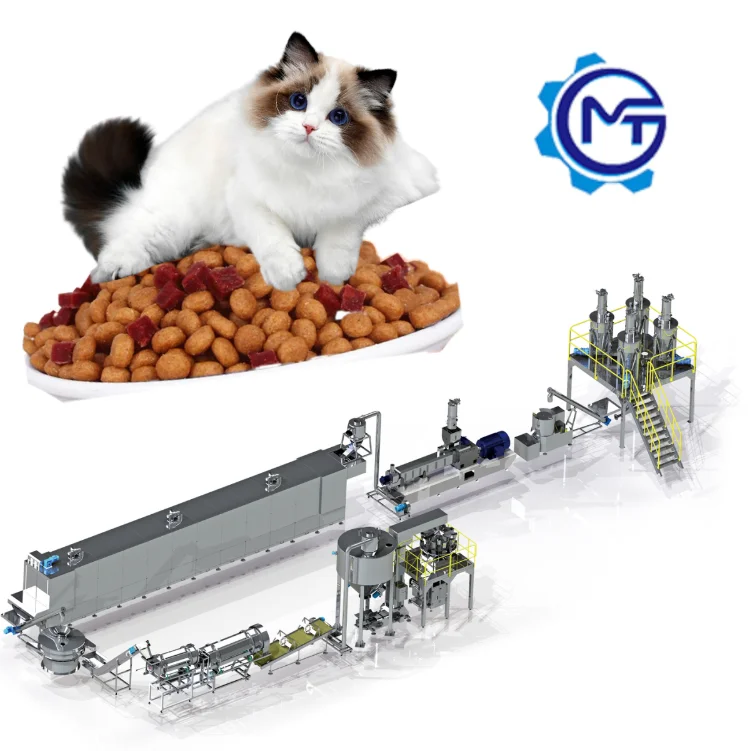
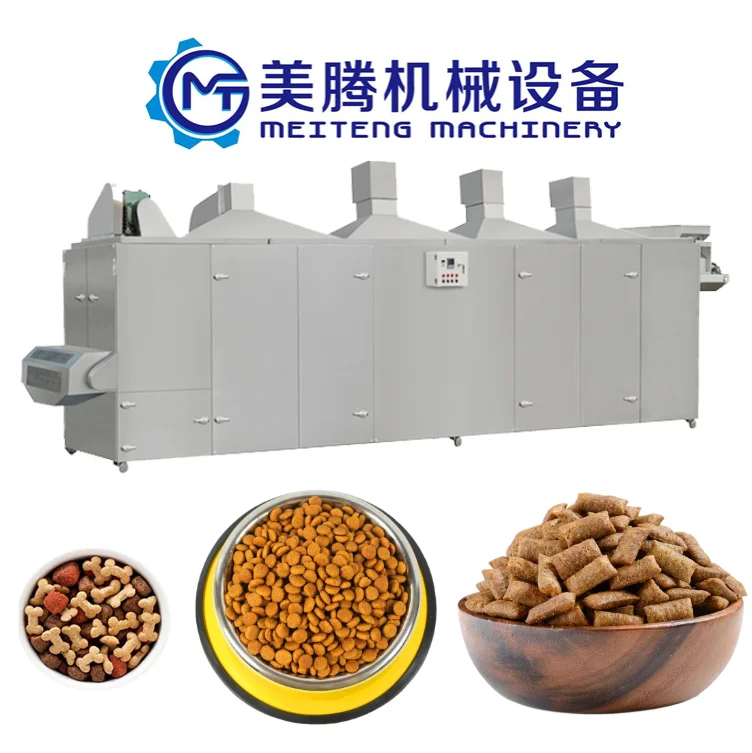


MT70 Twin-Screw Pet Food Extrusion Line, 380V 50Hz, 45 kW — designed as a complete turnkey project from batching through extrusion, drying to final packaging.
Screw configuration and die design are matched to your raw material and target kibble density, with PLC/MCC control integrating every station. Throughput is balanced across mixing, extruding, drying and packing to eliminate line bottlenecks.
Pre-shipment trial runs on your actual raw material confirm product texture, expansion and moisture before the line leaves our testing workshop.
Description
Complete turnkey line delivery — The MT70 pet food extrusion production line is engineered as an integrated system from batching through extrusion, drying, and packing, with throughput matched at every station to eliminate bottlenecks before they form.
Technical Specifications
| Parameter | Value |
|---|---|
| Model | MT70 |
| Product Type | Pet Food Extrusion Production Line |
| Output Capacity | 200–250 kg/h (basis not stated in source — confirm raw material, moisture content, and kibble size) |
| Screw Type | Twin-screw |
| Rated Power | 45 kW |
| Voltage & Frequency | 380V 50Hz Three Phase |
| Control System | PLC / MCC |
| Automation Level | Fully automated |
| Line Stations | Mixing → Extrusion → Drying → Packaging |
| Recipe Adaptability | Dry kibble, semi-moist, treats |
| Material Compliance | Food-grade contact materials throughout |
| Certifications | CE, FDA, ISO |
Application Suitability
| Application | Material or Output |
|---|---|
| Dry kibble production for dogs and cats | Corn, wheat, rice, meat meal, fish meal blends |
| Semi-moist pet food formulations | High-moisture dough with meat and fat content |
| Pet treats and functional snacks | Starch-protein matrices with added supplements |
| Aquatic feed adaptation | Floating and sinking pellet formats for aquaculture |
| Contract manufacturing for multiple brands | Quick recipe changeover across varying ingredient ratios |
What "200–250 kg/h" Actually Means for Your Raw Material
Capacity figures are meaningless without knowing what goes into the hopper.
Most pet food extrusion production line turnkey proposals quote a nominal throughput based on a clean starch matrix — corn flour at low moisture, minimal fat, no meat meal. Swap in a formula with high meat powder content and elevated fat ratios, and that same extruder behaves differently. Gelatinisation shifts, expansion drops, and kibble density climbs outside the specification your market expects. I once watched an entire production batch go to waste because the line had been configured on corn grits while the customer’s recipe relied heavily on meat meal. The extruder simply could not achieve the required puff on that formula. [NEED_CITE: impact of meat meal percentage on extrusion expansion rate]
Throughput Matching Across Every Station
A pet food extrusion production line turnkey project succeeds or fails on whether each station can keep pace with the extruder. The MT70 line is planned so that mixer batch cycles feed the extruder without starvation, the dryer belt speed and length accommodate the moisture removal requirement of the target kibble, and the packaging station handles the cooled output rate. When any single station lags, the extruder either idles or overfeeds downstream equipment, creating waste and inconsistency that accumulates across an eight-hour shift.
Screw Configuration Specified to Your Formula
The twin-screw assembly on the MT70 is not a fixed build. Screw element sequencing — conveying, kneading, and reverse-flight sections — is arranged around the buyer’s declared raw material profile and the texture the target market demands. A kibble aimed at premium dog food requires different shear and residence characteristics than a cat treat formulation. This configuration is validated during the in-house testing workshop before the machine leaves the factory floor, not discovered during commissioning at your site. [NEED_CITE: twin-screw element configuration for varying protein and starch ratios]
Interpreting the Core Parameters
The 45 kW main drive rating determines the shear energy available inside the barrel. Higher protein and fat formulas demand more torque to maintain consistent conveyance through the kneading zones, and an undersized motor will stall or surge when recipes shift. The 380V 50Hz three-phase supply specification must match your facility’s electrical infrastructure — voltage mismatch is a recurring cause of delayed commissioning and motor burnout on international installations. PLC and MCC control options provide recipe storage and repeatability: once a screw speed, barrel temperature profile, and feeder rate are dialled in for a specific formula, the system reproduces that combination on the next run without relying on operator memory. Food-grade material compliance across all product-contact surfaces meets regulatory requirements in markets with strict contamination standards.
The Hidden Cost of Mismatched Line Components
Purchasing an extruder from one vendor and a dryer from another often produces a throughput gap that only surfaces during production. The dryer may be rated for a different moisture load, leaving kibble either under-dried and prone to mould or over-dried and brittle. Flavouring drums that cannot match the extruder output rate create uneven coating distribution, generating complaints from end consumers. These mismatches are not always visible in the quotation stage because each vendor quotes their own equipment in isolation. [NEED_CITE: consequences of mismatched throughput in food processing lines]
Why Procurement Through a Single Line Integrator Matters
The MT70 pet food extrusion production line turnkey package is configured under one supplier, meaning the mixer capacity, extruder throughput, dryer residence time, and packaging speed are calculated together from the start. The screw and die combination is matched to your declared raw material rather than copied from a generic template. Every line ships after a trial run on the customer’s actual ingredients in our Jinan testing workshop, producing a documented test report before crating. Electrical schematics and control language are confirmed against your market requirements during the specification stage, preventing the commissioning delays that arise from mismatched voltage or unreadable HMI text. Wear parts — screws, dies, and seals — are catalogued and available from the same source, so the first replacement cycle does not require a separate supplier search.
Documentation & Verification
- Line layout drawing with throughput calculation for each station matched to your target kibble size
- Screw and die configuration record tied to your declared raw material formula
- Trial run report generated on your actual ingredients before dispatch
- Electrical schematic confirming voltage, frequency, and control language for your market
- Factory test record with product density, expansion, and moisture measurements
- Operation and maintenance manual with illustrated wear parts list
Installation, Commissioning & Support
- Foundation plan and floor space layout based on the MT70 line footprint and station spacing
- Power supply verification for 380V 50Hz three-phase with dedicated circuit for the 45 kW extruder drive
- Modular station assembly with sequential commissioning from mixer through packaging
- First-run parameter setting on your raw material with screw speed and barrel temperature adjustment
- Operator training covering PLC recipe management, MCC troubleshooting, and daily cleaning procedures
- Initial spare parts package including screws, dies, and seals for the first maintenance cycle
Preparing Your Inquiry
Share your target product format — kibble size, shape, and density range — along with the raw material formula including meat meal percentage and fat content. Specify your facility’s voltage, frequency, and preferred control language. If you are integrating the MT70 into an existing line or expanding alongside current equipment, provide the upstream and downstream machine details so that station throughput can be matched from the outset.
Frequently Asked Questions
Q: Under what conditions does the MT70 achieve its stated 200–250 kg/h output?
A: That throughput range depends on the raw material composition, moisture level at the preconditioner, and the target kibble diameter. A high-starch, low-fat formula will run at the upper end, while recipes with significant meat meal and fat content typically yield lower throughput. We confirm the realistic capacity by running your specific formula in our testing workshop before quoting.
Q: Can the voltage and control interface be adapted to my local electrical standards?
A: The standard configuration is 380V 50Hz three-phase, but voltage and frequency are confirmed during the specification stage to match your facility’s supply. The PLC and MCC control system supports multiple interface languages, and the electrical schematic is adapted before production begins so that your local electricians can service the line without translation barriers.
Q: How are screw and die combinations selected for different kibble textures?
A: The twin-screw element sequence is arranged based on the shear and residence time your formula requires. High-protein recipes need different kneading block placement than starch-dominant mixes. Die selection controls kibble shape and influences expansion ratio. Both are specified during pre-sales consultation and validated during the factory trial run.
Q: How is throughput balanced between the extruder, dryer, and packaging station?
A: Each station is sized during the layout phase so that no single point constrains the line. The dryer belt length and airflow are calculated for the moisture removal your product demands, and the packaging station speed is matched to cooled kibble output. This prevents the accumulation or starvation that occurs when stations are sourced from separate vendors.
Q: Is a trial run on my own raw material possible before shipment?
A: Yes. We require a sample of your actual formula and run it through the MT70 in our testing workshop before the line is crated. The trial run report documents product density, expansion rate, moisture content, and kibble appearance, giving you verified output data before installation rather than discovering formula behaviour on your factory floor.
Related products
-
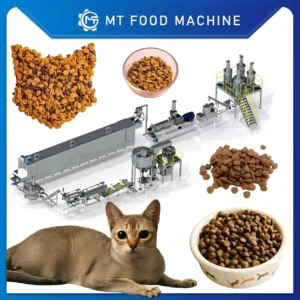
200-250kg/h Capacity PLC Controlled Multi-Species Dog Food Processing Line with MT-70 Extruder
¥35,000.00 Select options This product has multiple variants. The options may be chosen on the product page -
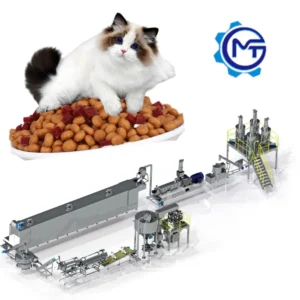
MT70 200-250kg/h Dog Cat Pet Food Processing Line 380V 50HZ Three Phase 45KW
¥35,000.00 Select options This product has multiple variants. The options may be chosen on the product page -
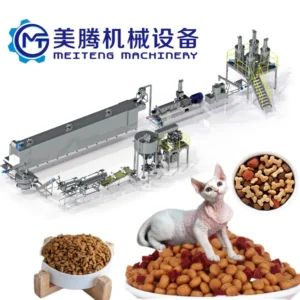
MT70 100-200kg/h Dog & Cat Pet Food Processing Line with 380V 50Hz Three Phase Power
¥35,000.00 Select options This product has multiple variants. The options may be chosen on the product page -

1.0-1.5t/h High Capacity Multi-Species Fish Feed Processing Line to Produce Fish Food
¥45,000.00 Select options This product has multiple variants. The options may be chosen on the product page