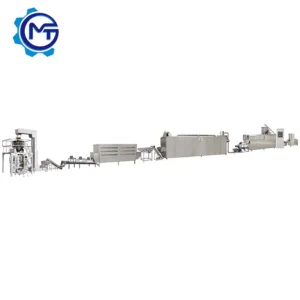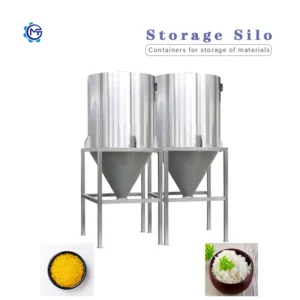
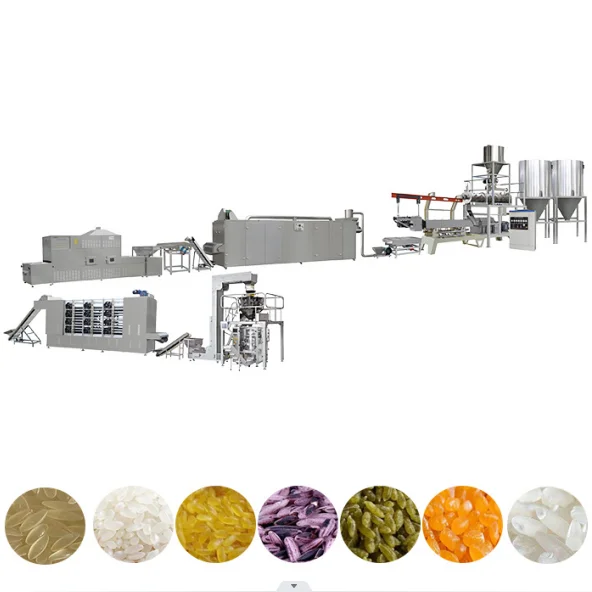

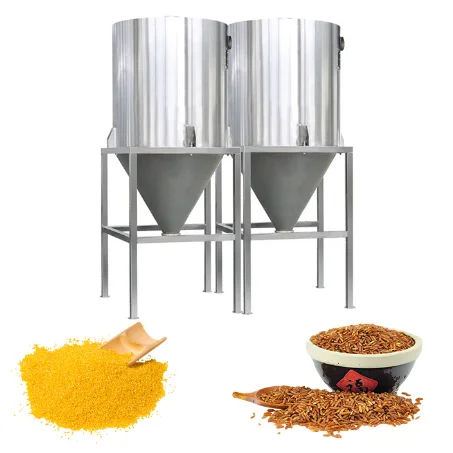
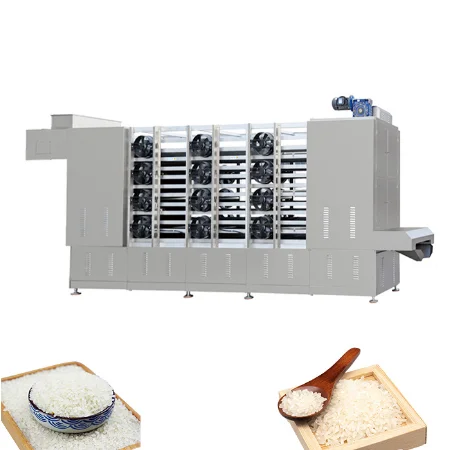

MT65 / MT70 / MT85 / MT75 / MT95 Fortified Artificial Rice Production Line, Twin-Screw Extrusion, Frequency Speed Control — configured for broken rice, rice bran, corn, millet, wheat, oats, buckwheat, bean, and starch blends with vitamin and mineral additives.
- Screw configuration and die design matched to your grain formulation and target kernel density, controlling expansion and texture across each capacity tier from pilot to ton-scale output.
- Line layout and throughput engineering validated through in-house trial runs on your raw material before shipment.
Description
Throughput-Matched Stations — A complete fortified artificial rice production line turnkey engineered so mixing, extrusion, drying, roasting, and packing operate at synchronized capacities rather than bottlenecking at any single point.
Technical Specifications
| Parameter | Value |
|---|---|
| Product Type | Nutritional Fortified Artificial Rice Production Line |
| Models Available | MT65, MT70, MT85, MT75, MT95 |
| Screw Type | Twin Screw |
| Installed Power (MT65) | 85 kW |
| Power Consumption (MT65) | 60 kW |
| Output Capacity (MT65) | 80–100 kg/h (basis not stated in source — confirm raw material / moisture / grain mix) |
| Overall Dimensions (MT65) | 28 × 1.2 × 2.2 m |
| Installed Power (MT70) | 120 kW |
| Power Consumption (MT70) | 85 kW |
| Output Capacity (MT70) | 100–120 kg/h (basis not stated in source — confirm raw material / moisture / grain mix) |
| Overall Dimensions (MT70) | 30 × 1.5 × 2.2 m |
| Installed Power (MT85) | 235 kW |
| Power Consumption (MT85) | 165 kW |
| Output Capacity (MT85) | 200–300 kg/h (basis not stated in source — confirm raw material / moisture / grain mix) |
| Overall Dimensions (MT85) | 34 × 3.5 × 4.3 m |
| Installed Power (MT75) | 180 kW |
| Power Consumption (MT75) | 135 kW |
| Output Capacity (MT75) | 300–500 kg/h (basis not stated in source — confirm raw material / moisture / grain mix) |
| Overall Dimensions (MT75) | 32 × 3.5 × 4.3 m |
| Installed Power (MT95) | 260 kW |
| Power Consumption (MT95) | 195 kW |
| Output Capacity (MT95) | 800–1000 kg/h (basis not stated in source — confirm raw material / moisture / grain mix) |
| Overall Dimensions (MT95) | 36 × 3.5 × 4.3 m |
| Control System | Frequency speed control (PLC / MCC available upon request) |
| Screw Material | Wear-resistant alloy |
| Feeding System | Single or double screw feeding matched to raw material |
| Auto Lubrication & Cooling | Yes |
| Dryer Heating Source | Electric or gas |
| Dryer Feature | Circulation drying, frequency motor controlled mesh belt |
| Voltage & Frequency | Customizable to buyer’s local standard |
| Raw Materials | Broken rice, rice bran, corn, millet, wheat, oats, buckwheat, bean, starch, vitamin and mineral additives |
| Final Products | Artificial rice, fortified rice kernels |
| Certifications | CE, ISO |
Application Suitability
| Application | Material or Output |
|---|---|
| Government and NGO fortified food programmes | Vitamin-enriched rice from broken rice and milled grain blends for distribution networks |
| Grain processing value addition | Converting rice bran, broken rice, and millet into reconstituted nutritional rice kernels |
| Infant and clinical nutrition ingredient supply | Starch and multi-grain based artificial rice fortified with mineral and vitamin premixes |
| Commercial breakfast and convenience food manufacturing | Fortified rice kernels from corn, oats, buckwheat, and bean flour blends for retail packaging |
| Food manufacturer plant expansion | Scaling existing artificial rice output by integrating additional extrusion and drying capacity |
Why "Rated Capacity" Means Nothing Without Your Grain Mix
The number on the quotation only holds if the extruder is configured for the exact grain blend and moisture content you will run.
A Southeast Asian buyer once signed for a line based on nominal throughput figures. Their formulation used a high proportion of brown rice and coarse grains that required a higher gelatinisation temperature than standard white rice flour. The screw profile and barrel heating zones were set for a generic recipe. Output dropped sharply, kernel density fell outside the target range, and the project nearly stalled at commissioning [NEED_CITE: twin-screw extrusion gelatinisation requirements for high-fibre grain blends]. The capacity figure in a brochure assumes a reference material — when your actual raw material behaves differently under heat and shear, the entire line must be re-tuned or the throughput expectation must be revised. This is why every fortified artificial rice production line turnkey we build is trialled on the buyer’s own grain mix before it leaves the factory.
Screw Configuration Dictates What Your Grain Blend Becomes
The twin-screw extruder at the heart of this line does not apply a universal screw profile. The screw element arrangement — conveying, kneading, and reverse sections — is specified after reviewing the buyer’s grain ratios, starch content, and target kernel density. A formulation heavy in broken rice and starch demands a different shear and residence time profile than one built around oats and buckwheat. Die geometry is matched to the desired kernel shape and expansion ratio. Getting this wrong means kernels that fracture during drying or fail to hold their shape during cooking.
Drying Uniformity Determines Whether Kernels Survive Storage
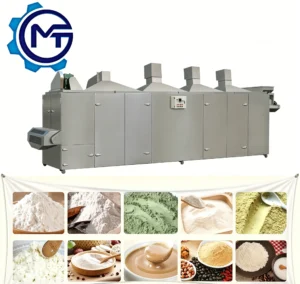
The circulation dryer uses a frequency-controlled mesh belt to move the extruded kernels through heated zones at a regulated pace. Moisture must be drawn down evenly across every kernel — wet spots invite microbial spoilage, while over-dried kernels crack during packing and transport. The choice between electric and gas heating depends on local utility cost and available infrastructure. For buyers running vitamin-fortified formulations, low-temperature drying stages protect heat-sensitive micronutrients from degradation [NEED_CITE: thermal degradation thresholds for vitamin premixes in extruded grain products].
Reading the Power and Capacity Spread Across Five Models
The range spans from MT65 at 85 kW installed power to MT95 at 260 kW, covering pilot-scale runs through to continuous ton-scale production. The jump in overall dimensions — from 28 m line length on MT65 to 36 m on MT95 — reflects the additional drying and cooling length required as throughput increases. Power consumption figures sit noticeably below installed power across all models, indicating that motors are sized with headroom rather than running at continuous peak load. The auto-lubrication and cooling system on the extruder barrel supports extended production runs without manual intervention on bearing temperatures. Feeding system selection between single and double screw depends on whether the raw material is free-flowing milled flour or a cohesive blend with higher moisture.
The Hidden Cost of Skipping a Pre-Shipment Trial
When a line ships without being trialled on the buyer’s actual raw material, every formulation adjustment happens during on-site commissioning — on the buyer’s clock, with installation engineers charging daily rates and production revenue delayed [NEED_CITE: typical commissioning delays when extrusion lines are not factory-tested]. Screw elements may need reordering, die plates replaced, and dryer belt speeds recalibrated. For fortified rice programmes with government delivery deadlines, a multi-week commissioning overrun can mean contractual penalties. A trial run in the testing workshop identifies the correct screw configuration, barrel temperature profile, and drying curve before the equipment is crated.
Why Buyers Source This Line Here
Each station from batching through packing is specified under a single line configuration, so the extruder output, dryer capacity, cooling conveyor length, and packing rate are calculated against one another rather than sourced independently. The screw and die configuration is documented against the buyer’s specific grain blend and kernel specification — not copied from a generic build. The in-house testing workshop runs the buyer’s raw material through the extruder before shipment, producing a trial report that confirms the formulation works. Electrical schematics are drawn with the buyer’s confirmed voltage, frequency, and control language before production begins, avoiding the commissioning delays that arise when a control panel arrives with the wrong supply rating. Five model options allow the line to be scaled from small-batch production to full industrial output without redesigning the downstream stations.
Documentation & Verification
- Line layout and capacity calculation showing throughput match from batching through extrusion to packing
- Screw and die configuration record documented against the buyer’s grain blend and kernel specification
- Trial run report on customer-supplied raw material conducted in the testing workshop before shipment
- Electrical schematic with confirmed voltage, frequency, and control language matched to the buyer’s facility
- Operation and maintenance manual covering extruder, dryer, roaster, and packing station
- CE declaration of conformity and ISO certificate for export market compliance
Installation, Commissioning & Support
- Foundation and floor space planning based on the selected model’s overall dimensions from 28 to 36 m line length
- Dedicated electrical circuits sized to the installed power requirement from 85 kW to 260 kW depending on model
- On-site assembly of extruder barrel sections, dryer modules, and cooling conveyors with alignment verification
- First-run parameter setting including barrel temperature zones, screw speed, and dryer belt frequency
- Operator training covering screw element inspection, die plate changeover, and auto-lubrication system monitoring
- Wear parts list including screw elements, die plates, and mesh belt sections with recommended replacement intervals
What We Need to Configure Your Line
To move from an initial inquiry to a line layout proposal, we need the specific grain blend and flour ratios you plan to run, the target moisture content of the finished kernel, and the daily or hourly production target your facility requires. Share your local voltage and frequency standard along with the preferred control panel language so the electrical design is confirmed before fabrication begins. If you have existing upstream milling or downstream packing equipment, provide the interface specifications so the new line stations are throughput-matched to your current setup.
Frequently Asked Questions
Q: How is line capacity verified against my specific grain blend and moisture content?
A: We conduct a trial run using your actual raw material in the in-house testing workshop before the line ships. The screw configuration, barrel temperature profile, and dryer settings are adjusted until the kernel density, shape retention, and moisture level meet your specification. The trial report documents the parameters that achieved the target output on your specific formulation.
Q: What voltage, frequency, and control language options are confirmed before production?
A: The electrical schematic is drawn and confirmed with the buyer before fabrication begins. Voltage and frequency are set to match the buyer’s local grid standard, and the control panel language is specified at the quotation stage. This prevents the situation where a line arrives on site and the electrical supply or operator interface does not match the facility.
Q: How is screw configuration and die design matched to broken rice, multi-grain, or starch-based formulations?
A: The screw element arrangement — the ratio of conveying, kneading, and reverse sections — is specified based on the starch content, fibre level, and gelatinisation temperature of the buyer’s grain blend. Die geometry is chosen to produce the target kernel shape and expansion ratio. Each configuration is recorded and can be replicated or adjusted as formulations evolve.
Q: Is a trial run on my raw material conducted before the line ships?
A: Yes. Every line undergoes a trial run in the factory testing workshop using the buyer’s supplied raw material. The extruder, dryer, and downstream stations are operated together to confirm that the complete process produces kernels meeting the buyer’s density, moisture, and dimensional specifications. The results are documented in a trial report shared before dispatch.
Q: How are extrusion, drying, and packing stations throughput-matched to avoid bottlenecks?
A: The entire line is configured as a single project rather than assembled from separate vendors. The extruder output rate, dryer belt length and speed, cooling conveyor capacity, and packing machine rate are all calculated against one another during the layout design stage. This ensures no single station restricts the throughput of the stations before or after it.
Related products
-
CE cerelac Instant Baby Food Porridge Making Machine Production Line
¥35,000.00 Select options This product has multiple variants. The options may be chosen on the product page -

Compact Automatic Baby Cereal Nutrition Powder Production Line with 500kg/h Capacity and PLC Control
¥9,500.00 Add to cart -

Full Automatic Complete Baby Food Nutrition Powder Porridge Processing Production Line for Infant Nutrition Factory
¥9,500.00 Add to cart -
Automatic Iron Fortified Baby Rice Cereal Nutrition Powder Making Machine 500kg/h PLC Controlled
¥8,238.27 Add to cart