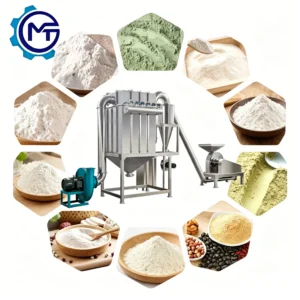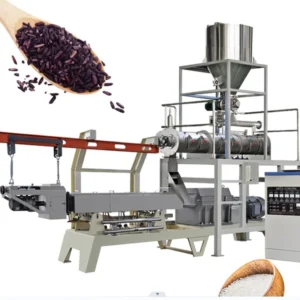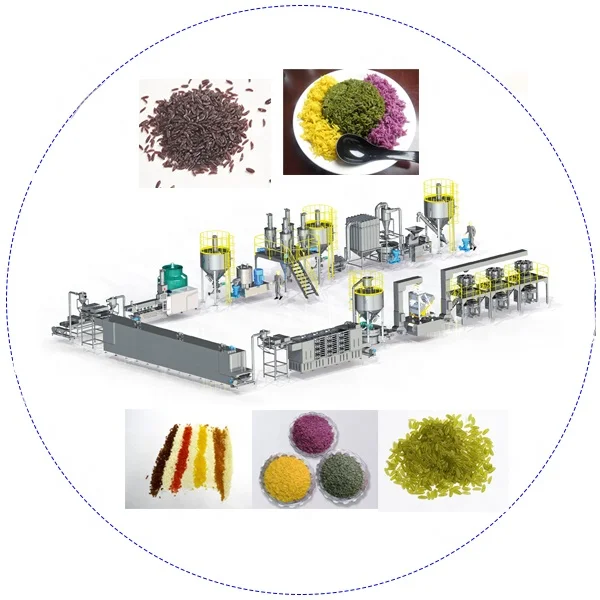
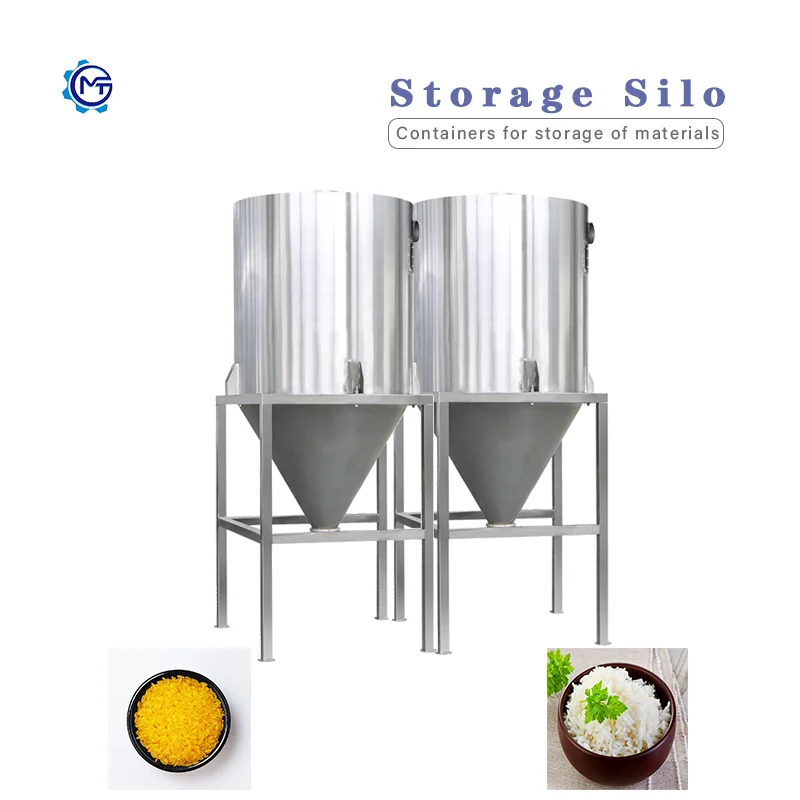
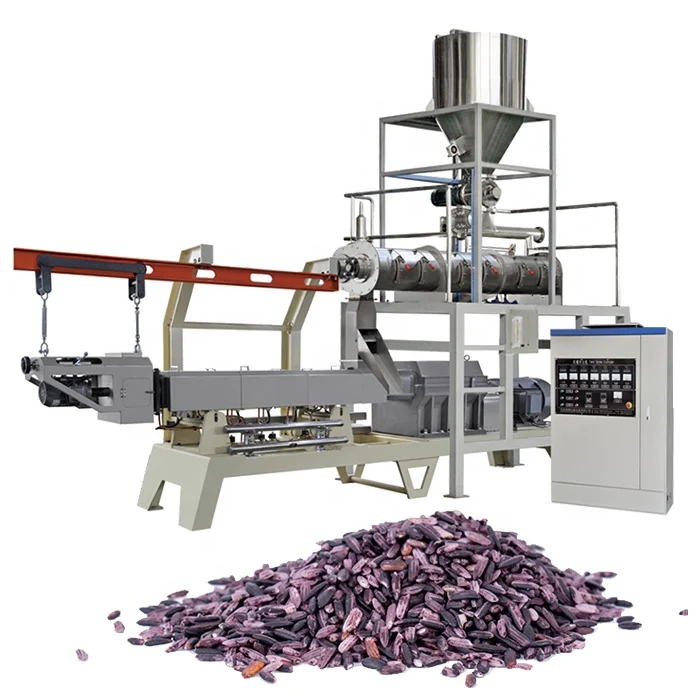
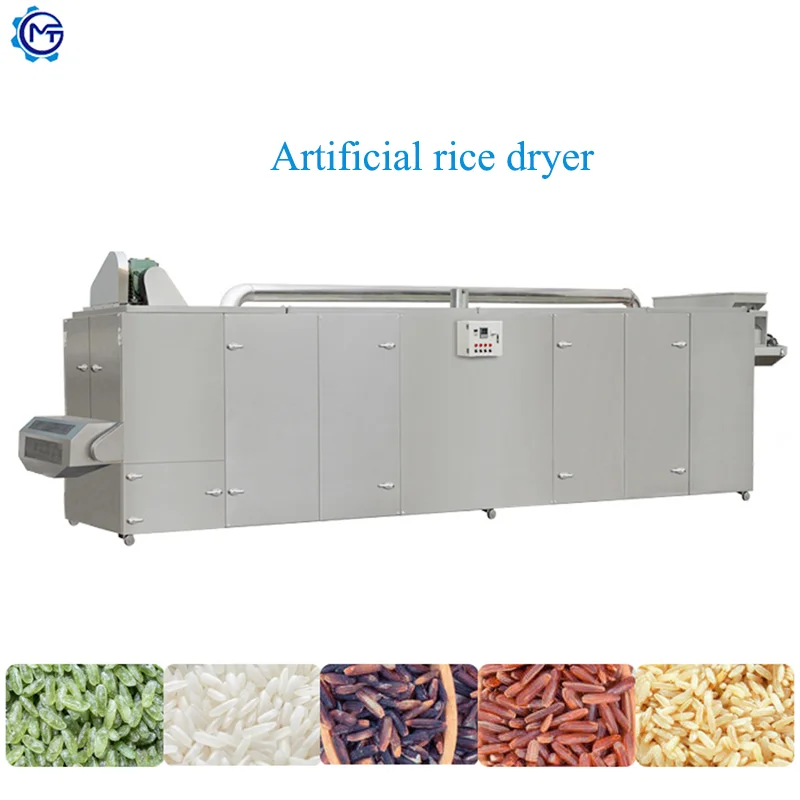
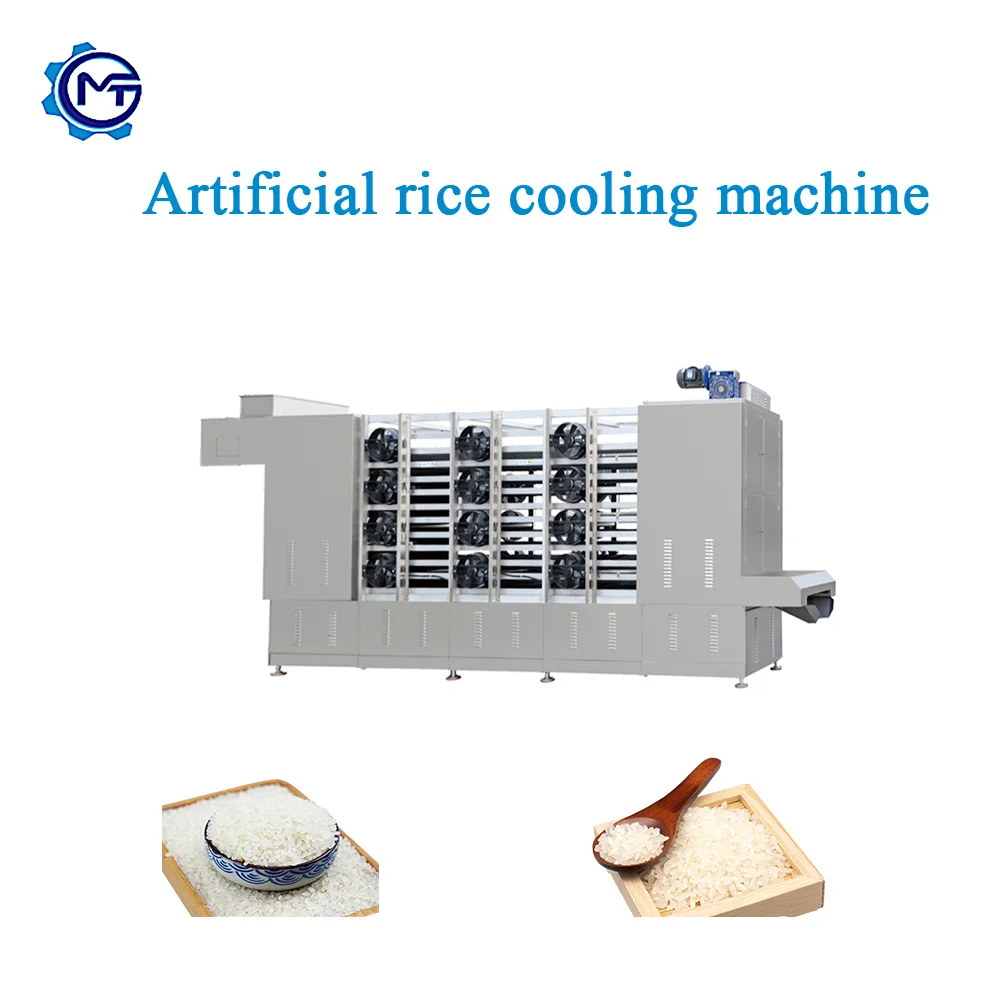
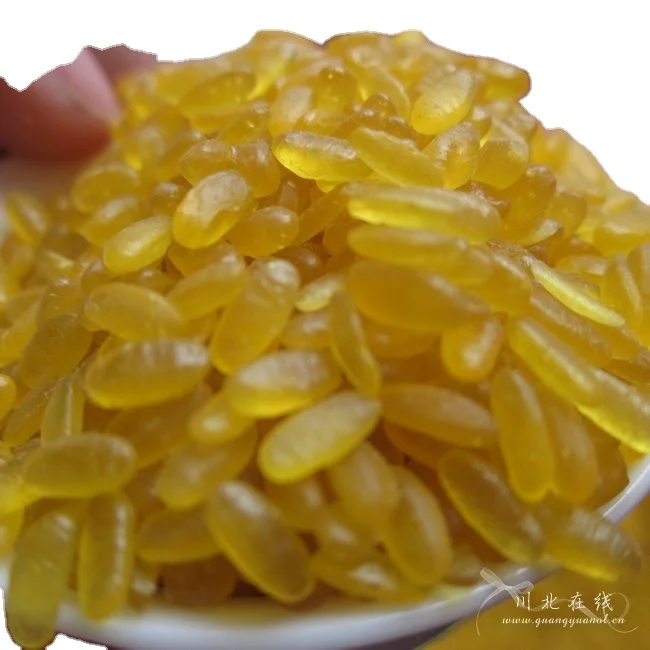
MT65 Fortified Rice Extrusion Line, 85KW Installed Power, Twin-Screw — designed for complete turnkey nutritional grain processing from batching through packing.
- Frequency speed control integrated across mixing, extruding, drying and roasting stations
- Single or double screw feeding selected by material uniformity
- Automatic lubrication and cooling system for continuous operation
Throughput is matched across every station under one supplier, with trial runs on your specific grain formulation and nutrient blend completed before shipment to verify real output.
Description
Integrated Throughput Design — Every station from batching to packing is sized against actual grain formulation behavior, not catalog defaults, so your fortified rice line holds steady output without bottlenecking at the dryer or roaster.
Technical Specifications
| Parameter | Value |
|---|---|
| Model | MT65 |
| Product Type | Fortified Rice Extrusion Line |
| Screw Type | Twin Screw |
| Installed Power | 85 kW |
| Power Consumption | 60 kW |
| Capacity | 80–100 kg/h (basis not stated in source — confirm raw material and moisture content) |
| Overall Dimensions | 28 × 1.2 × 2.2 m |
| Control System | Frequency speed controlling with high automation |
| Feeding System | Single or double screw feeding (selected based on material) |
| Lubrication | Automatic lubricating and cooling system |
| Production Procedure | Mixing → Extruding → Vibrating → Low-temperature drying → Cooling → High-temperature roasting → Cooling → Packing |
| Certification | CE, ISO |
Application Suitability
| Application | Material or Output |
|---|---|
| Nutritional fortified rice kernels | Broken rice, rice bran with vitamin and mineral micro-nutrient blends |
| Artificial rice production | Rice flour, corn, millet, wheat, buckwheat, oat-based grain formulations |
| Grain-based nutritional food manufacturing | Starch-forward blends with bean, oat, or wheat additives |
| Infant and dietary supplementary rice | Pregelatinized starch blends with fortified mineral premixes |
Why Nominal Line Capacity Rarely Survives Your Actual Grain Blend
A turnkey Fortified Rice Extrusion Line only performs as well as the throughput match between its extruder, dryer, and roaster on the buyer’s real formulation.
When a project is quoted on a single capacity number pulled from a standard rice recipe, the line often stumbles the moment the raw material shifts. I once watched a Southeast Asian commissioning stall for five days because the local broken rice was blended with sorghum and mung bean, pushing gelatinization temperatures well outside the original extruder profile. The extruder kept pushing, but the downstream low-temperature dryer could not handle the altered moisture curve, and the roaster scorched the kernel surface before the core dried through. Capacity on paper stayed the same; capacity on the floor collapsed [NEED_CITE: impact of grain blend variation on gelatinization temperature in twin-screw extrusion].
Laying Out a Fortified Rice Extrusion Line Turnkey Project Around Real Throughput
A Fortified Rice Extrusion Line turnkey project demands that every station be calculated against the same mass balance. The MT65 extruder section sets the output ceiling, but if the vibrating screen, low-temperature dryer, cooling conveyor, and high-temperature roaster are not each rated to absorb that output at the actual moisture and density of your kernel, the line either accumulates product between stations or forces the extruder to idle. Layout planning here means matching belt widths, drying residence time, and roaster drum volume to the specific grain and nutrient formulation you will run.
Utility Planning That Precedes the Foundation Pour
Before a single machine is bolted down, the factory floor needs confirmed electrical load distribution, gas supply for the high-temperature roasting stage, and cooling water circuits. The MT65 line draws roughly 60 kW in continuous operation, but starting surges across the extruder main drive, dryer blowers, and roaster burners must be sequenced so the local transformer is not overwhelmed. Utility routing also dictates where the drying and roasting sections sit relative to ventilation and exhaust ducting [NEED_CITE: industrial utility planning standards for food extrusion facilities]. Phased installation scheduling depends on getting these services stubbed out before the extruder arrives.
Reading the Specs That Actually Govern Kernel Quality
The twin-screw configuration on the MT65 gives operators shear control that a single-screw design cannot match when blending vitamin and mineral premixes into broken rice flour; the intermeshing screw flights wipe each other clean and prevent nutrient hot-spots. Frequency speed controlling across the line means the feeding system, extruder screw speed, and dryer belt speed can all be adjusted from a single automation panel, which matters when a recipe change requires a different residence time in the barrel. The automatic lubricating and cooling system protects the screw shaft seals during extended runs, reducing unplanned stops. Barrel temperature profile and die selection together determine whether the final kernel holds its shape through the roasting stage without collapsing or cracking.
The Hidden Cost of Skipping a Pre-Shipment Trial
When a fortified rice line ships without a trial run on the buyer’s actual broken rice and nutrient premix, the first production day becomes the development day. Screw configuration and die geometry are locked in at the factory, and if the real grain blend gelatinizes at a different temperature or absorbs moisture differently than the standard test flour, the kernel density falls outside market specification. Floating kernels that should sink in cooking water, or fortified kernels that fracture during packing, trace back to untested material assumptions. I have seen contractors lose entire commissioning windows chasing die swaps on-site because the trial never happened before the crates left Jinan [NEED_CITE: importance of pre-shipment material trial in extrusion projects].
Why Source This Line Through an Integrated Project Approach
Every station from the batching mixer through the packing scale is supplied and configured by one engineering team, so throughput calculations do not pass between unrelated vendors who each optimize their own machine in isolation. Screw configuration and die design are specified against the grain blend and nutrient additive ratio you provide, not copied from a generic rice build. The in-house testing workshop runs your actual broken rice and vitamin premix before the line is crated, producing a trial run report you can review before shipment. Electrical schematics arrive with voltage and frequency already confirmed for your local grid, avoiding commissioning delays. Operator training covers parameter setting on the frequency-controlled panel and screw wear inspection so your crew is productive from the first shift.
Documentation & Verification
- Line layout drawing with throughput calculation across extruder, dryer, roaster, and packing stations
- Trial run report on your specific broken rice and nutrient formulation before dispatch
- Electrical schematic confirming voltage, frequency, and control language for your facility
- Screw and die configuration record matched to your grain blend and kernel target density
- CE declaration of conformity and ISO certificate for the complete line
Installation, Commissioning & Support
- Foundation pad leveled for the 28-meter line footprint with anchor points mapped to extruder and roaster mass
- Dedicated 85 kW circuit with sequenced soft-start for the MT65 main drive to manage inrush current
- Extruder barrel and screw assembly verified on-site against factory configuration record before first run
- Frequency speed control panel calibrated to local voltage and operator language preference during commissioning
- Wear parts list covering screws, dies, and dryer belt sections stocked for first replacement cycle
- Operator training on barrel temperature profiling and feeding system adjustment for recipe changes
What to Prepare Before Requesting a Quotation
Share your exact grain formulation — including the ratio of broken rice to any secondary grains like millet, buckwheat, or bean flour — along with the vitamin and mineral premix composition. Confirm the local voltage and frequency at your facility, the available floor length for a line roughly 28 meters long, and whether gas supply for the high-temperature roasting stage is already in place. Let us know if you can send a representative batch of your raw material for a pre-shipment trial run.
Frequently Asked Questions
Q: How is capacity verified across the complete line when extruder, dryer, and roaster must match throughput?
A: Each station is sized against a mass balance calculated from your grain blend’s moisture content and kernel density target. The extruder output sets the ceiling, and the dryer residence time and roaster drum volume are then matched to absorb that output continuously. A pre-shipment trial run on your actual material confirms the balance before the line is finalized.
Q: What voltage and frequency confirmation is needed for the entire production line before commissioning?
A: We require your facility’s supply voltage, phase configuration, and frequency before the electrical schematics are finalized. The frequency-controlled drives and the roaster ignition system are then configured to match. Control panel language and safety interlock standards are also set at this stage to avoid rewiring or reprogramming during on-site commissioning.
Q: How do you match screw configuration and die design to our specific grain formulation and nutrient additives?
A: The twin-screw elements are arranged by pitch and kneading block angle to deliver the shear and residence time your grain blend requires. Die orifice diameter and land length are selected to produce the target kernel density after drying and roasting. Your nutrient premix composition influences barrel temperature profiling to prevent vitamin degradation during extrusion.
Q: What is included in the trial run before shipment, and can we test our actual broken rice and vitamin blend?
A: The trial run uses your shipped raw material and nutrient premix in the in-house testing workshop. We document extruder screw speed, barrel temperature profile, die selection, and the resulting kernel density and shape. A full trial run report accompanies the shipment so your team can reference baseline parameters from the first production day.
Q: How is utility planning integrated into the factory layout for electricity, gas, and cooling water?
A: The line layout drawing includes electrical load distribution across the extruder, dryer blowers, and roaster burners, along with gas supply routing and cooling water circuit stubs. Utility connection points are positioned before machine placement so that foundation work and service rough-ins proceed in the correct sequence during phased installation.
Related products
-

Automatic Instant Powder Production Line Nutritional Powder Extruder Machine
¥10,000.00 Select options This product has multiple variants. The options may be chosen on the product page -

High Precision Automatic 500kg/h Baby Food Nutrition Powder Rice Extrusion Processing Line
¥9,500.00 Add to cart -

High Quality Automatic PLC Controlled 500kg/h Twin Screw Extruder Machine for Baby Rice Nutrition Powder
¥8,238.27 Add to cart -

Industrial Automatic 500kg/h Baby Cereal Nutrition Powder Extruder Manufacturing Process Line
¥8,238.27 Add to cart