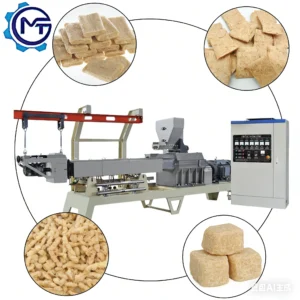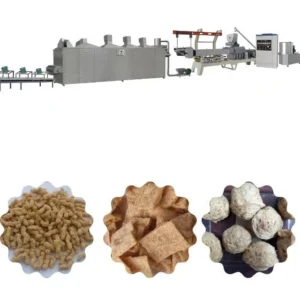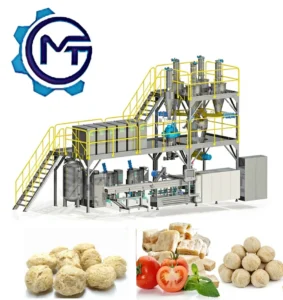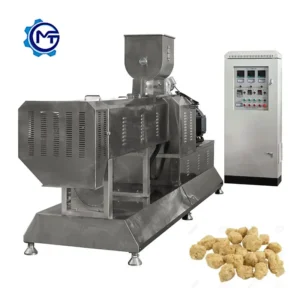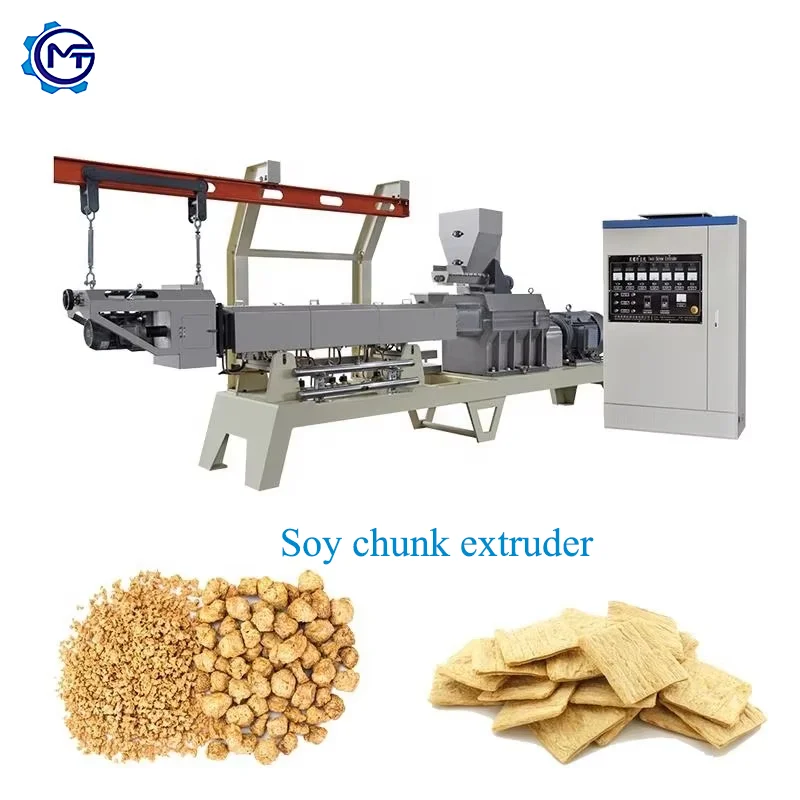

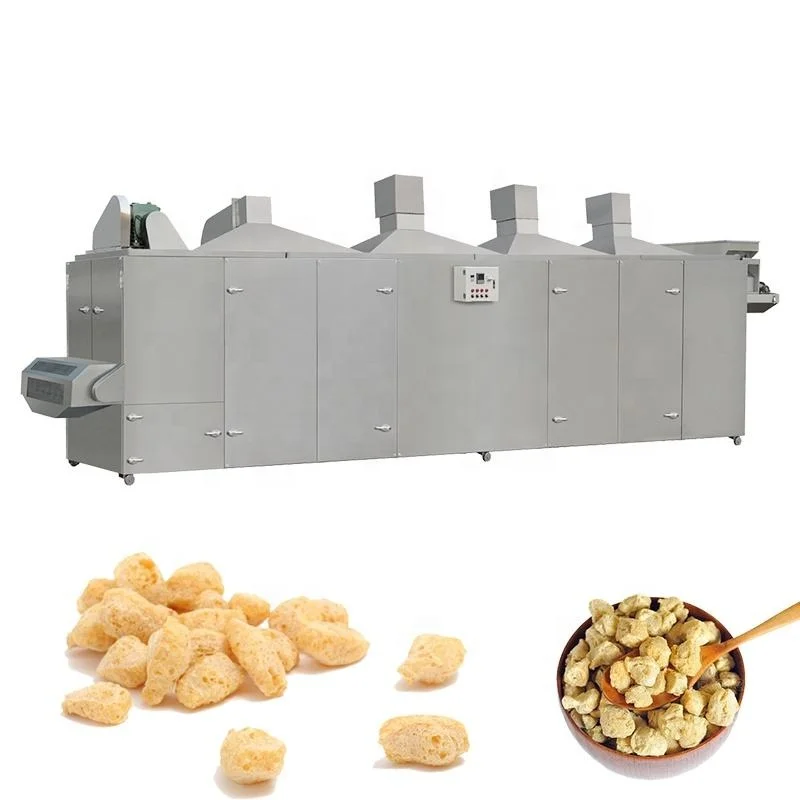


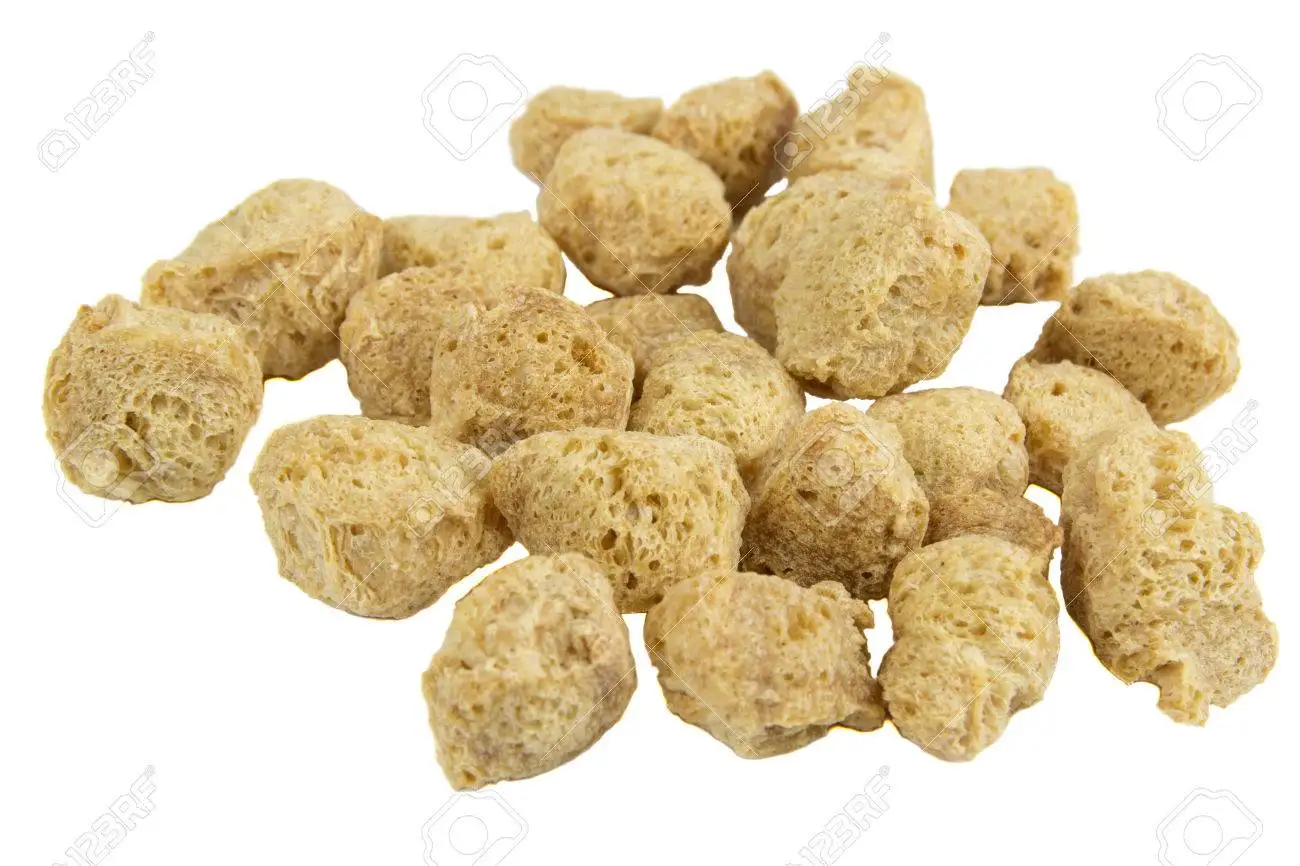
MT65 / MT70 / MT85 Textured Vegetable Protein Extrusion Production Line, Twin-Screw, PLC/MCC Control — engineered for plant-based meat and TVP processing with food-grade stainless steel construction across all contact points.
- Screw configuration and die design specified to your raw material, controlling fiber structure, moisture profile, and expansion density through the barrel zones.
- Complete turnkey line from batching through extrusion, drying, cooling, and packing, with throughput matched at every station to eliminate bottlenecks.
Line layout, capacity calculation, and trial run reports on your specific soybean or peanut meal provided before shipment for full process validation.
Description
Turnkey Line Throughput Balance — Every station from mixer to packing is sized to the extruder’s real output on your specific protein meal, eliminating the bottleneck that plagues lines assembled from separate vendors.
Technical Specifications
| Parameter | Value |
|---|---|
| Product Type | Textured Vegetable Protein (TVP) Extrusion Production Line |
| Model Options | MT65 / MT70 / MT85 |
| Screw Configuration | Twin-screw |
| Installed Power | MT65: 85 kW; MT70: 120 kW; MT85: 195 kW |
| Actual Power Consumption | MT65: 65 kW; MT70: 90 kW; MT85: 165 kW |
| Output Capacity | MT65: 150–200 kg/h (basis not stated in source); MT70: 200–300 kg/h (basis not stated in source); MT85: 600–800 kg/h (basis not stated in source) |
| Overall Line Dimensions | MT65: 18000×1300×2300 mm; MT70: 20000×1500×2400 mm; MT85: 24000×3500×4300 mm |
| Control System | PLC and MCC (configuration selectable) |
| Contact Material | Food-grade 304 stainless steel on main parts |
| Line Sequence | Raw material preparation → Mixing → Conveying → Extrusion → Conveying → Drying → Cooling → Packing |
| Assembly State | Complete turnkey line |
| Warranty | 1-year complete line warranty, lifetime maintenance support |
| Certification | CE (since 2014), ISO |
Application Suitability
| Application | Material or Output |
|---|---|
| Plant-based meat analogue production | Low-temperature soybean meal, peanut meal |
| Textured soy protein for sausage and ham filling | Defatted soybean meal at varying protein grades |
| Vegetarian frozen food ingredient processing | Blended plant protein meals with starch carriers |
| High-protein nutritional food bases | Soy and legume meals for retail or food-service markets |
| Canned food protein supplementation | Textured vegetable protein chunks and granules |
What "Nominal Output" Leaves Out on a Textured Vegetable Protein Production Line Turnkey
Capacity numbers mean nothing until the extruder runs your exact meal at your target moisture.
A common frustration in plant-based protein projects is receiving a line rated at a certain throughput on paper, only to find the actual output drops once local raw material enters the barrel. Protein content, fat residual, and particle size of soybean meal vary significantly by source and region. A textured vegetable protein production line turnkey that was never tested against the buyer’s specific feedstock often requires weeks of on-site screw reconfiguration before the fiber structure comes out right. I watched a Southeast Asian project stall for two full weeks because the local defatted soybean meal had lower protein than the generic test material, and the extruded output crumbled instead of forming coherent fibers. [NEED_CITE: impact of raw material protein content on extrusion fiber formation]
Screw Geometry and Fiber Alignment in TVP Extrusion
The twin-screw configuration on the MT65, MT70, and MT85 allows operators to adjust screw element sequencing — alternating conveying, kneading, and reverse-flight sections — to control shear intensity and residence time inside the barrel. For a textured vegetable protein production line turnkey, the screw profile directly governs how protein molecules unfold and align into the layered fiber structure that defines product quality. Barrel temperature zones work in concert with the screw arrangement, with each zone set independently to manage the transition from raw meal to molten protein mass.
Die Design and the Density Question
The die plate at the extruder discharge determines the cross-section and density of the extrudate. A die with too few orifices creates back-pressure that over-shears the protein, while too many orifices reduce pressure below the threshold needed for proper texturization. [NEED_CITE: die orifice count and pressure relationship in twin-screw extrusion] On this textured vegetable protein production line turnkey, die geometry is matched to the buyer’s target format — whether that means chunky granules for minced-meat replacement or longer strands for sliced deli-style products. Getting this wrong means the downstream dryer either over-dries a low-density product or fails to stabilize a high-density one.
Reading the Power and Dimension Data
Installed power versus actual consumption tells a practical story: the MT85 draws 195 kW at peak but settles around 165 kW during steady-state running, which is the figure that matters for your electrical infrastructure planning. Line length scales significantly across the three models — from 18 meters on the MT65 to 24 meters on the MT85 — meaning floor space and ceiling height requirements shift accordingly. The PLC and MCC control configuration governs how temperature, screw speed, and feed rate are coordinated across stations, with food-grade 304 stainless steel on all contact surfaces ensuring compliance with food safety standards. A textured vegetable protein production line turnkey must be specified against the actual utility supply at the installation site, because voltage and frequency mismatches discovered after delivery delay commissioning by weeks.
The Hidden Cost of a Mismatched Dryer
When the dryer capacity lags behind extruder output, wet product piles up on the conveyor, cooling unevenly and developing off-flavors before it ever reaches the packing station. This throughput imbalance is the single most common cause of unplanned downtime on extrusion-based protein lines, and it happens because the dryer was specified as a standalone item rather than calculated against the extruder’s real discharge rate. [NEED_CITE: throughput imbalance between extruder and dryer in food processing lines] On a textured vegetable protein production line turnkey, every downstream station — conveyor speed, dryer belt length, cooler airflow, and packing rate — must be engineered as a single system.
Why Source the Full Line from One Supplier
Every station from the batching mixer through the extruder, dryer, cooler, and packing unit is calculated as a single throughput chain, so no individual machine creates a bottleneck for the next. Screw configuration and die geometry are documented against your specific raw material sample, not copied from a generic build template. An in-house testing workshop runs your actual soybean or peanut meal through the extruder before shipment, generating a trial report that confirms fiber structure and output rate. The MT65, MT70, and MT85 models share a common control architecture, meaning operators trained on one unit can transition to another without relearning the interface. Commissioning includes on-site installation, parameter tuning against local conditions, and operator training with a wear parts list and maintenance schedule delivered at handover.
Documentation & Verification
- Line layout drawing showing station spacing and utility connection points for your chosen model
- Screw element sequence record matched to your raw material protein content and target fiber grade
- Trial run report on your actual soybean or peanut meal, generated before the line ships
- Electrical schematic with voltage and frequency confirmed for your destination market
- Operation manual covering PLC screen navigation, temperature zone settings, and safety interlocks
- Wear parts list identifying screws, dies, and barrel liners with replacement intervals
Installation, Commissioning & Support
- Foundation must support line dimensions up to 24000×3500×4300 mm on the MT85 with level concrete flooring
- Electrical supply must match confirmed voltage and frequency, with dedicated circuit breakers sized to 195 kW installed power on the MT85
- Line arrives in modular sections; assembly sequence is documented in the installation manual
- First-run commissioning includes barrel temperature profiling and screw speed calibration against your raw material
- Operator training covers PLC screen operation, emergency stop procedures, and daily cleaning protocols for food-grade stainless steel surfaces
- Spare screw elements and die plates are listed in the wear parts schedule with recommended stocking quantities
What to Include in Your Inquiry
When specifying a textured vegetable protein production line turnkey, the most useful details you can provide upfront are your raw material source and its protein percentage, your target daily output, and the physical format of the finished product. Include your local voltage and frequency, the available floor space and ceiling height, and whether you can send a sample of your meal for a pre-shipment trial run.
Frequently Asked Questions
Q: How is output capacity verified against my specific raw material and moisture content?
A: Before shipment, your raw material is run through the extruder in the testing workshop. The trial run report documents actual throughput, fiber structure quality, and moisture levels at discharge. Capacity figures quoted in the proposal are then adjusted to reflect your specific meal rather than a generic benchmark material.
Q: What screw configuration and die design will be used for my target TVP fiber structure?
A: The screw element sequence — conveying, kneading, and reverse-flight sections — is designed around your raw material protein content and the fiber density you need. Die orifice count and shape are matched to your target product format, whether granules, chunks, or strands, and documented in the configuration record.
Q: How do you ensure dryer and cooler capacity matches the extruder output without bottlenecks?
A: Each downstream station is calculated against the extruder’s real discharge rate on your material, not a nominal rating. Dryer belt length, airflow volume, and cooler capacity are specified so that wet product never accumulates between stations during continuous operation.
Q: Can I send my raw material for a trial run before the line ships?
A: Yes. The in-house testing workshop accepts customer-supplied raw material for pre-shipment trials. You receive a trial run report covering throughput, product appearance, fiber alignment, and moisture content, allowing process adjustments before the equipment leaves the factory.
Related products
-
High-yield Soybean Protein Automated Production Line Single Screw Extruder for TVP
Price range: ¥20.00 through ¥30.00 Select options This product has multiple variants. The options may be chosen on the product page -
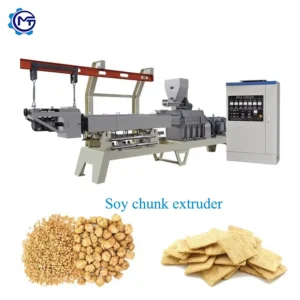
Textured Soybean Protein Extruder Plant Protein Processing Production Line TVP Making Machine
¥30.00 Select options This product has multiple variants. The options may be chosen on the product page -
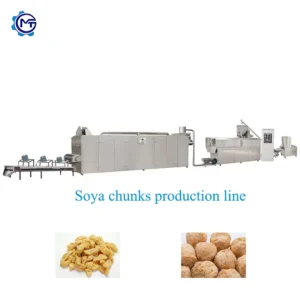
Soybean Protein Making Machine Automatic Soy Chunk Production Line
¥30.00 Select options This product has multiple variants. The options may be chosen on the product page -
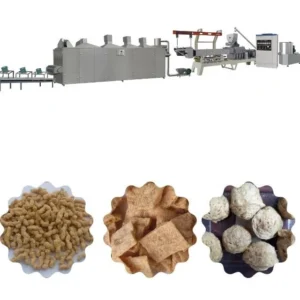
Dry Protein Drawing Equipment – Intelligent Puffing Machine for Cake Protein & Vegetarian Meat
¥65.00 Select options This product has multiple variants. The options may be chosen on the product page