

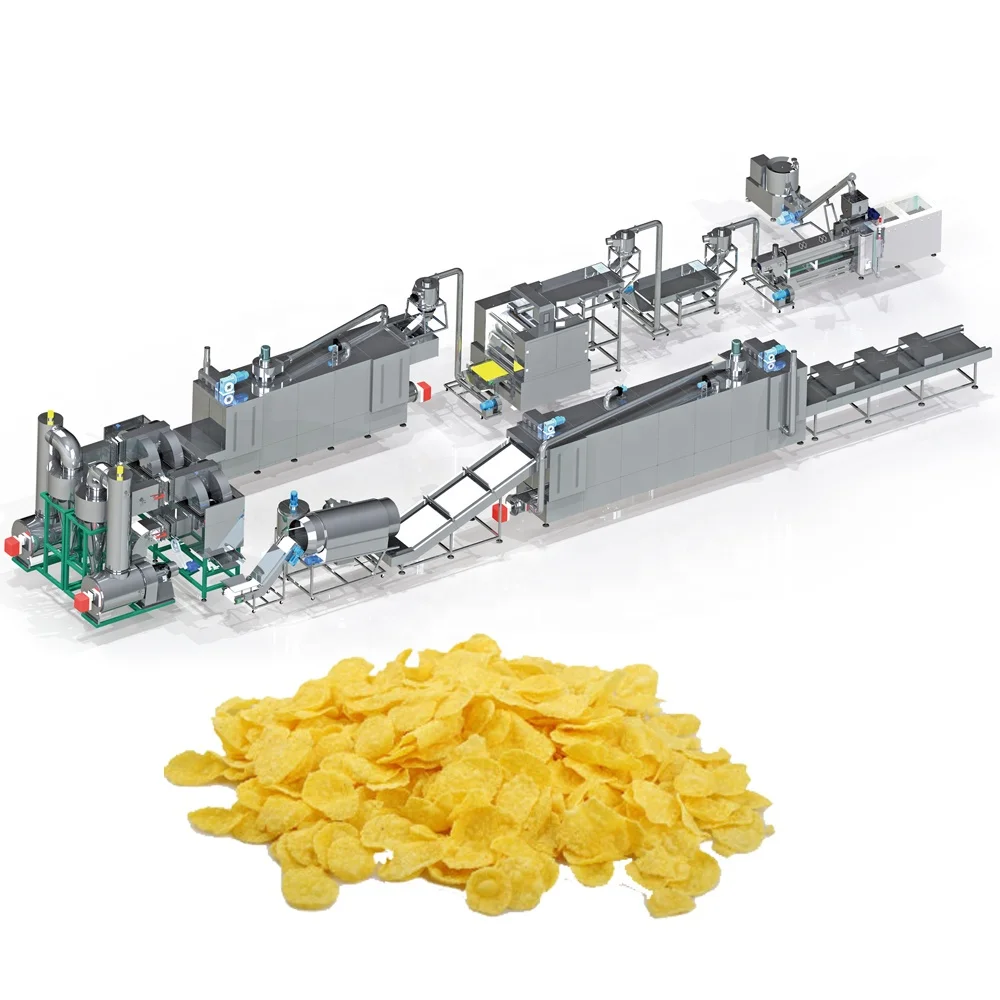
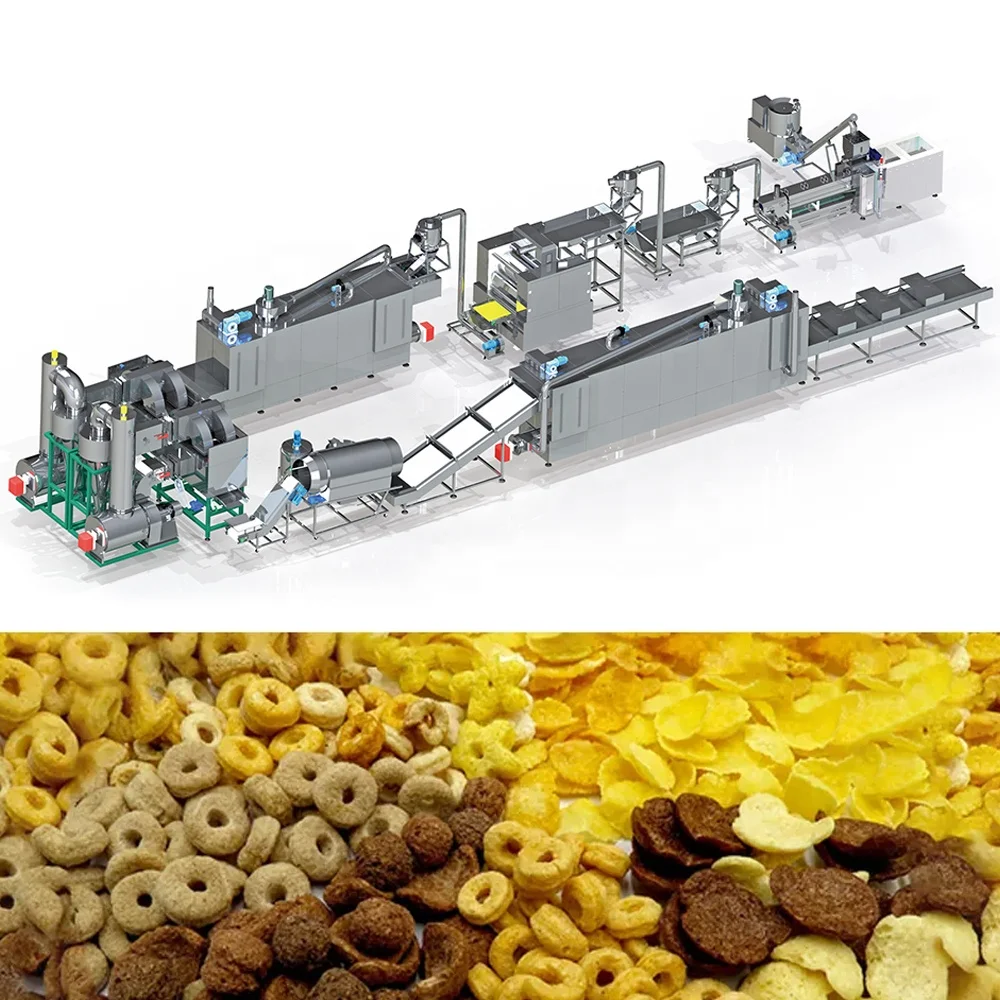
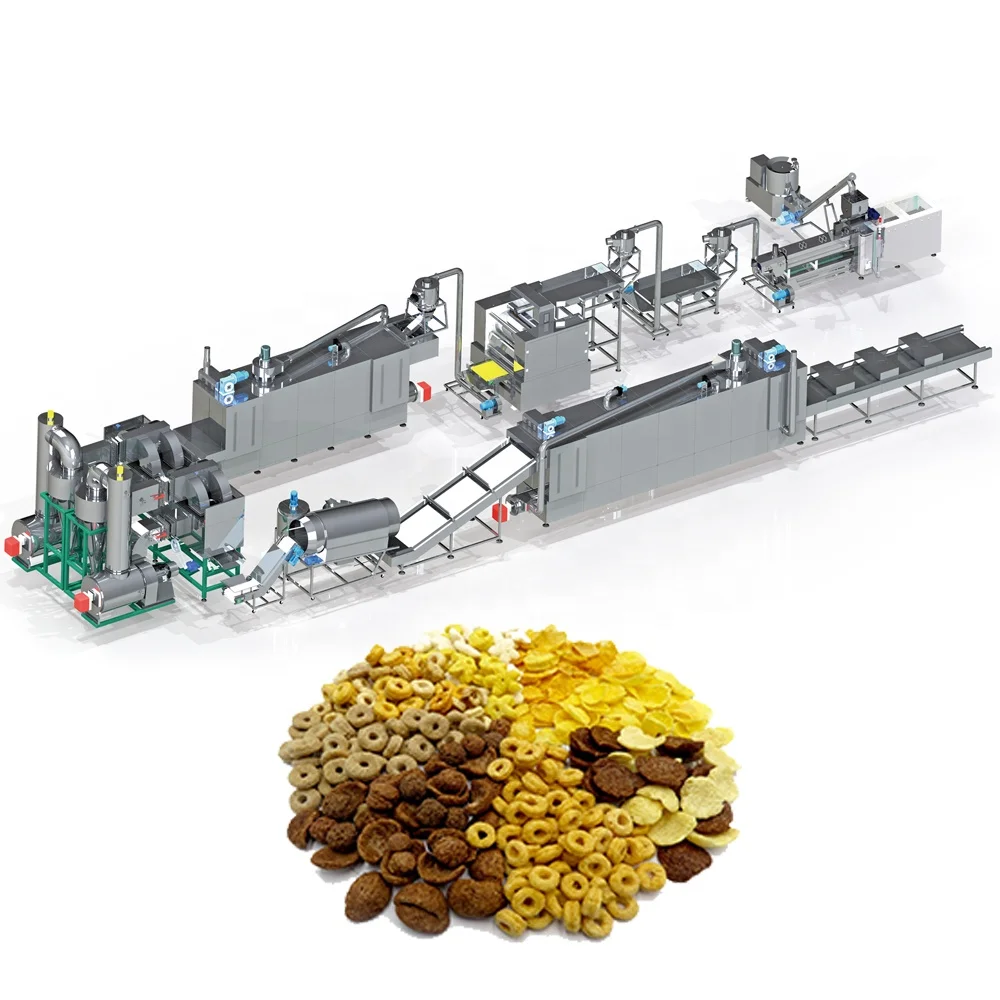
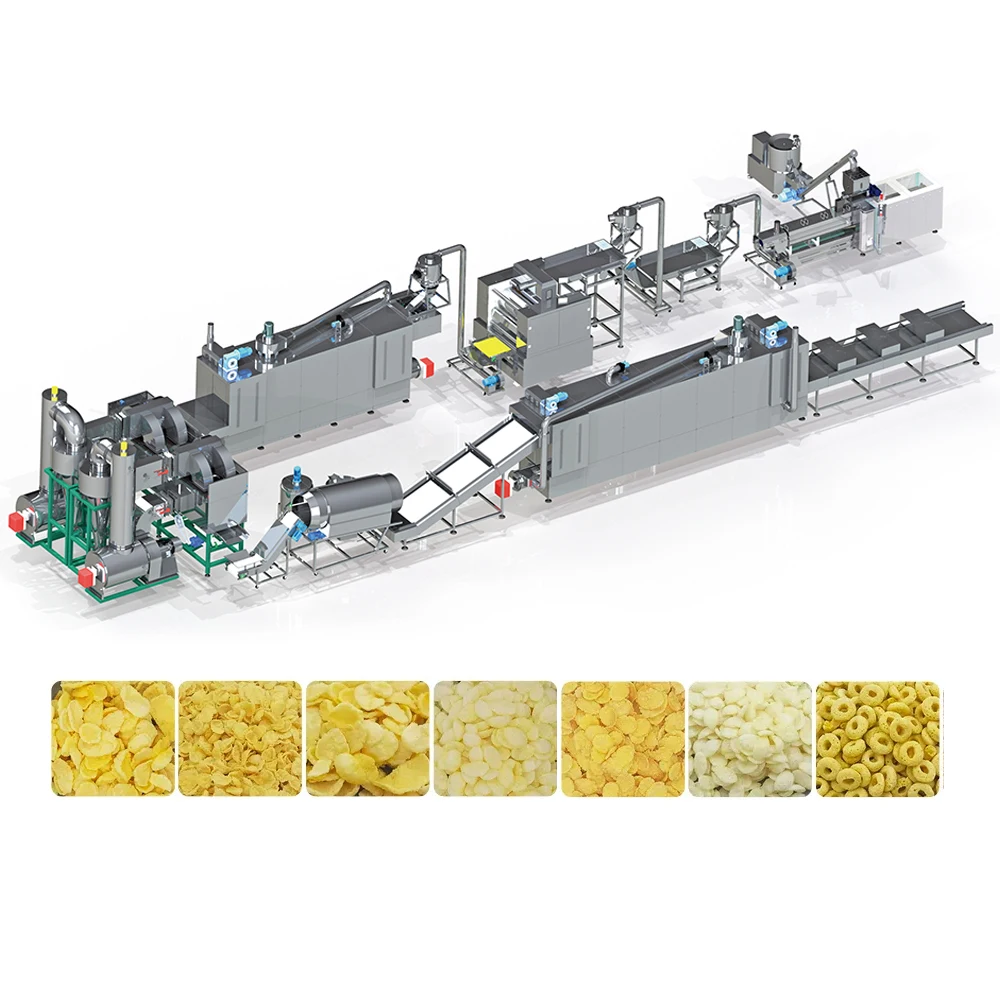
MT70 / MT85 / MT75 Corn Flakes Production Line, Twin-Screw Extruder, PLC Control — complete turnkey layout from mixing through extrusion, flaking, drying, roasting and coating, with throughput matched across every station to your raw material and target output.
- Screw configuration and die design specified to corn, rice, wheat or oat blends for consistent flake density and expansion
- Hydraulic double-roller flaker with infrared temperature sensing ensures uniform thickness before roasting
- Trial runs on your actual raw material performed in our testing workshop before shipment, with full line layout and capacity documentation provided
Description
Matched Throughput Across Stations — every section of this corn flakes line is sized against your actual raw material profile, not catalog assumptions, so extruder output never outpaces the dryer or flaking capacity.
Technical Specifications
| Parameter | Value |
|---|---|
| Model | MT70 / MT85 / MT75 |
| Product Type | Corn Flakes Production Line |
| Screw Type | Twin-screw |
| Installed Power | MT70 — 160 kW; MT85 — 190 kW; MT75 — 210 kW |
| Power Consumption | MT70 — 120 kW; MT85 — 140 kW; MT75 — 150 kW |
| Output Capacity | MT70 — 150–200 kg/h (basis not stated in source — confirm raw material / moisture); MT85 — 300–400 kg/h (basis to be confirmed); MT75 — 300–500 kg/h (basis to be confirmed) |
| Overall Dimensions | MT70 — 41 × 1.5 × 2.2 m; MT85 — 43 × 1.5 × 3.2 m; MT75 — 45 × 1.5 × 3.5 m |
| Control System | PLC and MCC available |
| Basic Raw Materials | Powder of corn, rice, wheat, oat, barley |
| Production Procedure | Mixing → Extruding → Flaking → Drying → Hot Air Roasting → Sugar Coating (optional) → Cooling → Packing |
| Heating Source (Dryer) | Gas or Electric |
| Standards | CE, ISO |
Application Suitability
| Application | Material or Output |
|---|---|
| Natural breakfast corn flakes | Corn grits or corn flour base |
| Sugar-coated corn flakes | Corn base with sugar or honey glaze |
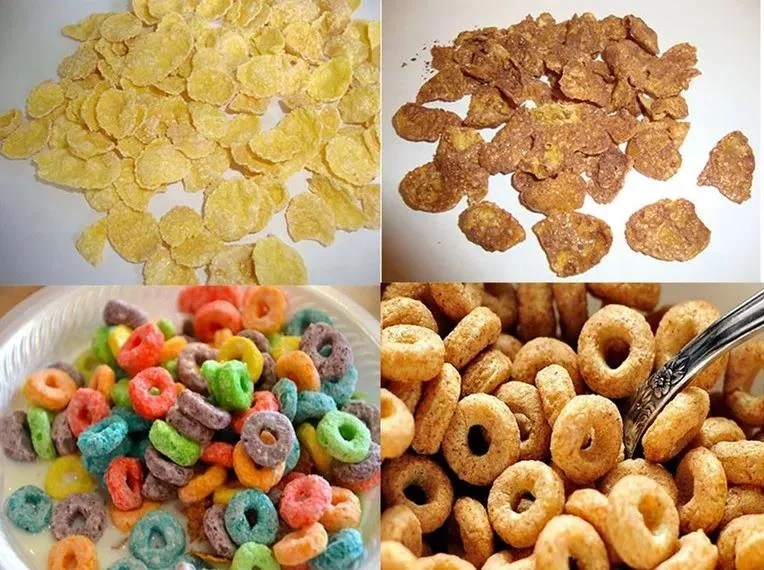
| Shaped cereal snacks | Rice, wheat, oat, or barley blends formed into rings, stars, balls, tubes, fruit loops, or wheels |
| Mixed-grain breakfast cereal | Multi-grain formulations combining corn with oat or barley |
| Fortified flaked cereal | Cereal base with added nutritional premix |
What a Corn Flakes Production Line Turnkey Quote Should Really Cover
The output number on the quotation means nothing until you know the raw material particle size and moisture content it was based on.
I remember a project where a buyer in the Middle East signed off on a corn flakes line based on a rated capacity figure. Their local corn flour ran coarser than the standard test material. The extruder could not achieve the same gelatinisation level, expansion dropped, and actual throughput fell well below the signed number. The dryer ended up half-empty while the extruder struggled to catch up. That mismatch between extruder throughput and downstream capacity is the single most common failure point on these lines. A Corn Flakes Production Line turnkey arrangement only works when every station — from the mixer through the flaking rollers to the roasting oven — is balanced against the specific raw material behaviour. [NEED_CITE: raw material particle size effect on twin-screw extrusion output]
Screw Configuration and Die Design for Flake Density
The twin-screw extruder in this line is configured with a screw profile and die geometry matched to the buyer’s raw material blend and the target flake density. Corn with higher fat content requires a different shear profile than lean rice or oat flour to achieve consistent gelatinisation. The barrel temperature zones are set to control starch expansion so the extruded rope reaches the flaking rollers at the correct moisture and plasticity. This determines whether the final flake holds its structure through roasting or crumbles during coating and packing.
Throughput Balance from Extruder to Coating Drum
A Corn Flakes Production Line turnkey project must address the capacity relationship between every connected station. The extruder output defines the material flow rate, but the dryer must have enough belt area and residence time to reduce moisture uniformly. The hot air roasting oven uses dual circulating fans and a vibrating pan to ensure every flake receives the same heat exposure. If the coating system is included, the double tumble melter and spraying drum must handle the full throughput without creating a backlog that forces the extruder to idle.
Reading the Power and Dimension Data
The installed power figures — 160 kW for the MT70, 190 kW for the MT85, and 210 kW for the MT75 — cover the full line including mixer, extruder, dryer, roasting oven, and supporting conveyors. Actual power consumption runs lower at 120 kW, 140 kW, and 150 kW respectively, which reflects the duty cycle of heating elements and drive motors under load. Line length spans 41 to 45 metres, which means buyers need a production hall with sufficient straight-run space or a layout that allows the dryer and roasting sections to fold back. The PLC and MCC control options allow the line to run with operator language and voltage specifications set for the destination market before dispatch. [NEED_CITE: industrial voltage and frequency standards by export region]
When Stations Are Mismatched
If the flaking machine rollers are set too slow for the extruder output, the extruded rope cools below the correct flaking temperature, producing uneven thickness and brittle flakes that shatter during roasting. If the dryer is undersized, residual moisture causes the flakes to stick together in the roasting oven, creating clumps that jam the vibrating pan. These problems surface only after installation and can take weeks of trial-and-error adjustment to trace back to the original sizing error. Buyers end up adding shifts or accepting a lower daily output than planned. [NEED_CITE: throughput mismatch consequences in food extrusion lines]
Why Buyers Specify This Line as a Single Package
The entire production sequence from batching to packing comes from one supplier, so throughput calculations are based on actual station-to-station flow rather than nominal catalog ratings from different vendors. The screw configuration and die design are documented against the buyer’s specific raw material sample. An in-house testing workshop runs the buyer’s actual corn, rice, or oat flour before shipment, producing a trial report that confirms expansion, flake integrity, and output. Pre-sales engineering covers the full line layout, utility planning, and commissioning schedule rather than leaving integration to the buyer.
Documentation & Verification
- Line layout showing station throughput match across extruder, dryer, flaker, and roasting oven
- Screw and die configuration record specified to your raw material blend
- Trial run report conducted on your actual corn or grain sample before dispatch
- Electrical schematic confirming voltage, frequency, and control language for your market
- Operation and maintenance manual covering PLC parameters and flaking roller adjustment
- Wear parts list with screw elements, die plates, and roller surfaces
Installation, Commissioning & Support
- Foundation plan aligned to the 41–45 m line length and station weight distribution
- Electrical connection schedule for the 160–210 kW installed power requirement with dedicated circuits
- Assembly sequence for extruder barrel sections, flaking rollers, and roasting oven vibrating pan
- First-run parameter setting covering barrel temperatures, screw speed, and hydraulic roller pressure
- Operator training on PLC interface, die changeover for different cereal shapes, and coating drum operation
- Spare screw elements, die plates, and flaking roller surfaces stocked for initial maintenance cycle
What to Prepare Before Requesting a Quotation
To size a Corn Flakes Production Line turnkey project accurately, share your raw material specification including grain type, particle size distribution, and typical moisture content. Confirm your target daily output and whether you need the sugar coating station integrated or left as a future option. Provide your factory floor dimensions and ceiling height, along with local voltage and frequency so the electrical system can be configured before production begins.
Frequently Asked Questions
Q: How is line throughput matched across the extruder, dryer, flaker, and coating stations?
A: Each station is sized based on the material flow rate from the extruder under your specific raw material conditions. The dryer belt area and residence time, the flaking roller speed, and the coating drum volume are all calculated so no station creates a bottleneck or forces upstream equipment to idle during continuous production.
Q: Can the layout fit an existing factory floor with limited straight-run space?
A: The line layout is designed around your factory dimensions. The drying and roasting sections can be arranged in parallel or folded configurations when the full 41–45 metre straight run is not available, provided that material transfer points maintain the correct product temperature and flow rate.
Q: What screw and die configuration will be used for our raw material blend?
A: The screw profile, compression ratio, and die geometry are selected after testing your actual grain sample in the workshop. This determines the gelatinisation level, expansion ratio, and rope moisture needed for consistent flaking, and the configuration is documented in the delivery package.
Q: Is a trial run performed on our actual raw material before shipment?
A: Yes. Your raw material sample is run through the extruder and flaking station in the testing workshop before the line ships. The trial run report records output rate, expansion behaviour, flake thickness uniformity, and any adjustments made to screw configuration or barrel temperatures.
Related products
-

Full Automatic Crispy Maize Chocos Corn Flakes Breakfast Cereals Processing Production Line Industrial Equipment
¥1,000.00 Select options This product has multiple variants. The options may be chosen on the product page -

Stainless Steel Corn Puff Cake Making Machine Corn Snack Food Machines Top Selling Snacks Machine
¥8,560.00 Select options This product has multiple variants. The options may be chosen on the product page -

Corn Puff Processing Line with Mixer Fryer Baking Oven Automatic High Productivity Grain Products Snack Making Machine
¥8,300.00 Select options This product has multiple variants. The options may be chosen on the product page -

Automatic Corn Crisps Extruder Production Machine for Maize Chips and Corn Sticks New Condition
¥8,000.00 Select options This product has multiple variants. The options may be chosen on the product page


