

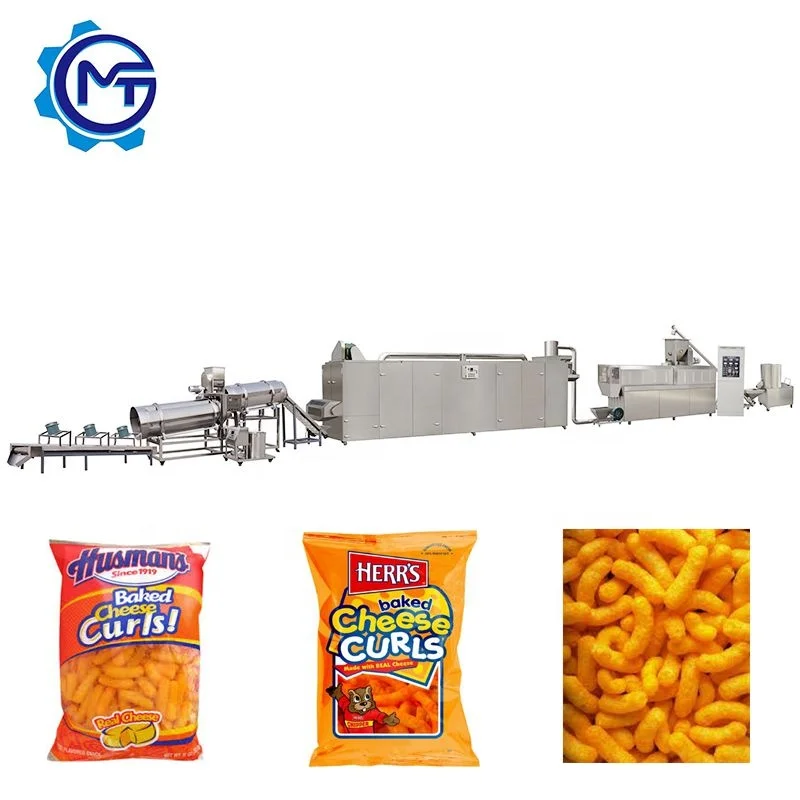
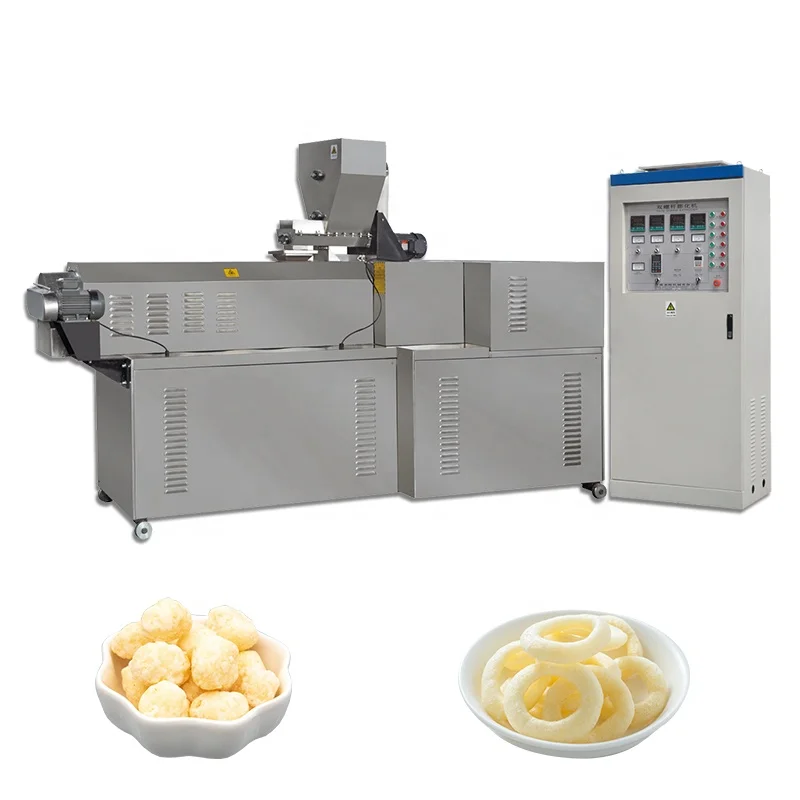
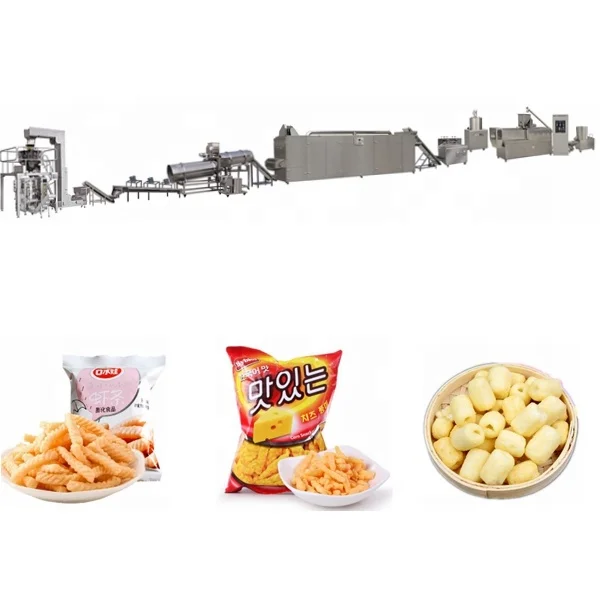
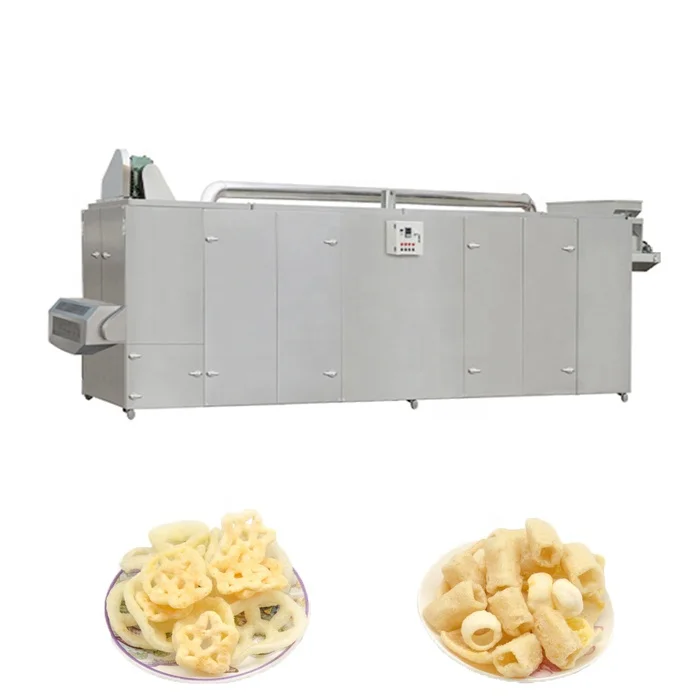
MT65 / MT70 / MT70C / MT75 Twin-Screw Puffed Corn Snack Extrusion Line, 110–190 kW Installed Power, PLC & Frequency Conversion Control — engineered as a complete turnkey project from batching through extrusion, drying, flavouring to packing. Screw configuration, barrel temperature profile and die design are specified to your raw material and target snack density, with matched downstream stations sized to extruder output to prevent line bottlenecks. In-house trial runs on customer raw material validate capacity, texture and expansion before shipment.
- Models span 100–350 kg/h across MT65 to MT75 configurations
- Core-filling station option for cream, chocolate, fruit paste and jelly
- Multi-layer dryer with selectable heating source and adjustable time/temperature
- CE certified, full documentation package with layout and electrical schematics
Description
Throughput Matched Across Every Station — from batching through extrusion, drying, flavouring and packing, each unit in this twin-screw line is sized to the actual output on your raw material, not a generic nameplate figure, so no single stage becomes a bottleneck when production starts.
Technical Specifications
| Parameter | Value |
|---|---|
| Product Type | Twin-Screw Puffed Corn Snack Extrusion Line |
| Models Available | MT65 / MT70 / MT70C / MT75 |
| Screw Type | Twin-screw |
| Installed Power (MT65 / MT70 / MT70C / MT75) | 110 kW / 160 kW / 170 kW / 190 kW |
| Power Consumption (MT65 / MT70 / MT70C / MT75) | 90 kW / 140 kW / 145 kW / 150 kW |
| Output Capacity (MT65) | 100–150 kg/h (basis not stated in source — confirm raw material, moisture, product format) |
| Output Capacity (MT70) | 150–200 kg/h (basis not stated in source — confirm raw material, moisture, product format) |
| Output Capacity (MT70C) | 200–250 kg/h (basis not stated in source — confirm raw material, moisture, product format) |
| Output Capacity (MT75) | 300–350 kg/h (basis not stated in source — confirm raw material, moisture, product format) |
| Overall Dimensions (MT65) | 40000 × 1500 × 2200 mm |
| Overall Dimensions (MT70) | 41000 × 1500 × 2200 mm |
| Overall Dimensions (MT70C) | 42000 × 1500 × 2400 mm |
| Overall Dimensions (MT75) | 43000 × 1500 × 3200 mm |
| Control System | Frequency conversion on feeding, rotary cutting and spindle; PLC availability to confirm per model |
| Line Stations | Mixing → Extruding → Cutting → Drying → Flavouring / Coating → Packing |
| Dryer Heating Source | Fuel, gas or electricity (selectable) |
| Raw Material Form | Powder (flour) or grits |
| Core-Filling Capability | Cream, chocolate, fruit paste, date paste, jelly (integrated filling station) |
| Standards | CE (company-level since 2014); ISO certified; electronic export certificates on request |
Application Suitability
| Application | Material or Output |
|---|---|
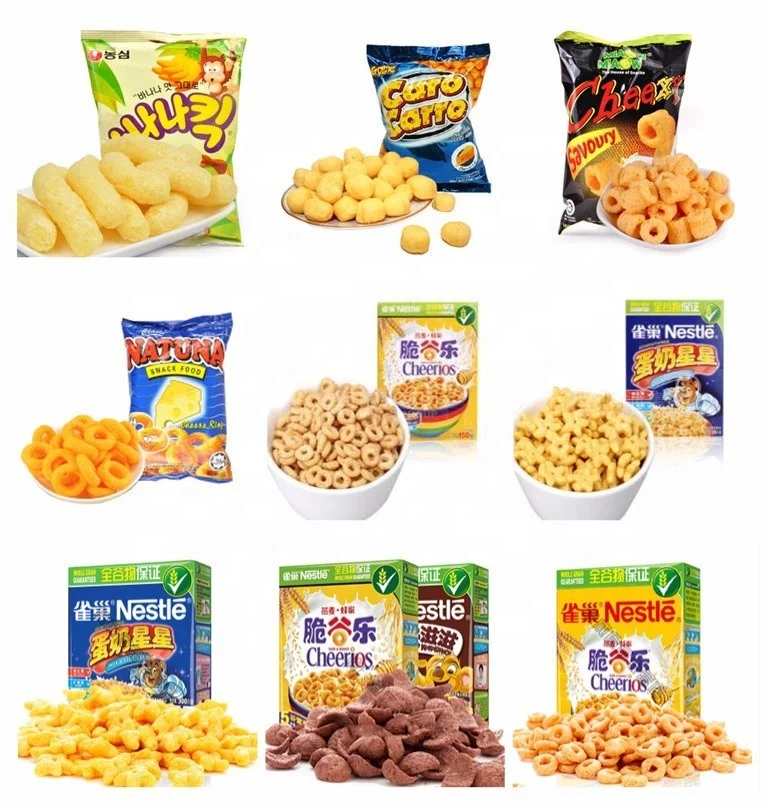
| Puffed corn snacks | Corn flour or corn grits, single or blended with rice, millet, wheat, oat, barley |
| Core-filled snack pillows and tubes | Corn or multi-grain dough with cream, chocolate, fruit paste, date paste or jelly filling |
| Extruded snack pellets in 2D / 3D shapes | Corn, rice, wheat, oat or barley flour processed through interchangeable die plates |
| Multi-grain puffed cereal pieces | Blended grain flours at moisture levels adjusted for target expansion and crunch |
Why Nominal Capacity Numbers Mislead on a Puffed Corn Snack Extrusion Production Line Turnkey
A rated output means nothing until it is proven on the exact flour or grits you will actually feed into the hopper.
I have watched a puffed corn line stall within the first hour because the buyer’s local corn grits carried a different moisture level than what the factory used during the benchmark test. The extruder pushed material through, but the expansion collapsed before the product reached the dryer infeed. Piles of dense, half-expanded pellets backed up on the conveyor while operators scrambled to adjust screw speed and barrel temperature [NEED_CITE: moisture content impact on starch gelatinisation in twin-screw extrusion]. When the dryer, flavouring drum and packing station are each spec’d against an optimistic nameplate figure, a small shortfall at the extruder cascades into idle downstream equipment or, worse, product that does not meet the density the market expects. A puffed corn snack extrusion production line turnkey should be validated on your material before it leaves the factory floor.
Screw Configuration and Die Geometry Define the Snack
Every barrel section, screw element and die opening is chosen around the starch behaviour of the specific grain blend the buyer intends to run. Corn flour gelatinises at a different temperature window and shear threshold than oat or barley flour, so the screw profile that produces a light, airy puff on pure corn will yield a dense, under-expanded pellet on a multi-grain mix. The twin-screw extruder in this line allows the screw configuration and die design to be re-specified whenever the raw material or target snack format changes, rather than relying on a single generic build across all product SKUs.
Drying, Flavouring and Packing Stations Sized to Actual Output
A common failure mode on snack lines is a dryer that cannot keep pace with the extruder, forcing the operator to slow the screw or let product accumulate on the belt. The multi-layer oven supplied with this puffed corn snack extrusion production line turnkey offers selectable heating — fuel, gas or electricity — with adjustable temperature zones and residence time, matched to the extruder model’s verified throughput. Downstream, the screw-fed seasoning drum uses an imported oil nozzle with adjustable spray pattern and an electrically heated oil tank with pump delivery, ensuring flavouring coverage stays uniform even when the line runs at the upper end of its capacity band. Packing station feed rate is calculated from the same verified output, closing the loop from batching to bag.
Reading the Specification Sheet Against Real Production Conditions
Installed power ranges from 110 kW on the MT65 to 190 kW on the MT75, but the number that matters on the factory floor is power consumption — 90 kW to 150 kW across the same range — because that figure determines transformer sizing and running cost. Frequency conversion control on feeding, rotary cutting and the main spindle lets operators fine-tune each variable independently, which is critical when switching between a light corn puff and a denser core-filled pillow. The line dimensions stretch from 40 m on the smallest model to 43 m on the MT75, so workshop length, column spacing and overhead clearance must be confirmed before the layout drawing is finalised [NEED_CITE: industrial floor planning standards for continuous food processing lines]. Core-filling capability for cream, chocolate, fruit paste, date paste and jelly is integrated into the same one-pass layout, avoiding a separate filling station that would require additional floor space and conveying links.
The Cost of Skipping a Pre-Shipment Trial Run
When a line ships without a trial on the buyer’s own raw material, the first week of production often turns into an expensive experiment. Screw speed, barrel temperature profile and moisture addition are adjusted by trial and error while raw material is wasted and delivery deadlines slip. If the dryer was spec’d against a higher nominal output, product exits the oven under-dried, shortening shelf life and inviting mould complaints from retailers. Flavouring oil consumption climbs as operators over-spray to compensate for uneven surface texture caused by poor expansion [NEED_CITE: shelf life reduction from residual moisture in extruded snacks]. These are not warranty issues — the machines are mechanically sound — but they erode margin and buyer confidence long before the root cause is traced back to an unverified capacity claim.
What Single-Source Responsibility Changes
Having one supplier cover every station from batching to packing eliminates the finger-pointing that occurs when the extruder vendor blames the dryer vendor for a throughput gap. The screw and die configuration is documented against the buyer’s target product density and shape before production begins, not copied from a generic template. An in-house testing workshop runs the buyer’s raw material — at the buyer’s specified moisture and blend ratio — and generates a trial run report that records actual throughput, expansion ratio and product texture before the line is crated. Electrical schematics confirm voltage, frequency and control language for the destination country, so the first day on-site is spent fine-tuning, not rewiring. CE and ISO documentation is compiled per shipment, and a wear parts list covering screws, dies and cutter blades is included so the first replacement cycle does not trigger an emergency air-freight order.
Documentation & Verification
- Line layout and capacity calculation showing throughput match across extruder, dryer, flavouring drum and packing station
- Trial run report on customer raw material recording actual output, expansion ratio and product density
- Screw and die configuration record mapped to target snack shape and texture specification
- Electrical schematic with voltage, frequency and control language confirmed before production starts
- CE declaration of conformity and ISO certificate included with each shipment
- Wear parts list covering screws, dies and rotary cutter blades with recommended replacement intervals
Installation, Commissioning & Support
- Foundation and floor space planned against line length up to 43 m and station footprint for the selected model
- Dedicated power circuit sized to installed power up to 190 kW with voltage and frequency matched to local supply
- Stations shipped in modular sections for sequential assembly and belt alignment on-site
- First-run parameter setting covering screw speed, barrel temperature zones and die gap for the buyer’s raw material
- Operator training on frequency conversion controls for feeding, cutting and spindle speed adjustment
- On-site wear parts inventory review covering screws, dies and cutter blades for the initial production period
What We Need to Move from Inquiry to Line Layout
Send the raw material specification — grain type, flour or grits form, typical moisture content — along with the target snack format, whether puffed pieces, core-filled pillows or shaped pellets. Include the intended daily output and the number of operating shifts so the capacity calculation reflects real scheduling. Workshop length, column spacing and ceiling height determine which model fits, and the local voltage and frequency are needed before electrical schematics are drafted. If a core-filled SKU is in the plan, specify the filling type and desired fill-to-shell ratio so the filling station is sized accordingly.
Frequently Asked Questions
Q: How is the nominal output capacity verified on my specific raw material and snack format?
A: Before the line ships, your raw material is run in the in-house testing workshop at the moisture level and blend ratio you specify. The trial records actual throughput, expansion ratio and product density. A trial run report is issued, and the downstream dryer, flavouring drum and packing station are sized against that verified figure rather than a generic nameplate value.
Q: How do you ensure the dryer and flavouring station match the extruder output?
A: Each downstream station is calculated from the trial-verified throughput, not from the extruder’s maximum nameplate rating. The multi-layer oven’s residence time and temperature zones are set so product exits at the target residual moisture. The seasoning drum’s screw feed rate and oil nozzle spray volume are calibrated to the same output band, preventing pile-ups or under-seasoned product.
Q: What screw and die configuration will be specified for my target product?
A: The screw profile and die geometry are selected based on your grain blend, target expansion ratio and final snack density. Corn flour, rice flour and multi-grain mixes each require different shear and temperature profiles. A configuration record documenting the chosen screw elements and die plate is provided before production so the setup can be replicated or adjusted for future SKUs.
Q: Can I send my raw material for a trial run before the line ships?
A: Yes. The testing workshop accepts buyer-supplied raw material and runs it on the exact extruder model ordered. The trial report covers throughput, product texture, expansion ratio and moisture after drying. Any necessary screw or die adjustments are made before the line is disassembled for packing, so commissioning on-site starts from a proven baseline.
Q: How are voltage, frequency and control language handled for my factory?
A: Electrical schematics are drafted only after the destination country’s voltage and frequency are confirmed. Control panel labels, PLC interface language and motor nameplate data are set to match local requirements. This confirmation step is completed before production begins, preventing rewiring or panel replacement after the line arrives on-site.
Related products
-

New Stainless Steel Automatic Snack Food Machinery Extruder Puffed Corn Maize Puff Processing Line for Food Industry High
¥12,350.00 Select options This product has multiple variants. The options may be chosen on the product page -

Full Automatic Puffed Corn Snack Food Extruder Puffed Snack Corn bar Making Machine
¥8,500.00 Select options This product has multiple variants. The options may be chosen on the product page -

Stainless Steel Corn Puff Cake Making Machine Corn Snack Food Machines Top Selling Snacks Machine
¥8,560.00 Select options This product has multiple variants. The options may be chosen on the product page -

Automatic Puff Corn Snack Stick Production Line Equipment New Condition Machines
¥100.00 Select options This product has multiple variants. The options may be chosen on the product page


