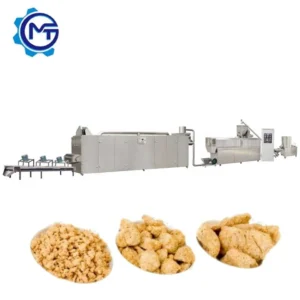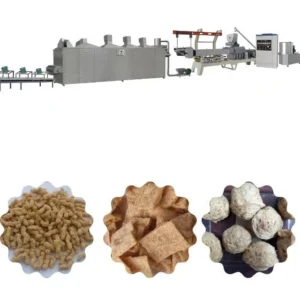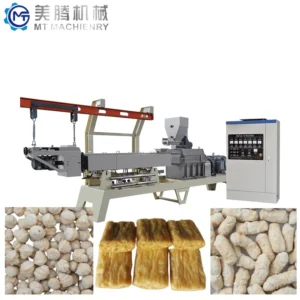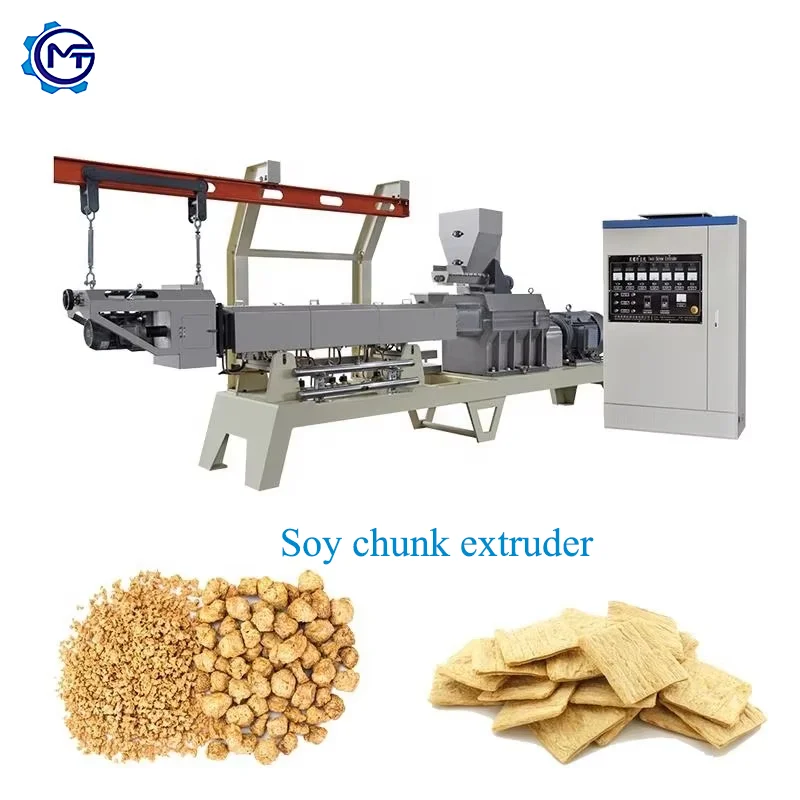

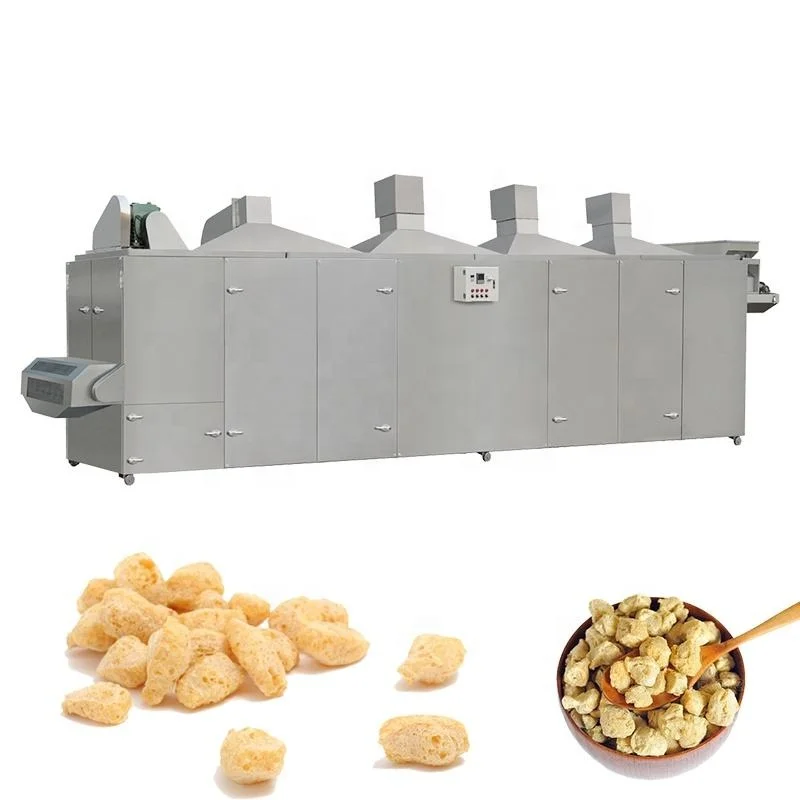


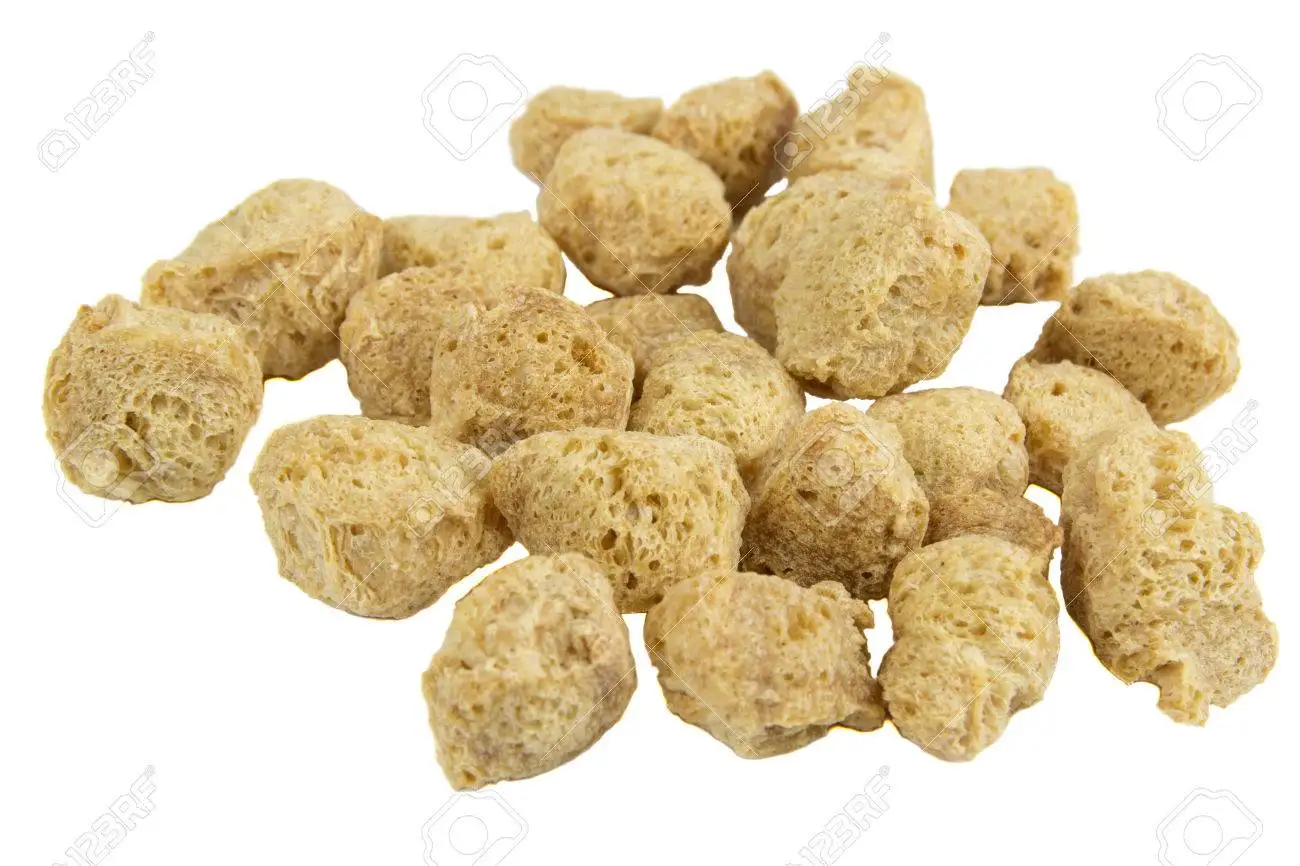
MT65, MT70, MT85 Textured Vegetable Protein Production Line, Twin-Screw Extrusion — turnkey system covering mixing, extrusion, drying, cooling and packing under one supplier.
- Twin-screw configuration and die design matched to soybean meal formulation for target fiber structure, with PLC and MCC control across all stations
- In-house testing workshop validates raw material behavior before shipment
- Throughput matched at every station so actual output aligns with line design rather than nominal extruder rating alone
Description
Screw configuration matched to formulation — Die geometry and barrel temperature profiles are engineered around your specific soybean meal fiber content and target TVP density, not copied from a generic build.
Technical Specifications
| Parameter | Value |
|---|---|
| Product Type | Textured Vegetable Protein (TVP) Extrusion Production Line |
| Models Available | MT65, MT70, MT85 |
| Extruder Type | Twin-screw |
| MT65 Installed Power | 85 kW (Real Power: 65 kW) |
| MT65 Output | 150–200 kg/h (basis not stated in source — confirm raw material formulation and moisture content) |
| MT65 Dimension | 18,000 × 1,300 × 2,300 mm |
| MT70 Installed Power | 120 kW (Real Power: 90 kW) |
| MT70 Output | 200–300 kg/h (basis not stated in source — confirm raw material formulation and moisture content) |
| MT70 Dimension | 20,000 × 1,500 × 2,400 mm |
| MT85 Installed Power | 195 kW (Real Power: 165 kW) |
| MT85 Output | 600–800 kg/h (basis not stated in source — confirm raw material formulation and moisture content) |
| MT85 Dimension | 24,000 × 3,500 × 4,300 mm |
| Powder Mixer Tank Volume | 150 kg per batch |
| Powder Mixer Output | 300–600 kg/h |
| Powder Mixer Rotary Speed | 385 rpm |
| Powder Mixer Mixing Time | 10 min per batch |
| Powder Mixer Power | 4 kW |
| High-temperature Roaster Output | 300–400 kg/h |
| High-temperature Roaster Belt Length | 3.5 m effective |
| High-temperature Roaster Heating | Far infrared 3.9 kW × 24 elements |
| High-temperature Roaster Gas Consumption | 6.8 m³/h |
| Construction Material | Food-grade stainless steel contact surfaces |
| Control System | PLC and MCC control available |
| Standards | CE, ISO certified |
Application Suitability
| Application | Material or Output |
|---|---|
| Textured vegetable protein for meat analogues | Low-temperature soybean meal, peanut meal |
| Plant-based ham and sausage ingredients | Soy protein concentrate with fiber structuring |
| Vegetarian canned and quick-frozen food | Defatted soy flour blends |
| Fast food and convenience meal components | Textured soy chunks, strips, and granules |
| Protein fortification products | Blended soy and legume meal formulations |
What Happens When Line Stations Are Sized Independently
A textured vegetable protein production line turnkey only delivers its rated throughput when every station — mixer, extruder, dryer, cooler — is balanced to the same output.
I have watched buyers compare extruder quotes in isolation, pick the lowest per-kilogram-hour figure, and then discover that their drying belt cannot keep up during continuous runs. The extruder sits idle while the roaster catches up, or the opposite — dried product piles up waiting for the cooling conveyor. Those bottlenecks never show up on a spec sheet [NEED_CITE: twin-screw extrusion line throughput matching principles]. When the line is engineered as one project rather than assembled from separate purchase orders, each station’s capacity is calculated against the same raw material formulation and target moisture curve.
How Screw Geometry Controls Fiber Formation
The twin-screw configuration inside this textured vegetable protein production line turnkey directly determines whether your soybean meal develops the layered fiber structure that meat analogues require. Screw element sequence — conveying, kneading, reverse — sets residence time and shear profile inside the barrel. A formulation with higher crude fiber content demands a different kneading block arrangement than one based on low-temperature defatted meal. Die aperture and land length then govern expansion ratio as the superheated moisture flashes off at the exit. Getting these three variables wrong produces dense, rubbery output instead of the open, striated texture that downstream processors expect.
Barrel Temperature Zones and Protein Denaturation
Each barrel section on the MT65, MT70, and MT85 can be set to an independent temperature target, giving operators control over the denaturation curve. Soy glycinin and beta-conglycinin unfold at different thermal thresholds, and the sequence in which they denature influences how tightly the protein matrix cross-links during extrusion [NEED_CITE: soy protein thermal denaturation and texturization mechanism]. Too rapid a ramp and the outer layer sets before the core has fully plasticised, creating a hard shell around a soft center. Gradual staging across four or five heating zones produces a uniform fiber network throughout each piece.
Reading the Specification Sheet Beyond Nominal Numbers
Installed power versus real power tells you how much electrical headroom the drive system actually has under load. The MT85, for instance, draws 165 kW in steady-state operation against a 195 kW installed capacity, leaving margin for startup surges and formulation changes that raise viscosity. The powder mixer’s 10-minute batch cycle at 385 rpm is sized so that each 150 kg blend finishes well before the extruder hopper runs low, avoiding the start-stop pattern that breaks fiber continuity. The roaster’s 3.5-meter effective belt length provides the dwell time needed to reduce moisture without case-hardening the surface, while its combination of far infrared elements and gas burners lets operators dial in the drying profile that matches their specific TVP geometry.
The Cost of Skipping Pre-Shipment Trials
When a line ships without running the buyer’s actual soybean meal through the extruder, the first commissioning week becomes an expensive experiment. I recall a South American buyer whose meal carried higher fiber than the lab samples used for quotation; the generic screw combination produced TVP chunks that tore apart instead of pulling into strands. On-site reconfiguration took days of downtime and consumed raw material the buyer had not budgeted for [NEED_CITE: extrusion screw reconfiguration costs during field commissioning]. A trial run in the factory workshop, using material shipped by the buyer, surfaces these mismatches before the crate is sealed.
Why a Single Supplier Changes the Project Timeline
Sourcing mixer, extruder, roaster, and cooler from separate vendors means each shipment arrives on its own schedule, and interface dimensions are reconciled only when the containers are opened on the factory floor. Coordinating a complete textured vegetable protein production line turnkey under one supplier compresses that timeline because mechanical drawings, conveyor heights, and electrical interlocks are finalized in a single design review. PLC logic and MCC panels are programmed together, so the extruder’s start sequence already talks to the roaster’s belt speed and the cooling fan ramp — eliminating the weeks of on-site signal mapping that plague multi-vendor installations.
Documentation & Verification
- Line layout drawing showing throughput calculation at every station for your target TVP output
- Screw and die configuration record matched to your soybean meal formulation
- Trial run report on your actual raw material confirming fiber structure before dispatch
- Electrical schematic with voltage and frequency locked to your facility specification
- Factory test record documenting steady-state output and power draw per model
- Operation and maintenance manual covering PLC parameter adjustment and wear part replacement
Installation, Commissioning & Support
- Foundation plan referencing the MT85’s 24-meter footprint and load points for level mounting
- Dedicated power circuit sizing based on 195 kW installed capacity for the largest model
- Modular station delivery allowing phased unloading in facilities with limited bay height
- First-run parameter tuning on your soybean meal, adjusting barrel zones and die gap
- Operator training covering PLC recipe storage for repeatable batch-to-batch consistency
- Wear parts inventory list identifying screw elements and die inserts for initial spares stock
- Scheduled maintenance intervals tied to roaster belt tension and mixer seal inspection
What to Include with Your Inquiry
To size the line accurately, share your primary raw material specification — protein content, fiber percentage, and moisture at intake — along with the TVP chunk or strip dimensions your downstream process requires. State your target hourly output and the voltage and frequency at your facility so the MCC panel and motor drives are configured before production begins. If you have existing upstream milling or downstream packing equipment, note the interface heights and conveyor speeds so the line layout accounts for those connection points.
Frequently Asked Questions
Q: How is throughput balanced across the mixer, extruder, and roaster stations?
A: Each station’s capacity is calculated against the same raw material formulation and target moisture curve. The mixer’s batch cycle, the twin-screw’s continuous output, and the roaster’s belt dwell time are aligned so material flows without queuing or starving any single unit.
Q: Can a trial run be done on my specific soybean meal before shipment?
A: Yes. You send a representative sample of your raw material to the in-house testing workshop, and the extruder runs with your screw and die configuration. The trial run report documents fiber texture, output rate, and moisture levels for your review before the line is packed.
Q: What determines the screw and die configuration for my TVP target?
A: Your soybean meal’s protein-to-fiber ratio, the desired chunk size, and the expansion density your market expects all drive the selection. Kneading block sequence, screw pitch, and die aperture are specified together to produce the correct fiber alignment.
Q: What voltage and control language options are supported?
A: The MCC and PLC system can be configured to your facility’s voltage and frequency. Control panel language and HMI labels are confirmed during the design review so operators can navigate recipes and alarms in their working language from day one.
Q: How is installation phased for a complete TVP line?
A: Stations arrive in modular sections sized for standard container transport. The foundation plan, utility connections, and station-to-station conveyor heights are pre-documented so mechanical assembly, electrical termination, and commissioning follow a sequenced schedule rather than overlapping trades.
Related products
-
High Capacity Soy Protein Vegetarian Meat Processing Line
¥9,500.00 Select options This product has multiple variants. The options may be chosen on the product page -
Automatic TVP Vegetarian Meat Manufacturing Plant
¥9,500.00 Select options This product has multiple variants. The options may be chosen on the product page -
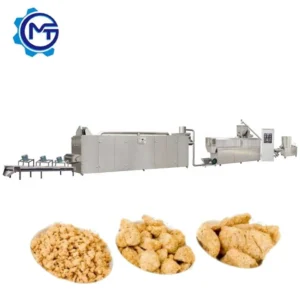
New Pea and Soybean Protein Production Line Equipment with Mechanical Extruder Food Grade Stainless Steel High Productivity
¥65.00 Select options This product has multiple variants. The options may be chosen on the product page -
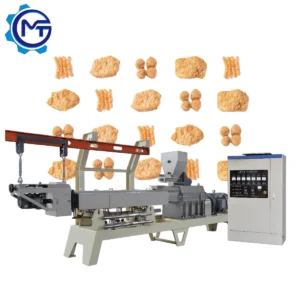
Textured Soy Protein Production Line for Vegetarian Meat Nugget Manufacturing
¥8,238.27 Select options This product has multiple variants. The options may be chosen on the product page