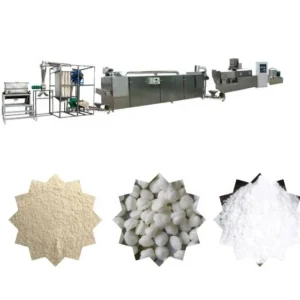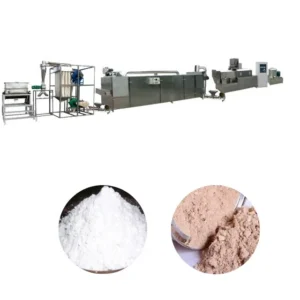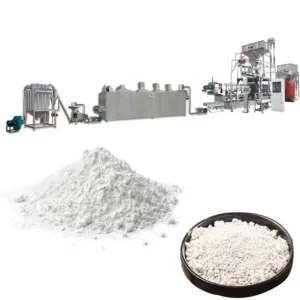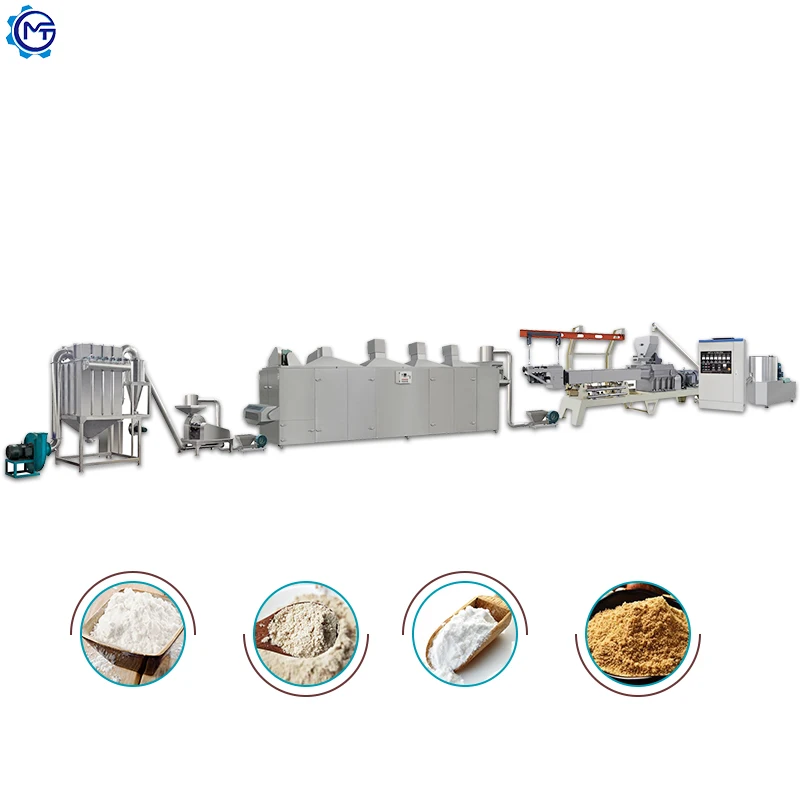


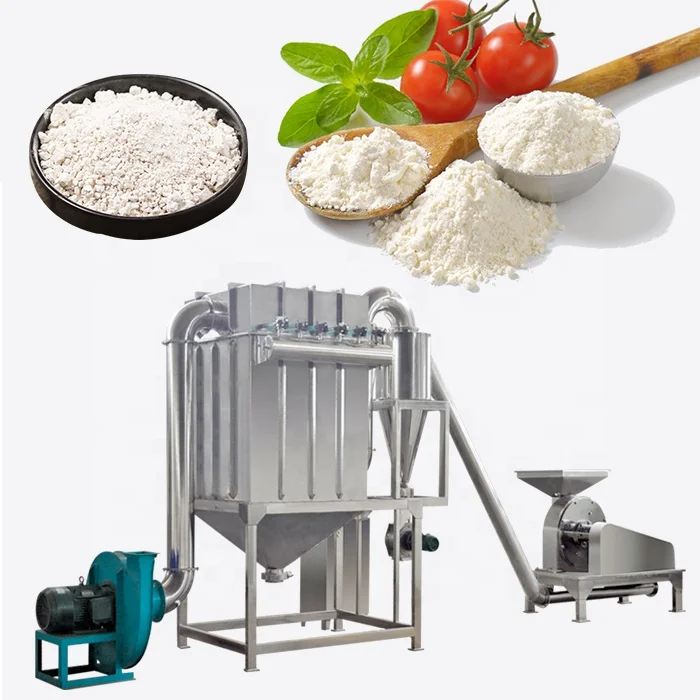
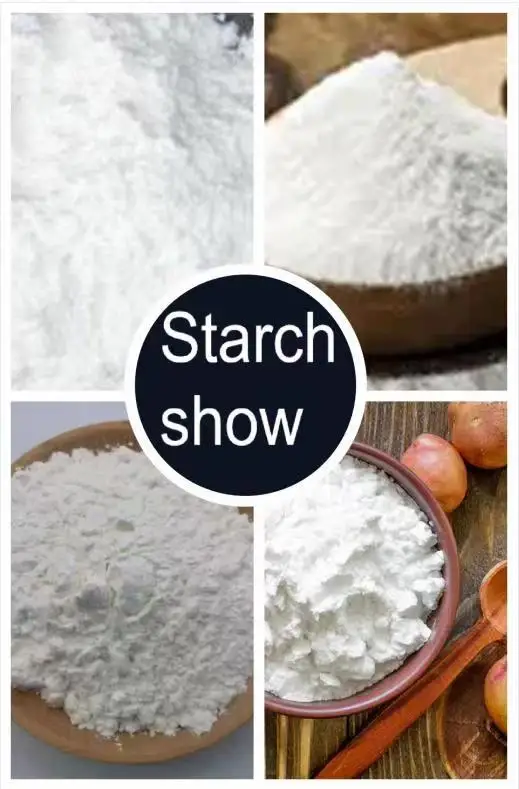

Modified Starch Processing Line, Twin Screw, 80–500 kg/h, Food Grade SS304 Contact — engineered for pregelatinized and modified starch production from corn, wheat, or potato feedstock across food and industrial applications.
- Extruder screw configuration and die design matched to raw material behaviour and target modification degree
- Complete station layout from mixer through dryer, conditioning and grinder with throughput balanced at every stage
One supplier delivers the full line with pre-shipment trial runs on your material and on-site commissioning support.
Description
Integrated Throughput Alignment — Every station from batching to grinding is capacity-matched on this modified starch processing line turnkey, preventing the dryer or conditioning bottleneck that often stalls single-vendor extruder purchases.
Technical Specifications
| Parameter | Value |
|---|---|
| Product Type | Modified Starch Processing Line |
| Screw Type | Twin screw |
| Capacity Range | 80–500 kg/h (basis to be confirmed with raw material, moisture content and modification degree) |
| Raw Materials | Wheat flour, corn starch, potato starch |
| Voltage & Frequency | Three-phase 380 V / 50 Hz; Single-phase 220 V / 50 Hz (customizable) |
| Frame Material | Stainless steel 201 |
| Contact Material | Food grade stainless steel 304 |
| Energy Source Options | Electricity, gas, diesel, or steam |
| Installed Power (electric heating) | Approx. 100 kW (source value — verify against manufacturer catalog) |
| Installed Power (gas/diesel heating) | Approx. 50–60 kW (source value — verify against manufacturer catalog) |
| Mixer Main Motor | 4.0 kW |
| Mixer Output | 3.0–4.0 kg/batch (basis to be confirmed with batch cycle time and moisture addition) |
| Mixer Dimensions (L×W×H) | 1.2 × 0.9 × 1.4 m |
| Screw Conveyor Main Motor | 1.1 kW |
| Screw Conveyor Output | 0–150 kg/h (basis to be confirmed with material density and screw speed) |
| Screw Conveyor Dimensions (L×W×H) | 2.5 × 0.6 × 2.3 m |
| Extruder Barrel Material | 45 steel (screw element) |
| Die Configuration | Interchangeable dies for different product forms |
| Warranty | One year |
Application Suitability
| Application | Material or Output |
|---|---|
| Food-grade modified starch for meat products, sauces, and bakery ingredients | Corn starch, wheat flour, potato starch undergoing hydrolysis and denaturation |
| Pregelatinized starch for instant food and nutritional powders | Wheat flour and corn starch with controlled gelatinisation via twin-screw extrusion |
| Industrial modified starch for papermaking and textile sizing | Corn starch and potato starch processed through saccharification and drying |
| Deep-processed starch derivatives requiring precise moisture and shear control | Blends of native starches with additives for specific viscosity targets |
Why the Capacity Number Means Nothing Without the Raw Material
The rated throughput of any modified starch processing line turnkey is only valid against the specific starch source, moisture level, and degree of modification you intend to run.
I once helped a Middle East client who ordered a starch line based on a brochure capacity figure. When his cassava starch arrived at the workshop, the viscosity behaviour was completely different from the corn starch used for the original rating. Output dropped noticeably, and the screw configuration had to be rebuilt from scratch. That experience changed how I approach every inquiry: the first question is always about the exact raw material, and trial runs happen before any layout is finalised [NEED_CITE: raw material variability in starch extrusion processing].
Screw Configuration Dictates What the Line Can Actually Produce
The twin-screw extruder in this modified starch processing line turnkey uses interchangeable dies and adjustable screw elements to handle different modification targets. The 45 steel screw elements are arranged in specific sequences — conveying, kneading, and reverse elements — to control residence time and shear intensity inside the barrel. Pregelatinised starch requires high shear and sufficient moisture to achieve full gelatinisation, while lightly modified starch for industrial use may need gentler treatment to preserve granule structure. The screw profile is selected only after your raw material has been identified and tested.
Matching Dryer Capacity to Extruder Output
A common failure in starch line projects is specifying the extruder independently from the downstream dryer and conditioning stations. If the dryer cannot remove moisture at the same rate the extruder produces it, material backs up and the entire line slows down. This modified starch processing line turnkey addresses that by sizing the air conveyor, dryer, and conditioning units as a single throughput chain rather than individual purchases. The energy source — electricity, gas, diesel, or steam — is selected based on your factory utility profile so that heating capacity remains consistent [NEED_CITE: industrial dryer sizing for starch moisture removal].
Reading the Power and Voltage Specifications
The installed power figure varies significantly depending on whether electric, gas, or diesel heating is selected. Electric heating draws approximately 100 kW, while gas or diesel options reduce electrical demand to a lower range. This matters for your facility’s transformer sizing and dedicated circuit planning. The standard voltage is three-phase 380 V / 50 Hz, but this is configurable for markets running 415 V / 60 Hz or other local standards. Confirming voltage and frequency before production avoids the situation where the control cabinet arrives and cannot be energised on site.
The Cost of Skipping the Trial Run
Buyers who skip pre-shipment testing often discover after installation that their starch source produces a different expansion ratio or viscosity than expected. The screw configuration that worked perfectly on the factory’s standard test material may not deliver the target modification degree on your specific flour or starch. Reworking screw elements and die geometry after installation means production delays, additional shipping costs for replacement parts, and extended commissioning periods. Every parameter that looks stable on paper behaves differently once real raw material enters the barrel [NEED_CITE: extrusion trial run importance before shipment].
Why Procurement Through This Channel Works
The line layout and capacity calculation are produced as a single document, showing how each station — mixer, screw conveyor, extruder, shifter, air conveyor, dryer, conditioning unit, grinder — passes material at matched rates. Screw and die configurations are recorded specifically against your raw material sample, not copied from a generic build. The in-house testing workshop allows trial runs on your actual starch before the line ships, so product development starts before installation rather than after. Electrical schematics and voltage confirmation documents are issued before production begins, ensuring the control cabinet matches your local power grid. Food grade stainless steel 304 contact materials are used throughout the product contact zones, meeting food safety requirements for starch destined for human consumption.
Documentation & Verification
- Line layout drawing showing station-by-station throughput matching for your starch type
- Screw and die configuration record specific to your raw material and target modification
- Electrical schematic with confirmed voltage, frequency, and control language
- Factory trial run report using your supplied starch sample before dispatch
- CE declaration of conformity available for on-site verification at factory
- Wear parts list covering screw elements, dies, and conveyor components
Installation, Commissioning & Support
- Foundation requirements based on overall line dimensions and mixer vibration load
- Dedicated electrical circuit sized to the confirmed heating method and installed power
- Assembly sequence from individual station modules to connected line with air conveyors
- First-run parameter setting for barrel temperature profile and screw speed on your starch
- Operator training covering die changeover and screw element replacement procedures
- Spare screw elements and dies stocked against the specific configuration record
What to Include in Your Inquiry
To move from a general capacity range to a firm line configuration, provide the specific starch type you plan to process — corn, wheat, potato, or cassava — along with the target modification degree and intended application. Confirm your facility’s available voltage, frequency, and preferred energy source for the dryer. If you have existing upstream batching or downstream packing equipment, share the interface requirements so the line connects without throughput gaps.
Frequently Asked Questions
Q: How is the 80–500 kg/h capacity range validated for my specific starch?
A: The throughput depends on your raw material type, incoming moisture content, and the degree of modification or gelatinisation required. We run your actual starch sample in the testing workshop to measure real output under the target screw configuration and barrel temperature profile, then document the result in a trial run report before quotation.
Q: How are the screw elements and dies selected for my product?
A: Screw configuration — the sequence of conveying, kneading, and reverse elements — is designed around your starch type and modification target. Die geometry controls the pressure drop and expansion at the barrel exit. Both are recorded in a configuration document tied to your trial run, so replacements can be ordered with the same specification.
Q: Will the dryer and conditioning stations keep up at full extruder output?
A: Each downstream station is sized against the extruder’s confirmed throughput on your material, not against a nominal catalogue figure. The dryer’s moisture removal rate and the conditioning unit’s residence time are calculated to match the extruder discharge rate, preventing material backlog or forced line slowdowns.
Q: How do we confirm voltage and control language before shipment?
A: Your local voltage, frequency, and preferred control interface language are confirmed in writing before the electrical cabinet enters production. The electrical schematic is issued for your approval so that the control system, motor starters, and heating circuits match your facility’s power supply and operator requirements.
Q: Can we witness the trial run before the line ships?
A: Yes. Your starch sample is processed through the configured extruder and downstream stations in the testing workshop. You receive a trial run report documenting throughput, product quality, and parameter settings. Remote video witnessing or on-site attendance can be arranged depending on your schedule.
Related products
-
High-Efficiency Customizable Modified Starch Production Line – Automatic Corn Pellet Adhesive Making Equipment
¥65.00 Select options This product has multiple variants. The options may be chosen on the product page -
Cassava Corn Potato Flour Starch Production Line – Industrial Pregelatinized & Modified Extrusion Machinery
¥65.00 Select options This product has multiple variants. The options may be chosen on the product page -
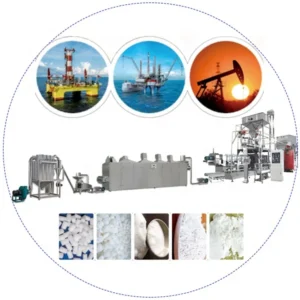
Pre-gelatinized Starch Production Line – Modified Starch Integrated Puffing Equipment
¥65.00 Select options This product has multiple variants. The options may be chosen on the product page -
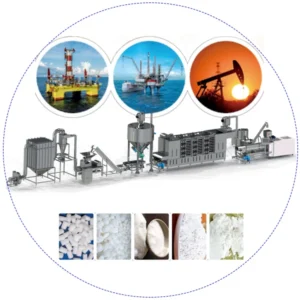
Modified Starch Production Line for Industrial Drilling Twin Screw Extruder Large Output Modified Starch Manufacturing Machine
¥50.00 Select options This product has multiple variants. The options may be chosen on the product page