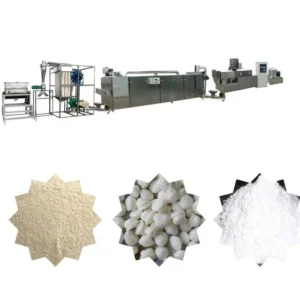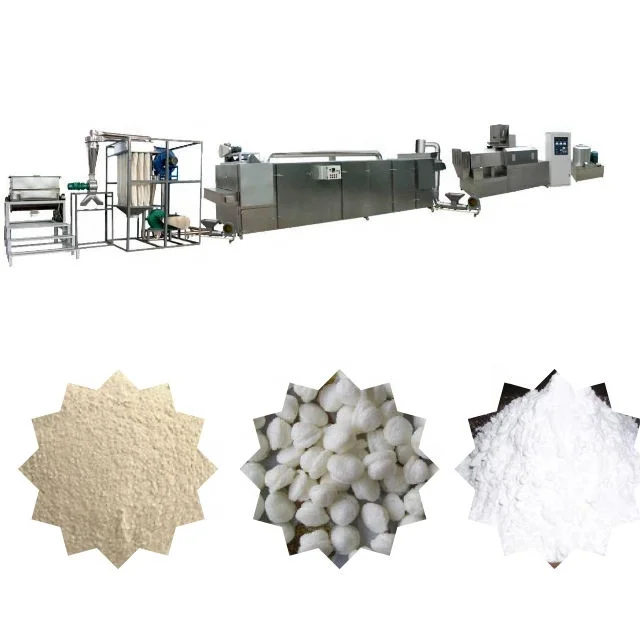




Modified Starch Processing Line, Twin Screw Extrusion, 80–500 kg/h Capacity — designed for pregelatinized and modified starch production from corn, potato, and wheat raw materials.
- Throughput-matched stations from mixing through drying and grinding
- Screw configuration and die design specified to raw material properties
- PLC/MCC control with voltage confirmation to local supply
- Food-grade 304 stainless steel contact surfaces
- Energy flexibility: electric, gas, diesel, or steam heating
CE-certified line tested in-house on customer raw material before shipment, with full documentation including screw configuration record and trial run report.
Description
Integrated Process Design — Throughput between extrusion, drying, and grinding is calculated together so no single station throttles a modified starch processing line turnkey project.
Technical Specifications
| Parameter | Value |
|---|---|
| Product Type | Twin Screw Extrusion Modified Starch Processing Line |
| Extruder Type | Twin Screw Extruder |
| Raw Materials | Wheat flour, corn starch, potato starch |
| Capacity Range | 80–500 kg/h (basis not stated in source — confirm raw material type, moisture content and target starch specification) |
| Process Flow | Mixer → Screw Conveyor → Twin Screw Extruder → Shift → Air Conveyor → Dryer → Air Conveyor → Conditioning → Conveyor → Grinder |
| Voltage & Frequency | Three-phase 380V/50Hz; Single-phase 220V/50Hz (customizable to buyer’s local voltage) |
| Frame Material | Stainless steel 201 |
| Contact Material | Food-grade stainless steel 304 |
| Energy Source Options | Electricity, gas, diesel, or steam |
| Total Power (electric heating) | approx. 100 kW (rated or peak not specified) |
| Total Power (gas/diesel heating) | approx. 50–60 kW (rated or peak not specified) |
| Control System | PLC and MCC |
| Mixer Motor | 4.0 kW |
| Mixer Dimensions | 1.2 × 0.9 × 1.4 m |
| Mixer Batch Output | 3.0–4.0 kg per cycle (basis not stated in source — confirm batch time and material density) |
| Screw Conveyor Motor | 1.1 kW |
| Screw Conveyor Dimensions | 2.5 × 0.6 × 2.3 m |
| Screw Conveyor Output | 0–150 kg/h (basis not stated in source — confirm material bulk density) |
| Motor Brand | Siemens (China-made) or equivalent China top brand |
| Inverter Brand | Delixi or Delta |
| Die Configuration | Interchangeable dies on extruder |
| Assembly State | Complete line with supporting equipment |
| Warranty | One year with lifetime technical guidance |
| Certification | CE |
Application Suitability
| Application | Material or Output |
|---|---|
| Pregelatinized starch for food processing | Corn starch, potato starch processed to target viscosity and gelling properties |
| Modified starch for paper manufacturing | Wheat flour or corn starch modified for industrial binder applications |
| Modified starch for textile and construction | Potato starch or corn starch treated for specific functional performance |
| Nutritional powder base material | Corn starch or wheat flour extruded to controlled gelatinisation degree |
What "80–500 kg/h" Leaves Out About Starch Line Capacity
A capacity number means nothing without the raw material type, moisture content, and target modification specification written next to it.
I once commissioned a pregelatinized starch line where factory trials ran perfectly on corn starch. The buyer switched to locally sourced cassava starch on site, and the gelatinisation temperature shifted by over ten degrees. Every screw speed and barrel temperature zone had to be re-mapped from scratch, pushing production start back by weeks. When sourcing a modified starch processing line turnkey system, the capacity figure quoted on one starch type will not automatically transfer to another. Raw material behaviour under twin screw shear — moisture absorption rate, gelatinisation onset temperature, melt viscosity — determines what throughput is actually achievable [NEED_CITE: starch gelatinisation behaviour under twin screw extrusion conditions].
How Screw Configuration Defines Your Starch Output
The twin screw arrangement determines residence time, shear intensity, and the degree of starch granule disruption inside the barrel. A modified starch processing line turnkey build must match screw element sequencing — conveying, kneading, and reverse elements — to the specific raw material and the target functional property. Potato starch granules are larger and rupture at lower shear than corn starch, so the kneading block arrangement that works for one will over-process or under-process the other.
Barrel Temperature Profiling Across Starch Types
Each barrel zone operates on an independent heating and cooling circuit, creating a temperature gradient that guides the starch through gelatinisation stages. Corn starch typically gelatinises between 62 and 72 degrees Celsius, while potato starch begins around 58 degrees — a difference that shifts the entire thermal profile. When the energy source is switched from electric to steam or gas, the response time of each zone changes, and the PLC programme must account for that lag to hold consistent modification quality [NEED_CITE: industrial starch extrusion temperature control requirements].
Reading the Specifications That Actually Matter
The twin screw extruder sits at the centre of this line, and its motor rating, screw configuration, and die selection collectively determine what modification is achievable. Food-grade stainless steel 304 contact materials prevent contamination across corn starch, potato starch, and wheat flour runs. The PLC and MCC control system coordinates every station from the mixer through the grinder, holding barrel temperatures and screw speeds within set tolerances across production shifts. Energy source flexibility — electric at approximately 100 kW total, or gas and diesel at approximately 50–60 kW — lets plant engineers match the dryer and barrel heaters to available utility infrastructure rather than forcing an electrical upgrade. The mixer batch output of 3.0–4.0 kg per cycle and screw conveyor rated at 0–150 kg/h must be evaluated against the extruder throughput to confirm there is no upstream starvation or downstream bottleneck.
The Hidden Cost of Mismatched Stations
When the dryer capacity is sized to a generic standard rather than the actual moisture load leaving the extruder, partially gelatinised starch reaches the grinder and produces inconsistent particle size. I have seen lines where the conditioning station could not keep pace with extruder output, forcing the operator to throttle the screw speed down and run below the nameplate capacity. These imbalances are not visible in a quotation that lists each machine separately without a throughput calculation tying them together [NEED_CITE: throughput matching in continuous food processing lines]. Downstream bottlenecks compound quickly in starch processing because the material sets and hardens if it waits too long between stages.
Why This Line Configuration Holds Up
Every station from batching through grinding is specified under a single supplier, meaning throughput is calculated across the entire chain rather than assembled from disconnected quotations. Screw configuration and die design are set after reviewing your raw material data sheet, not copied from a previous build on a different starch. The in-house testing workshop runs your actual corn starch, potato starch, or wheat flour before the line ships, producing a trial run report that documents gelatinisation degree and viscosity readings. Voltage and frequency are confirmed against your plant supply before production begins, preventing the commissioning delays that happen when a 380V machine arrives at a 415V site. The PLC and MCC panels are wired and labelled in the control language your operators will use daily.
Documentation & Verification
- Line layout and capacity calculation showing throughput matched from mixer through grinder
- Screw and die configuration record specific to your starch type and target modification
- Trial run report on your raw material documenting gelatinisation and viscosity results
- Electrical schematic with voltage and frequency confirmed to your plant supply
- Operation and maintenance manual with wear parts list for screws and dies
Installation, Commissioning & Support
- Foundation and floor space planned around the full line footprint including the 2.5 m screw conveyor and dryer length
- Power supply verified against the approximately 100 kW electric heating load or 50–60 kW gas heating configuration
- PLC and MCC panels tested at rated voltage before dispatch to match local three-phase 380V or custom supply
- Barrel temperature zones and screw speeds calibrated on your raw material during on-site commissioning
- Operator training covers die changeover procedures and screw element replacement sequences
- Wear parts list provided with recommended spare screw elements and dies for first replacement cycle
What We Need to Configure Your Line
Share the raw material type you plan to process — corn starch, potato starch, or wheat flour — along with the target modified starch specification your market requires. Confirm your plant voltage and frequency, the energy source available for the dryer and barrel heaters, and the control language your operators need. If you can send a raw material sample, we can run it through the testing workshop before the quotation is finalised.
Frequently Asked Questions
Q: How is line capacity verified for my specific starch raw material?
A: Capacity depends on raw material type, moisture content, and target modification specification. We run your actual starch sample in the testing workshop and document throughput, gelatinisation degree, and viscosity in a trial run report before the quotation is confirmed.
Q: How is the twin screw configuration matched to my starch type?
A: Screw element sequencing — conveying, kneading, and reverse elements — is selected based on your raw material granule size and the target functional property. Potato starch and corn starch require different shear profiles, and the die design is matched accordingly.
Q: Can the line be tested on my raw material before shipment?
A: Yes. The in-house testing workshop processes your raw material on the actual extruder configuration. The trial run report covers gelatinisation degree, viscosity readings, and extruder operating parameters so you can verify output quality before the line ships.
Q: What voltage and control options are confirmed before production?
A: Voltage, frequency, and control language are confirmed against your plant supply before production begins. The PLC and MCC panels are configured to your local three-phase or single-phase requirements, preventing commissioning delays on site.
Q: How is throughput balanced between the extruder and downstream stations?
A: Each station — dryer, conditioning, grinder — is sized based on the moisture load and output rate leaving the extruder. A line layout and capacity calculation document shows the matched throughput across every station to prevent bottlenecks.
Related products
-
API Standard Pregelatinized Starch Line for Oilfield Drilling Fluid. High Yield Modified Starch Equipment
¥65.00 Select options This product has multiple variants. The options may be chosen on the product page -
Automatic Deep Processing Machine – Food Grade Modified & Pregelatinized Starch Manufacturing Line
¥65.00 Select options This product has multiple variants. The options may be chosen on the product page -
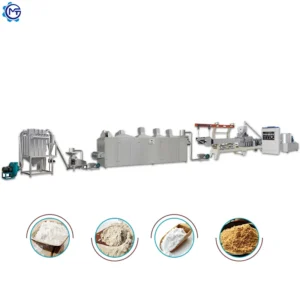
Twin-Screw Extrusion Line for Modified Starch. Producing Pregelatinized Adhesive & Food Grade Powder
¥65.00 Select options This product has multiple variants. The options may be chosen on the product page -
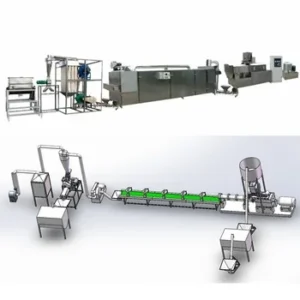
2025 New Design Modified Starch Big Capacity Industrial Use Food Additives Core Components Motor Bearing
¥50.00 Select options This product has multiple variants. The options may be chosen on the product page