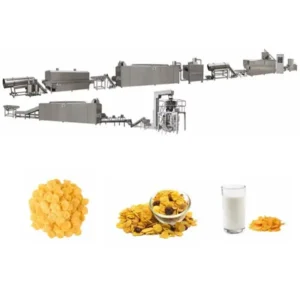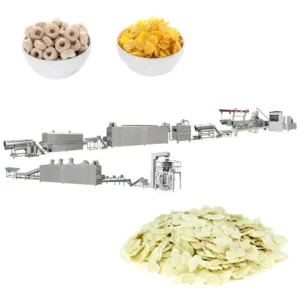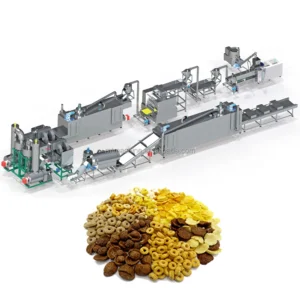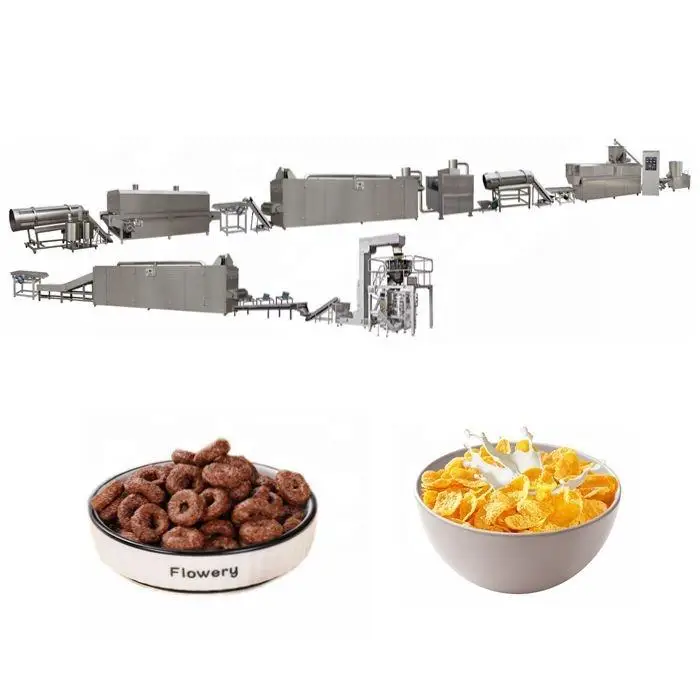
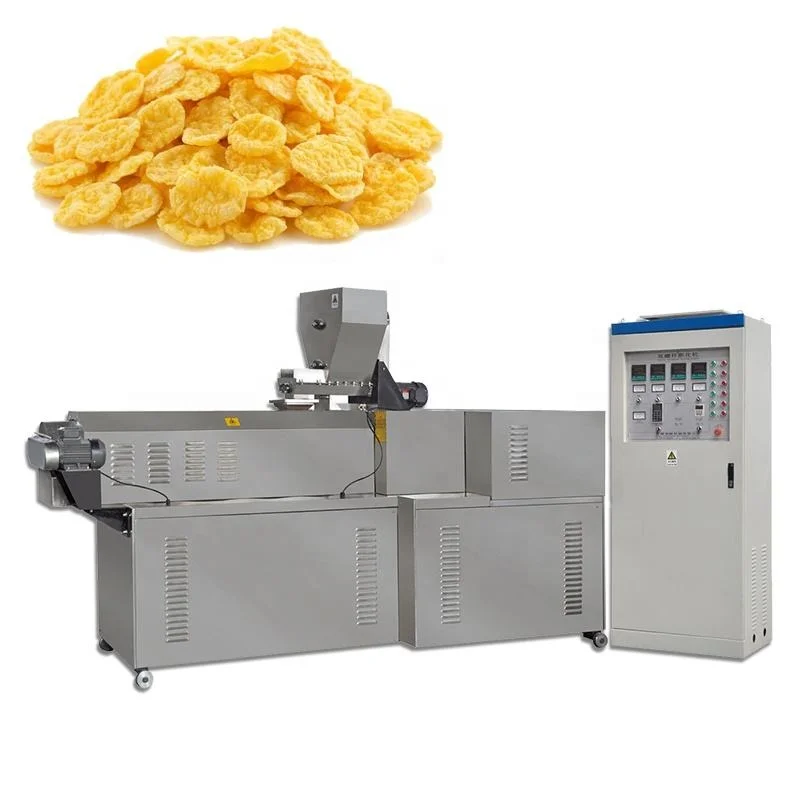


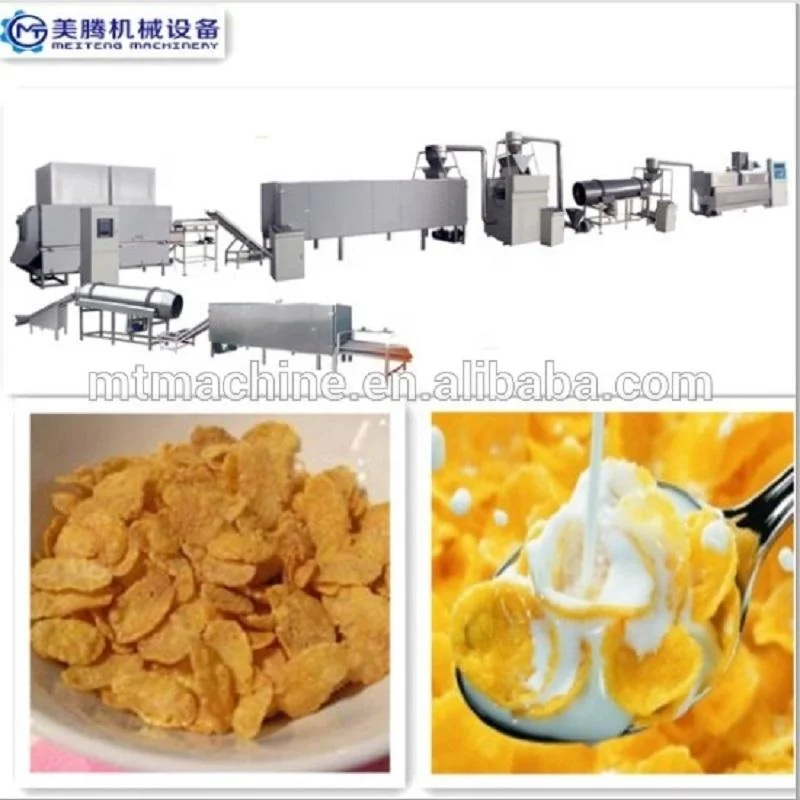
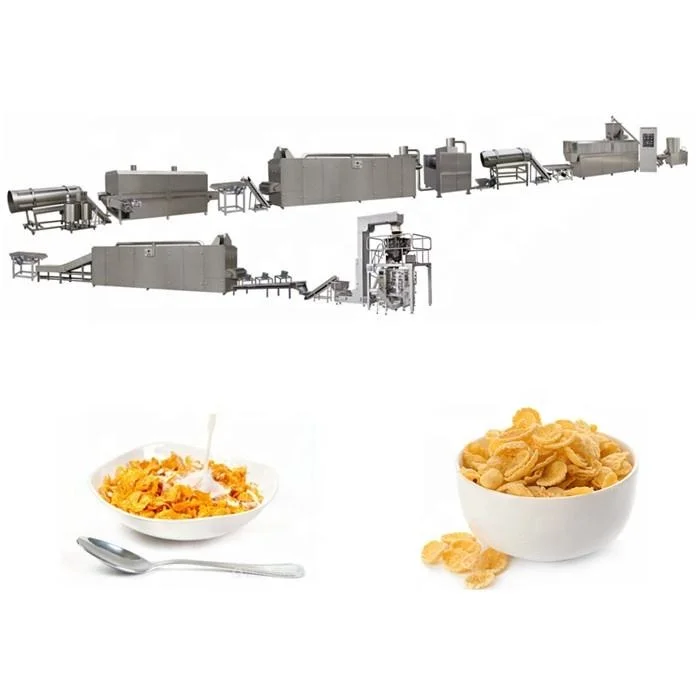
MT70 / MT85 / MT75 Breakfast Cereal Corn Flake Production Line, Twin-Screw Extruder, PLC & MCC Control, Gas/Electric Dryer — configured as a complete turnkey project from batching through extrusion, flaking, drying, roasting, coating to packing. Throughput across every station is matched to eliminate bottlenecks, with screw and die design specified to the buyer’s raw material and target flake density.
- Hydraulic double-roller flaking with infrared temperature control for uniform sheet thickness
- Hot air roasting oven with vibrating pan, dual circulating fans and cyclone dust removal
- Line layout, capacity calculation and trial run report on customer raw material provided before shipment
- CE and ISO certified, with on-site installation, commissioning and operator training included
Description
Balanced Throughput Across Every Station — Each segment of this corn flake line is sized against the actual extruder output on your grain recipe, so drying and roasting never bottleneck the extruder.
Technical Specifications
| Parameter | Value |
|---|---|
| Product Type | Breakfast Cereal Corn Flake Production Line |
| Model Options | MT70 / MT85 / MT75 |
| Extruder Type | Twin Screw |
| Installed Power | MT70: 160 kW; MT85: 190 kW; MT75: 210 kW |
| Power Consumption | MT70: 120 kW; MT85: 140 kW; MT75: 150 kW |
| Output Capacity | MT70: 150–200 kg/hr (basis to be confirmed); MT85: 300–400 kg/hr (basis to be confirmed); MT75: 300–500 kg/hr (basis to be confirmed) |
| Overall Dimensions (L×W×H) | MT70: 41 × 1.5 × 2.2 m; MT85: 43 × 1.5 × 3.2 m; MT75: 45 × 1.5 × 3.5 m |
| Flaking Machine | Hydraulic double rollers, dual independent motors, infrared sensor temperature control |
| Dryer Heating Source | Gas or Electric |
| Roasting Oven | Hot air roasting with vibrating pan, conciliation burner, dual circulating fans, cyclone dust removal |
| Coating System | Double tumble sugar melting, elevator, coating drum, spraying nozzle |
| Control System | PLC and MCC available |
| Screw Material | Wear-resistant alloy, special heat treatment |
| Lubrication | Automatic lubricating and cooling system |
| Certifications | CE, ISO |
Application Suitability
| Application | Material or Output |
|---|---|
| Natural corn flake production | Corn grits, rice, wheat, oat, barley powder |
| Sugar-coated breakfast cereal | Corn flakes with syrup or sugar glaze |
| Shaped cereal variants | Ball, tube, stick, ring, fruit loop, star, wheel, flower, heart profiles via die change |
| Fortified nutrition programmes | Vitamin and mineral blended grain formulations |
| Contract manufacturing | Multiple cereal formats on a single line with die and coating changeover |
Why Nominal Capacity Figures Mislead Buyers
A line is only as fast as its slowest matched station.
When a breakfast cereal corn flake production line turnkey is quoted on a single headline number, that figure often reflects the extruder running on an ideal grain recipe under laboratory conditions. In real production, corn variety, moisture content and flake thickness all pull the actual output below the nameplate. If the dryer and roaster were sized to that nameplate rather than the real output, you will see half-pressed flakes stacking up on conveyors, absorbing ambient moisture and clumping before they ever reach the coating drum [NEED_CITE: throughput matching methodology in extrusion line design]. I once watched a Middle Eastern installation stall because the flaking press ran ahead of the oven, and the backlog turned into a damp, unusable mass within an hour. Sizing every station against verified throughput on the buyer’s actual grain eliminates that class of failure entirely.
Station-to-Station Flow and Where Lines Fail
A breakfast cereal corn flake production line turnkey moves grain through mixing, extrusion, flaking, drying, hot air roasting, optional sugar coating and cooling before packing. The common failure mode is not a single machine underperforming but two adjacent stations running at different effective rates. When the flaking unit presses faster than the dryer can remove moisture, the downstream belt loads up and flakes begin to stick together. Matching each station to the verified extruder output on your specific corn or oat recipe keeps material moving continuously without manual intervention or buffer bins.
Hydraulics and Heat Control at the Flake Press
The flaking stage determines whether the final product has the thin, crisp geometry buyers expect or a thick, doughy centre. The hydraulic double-roller system on this line applies even pressure across the full roller width, while dual independent motors prevent speed drift between the two surfaces. Infrared sensors monitor roller temperature in real time [NEED_CITE: infrared temperature monitoring in cereal flaking]. Stable roller heat keeps the dough sheet pliable so it compresses to a uniform thickness rather than cracking at the edges, which directly influences how evenly the flakes toast in the roasting oven.
Reading the Spec Sheet Against Your Grain Bill
Twin-screw extrusion gives the MT-series line the shear range to handle both low-fat corn grits and higher-oat or barley blends that would stall a single-screw barrel. Installed power spans from 160 kW on the MT70 up to 210 kW on the MT75, reflecting the torque required for denser grain mixes at higher throughputs. The automatic lubricating and cooling circuit inside the extruder keeps barrel and screw temperatures within the gelatinisation window, preventing the starch from over-shearing into a gummy mass that clogs the die. On the roasting end, dual circulating fans paired with a cyclone dust collector pull fines out of the hot air stream so they do not scorch and discolour subsequent batches.
The Cost of Undersizing the Roast Oven
When the roasting oven capacity falls short of the flaker output, operators slow the entire line to prevent a backlog. This throttling lowers effective output and forces longer run times, which drives up energy cost per kilogram of saleable product. Flakes held too long in a humid conveyor section absorb moisture and lose the surface blister that consumers associate with a properly roasted corn flake [NEED_CITE: surface blister formation during cereal roasting]. Recycled or off-spec flake cannot be re-run through the oven without over-drying, so material waste climbs. These costs rarely appear in the initial quotation but show up within the first production quarter.
What Sets This Line Configuration Apart
Every station from the batching mixer through the packing conveyor is sourced and integrated by a single supplier, which means throughput calculations rest on one data set rather than assembled from separate vendor claims. The screw configuration and die geometry are selected against the buyer’s grain recipe and target flake thickness before the extruder is built, not copied from a generic template. An in-house testing workshop allows trial runs on the buyer’s actual corn, oat or barley material before shipment, producing a documented run report. PLC and MCC controls are configured to the destination market’s voltage, frequency and operator language, reducing commissioning delays once the line is on the factory floor. Pre-sales engineering covers layout, utility planning and phased installation scheduling so that foundation work, power drops and ventilation are ready before the crates arrive.
Documentation & Verification
- Line layout drawing with station-by-station throughput calculation for your grain recipe
- Screw and die configuration record matched to your corn or oat formulation
- Factory trial run report on your raw material before dispatch
- Electrical schematic with voltage and frequency confirmed for destination market
- CE declaration of conformity and ISO certificate included with shipment
- Wear parts list covering screws, dies and roller surfaces with replacement intervals
Installation, Commissioning & Support
- Foundation plan accounts for the 41–45 m line length and 1.5 m width corridor
- Dedicated power circuit sized to 160–210 kW installed load depending on model selected
- Machines ship in modular sections for staged assembly inside low-clearance workshops
- PLC interface set to local operator language before first power-on
- On-site commissioning includes flake thickness adjustment and roaster temperature profiling
- Spare screw elements and hydraulic roller seals stocked for first-year maintenance
Preparing Your Inquiry
To size the correct model and confirm station throughput, share the grain types and moisture levels you plan to run, the daily output target in kilograms, and the available floor space including ceiling height. Specify the local voltage, frequency and preferred control language so the MCC and PLC panels are built accordingly. If you already operate upstream milling or downstream packing equipment, note the interface points so the conveyor heights and signal handshakes align.
Frequently Asked Questions
Q: How is actual output verified before the line ships?
A: The testing workshop runs your grain recipe through the extruder, flaker and dryer at target settings. A trial run report documents measured throughput, flake thickness and moisture at each station, confirming whether the quoted capacity holds on your material rather than on a generic corn grits baseline.
Q: What voltage and frequency options are available?
A: The PLC and MCC panels are configured to your site supply before build. Confirm local voltage, phase and frequency during inquiry so transformers, motor ratings and control components match. This avoids rewiring or component swaps during commissioning [NEED_CITE: industrial voltage standards by region].
Q: Can the line produce shapes beyond standard corn flakes?
A: Changing the extruder die yields ball, tube, ring, star and other profiles on the same barrel and screw platform. The flaking station is bypassed for non-flake shapes, and downstream drying and coating parameters are adjusted to suit the new geometry and surface area.
Q: How are dryer and roaster capacities matched to the extruder?
A: Each thermal station is sized against the verified extruder output on your recipe, not against a generic nameplate figure. Belt speed, residence time and burner capacity are calculated so that material flows continuously without buffering or moisture reabsorption between stations.
Related products
-
Hot Selling Automatic Corn Flakes Breakfast Cereal Production Line Making Machine
¥20,000.00 Select options This product has multiple variants. The options may be chosen on the product page -
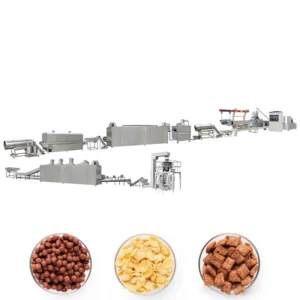
Kelloggs Corn Flakes Breakfast Cereal Normal Making Machine Breakfast Cereal Extruder Production Line
¥30,000.00 Select options This product has multiple variants. The options may be chosen on the product page -
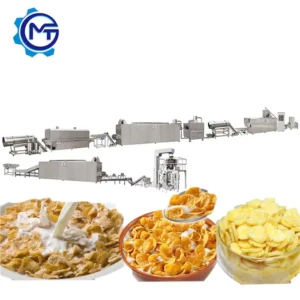
Automatic 500kg/h Corn Flakes Making Machine New Condition High Productivity Sweet Breakfast Cereal Processing Line From Factory
¥8,500.00 Select options This product has multiple variants. The options may be chosen on the product page -
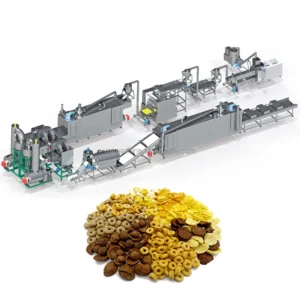
Stainless Steel Honey Small Corn Flake Breakfast Cereal Flakes Maker Making Machine Production Plant
¥30,000.00 Add to cart