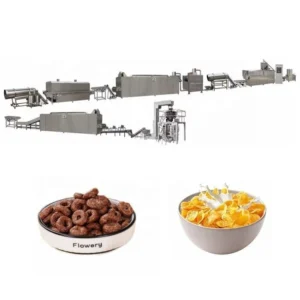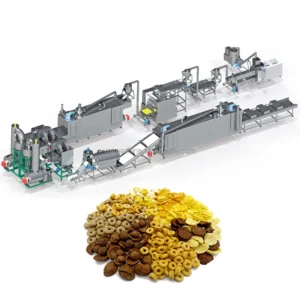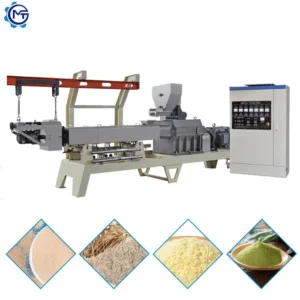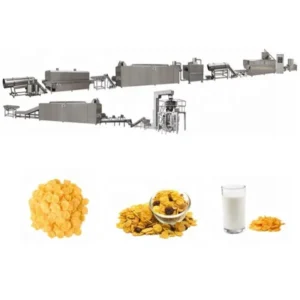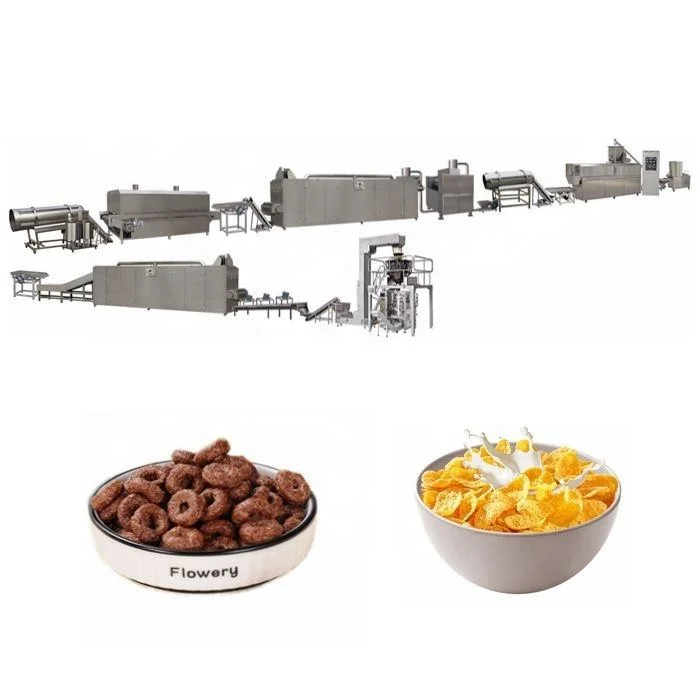


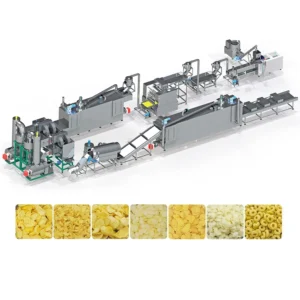
MT70 / MT85 / MT75 Corn Flakes Breakfast Cereal Production Line, Twin-screw Extruder, PLC-controlled Flaking — engineered as one integrated turnkey project from mixing through extrusion, flaking, hot air roasting, sugar coating and packing. Screw configuration and die design are matched to your raw material and target flake density, with interchangeable moulds for ring, ball, star and tube formats on a single line.
- Capacity, voltage and control language confirmed before production to match your market
- In-house testing workshop trial runs on your actual raw material before shipment
- Complete layout, electrical schematic and CE documentation provided as one unified package
Description
Throughput-Matched Line Design — Every station from the mixer to the packer is calculated against the extruder’s actual output on your grain formulation, preventing mid-line accumulation and unplanned shutdowns.
Technical Specifications
| Parameter | Value |
|---|---|
| Product Type | Corn Flakes Breakfast Cereal Production Line |
| Model Options | MT70 / MT85 / MT75 |
| Screw Type | Twin-screw |
| Installed Power (MT70) | 160 kW |
| Installed Power (MT85) | 190 kW |
| Installed Power (MT75) | 210 kW |
| Power Consumption (MT70) | 120 kW |
| Power Consumption (MT85) | 140 kW |
| Power Consumption (MT75) | 150 kW |
| Output Capacity (MT70) | 150–200 kg/h (basis to be confirmed) |
| Output Capacity (MT85) | 300–400 kg/h (basis to be confirmed) |
| Output Capacity (MT75) | 300–500 kg/h (basis to be confirmed) |
| Overall Dimensions (MT70) | 41 × 1.5 × 2.2 m |
| Overall Dimensions (MT85) | 43 × 1.5 × 3.2 m |
| Overall Dimensions (MT75) | 45 × 1.5 × 3.5 m |
| Control System | PLC with MCC available per customer requirement |
| Raw Materials | Corn, rice, wheat, oat, barley powder |
| Flaking Drive | Double motors with hydraulic roller system |
| Dryer Heating Source | Gas or electric |
| Certifications | CE, ISO |
Application Suitability
| Application | Material or Output |
|---|---|
| Natural corn flakes production | Corn grits, corn flour |
| Sugar-coated corn flakes | Corn base with sugar syrup coating |
| Multi-grain breakfast cereals | Rice, wheat, oat, barley powder blends |
| Shaped cereal formats | Ball, tube, ring, star, flower, heart via interchangeable dies |
Why Nominal Line Capacity Misses the Real Output on Your Grain Blend
A corn flakes production line turnkey rated at a single number rarely holds that figure when your raw material moisture and starch profile differ from the test standard.
I spent years commissioning breakfast cereal lines across the Middle East, and the most frustrating failures were never about the extruder itself. The extruder would run fine at its quoted figure, but the flaker two stations down could not keep pace, and cooked dough would pile up on the conveyor, cooling and clumping until someone shut the line down to scrape it off. That downtime was never in the capacity calculation [NEED_CITE: throughput mismatch consequences in cereal processing lines]. A corn flakes production line turnkey must be engineered so that each station’s realistic throughput is verified against the actual formulation you intend to run, not a generic corn grits benchmark.
Matching Every Station to the Extruder’s Real Output
The extruder sets the pace, but the flaking rollers, the dryer belt speed, and the hot air roasting oven all have their own physical limits. When a corn flakes production line turnkey is assembled from separate vendors, each supplier quotes their machine independently, and the gaps show up on day one of commissioning. Here, the line is configured as a single project: the PLC-controlled flaking machinery with its hydraulic double-roller system is sized so that roller gap and throughput match what the twin-screw extruder actually delivers at your target moisture level.
How the Roasting and Coating Stations Stay in Sync
After flaking and initial drying, the flakes enter a hot air roasting oven equipped with dual circulating fans and a cyclone dust removal device. The conciliation burner and vibrating pan with high-temperature spraying tubes are calibrated to the moisture leaving the dryer, ensuring uniform surface blistering without scorching. For sugar-coated variants, the inline coating station — double tumble melter, elevator, coating drum, and spray nozzles — is matched to the roaster’s discharge rate so that coated flakes move continuously to cooling and packing without queuing [NEED_CITE: sugar coating integration in breakfast cereal lines].
Reading the Spec Sheet for What Matters on the Floor
The twin-screw extruder’s interchangeable die set allows a single line to run natural flakes alongside ring, ball, star, and tube formats, but each shape changes the expansion ratio and therefore the bulk density entering the flaker. Installed power ranges from 160 kW on the MT70 to 210 kW on the MT75, and the corresponding line footprints stretch from 41 m to 45 m in length — dimensions that must be reconciled with your workshop’s ceiling height and column spacing before the foundation is poured. The flaking machinery’s infrared temperature sensor and hydraulic roller pressure control are what hold flake thickness consistent across a long production run, and the choice between gas and electric dryer heating will affect both your utility connection requirements and daily operating cost in your local tariff structure.
The Cost of Undersizing the Flaker or Dryer
When the flaker cannot accept the extruder’s output, partially gelatinised dough sits on the transfer conveyor, losing temperature *niform flakes. Operators then slow the extruder to compensate, and the line never reaches the throughput that justified the capital investment. I have watched this exact scenario force a plant to run two shifts where one should have been enough, eroding margins on every tonne of cereal produced [NEED_CITE: bottleneck effects on cereal plant shift planning]. A corn flakes production line turnkey that ignores downstream capacity is simply a collection of expensive standalone machines.
What This Supplier Does Differently on Turnkey Cereal Projects
The entire line from batching to packing comes from one engineering team, so throughput calculations are reconciled before fabrication rather than debated during installation. Screw configuration and die design are specified to the buyer’s raw material and target flake density, not copied from a generic build. An in-house testing workshop runs trial production on your actual grain blend before shipment, generating a trial run report that confirms flake thickness, expansion, and roast colour. Pre-sales layout work accounts for your factory’s ceiling height, door width, and utility entry points. The PLC and MCC control package is configured to your local voltage, frequency, and preferred operator language before the panels are wired.
Documentation & Verification
- Line layout and capacity calculation showing throughput at every station for your formulation
- Screw and die configuration record matched to your target flake density and shape
- Trial run report on your raw material conducted in the testing workshop before dispatch
- Electrical schematic with voltage and frequency confirmed for your market
- CE declaration of conformity and ISO certificate included in the shipping documentation
- Operation and maintenance manual with wear parts list for screws, dies, and roller surfaces
Installation, Commissioning & Support
- Foundation plan accounts for the 41–45 m line length and 1.5 m working width with utility trench locations
- Power supply must match the 160–210 kW installed power range with dedicated circuit breakers per station
- PLC and MCC panels arrive pre-wired to confirmed voltage, frequency, and operator language
- On-site commissioning includes flaker roller gap calibration and roasting oven temperature profiling
- Operator training covers die changeover procedures for multi-shape cereal formats
- Wear parts inventory list covers twin-screw segments, extruder dies, and flaker roller sleeves
What We Need to Build Your Line Layout
To prepare an accurate layout and capacity proposal, share your target cereal format — natural flakes, sugar-coated, or multi-shape — along with the grain blend and moisture content you plan to run. We also need your workshop dimensions including ceiling height and access door width, your local voltage and frequency, and whether you prefer gas or electric dryer heating. If you have existing upstream milling or downstream packing equipment, provide the model and throughput so the new corn flakes production line turnkey integrates without creating a new bottleneck.
Frequently Asked Questions
Q: How is line capacity verified against my specific raw material formulation?
A: Before shipment, your grain blend is run through the extruder, flaker, and dryer in our in-house testing workshop. The trial run records actual throughput, flake thickness, and roast colour at your target moisture content, and the results are shared as a formal report so you know the line’s real output before it leaves the factory.
Q: How do you prevent bottlenecks between the extruder and downstream stations?
A: Each station’s capacity is calculated from the extruder’s verified output on your material. The flaker’s hydraulic roller system, the dryer belt speed, and the roasting oven volume are all sized to accept continuous discharge without accumulation, and the layout document shows the matched throughput at every point.
Q: What does the installation and commissioning schedule look like?
A: The line arrives in sectioned modules that align with your floor plan. Commissioning begins with utility connections and PLC power-up, followed by cold runs of each station, then hot extrusion trials with your material. Operator training runs in parallel, and the full process typically spans several weeks depending on site readiness.
Q: Can one line produce both natural and sugar-coated corn flakes?
A: Yes. The sugar coating station — double tumble melter, elevator, coating drum, and spray nozzles — is integrated inline after the roasting oven. When natural flakes are the target, the coating station is bypassed via the PLC-controlled routing, and changeover between formats is handled through recipe selection on the control panel.
Q: What documentation comes with the shipment?
A: You receive a line layout with capacity calculations, screw and die configuration records, an electrical schematic confirmed to your voltage and frequency, the trial run report on your raw material, CE and ISO certificates, and an operation manual with a complete wear parts list for ongoing maintenance planning.
Related products
-
New High Efficiency Electric Corn Flakes Production & Manufacturing Machine
¥7,500.00 Select options This product has multiple variants. The options may be chosen on the product page -
Small Scale Breakfast Cereal Manufacturing Machine for Corn Flakes Process Line
¥45,000.00 Select options This product has multiple variants. The options may be chosen on the product page -
Automatic Cornflakes Making Machine Corn Flakes Breakfast Cereals Processing Production Line
¥500.00 Select options This product has multiple variants. The options may be chosen on the product page -
Automatic Commercial Breakfast Wheat Circle Corn Flake Production Line
¥65,000.00 Add to cart