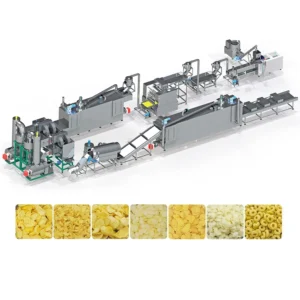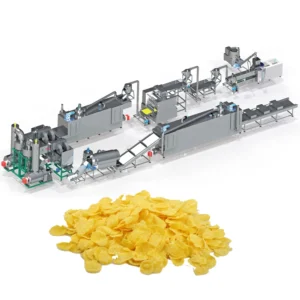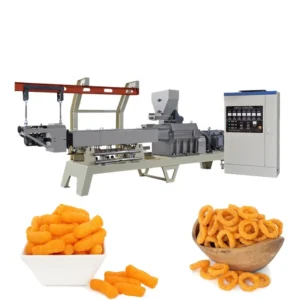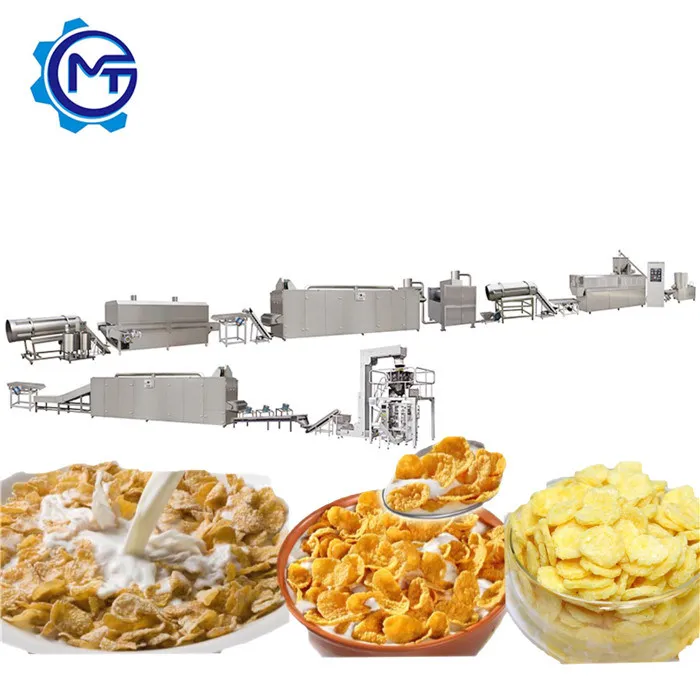


MT75 Twin-Screw Corn Flakes Production Line, 210 kW Installed Power, PLC Control — engineered as one turnkey project from mixing through extrusion, flaking, roasting, coating, and packing, with every station throughput-matched under a single supplier to eliminate bottleneck risk.
- Hydraulic double-roller flaking system with infrared sensor temperature control ensures consistent flake thickness across corn, rice, wheat, and oat formulations.
- Hot air roasting oven with dual circulating fans and cyclone dust removal delivers uniform surface blistering and crispness.
- Screw configuration and die design specified to buyer’s raw material and target product format.
- Trial runs on customer raw material performed in-house before shipment, with layout and capacity calculation documented for every station.
Description
Matched Throughput Stations — From mixing to packing, the MT75 corn flakes line is engineered as a single project where extruder output, flaker speed, roaster capacity, and coating drum volume are calculated together to eliminate the bottleneck that plagues multi-vendor assemblies.
Technical Specifications
| Parameter | Value |
|---|---|
| Product Type | Corn Flakes Production Line (Twin-Screw Extrusion) |
| Screw Configuration | Twin-screw |
| Installed Power (Extruder MT75) | 210 kW |
| Power Consumption (MT75) | 150 kW |
| Output Capacity | 300–500 kg/h (basis not stated in source — subject to raw material, moisture, and flake format) |
| Control System | PLC control for flaking machinery; MCC/PLC for complete line |
| Overall Line Dimensions (MT75) | 45 × 1.5 × 3.5 m |
| Flaking Machinery | Hydraulic double-roller system, dual motors, infrared sensor temperature control |
| Dryer Heating Source | Gas or Electric (configurable) |
| Roasting Oven | Hot air roasting, vibrating pan, high-temperature spraying tubes, conciliation burner, dual circulating fans, cyclone dust removal |
| Coating System | Double tumble sugar melting, elevator, coating drum, spraying nozzle |
| Final Products | Natural corn flakes, sugar-coated corn flakes, shaped cereals (ball, tube, ring, star, wheel) |
| Raw Materials | Corn, rice, wheat, oat, barley powder |
| Certifications | CE (since 2014), ISO certified |
Application Suitability
| Application | Material or Output |
|---|---|
| Natural corn flakes for retail breakfast cereal | Corn grits or corn flour, toasted and packed |
| Sugar-coated corn flakes for mass market | Extruded corn base with sugar spray and tumble coating |
| Multi-grain breakfast cereals | Blends of rice, wheat, oat, and barley powder |
| Shaped cereal snacks | Ball, tube, stick, ring, fruit loop, star, wheel, flower, heart formats via die change |
| Greenfield cereal processing facility | Complete line from batching system through extrusion to packing |
What "300–500 kg/h" Actually Depends On in Corn Flake Extrusion
A rated capacity figure means little until it is verified against your specific corn variety, moisture content, and target flake thickness.
I remember a project where the buyer sourced corn locally instead of the standard test material. The extruder ran fine, but the flakes came out of the roaster brittle and undersized because the raw material absorbed water differently during conditioning. The line sat idle for weeks while we reconfigured the screw profile and adjusted the barrel temperature zones. That is the gap between a brochure number and a real production rate [NEED_CITE: raw material variability in cereal extrusion and its effect on line throughput]. A corn flakes production line turnkey project must account for the buyer’s actual supply chain, not a lab-grade ideal.
How Twin-Screw Extrusion Shapes the Corn Flake
The twin-screw design in the MT75 provides the shear and residence time needed to fully gelatinise corn starch before the dough reaches the die. Single-screw extruders struggle with the moisture levels and particle sizes typical of corn grits, often resulting in uneven expansion. The screw configuration is selected based on the buyer’s raw material — a high-fat corn blend requires a different screw element arrangement than a lean rice-and-barley mix. This is the core of extrusion technology: matching mechanical energy input to the starch behaviour of the grain.
Why the Flaking and Roasting Stations Cannot Be an Afterthought
The hydraulic double-roller flaking machinery uses infrared sensor temperature control to maintain consistent roller surface heat, which directly determines flake thickness and integrity. If the rollers run too cool, the dough sheet cracks instead of pressing into a clean flake. Downstream, the hot air roasting oven relies on dual circulating fans and a conciliation burner to deliver even surface blistering — the signature crispness that defines a quality corn flake. A corn flakes production line turnkey project fails when the roaster is undersized relative to the flaker output, leaving wet, under-toasted product in the packaging [NEED_CITE: thermal balance between flaking and roasting stations in cereal lines].
Reading the Specs: What Matters Beyond Installed Power
The MT75 draws 210 kW installed but consumes approximately 150 kW during steady-state operation — the difference reflects motor start-up loads and heater cycling. For facility planning, the 150 kW figure determines your transformer sizing and cable gauge, not the peak value. The 45 × 1.5 × 3.5 m footprint dictates building clearance and foundation layout; the 3.5 m height requires adequate roof clearance for the roaster’s exhaust ducting and cyclone dust removal device. The PLC control system governing the flaking machinery allows operators to set roller gap, temperature, and feed rate from a single interface, reducing the manual adjustments that introduce batch-to-batch variation. When the dryer heating source is configured for gas rather than electric, the utility planning shifts entirely — gas line diameter, pressure regulation, and combustion ventilation replace electrical load calculations.
The Hidden Cost of Mismatched Line Stations
When an extruder is paired with a dryer that cannot handle its output, the entire line slows to the dryer’s pace. Operators throttle back the feed rate, the extruder runs below its designed fill level, and the screw wear pattern shifts unevenly. I have walked into facilities where the coating drum was sized for a smaller predecessor line — sugar coverage was patchy, and the tumble time was too short for proper adhesion [NEED_CITE: bottleneck effects in multi-station food processing lines]. The corn flakes production line turnkey approach prevents this by calculating every station’s throughput from the same production target rather than bolting together independently quoted machines.
Why Engineers Specify Meiteng for Cereal Line Projects
The line layout and capacity calculation is prepared as one document covering every station, so the extruder, flaker, dryer, roaster, coater, and cooler are throughput-matched before fabrication begins. Screw configuration and die design are specified to the buyer’s raw material and target flake format, not copied from a generic build. An in-house testing workshop runs the buyer’s actual corn, rice, or multi-grain blend before shipment, generating a trial run report that confirms product texture and line rate. Pre-sales consultation extends through on-site installation, commissioning, and operator training, meaning the same engineering team that designed the layout oversees the first production shift. Voltage, frequency, and control language are confirmed during the specification phase, preventing the commissioning delays that arise when a control panel arrives labelled in the wrong language or wired for the wrong supply [NEED_CITE: common commissioning delays in exported food processing equipment].
Documentation & Verification
- Line layout drawing with throughput matched across mixing, extrusion, flaking, roasting, and packing stations
- Trial run report on your specific corn or multi-grain raw material conducted in the testing workshop
- Screw and die configuration record matched to your target flake thickness and product shape
- Electrical schematic with voltage, frequency, and control language confirmed before production
- Factory test record documenting steady-state output and flake quality parameters before dispatch
- CE declaration of conformity and ISO certificate for customs and regulatory submission
Installation, Commissioning & Support
- Foundation plan based on the 45 × 1.5 × 3.5 m line footprint and roaster exhaust requirements
- Dedicated electrical circuit sized to the 150 kW operating load or gas supply line for thermal stations
- Assembly sequence from extruder through flaker, dryer, roaster, coater, and cooler with phased schedule
- First-run parameter setting for screw speed, barrel temperature, roller gap, and roaster airflow
- Operator training covering PLC interface navigation, die changeover, and emergency stop procedures
- Wear parts list specifying screw elements, die plates, and roller surfaces with reorder intervals
What We Need to Engineer Your Line
To prepare an accurate layout and capacity calculation, share your target raw material — corn variety, grits or flour, moisture range — and your intended product format, whether natural flakes, sugar-coated, or shaped cereal. Confirm your facility voltage and frequency, available floor space and ceiling height, and whether you plan to source gas or electric heating for the dryer and roaster. If you have existing upstream batching or downstream packing equipment, provide the interface specifications so the corn flakes production line turnkey layout accounts for those connection points.
Frequently Asked Questions
Q: How is line throughput verified across every station to prevent bottlenecks?
A: Every station — extruder, flaker, dryer, roaster, coater, cooler — is calculated against the same target output during the layout phase. The capacity document shows material flow rate at each transfer point. If the roaster cannot handle the flaker output, the roaster is resized before the quotation is issued, not discovered during commissioning.
Q: What does the trial run on buyer’s raw material cover?
A: Your corn, rice, or multi-grain blend is run through the extruder and flaker in the testing workshop. The trial report documents screw configuration, barrel temperature profile, flake thickness, moisture at each station, and final product texture. This confirms the line will produce your target flake before shipment.
Q: How are screw and die configurations selected for different grains?
A: Corn grits require a specific screw element sequence for complete starch gelatinisation at typical moisture levels. Rice and oat blends behave differently under shear and need adjusted compression ratios. The die aperture is matched to the target flake or shape dimension. Each configuration is recorded and supplied with the line.
Q: What utility details must be confirmed before production begins?
A: Voltage, frequency, and phase for the electrical supply; gas pressure and line diameter if gas heating is selected; compressed air availability for pneumatic controls; water supply for the cooling system; and exhaust ventilation for the roaster cyclone. These are finalised during the specification sign-off phase.
Q: What is included in the commissioning schedule for a turnkey cereal line?
A: Phased installation from extruder through packing station, electrical and gas connection verification, no-load testing, product trial runs with parameter adjustment, and operator training on the PLC interface and routine maintenance. The schedule accounts for utility readiness and building completion at your site.
Related products
-
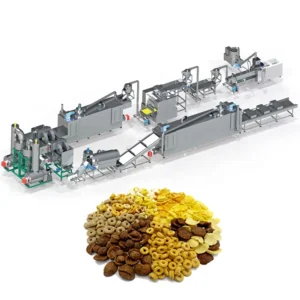
Corn Flakes Production Line Breakfast Cereal Production Machine Line Corn Flake Making Machinery
¥59,800.00 Select options This product has multiple variants. The options may be chosen on the product page -
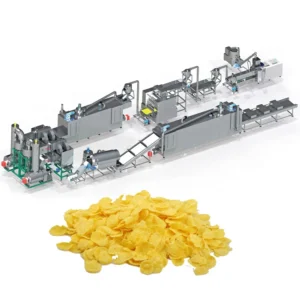
Best Price Corn Flakes Making Machine Breakfast Cereals Processing Line with Motor As Core Component
¥19,000.00 Select options This product has multiple variants. The options may be chosen on the product page -
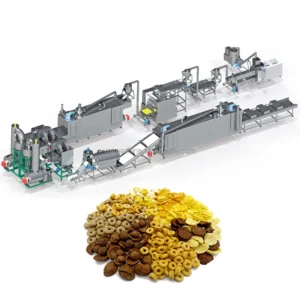
Stainless Steel Honey Small Corn Flake Breakfast Cereal Flakes Maker Making Machine Production Plant
¥30,000.00 Add to cart -
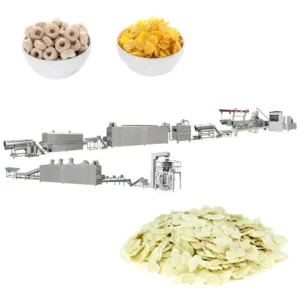
200kg/h Breakfast Cereal Extruder Making Machine Hot Sale Corn Flake Production Line
¥30,000.00 Select options This product has multiple variants. The options may be chosen on the product page