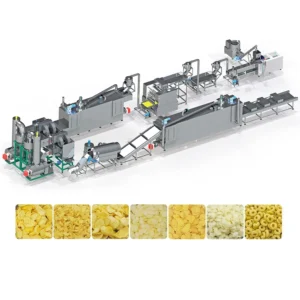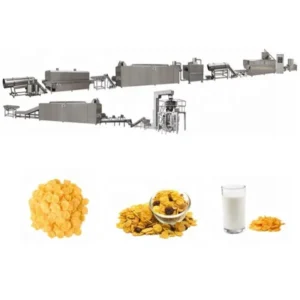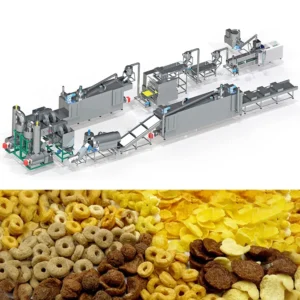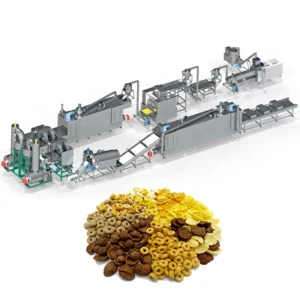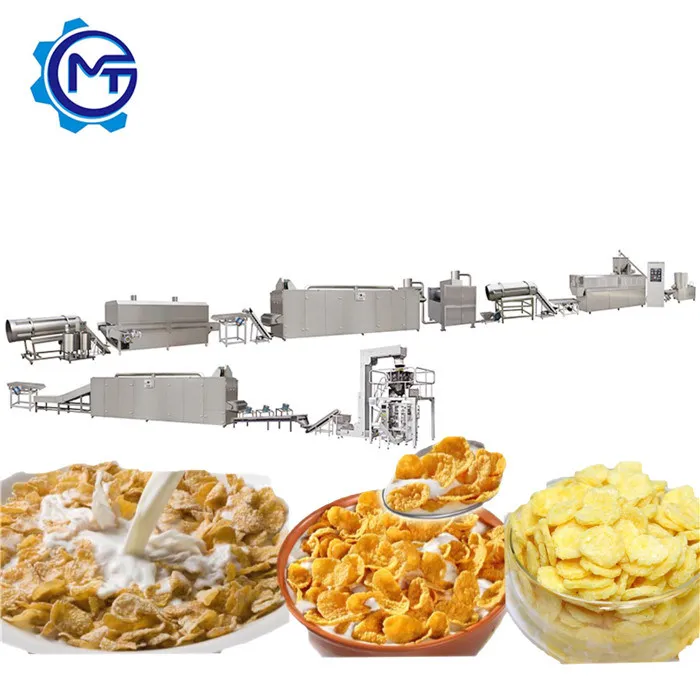


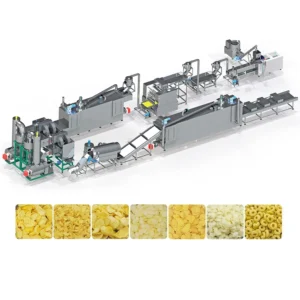
MT75 Corn Flakes Production Line, Twin-Screw Extrusion, 210 kW Installed Power — engineered as one integrated turnkey project from mixing through flaking, roasting and coating. The twin-screw extruder features automatic lubrication and integrated cooling, while the flaking unit uses PLC-controlled hydraulic double rollers with infrared temperature monitoring for uniform thickness. Every station’s throughput is matched to eliminate bottlenecks across the line. Delivered with factory trial runs on your actual raw material before shipment to verify capacity and flake density.
MT75 Corn Flakes Production Line, Twin-Screw Extrusion, 210 kW Installed Power — engineered as one integrated turnkey project from mixing through flaking, roasting and coating. The twin-screw extruder features automatic lubrication and integrated cooling, while the flaking unit uses PLC-controlled hydraulic double rollers with infrared temperature monitoring for uniform thickness. Every station’s throughput is matched to eliminate bottlenecks across the line. Delivered with factory trial runs on your actual raw material before shipment to verify capacity and flake density.
Description
Throughput-matched extrusion design — Every station from the twin-screw cooker to the flaking rollers and roasting oven is sized against the MT75’s actual throughput on your cereal formulation, not a generic catalog number.
Technical Specifications
| Parameter | Value |
|---|---|
| Model | MT75 |
| Product Type | Corn Flakes Production Line |
| Extruder Type | Twin Screw (MT-75) |
| Installed Power | 210 kW |
| Power Consumption | 150 kW |
| Output Capacity | 300-500 kg/h (basis not stated in source — confirm raw material and moisture content) |
| Overall Dimensions | 45 × 1.5 × 3.5 m |
| Extruder Features | Automatic lubricating system, integrated cooling function, wear-resistant screw manufacturing process |
| Flaking Machine | PLC control, hydraulic double-roller system, dual separate-drive motors, infrared sensor temperature control |
| Dryer Heating Source | Gas or Electric (selectable) |
| Roasting Oven | Hot air with vibrating pan, high-temperature spraying tubes, conciliation burner, two circulating fans, cyclone dust removal |
| Coating System | Double tumble sugar melting unit, elevator, coating drum, spraying nozzle |
| Line Stations | Mixing → Extruding → Flaking → Drying → Hot Air Roasting → Sugar Spraying & Coating → Drying → Cooling → Packing |
| Raw Materials | Corn, rice, wheat, oat, barley powder |
| Final Product Shapes | Ball, tube, stick, ring, fruit loop, star, wheel, flower, heart (via extruder mould adjustment) |
| Control System | PLC (confirmed on flaking unit; line-wide scope to be confirmed) |
Application Suitability
| Application | Material or Output |
|---|---|
| Natural corn flakes for breakfast cereal packs | Corn grits and corn flour |
| Sugar-coated and honey-glazed corn flakes | Corn base with sugar or honey spray coating |
| Shaped breakfast cereal snacks | Rice, wheat, oat, and barley powder blends formed as rings, balls, fruit loops, stars |
| Fortified cereal production for institutional nutrition programmes | Multi-grain powder with vitamin and mineral premix |
| Snack-format extruded shapes on the same platform | Corn and rice blends for tube, stick, wheel, and heart shapes |
What the Stated Capacity of a Corn Flakes Line Rarely Tells You
A capacity number without a raw material basis is a marketing claim, not an engineering guarantee.
I have watched commissioning schedules collapse because the corn flakes production line turnkey project was quoted at a nominal hourly output tested on standard corn grits, then the buyer switched to a high-sugar formulation on day one and the extruder could not maintain expansion or throughput. The extruder slowed down, the flaking unit sat idle, and the roasting oven ran below temperature. The entire line rhythm broke. This happens more often than equipment suppliers admit [NEED_CITE: common causes of commissioning delays in cereal extrusion lines]. When you evaluate a corn flakes line, the first question should never be about the top-line number — it should be about what formulation that number was measured on, and whether your actual recipe has been tested.
Matching the Screw Profile to Your Cereal Formulation
The MT-75 twin-screw extruder at the heart of this line uses a screw configuration selected against your specific raw material blend and target flake density. Corn grits behave differently under shear and heat than a rice-and-oat composite flour. The screw elements, their spacing, and the die geometry together determine residence time, gelatinisation degree, and the expansion that sets flake thickness downstream. A corn flakes production line turnkey project only holds its output when the screw profile matches what is actually feeding into the hopper.
Why the Flaking and Roasting Stations Must Keep Pace
A twin-screw extruder producing cooked cereal dough is only one step. The flaking unit uses PLC-controlled hydraulic pressure across its double rollers, with infrared temperature monitoring to maintain consistent sheet thickness. If the flaking station cannot process dough at the rate the extruder delivers it, material backs up and moisture content shifts before pressing. The hot air roasting oven that follows uses dual circulating fans and a cyclone dust removal system to achieve the surface bubbling and crispness that defines a market-ready corn flake. Each station in this corn flakes production line turnkey is sized so that throughput does not bottleneck at any single point.
Reading the Specs That Actually Matter on the Floor
The 210 kW installed power and 150 kW operating consumption on the MT75 tell you the electrical infrastructure this line demands — dedicated circuits, correct transformer sizing, and cable runs rated for sustained load in a hot processing environment. The 45-metre line footprint at 3.5 metres in height sets your floor space and ceiling clearance requirements before a single foundation bolt is placed. The selectable gas or electric dryer heating source determines whether you need a gas supply permit and combustion ventilation or additional electrical capacity. The roasting oven’s conciliation burner and vibrating pan together control how evenly heat reaches every flake surface; uneven roasting shows up immediately as colour variation in the final pack. These are the specifications that separate a line that runs on day one from one that requires weeks of adjustment [NEED_CITE: industrial electrical and utility planning for food extrusion installations].
The Cost of Skipping Pre-Shipment Verification
When a cereal line arrives at your facility and the first test run reveals that the flake density is wrong, the sugar coating drums cannot handle the throughput, or the voltage does not match your local grid, the corrective work happens on your floor at your expense. Reworking screw configurations, replacing die plates, and rewiring control panels after installation costs far more in lost production time than a factory trial run before the equipment ever leaves the manufacturer. Buyers who skip this step often discover the real problems only after raw material is loaded and the line is expected to produce saleable product [NEED_CITE: risks of skipping factory acceptance testing on food processing lines].
Why This Line Is Engineered as a Single Project
Every station from the batching mixer through the cooling conveyor to the packing interface is supplied and matched by one entity, so throughput is calculated across the entire chain rather than assembled from independent vendors who each guarantee only their own machine. The screw and die configuration is recorded against your specific formulation before the extruder is built. The in-house testing workshop runs your actual raw material through the line before shipment, generating a trial report that documents real output and product quality. Electrical schematics and voltage are confirmed against your installation site, not left as a default. The same engineering team that designs the layout handles on-site commissioning, so the people who specified the line are the ones watching it run in your facility.
Documentation & Verification
- Line layout drawing with capacity calculation matched to your cereal formulation
- Screw and die configuration record specific to your raw material and target flake density
- Trial run report from testing workshop using your supplied raw material before dispatch
- Electrical schematic with voltage, frequency, and control language confirmed for your site
- Factory test record documenting actual throughput and product quality at each station
- CE declaration of conformity and ISO certificate for the complete line
Installation, Commissioning & Support
- Foundation and floor space planning based on the 45 × 1.5 × 3.5 m MT75 line footprint
- Dedicated power circuit sizing against the 210 kW installed load and local voltage specification
- Staged assembly sequence with utility connections mapped to each station before mechanical installation
- First-run parameter setting on your actual corn, rice, or multi-grain formulation with engineer oversight
- Operator training covering screw speed, flaking pressure, roasting temperature, and coating drum timing
- Wear parts list including screws and dies with recommended replacement intervals for your production volume
What to Prepare Before You Request a Quotation
To configure this corn flakes production line turnkey accurately, share your target raw material formulation with moisture content, your intended daily output and shift pattern, and the ceiling height and floor area available in your facility. Specify your local voltage, frequency, and preferred control language so the electrical package is built correctly from the start. If you plan to produce both natural and sugar-coated variants, confirm which coating system capacity you need.
Frequently Asked Questions
Q: How is line throughput verified against my actual raw material before shipment?
A: Your specific cereal formulation is run through the MT75 extruder and downstream stations in the testing workshop before dispatch. A trial report documents the actual output, flake density, and product quality achieved. If the results deviate from your target, screw configuration and die design are adjusted and the test is repeated until the line meets specification on your material.
Q: What voltage, frequency, and control language are confirmed before production starts?
A: Your installation site’s electrical standard is collected during the quotation stage and written into the electrical schematic. The control panel, motor ratings, and heating elements are all built to that specification. The PLC interface language on the flaking unit and any additional line-wide controls is confirmed to match your operators’ requirements before the panels are assembled.
Q: How do you ensure the flaking, drying, and roasting stations keep pace with the extruder output?
A: Each station is selected and sized based on the extruder’s verified throughput on your formulation, not on independent nameplate ratings. The hydraulic flaking unit, dryer belt length, and roasting oven volume are all calculated so that material flows continuously without accumulation or idle time at any point in the line.
Q: Can the line be configured for both natural and sugar-coated corn flakes on the same layout?
A: The coating system with its double tumble sugar melting unit, elevator, and spray drum is included as an integrated station. The line layout accommodates both production modes so you can switch between natural and coated product by engaging or bypassing the coating section without mechanical reconfiguration.
Q: What does on-site installation, commissioning, and operator training cover?
A: The engineering team handles mechanical assembly, utility connection, and first-run parameter tuning using your raw material on your floor. Operators are trained on extruder screw speed, flaking roller pressure and temperature, roasting oven settings, and coating drum operation. A wear parts schedule and maintenance intervals are handed over with the operation manual.
Related products
-
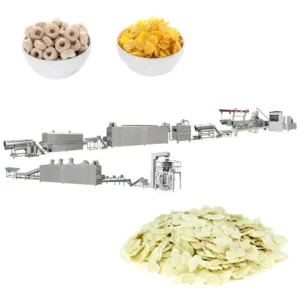
200kg/h Breakfast Cereal Extruder Making Machine Hot Sale Corn Flake Production Line
¥30,000.00 Select options This product has multiple variants. The options may be chosen on the product page -
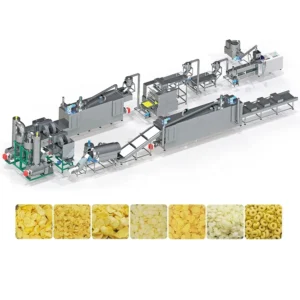
Whole Grain Choco Hoop Crunchy Wheat Cereal Ring Fruit Loops Snacks Extruder Machine /breakfast Cereals Corn Flakes Production
¥48,000.00 Select options This product has multiple variants. The options may be chosen on the product page -
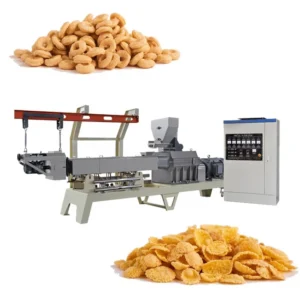
Corn Flakes Machine Breakfast Cereal Corn Flakes Production Line Cornflakes Making Machine
¥85,800.00 Select options This product has multiple variants. The options may be chosen on the product page -
Automatic Commercial Breakfast Wheat Circle Corn Flake Production Line
¥65,000.00 Add to cart