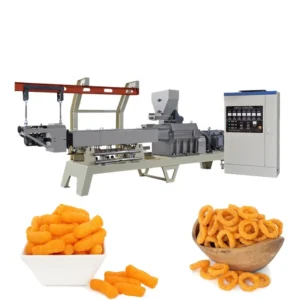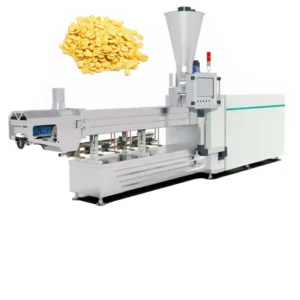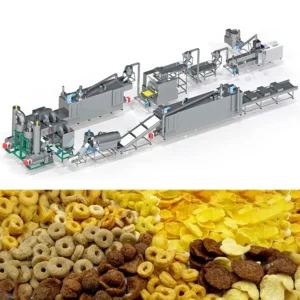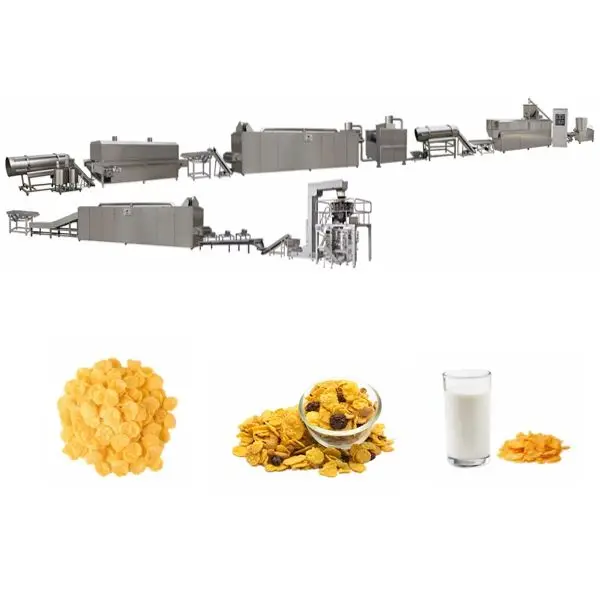


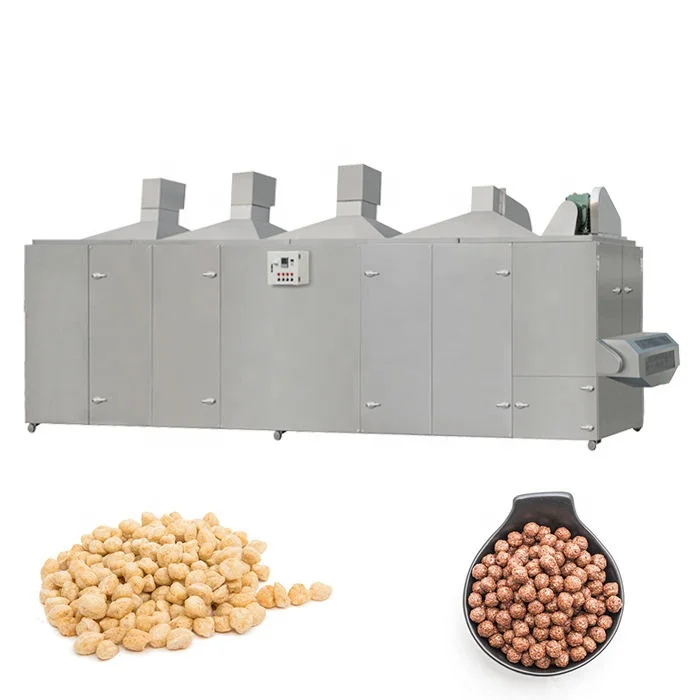
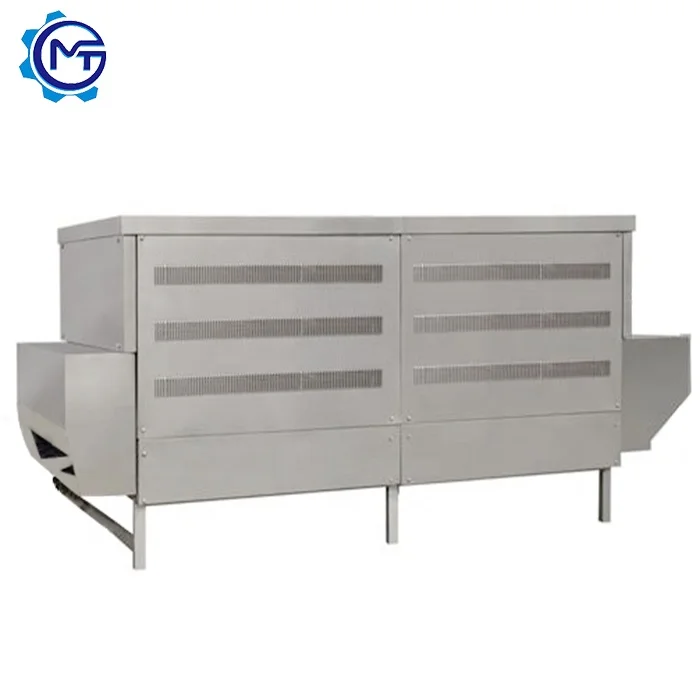

MT70 / MT85 / MT75 Corn Flakes Production Line, Twin-Screw Extrusion, PLC & MCC Control — engineered as a complete turnkey project from batching through extrusion, flaking, roasting, coating, and packing. Every station is throughput-matched under one supplier scope, with screw configuration and die design specified to your grain formulation and target flake density. Layout drawings, factory trial runs on your raw material, and on-site commissioning are included to ensure the line meets your product specification before handover.
- Line stations: Mixing → Extruding → Flaking → Drying → Hot Air Roasting → Sugar Coating → Cooling → Packing
- Hydraulic double-roller flaking with infrared temperature sensing for uniform flake thickness
- Hot air roasting oven with dual circulating fans and cyclone dust removal
- Natural and sugar-coated corn flake variants supported within one line configuration
- CE and ISO certified; voltage, frequency, and control language customized to your facility
Description
Integrated Extrusion Line Engineering — Screw configuration and die design specified to your grain formulation, with throughput matched across every station from batching to packing under one supplier scope.
Technical Specifications
| Parameter | Value |
|---|---|
| Product Type | Corn Flake Production Line / Breakfast Cereal Extruder |
| Models Available | MT70 / MT85 / MT75 |
| Extruder Type | Twin Screw |
| Control System | PLC and MCC available per customer requirement |
| Installed Power (MT70 / MT85 / MT75) | 160 kW / 190 kW / 210 kW |
| Power Consumption (MT70 / MT85 / MT75) | 120 kW / 140 kW / 150 kW |
| Output Capacity | 150–200 kg/h (MT70), 300–400 kg/h (MT85), 300–500 kg/h (MT75) (basis to be confirmed against raw material formulation and moisture content) |
| Overall Dimensions (MT70 / MT85 / MT75) | 41 × 1.5 × 2.2 m / 43 × 1.5 × 3.2 m / 45 × 1.5 × 3.5 m |
| Flaking Machinery | Hydraulic double-roller system, separate motor drives, infrared temperature sensor |
| Dryer Heating Source | Gas or Electric |
| Roasting Oven | Hot air roasting with vibrating pan, dual circulating fans, cyclone dust removal |
| Coating System | Double tumble sugar melting, elevator, coating drum, spraying nozzle |
| Raw Materials | Corn, rice, wheat, oat, barley powder |
| Final Product Shapes | Ball, tube, stick, ring, fruit loop, star, wheel, flower, heart |
| Voltage & Frequency | Customized to customer local voltage |
| Standards | CE, ISO |
Application Suitability
| Application | Material or Output |
|---|---|
| Natural corn flake production from greenfield | Corn grits and corn flour blends |
| Sugar-coated breakfast cereal line | Corn, rice, and multi-grain formulations with sugar or honey coating |
| Capacity expansion with a matched second line | Existing cereal producers adding throughput without reconfiguring upstream batching |
| Turnkey project contractor sourcing for food factory build-out | Full extrusion-based cereal line from batching through packing |
| Multi-grain flake variants | Wheat, oat, and barley powder blends requiring adjusted screw profiles |
What "300 kg/h Output" Leaves Out About Your Corn Flake Line
Nominal capacity means nothing until the extruder runs on your actual grain blend at your target moisture.
I spent years bolting extruders together on workshop floors before moving into line integration. One project stands out: a Middle Eastern client who received a corn flake line quoted at a nominal hourly output. Their local corn flour ran coarser than the standard test material. The flakes came out shattered, yield dropped sharply, and commissioning dragged on weeks past schedule [NEED_CITE: raw material particle size effect on extrusion output stability]. The root cause was not the extruder itself — it was the absence of a pre-shipment trial on the buyer’s specific formulation.
A corn flakes production line turnkey project should never be quoted on a generic capacity figure alone. The moisture content, particle size distribution, and starch composition of your corn, rice, or oat blend all shift how the material behaves inside the barrel. Without a documented trial on your raw material, the capacity number on the quotation is a placeholder.
How Extrusion Parameters Shape the Final Flake
The twin-screw configuration on these extruders determines how aggressively the grain blend is sheared, hydrated, and gelatinized before it reaches the die. Barrel temperature profiling across multiple zones lets the operator control the degree of starch gelatinisation, which directly sets the expansion ratio of the extrudate rope. Die aperture and screw pitch are selected together — a wider die with tighter pitch may suit a dense, slow-cooking flake, while a narrower die with longer residence time produces a lighter, crispier output.
Screw element sequencing — forward-flight, kneading block, and reverse-flight sections — is rearranged depending on whether the raw material is pure corn grits or a multi-grain blend containing oat and barley powder. Each grain has a different gelatinization temperature and fibre content, and the screw build must account for that. Getting this wrong means the extrudate either collapses before flaking or refuses to flatten uniformly between the rollers.
Why the Dryer and Roaster Cannot Be Sized Separately
A common integration failure in breakfast cereal projects is specifying the extruder and flaking mill on one capacity basis, then sourcing the dryer and roasting oven from a different vendor who sizes them on a different assumption [NEED_CITE: throughput mismatch between extrusion and drying stations in cereal lines]. The flaking stage produces a wet, delicate sheet that must enter the dryer within a narrow moisture window. If the dryer is undersized, flakes back up on the conveyor, stick together, and develop uneven moisture that ruins the roasting stage downstream.
The hot air roasting oven on this line uses dual circulating fans and a cyclone dust removal device to maintain consistent surface blistering. The conciliation burner and high-temperature spraying tubes ensure that each flake receives uniform heat exposure as the vibrating pan advances it through the chamber. When this station is throughput-matched to the flaking mill output, the roasting cycle holds steady without operators manually adjusting belt speed or temperature to compensate for surges.
Reading the Specification Sheet Beyond the Headline Numbers
The installed power figures across the three models — 160 kW for the MT70, 190 kW for the MT85, and 210 kW for the MT75 — reflect the total connected load of each extruder configuration, not continuous draw. Power consumption under load is typically lower, at 120 kW, 140 kW, and 150 kW respectively, which is the figure to use when planning electrical infrastructure and transformer sizing.
The hydraulic double-roller flaking machinery uses separate motor drives for each roller, allowing differential speed adjustment that influences flake surface texture. Infrared temperature sensing on the roller surface provides closed-loop feedback, preventing the rollers from overheating during continuous operation — a condition that causes flakes to scorch before they reach the dryer. The PLC control system ties the extruder, flaking mill, and dryer into a single logic loop so that a feed-rate change at the mixer propagates through every downstream station automatically.
The Hidden Cost of an Unmatched Line Configuration
When stations are assembled from separate vendors without a single integration authority, the consequences show up during commissioning. A coating drum that cannot keep pace with the roaster output forces the roaster to cycle down, producing batches with inconsistent surface blistering. A sugar-coating variant of the line adds a double tumble sugar melting system, an elevator, and a second drying pass — if any of these stations is undersized, the sugar crystallizes unevenly and the final product fails visual quality checks [NEED_CITE: sugar coating uniformity issues in cereal finishing lines].
I have walked into facilities where the flaking mill was rated higher than the extruder could sustainably feed, leaving the rollers running half-empty and generating excessive edge trim waste. These are not equipment defects — they are integration oversights that a proper turnkey project scope prevents by calculating throughput at every transfer point before any machine is built.
Why Procurement Consolidation Matters for This Line
Every station from the batching system through the extruder, flaking mill, dryer, roasting oven, coating drum, cooler, and packing conveyor is specified under one supplier scope, which means throughput calculations are cross-checked at every handoff point before the line layout is finalized.
Screw configuration and die design are documented against the buyer’s raw material sample and target flake density, not copied from a generic build sheet. The in-house testing workshop runs your grain formulation through the extruder before shipment, producing a trial report that confirms product shape, expansion ratio, and moisture profile at the die exit.
Pre-sales consultation includes line layout drawing and capacity calculation, on-site installation follows a phased schedule, and operator training covers the specific PLC parameters for your product specification. Wear parts — screws, dies, and flaking rollers — are inventoried with a documented list so the first replacement cycle is planned before commissioning begins.
Documentation & Verification
- Line layout drawing showing throughput-matched station capacities across the full corn flake process
- Screw and die configuration record matched to your grain formulation and target flake density
- Trial run report on your raw material blend executed in the testing workshop before dispatch
- Electrical schematic confirming voltage, frequency, and control language for your facility
- CE declaration of conformity and ISO certificate for the complete line scope
Installation, Commissioning & Support
- Foundation and utility planning based on the 41–45 m line length and station-specific power drops
- Dedicated circuit allocation for the 120–150 kW operating load and hydraulic flaking system
- Phased installation schedule with station-by-station mechanical and electrical sign-off
- First-run parameter setting on the PLC for your grain blend moisture and target flake thickness
- Operator training covering screw changeover, roller gap adjustment, and roasting oven temperature profiling
- Documented wear parts list covering screws, dies, and roller surfaces with stocking recommendations
What We Need to Start Your Line Configuration
Before any capacity calculation or layout drawing can begin, share your primary grain formulation — whether pure corn grits, a multi-grain blend, or a rice-and-oat mix — along with the particle size distribution your mill produces. Specify whether the target product is a natural flake, a sugar-coated variant, or both on the same line. Confirm your local voltage and frequency, the available workshop footprint and ceiling height, and the control language your operators require. If you have existing upstream batching or downstream packing equipment that this line must interface with, include those specifications so the throughput matching accounts for every transfer point.
Frequently Asked Questions
Q: How is line throughput matched across mixing, extrusion, flaking, roasting, coating, and packing stations?
A: Each station is sized on the same mass-flow basis derived from your target hourly output and raw material moisture content. Transfer conveyors and buffer hoppers are specified to prevent bottlenecks, and the PLC logic synchronizes feed rates across the entire corn flakes production line turnkey scope so that no single station runs starved or overloaded.
Q: What raw material formulations have been trialled, and can we run a test on our specific grain blend before shipment?
A: Corn, rice, wheat, oat, and barley powder blends have all been processed through the testing workshop. Your specific formulation is run on the twin-screw extruder with your chosen screw and die configuration, generating a trial report that documents expansion ratio, extrudate moisture, and flake geometry before the line ships.
Q: How is the factory layout designed and phased for installation within our facility footprint?
A: The line layout drawing maps the 41 to 45 metre line length to your available floor space, accounting for utility drops, operator access corridors, and maintenance clearance. Installation is phased station-by-station, starting with the extruder and flaking mill on fixed foundations, then adding dryer, roaster, and coating modules in sequence.
Q: What is the commissioning schedule, and does it include operator training on our product specification?
A: Commissioning follows a structured sequence from cold mechanical checks through hot product runs. Operators are trained on the PLC interface, screw changeover procedures, roller gap settings, and roasting oven parameters specific to your flake thickness and density targets.
Q: How are spare wear parts — screws, dies, flaking rollers — stocked and supplied for first replacement?
A: A documented wear parts list is delivered with the line, identifying each consumable component by part number. The first replacement set is typically stocked before shipment, and the supplier maintains inventory records so subsequent orders are fulfilled without extended lead times.
Related products
-

MT Cocoa Flour Puffed Breakfast Cereal Production Line-High Large Capacity Multi-Fuel (Steam/Gas/Electric) New Shandong Origin
¥8,000.00 Select options This product has multiple variants. The options may be chosen on the product page -

Best Price Corn Flakes Making Machine Breakfast Cereals Processing Line with Motor As Core Component
¥19,000.00 Select options This product has multiple variants. The options may be chosen on the product page -

Hot Selling Automatic Corn Flakes Breakfast Cereal Production Line Making Machine
¥20,000.00 Select options This product has multiple variants. The options may be chosen on the product page -
Automatic Commercial Breakfast Wheat Circle Corn Flake Production Line
¥65,000.00 Add to cart