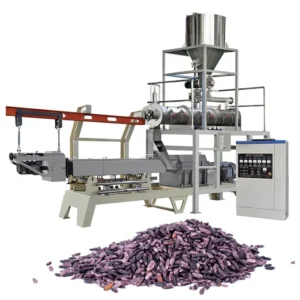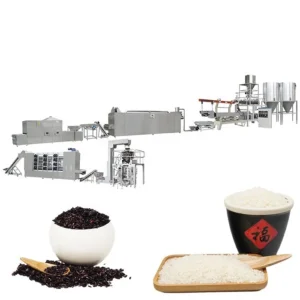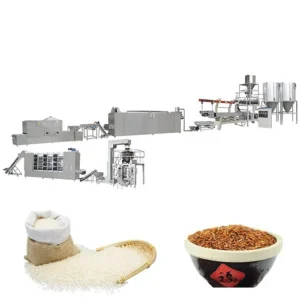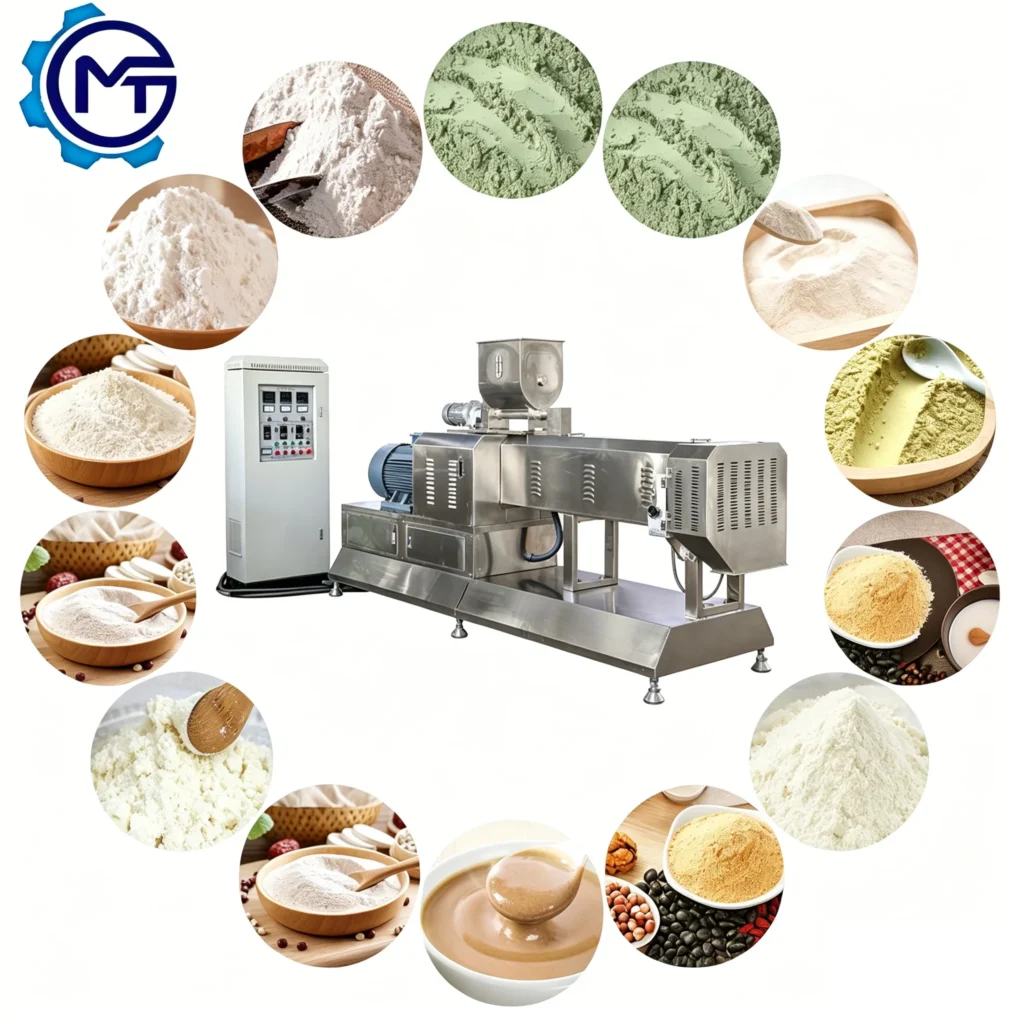


MT65 / MT70 / MT75 / MT85 Nutrition Powder Production Line, Twin-Screw Extrusion, 304 Stainless Steel Contact — engineered as a complete turnkey project from batching through extrusion to pulse grinding.
- Screw configuration and die design specified to your raw material formulation for consistent gelatinisation and density
- Line throughput calculated station-by-station to eliminate bottlenecks between mixer, extruder, dryer and grinder
- PLC and MCC control integrated across all stations for synchronized operation
Trial runs on your actual raw material are completed in our in-house testing workshop before shipment, so product development starts before installation — not after.
Description
Turnkey Line Engineering — Every station in this nutrition powder production line turnkey project is throughput-matched from batching through extrusion to pulse grinding, eliminating the capacity gaps that stall output at the bottleneck.
Technical Specifications
| Parameter | Value |
|---|---|
| Product Type | Nutrition Powder Production Line |
| Models Available | MT65 / MT70 / MT75 / MT85 |
| Installed Power | 84 kW (MT65) / 160 kW (MT70) / 190 kW (MT75) / 210 kW (MT85) |
| Power Consumption | 59 kW (MT65) / 120 kW (MT70) / 140 kW (MT75) / 150 kW (MT85) |
| Output Capacity | 120–150 kg/h (MT65) / 150–200 kg/h (MT70) / 200–250 kg/h (MT75) / 300–400 kg/h (MT85) (basis not stated in source — confirm raw material formulation and moisture content) |
| Overall Dimensions | 20,000 × 1,500 × 2,200 mm (MT65) to 25,000 × 1,500 × 3,500 mm (MT85) |
| Screw Type | Twin screw |
| Line Stations | Mixing → Screw Conveying → Extruding → Air Conveying → Drying → Air Conveyor → Pulse Grinder |
| Mixer Power Options | 4 kW / 7.5 kW / 15 kW |
| Mixer Batch Capacity | 20–30 kg / 70–80 kg / 170–180 kg per batch |
| Pulse Crusher Power | 11 kW |
| Pulse Crusher Capacity | Approx. 200 kg/h (basis not stated in source — confirm material and fineness requirement) |
| Voltage | 380V 50Hz Three Phase |
| Contact Material | 304 Stainless Steel |
| Drying Oven Fuel Options | Fuel, gas, or electricity |
| Standards | CE, ISO |
| Warranty | One year |
Application Suitability
| Application | Material or Output |
|---|---|
| Fortified nutrition powder | Grain-based blends with added vitamins and minerals for institutional feeding programmes |
| Baby food and infant cereal powder | Rice, oat, and corn formulations requiring full gelatinisation and fine grind |
| Modified and pregelatinised starch | Cassava, corn, or potato starch for food and industrial use |
| Therapeutic and functional food powder | High-protein or calorie-dense blends for clinical nutrition markets |
| Artificial rice production | Extruded rice-shaped pellets from broken rice or alternative grain flour |
Why Capacity Claims Fail When Raw Material Changes
Buyers often sign contracts based on a quoted output figure, only to discover that their actual grain formulation — higher protein, different moisture, coarser grind — cuts throughput dramatically. The extruder barrel fills differently, the screw shear is insufficient for full gelatinisation, and the dryer cannot keep up with the altered moisture profile leaving the die. A nutrition powder production line turnkey project must be validated against the buyer’s specific raw material before any capacity commitment is made. [NEED_CITE: twin-screw extrusion behaviour across varying starch and protein ratios]
I have seen this pattern repeat across infant cereal and fortified food projects. The buyer sends a sample of competitor product and expects the line to match that output on their own local grain supply. When the protein content runs higher than the sample, the dough viscosity inside the barrel rises, residence time increases, and the line chokes at a fraction of the promised rate.
Throughput Matching Across Every Station
A complete nutrition powder production line turnkey installation fails the moment one station runs slower than the rest. If the mixer batches every 20 minutes but the extruder consumes material every 15, the extruder starves. If the dryer holds less volume per hour than the extruder discharges, product piles up and degrades. Each model in the MT65 through MT85 range is configured so that mixer batch size, screw conveying rate, dryer belt area, and pulse grinder capacity all align to the same target output, removing the guesswork from line balancing.
Screw Configuration Specified to Your Formulation
Twin-screw extrusion for nutrition powder demands a screw profile matched to the exact ratio of starch to protein in the buyer’s recipe. A high-rice formulation needs a different compression ratio and kneading block arrangement than a soy-fortified blend. The die opening must then be sized so the extrudate exits at the correct expansion rate for downstream grinding. [NEED_CITE: screw element arrangement and die geometry in food extrusion] This is not a catalogue pick — it is calculated after reviewing the buyer’s material data sheet and confirmed through a trial run in the testing workshop.
Reading the Power and Dimension Data
The installed power range from 84 kW on the MT65 up to 210 kW on the MT85 reflects the motor and heater load required to process increasingly viscous doughs at higher throughputs. Power consumption figures sit roughly 30 percent below installed capacity, indicating the actual draw during steady-state running. Overall line length stretches from 20 metres to 25 metres depending on model, which dictates workshop floor planning well before installation day. The 304 stainless steel contact surfaces meet food-grade requirements for infant and therapeutic products, while the drying oven’s fuel flexibility — gas, liquid fuel, or electric — allows the line to match local utility costs and availability. [NEED_CITE: food contact material regulations for infant food processing equipment]
The Hidden Cost of Skipping the Trial Run
When a nutrition powder line ships without a prior trial on the buyer’s actual raw material, the first weeks of production become an expensive experiment. Screw combinations are swapped, die plates are re-ordered, and dryer temperatures are adjusted by trial and error while raw material is wasted and delivery deadlines slip. In one project I configured, a West African buyer’s local sorghum variety had a gelatinisation temperature several degrees higher than the maize we tested with. Without a pre-shipment trial, the extruder would have arrived producing undercooked, gritty powder until new heating zones and a revised screw profile were flown in — a delay measured in weeks, not hours. [NEED_CITE: gelatinisation temperature variation across grain cultivars]
What Makes This a Single-Source Turnkey Project
Every station from the 4–15 kW mixer through the 11 kW pulse grinder is supplied and integrated by one engineering team, so accountability for throughput sits in one place. Screw and die configurations are recorded per buyer formulation, not copied from a generic build. The in-house testing workshop runs the buyer’s raw material before the line leaves the factory, producing a trial report that documents actual output, texture, and gelatinisation degree. Electrical schematics are drawn with the destination voltage, frequency, and control language confirmed before panel fabrication. PLC and MCC control integration synchronises start-up and shutdown across the full line sequence, reducing the operator intervention needed during shift changes.
Documentation & Verification
- Line layout drawing showing station throughput balance for your target output
- Screw and die configuration record matched to your grain formulation
- Trial run report on your raw material before dispatch
- Electrical schematic with confirmed voltage, frequency, and panel language
- CE declaration of conformity and ISO certificate
- Operation and maintenance manual with wear parts list
Installation, Commissioning & Support
- Floor plan review against the 20–25 metre line length and 3,200–3,500 mm maximum height clearance
- Dedicated three-phase 380V 50Hz circuit sized for up to 210 kW installed load
- Modular station delivery with on-site assembly sequence and utility hook-up plan
- First-run parameter setting for screw speed, barrel temperatures, and dryer profile
- Operator training covering mixer loading sequence, extruder adjustment, and pulse grinder fineness control
- Wear parts list including screw segments and die plates with recommended replacement intervals
Before You Request a Quote
To configure a nutrition powder production line turnkey project that holds its rated output on your material, we need to know your base grain or flour type, protein and fat percentages, target moisture in the finished powder, and the fineness specification after grinding. Share your workshop length and ceiling height so the line layout fits before foundation work starts. Confirm your facility voltage and frequency, and tell us whether the control interface needs to run in a specific language for your operators.
Frequently Asked Questions
Q: How is throughput verified across all stations to prevent line bottlenecks?
A: Each station — mixer, extruder, dryer, and pulse grinder — is sized during the layout phase so its maximum capacity meets or slightly exceeds the extruder output on your formulation. A capacity calculation document shows the throughput at every station, and the trial run in our testing workshop confirms the numbers on your actual raw material before the line ships.
Q: Can a trial run be conducted on our specific raw material before shipment?
A: Yes. Send us a representative sample of your grain blend, and we run it through the configured extruder and dryer in our in-house testing workshop. The trial report documents output rate, product texture, gelatinisation degree, and any screw or die adjustments made, so you see real production data before accepting the equipment.
Q: What installation and commissioning support is included?
A: Our engineers travel to your site to oversee station assembly, utility connections, and first-run parameter setting. Operator training covers the full sequence from mixer loading through pulse grinder adjustment. A phased commissioning schedule is agreed before shipment so each station is validated before the next one starts.
Q: How are voltage and control system language confirmed for our facility?
A: During the specification stage we collect your facility voltage, frequency, and preferred control language. The electrical schematic and PLC programme are then built to those parameters, and the panel is tested at the factory before packing, so no rewiring or reprogramming is needed on arrival.
Q: What is the phased commissioning schedule and utility planning process?
A: We provide a utility requirement sheet listing power, water, compressed air, and fuel needs per station. Commissioning follows a sequence: mixer and conveyor dry-run, extruder heat-up and screw calibration, dryer temperature profiling, then integrated line running with your material. Each phase is signed off before the next begins.
Related products
-

Full Automatic Complete Baby Food Nutrition Powder Porridge Processing Production Line for Infant Nutrition Factory
¥9,500.00 Add to cart -
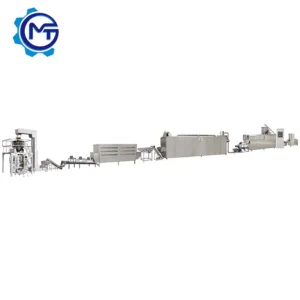
Automatic Nutritional Powder Making Machine Safe Rice Cereal for Babies
¥30.00 Select options This product has multiple variants. The options may be chosen on the product page -

High Precision Automatic 500kg/h Baby Food Nutrition Powder Rice Extrusion Processing Line
¥8,238.27 Add to cart -
High Productivity New Condition Nutritious Baby Food Meal Replacement Powder Production Line
¥30.00 Select options This product has multiple variants. The options may be chosen on the product page