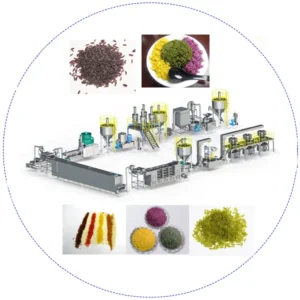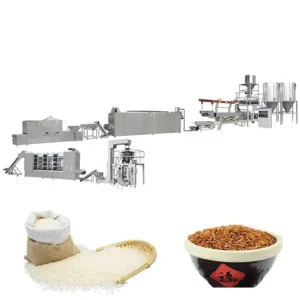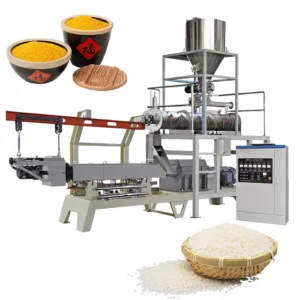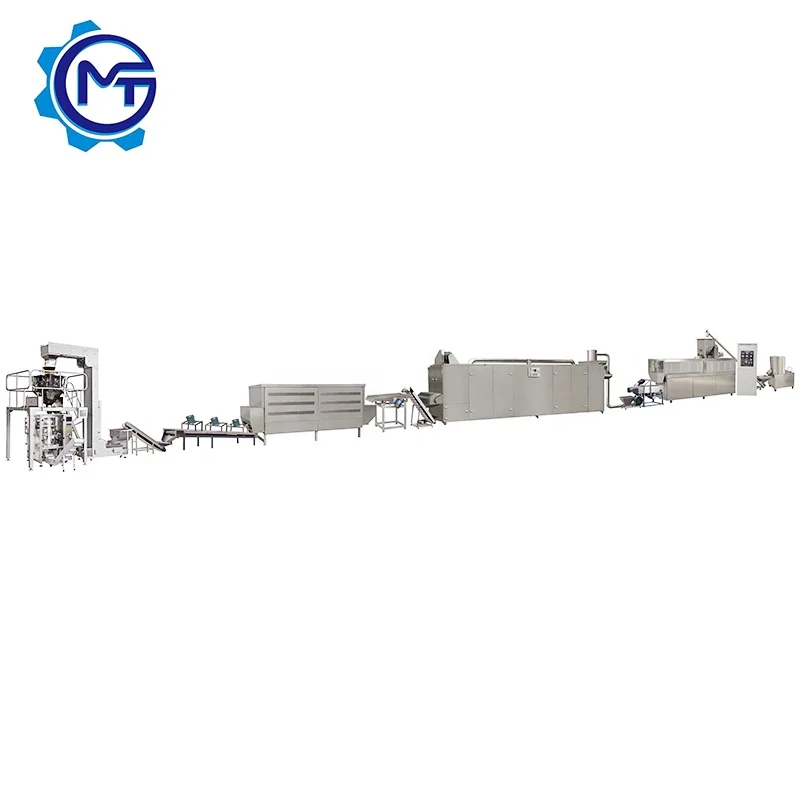


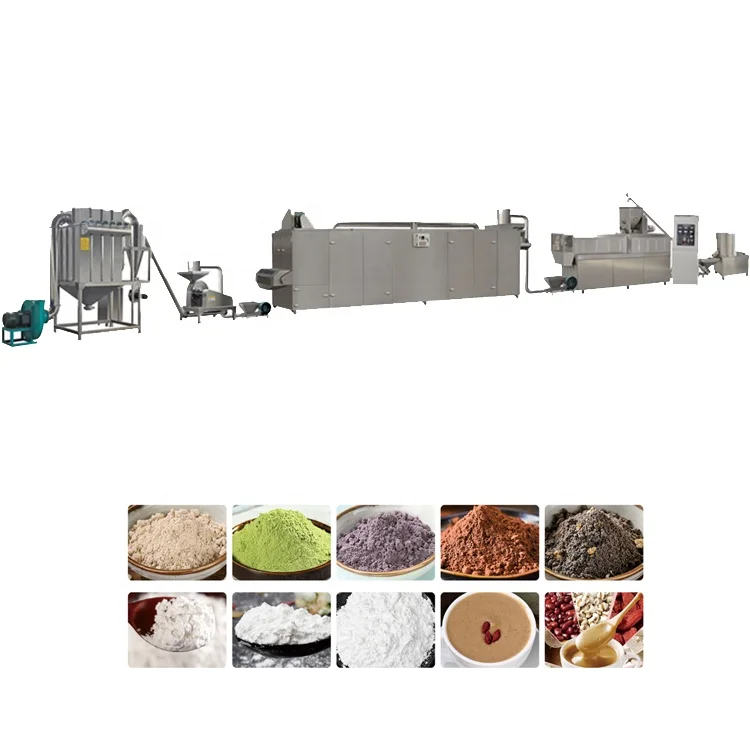


MT65 / MT70 / MT70C Nutritional Powder Processing Line, Twin-Screw Extrusion, PLC and MCC Control — engineered as a complete turnkey project from batching through extrusion, drying, milling to packing. Screw configuration and die design are specified to your grain formulation and target powder fineness, with throughput matched at every station to eliminate bottlenecks across the line.
- In-house testing workshop validates output on your raw material before shipment
- CE and ISO certified with full electrical schematic and voltage confirmation
- Phased on-site installation, commissioning and operator training included
Description
Throughput Matched End-to-End — Every station from batching to packing is sized against the same raw material baseline, so the extruder never waits on the dryer and the mill never chokes on the output.
Technical Specifications
| Parameter | Value |
|---|---|
| Product Type | Nutritional Powder Processing Line |
| Model | MT65 / MT70 / MT70C |
| Installed Power | 70 kW (MT65) / 90 kW (MT70) / 110 kW (MT70C) |
| Real Power Consumption | 40 kW (MT65) / 60 kW (MT70) / 90 kW (MT70C) |
| Output Capacity | 100–150 kg/h (MT65, basis to be confirmed with raw material and moisture content) |
| Output Capacity | 150–200 kg/h (MT70, basis to be confirmed with raw material and moisture content) |
| Output Capacity | 200–250 kg/h (MT70C, basis to be confirmed with raw material and moisture content) |
| Overall Dimensions (L×W×H) | 22000×1200×2200 mm (MT65) / 25000×1500×2200 mm (MT70) / 30000×3500×4300 mm (MT70C) |
| Extruder Type | Twin-screw |
| Control System | PLC and MCC automated control |
| Barrel Heating | High-temperature, high-pressure extrusion zones |
| Line Configuration | Mixing and batching → Twin-screw extrusion → Drying → Milling / Powder finishing → Packing |
| Assembly State | Complete turnkey production line |
| Certification | CE (since 2014), ISO certified |
Application Suitability
| Application | Material or Output |
|---|---|
| Infant rice cereal production | Rice flour, pregelatinised for instant reconstitution |
| Fortified baby food powder | Blends of wheat, corn, and rice flour with added micronutrients |
| Institutional nutrition programmes | Instant grain-based porridge powders for distribution |
| Pregelatinised nutritional starch | Wheat flour and corn flour processed for cold-water solubility |
| Dietary supplement base powder | Grain-derived carrier powders for blending with vitamins and minerals |
Why "250 kg/h" Means Nothing Without the Raw Material
The capacity number on the nameplate only holds when your grain formulation matches the test conditions.
A nutritional powder processing line turnkey quotation often leads with a headline output figure. In practice, that number was generated on a reference flour at a reference moisture level. Swap to a higher-fat formulation — the kind common in fortified baby food blends — and the extruder barrel behaves differently. Starch gelatinisation shifts, expansion drops, and the downstream dryer suddenly has a moisture load it was not sized for. I have watched a line stall for days because the supplier quoted capacity on standard rice flour while the buyer’s recipe carried noticeably more lipid content than the baseline. The entire line had to be re-profiled on site, costing weeks of downtime before a single saleable bag left the packing station [NEED_CITE: raw material variability and extrusion throughput correlation].
Phased Installation Across the Full Line Footprint
A complete nutritional powder processing line turnkey project involves more than dropping machines onto a factory floor. The MT65 footprint runs roughly 22 metres in length, while the MT70C extends to 30 metres with a wider cross-section for the larger drying and milling stations. Installation is sequenced so that foundation work, utility drops, and equipment rigging happen in logical stages — batching and mixing first, extrusion second, drying and finishing last. This phasing prevents the situation where one station sits idle waiting for another to be commissioned, and it keeps the buyer’s construction crew working in a predictable rhythm rather than scrambling across multiple zones simultaneously.
Starch Gelatinisation in Seconds, Not Hours
The twin-screw extruder applies high-temperature, high-pressure conditions that gelatinise raw grain starch within seconds of material entering the barrel. This rapid conversion is what gives instant nutritional powders their cold-water solubility and improved digestibility — essential attributes for infant rice cereal and fortified porridge products. The screw configuration and barrel zone profile are matched to the specific grain type and target powder fineness before the line ships. A line running predominantly corn flour needs a different compression ratio and residence time than one processing pure rice flour, and these parameters are locked in during the pre-shipment trial rather than guessed at during commissioning [NEED_CITE: twin-screw extrusion starch gelatinisation mechanisms].
Reading the Spec Sheet Against Your Actual Production Target
The installed power spread across the three models — 70 kW for the MT65, 90 kW for the MT70, and 110 kW for the MT70C — reflects the increasing mechanical and thermal demand of higher-throughput configurations. Real power consumption sits lower at 40 kW, 60 kW, and 90 kW respectively, which is the figure that matters for utility planning and transformer sizing. The PLC and MCC control architecture governs every station from the batching hopper through the packing conveyor, maintaining consistent powder particle size and moisture content across production runs. For buyers comparing models, the dimensional jump from the MT65 to the MT70C is significant: ceiling height and floor area requirements differ substantially, and the larger line demands a dedicated electrical circuit sized for continuous load rather than peak draw.
The Bottleneck That Hides in the Dryer
When an extruder is specified without matching the dryer capacity to the actual moisture load of the buyer’s formulation, the result is a line that physically cannot sustain its quoted output. Wet product piles up ahead of the dryer, operators slow the extruder to compensate, and the effective throughput drops well below what was promised. This mismatch is one of the most common reasons a nutritional powder processing line turnkey installation underperforms in its first months. The drying station must be sized not to the extruder’s theoretical output but to the specific moisture differential between extrudate and target powder — a calculation that requires knowing the buyer’s raw material and recipe before the line is built [NEED_CITE: extrusion line throughput bottleneck causes].
What One-Supplier Line Responsibility Actually Looks Like
Screw configuration and die design are specified to the buyer’s raw material and target powder fineness, not copied from a generic build that may not suit a high-fat infant cereal blend. Every station — mixing, extrusion, drying, milling, packing — is sourced and matched by a single supplier, eliminating the finger-pointing that occurs when separate vendors supply mismatched equipment. An in-house testing workshop runs the buyer’s actual grain formulation before the line ships, generating a trial run report that confirms output and powder quality under real conditions. Pre-sales engineering covers line layout, utility planning, and capacity calculation rather than stopping at a catalogue quotation. On-site installation, commissioning, and operator training are delivered by the same team that configured the line, so knowledge transfers directly from factory testing to production floor.
Documentation & Verification
- Line layout and capacity calculation specifying throughput at each station against your grain formulation
- Screw and die configuration record matched to your target powder particle size and grain type
- Trial run report on your raw material generated in the testing workshop before dispatch
- Electrical schematic with voltage, frequency, and control language confirmed before production
- CE declaration of conformity and ISO certificate included with shipping documentation
- Wear parts list covering screws, dies, and barrel liners with replacement intervals
Installation, Commissioning & Support
- Foundation plan accounts for the full line length up to 30 metres and floor load at each station
- Dedicated electrical circuit sized to real power draw of up to 90 kW for the MT70C configuration
- Equipment arrives in modular sections for phased rigging and sequential station commissioning
- PLC and MCC parameters are set during the pre-shipment trial and verified again on site at startup
- Operator training covers extruder barrel temperature profiles, screw speed adjustments, and dryer moisture targets
- Spare screws, dies, and barrel liners shipped with the line for the first scheduled maintenance cycle
What We Need to Quote Accurately
To configure a nutritional powder processing line turnkey project that holds its capacity on your specific product, we need your grain formulation and target moisture content, the daily or shift-based output you plan to sustain, and the voltage and frequency standard at your facility. If your recipe includes added fats, dairy powders, or micronutrient premixes, share the full ingredient list — these components change extrusion behaviour in ways that standard rice flour trials do not reveal.
Frequently Asked Questions
Q: How is line capacity verified against my specific grain formulation and moisture content?
A: Your raw material is run through the twin-screw extruder in our testing workshop before the line ships. We measure actual output, powder moisture, and particle size against your target specification. The trial run report documents these results, and any screw or die adjustments needed are made at that stage — not after the line arrives at your facility.
Q: How do you match throughput between the extruder, dryer, and powder finishing stations?
A: Each station is sized based on the moisture differential and particle size target specific to your formulation, not on a generic capacity table. The dryer is specified to handle the actual water load leaving the extruder, and the milling station is matched to the dried product’s hardness and target mesh size, so no single station constrains the others.
Q: What is included in the pre-shipment trial run, and can I supply my own raw material?
A: You send your grain formulation to our testing workshop, and we run it through the configured extruder and downstream stations. The trial produces a documented report covering output rate, powder fineness, moisture content, and any parameter adjustments. This eliminates the scenario where product development only begins after installation.
Q: What voltage, frequency, and control language options are confirmed before production?
A: Your facility’s electrical standard is confirmed during the specification stage, and the PLC and MCC cabinets are wired accordingly. Control panel language is set to match your operators’ requirements. The electrical schematic is provided for review before production starts, so there are no surprises when the cabinets are energised on site.
Q: How is on-site installation phased, and what operator training is provided during commissioning?
A: Installation follows a sequenced plan — batching and mixing first, then extrusion, then drying and finishing — so utility connections and rigging proceed without cross-traffic. Commissioning includes hands-on training for your operators on PLC interface navigation, barrel temperature adjustment, screw speed tuning, and routine wear part replacement using the spare parts shipped with the line.
Related products
-
Healthy Baby Food Production Line Nutritional Powder Equipment for Baby Food Supplements for Flour Processing Machinery
¥8,500.00 Select options This product has multiple variants. The options may be chosen on the product page -

Automatic Instant Powder Production Line Nutritional Powder Extruder Machine
¥10,000.00 Select options This product has multiple variants. The options may be chosen on the product page -

High Quality Automatic PLC Controlled 500kg/h Twin Screw Extruder Machine for Baby Rice Nutrition Powder
¥8,238.27 Add to cart -

New Automatic Nutritional Powder Making Machine for Baby Food Production Line
¥20.00 Select options This product has multiple variants. The options may be chosen on the product page