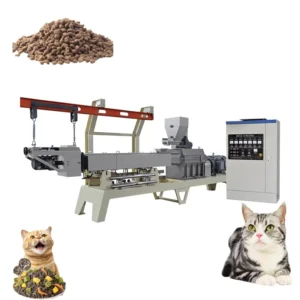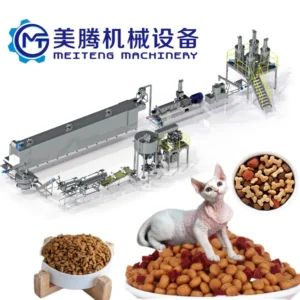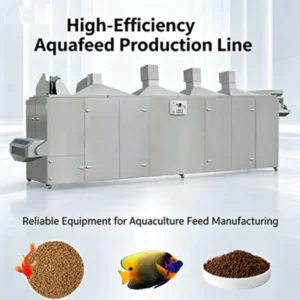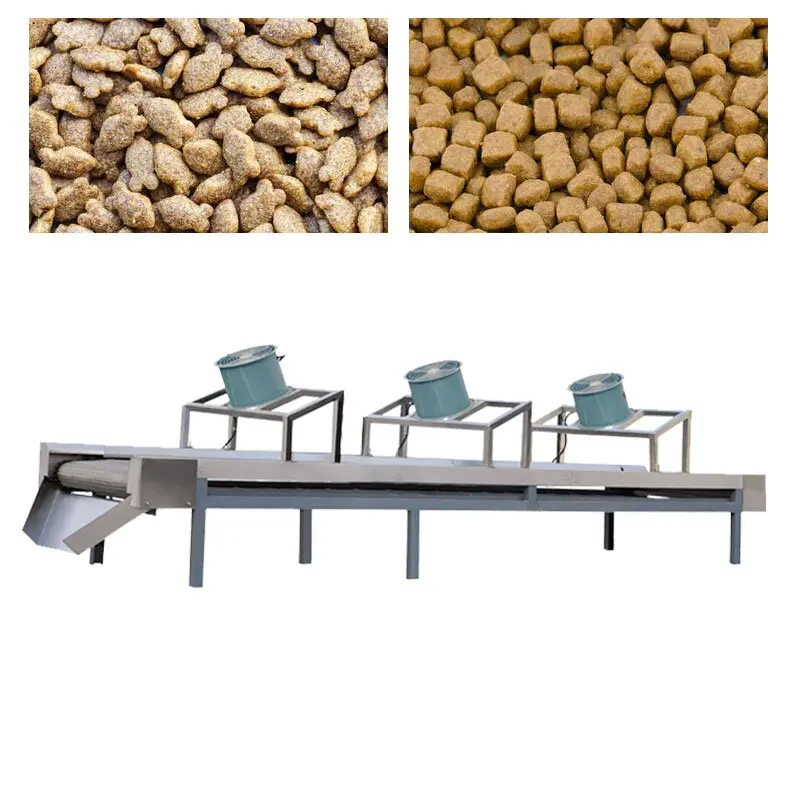


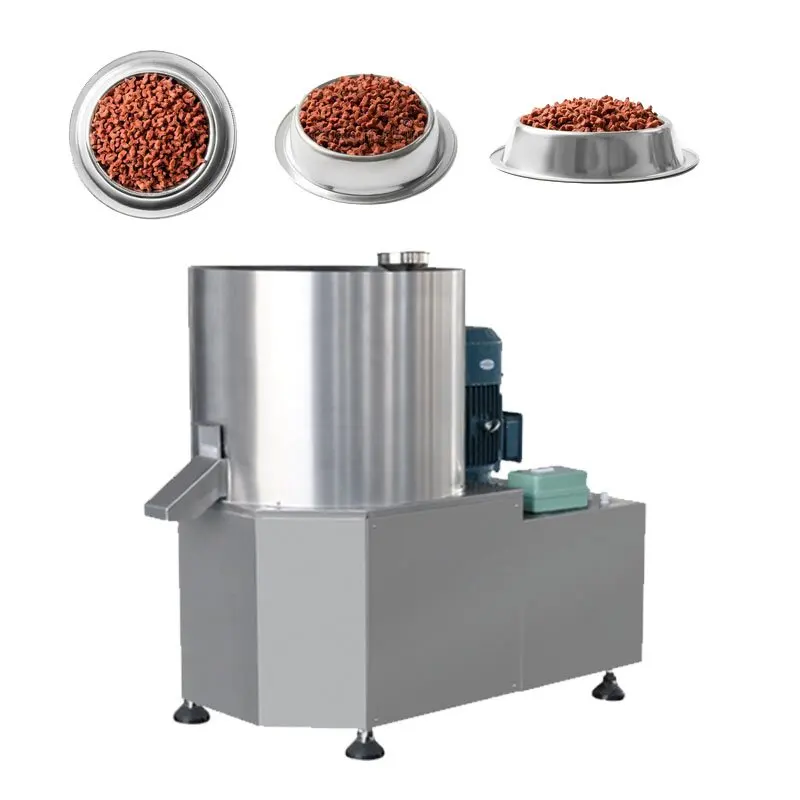

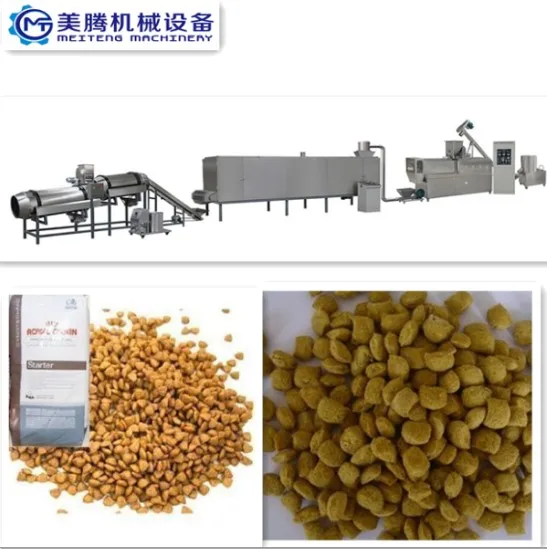
Turnkey Pet Food Extrusion Production Line, Twin Screw, Up to 3 Tons/Hour — engineered for dry kibble and aquatic feed applications with matched throughput across every station from batching to packing.
- Screw configuration and die design specified to your raw material formulation and target pellet density or buoyancy
- PLC and MCC automated control ensures consistent process parameters throughout extrusion, drying, flavouring, and cooling stages
Complete line capacity verified through in-house trial runs on your actual raw material before shipment, with full documentation including layout, electrical schematics, and screw configuration records.
Description
Throughput-Matched Line Design — Every station from batching to packing is sized against the extruder’s actual output on your raw material, not assembled from standalone catalogs.
Technical Specifications
| Parameter | Value |
|---|---|
| Product Type | Twin Screw Pet Food Extrusion Production Line |
| Screw Configuration | Twin Screw |
| Process Control | PLC and MCC automated control |
| Output Capacity | up to 3 tons per hour (basis not stated in source — confirm raw material formulation, moisture content, and pellet size) |
| Target Products | Dry pet food kibble, floating and sinking aquatic feed pellets |
| Line Stations Included | Mixing, extrusion, drying, flavouring, coating, cooling, packing |
| Food Contact Materials | Food-grade throughout |
| Warranty | 1 year |
Application Suitability
| Application | Material or Output |
|---|---|
| Dry dog and cat kibble production | Corn, wheat, rice, meat meal, bone meal, fish meal blends |
| Floating aquatic feed for tilapia and catfish | Grain and protein concentrates formulated for buoyancy |
| Sinking aquatic feed for shrimp and bottom-feeders | High-protein formulations requiring controlled density |
| Grain-based extruded treats and snacks | Cereal grains, starches, and flavouring additives |
What "Nominal Capacity" Really Means on a Pet Food Extrusion Line
A line rated on clean grain will choke on a high-meat-meal recipe unless the screw configuration is matched to your actual formulation before the contract is signed.
I spent years on the procurement side before moving to the seller’s seat, and the most uncomfortable meeting I ever sat through was a commissioning review where a fully automatic pet food extrusion production line turnkey installation was producing roughly half its nameplate output. The client had specified a high meat-meal inclusion rate, but the screw profile had been configured for a standard corn-based recipe. The extruder simply could not convey the denser, stickier mix at the rated feed speed. No one had run a trial on the client’s actual raw material before the line shipped [NEED_CITE: common causes of extrusion line underperformance at commissioning]. That single failure reshaped how I evaluate every subsequent project — capacity claims mean nothing without a raw material context.
How Screw and Die Configuration Define Your Kibble
The twin-screw assembly is where your recipe meets mechanical shear, and the combination of screw element spacing, barrel temperature zones, and die geometry determines whether the kibble exits at the density your market expects. A pet food extrusion production line turnkey package must specify these elements against your target product — floating pellet, sinking pellet, or crunchy kibble — rather than defaulting to a generic build. Changing the die orifice diameter or the screw pitch after installation is possible, but it costs production days and rarely matches the consistency of a configuration validated at the factory.
Why Downstream Stations Must Be Sized Together
An extruder running at full output is worthless if the dryer cannot remove moisture fast enough or the coating drum cannot tumble the volume without spillage. Each station in this line — mixing, conveying, drying, flavouring, cooling, and packing — is calculated against the extruder’s real throughput on your recipe, so the bottleneck never shifts downstream [NEED_CITE: throughput balancing methodology in continuous extrusion lines]. This is the difference between a line assembled from separate vendor catalogs and a single-supplier layout where every belt speed, dryer bed area, and drum volume is documented in the capacity calculation before steel is cut.
Reading the Specs That Matter for Pet Food and Aquatic Feed
The twin-screw designation means the machine can handle a wider range of raw material viscosities than a single-screw unit, which is critical when formulations shift between high-starch kibble and high-protein aquatic pellets. Moisture content at the barrel inlet directly influences expansion ratio and final pellet density — a variable that PLC control manages by regulating steam and water injection across production runs. The included fish feed process drawing documents the temperature and moisture profile at each barrel zone, giving your process engineers a baseline to adjust when switching between floating and sinking formulations. Food-grade contact materials throughout the wetted path are non-negotiable for pet food export markets where sanitation audits are part of the buyer qualification [NEED_CITE: food contact material compliance for extruded feed equipment].
The Hidden Cost of Skipping the Trial Run
When a line ships without a factory trial on the buyer’s raw material, the first week of installation becomes an expensive product development exercise. Screw elements are swapped, die plates are re-ordered, and dryer temperatures are guessed at while the client’s launch deadline slips. I have watched commissioning timelines stretch well beyond the original schedule because the formulation behaviour — gelatinisation point, expansion ratio, moisture migration in the dryer — had never been characterised before the machine left the workshop.
Why Buyers Source This Line Here
Every station is supplied under one contract, which means throughput accountability sits with a single entity rather than fragmented across equipment vendors. The in-house testing workshop allows trial runs on your raw material before shipment, producing a documented report that travels with the line. Screw and die configurations are recorded against your specific recipe, not copied from a standard template. PLC and MCC controls are programmed in the language and voltage standard of your facility before dispatch. The project scope includes layout design, installation supervision, commissioning, and operator training, so the line is handed over as a functioning process, not a collection of crated machines [NEED_CITE: scope boundaries in turnkey feed line contracts].
Documentation & Verification
- Line layout and capacity calculation matching every station to your confirmed formulation
- Screw and die configuration record tied to your raw material and target pellet density
- Trial run report on your raw material conducted in the testing workshop before shipment
- Electrical schematic with voltage and frequency confirmed to your local grid standard
- CE declaration of conformity and ISO certificate for customs and regulatory filing
- Operation, maintenance manual, and wear parts list provided at delivery
Installation, Commissioning & Support
- Foundation plan accounts for the extruder’s operating mass and vibration isolation requirements
- Dedicated electrical circuit sized to the PLC and MCC panel’s confirmed power draw
- Line arrives in sectional modules for assembly in facilities with standard bay clearances
- First-run parameter setting covers barrel temperature, screw speed, and moisture injection on your recipe
- Operator training addresses screw changeover, die cleaning, and dryer belt tension adjustment
- Wear parts list identifies screws, dies, and seals with reorder intervals from the trial run data
What to Prepare Before Requesting a Quotation
To size a pet food extrusion production line turnkey package accurately, we need your target product format, the raw material formulation with typical moisture content, and the daily or hourly production target. Confirm the voltage and frequency at your facility, the control language your operators require, and whether you can ship a sample batch of raw material for a pre-shipment trial run.
Frequently Asked Questions
Q: How is line capacity verified against my raw material and recipe?
A: Capacity is verified through a trial run in the testing workshop using your actual raw material or a close proxy. The extruder’s output is measured at steady state, and downstream stations are then confirmed or resized against that measured throughput before the final layout is released for fabrication.
Q: What screw and die configuration will be used for my target kibble or pellet?
A: The screw element arrangement and die plate geometry are specified after reviewing your formulation’s starch-to-protein ratio, moisture content, and the target pellet density or kibble crunch. The configuration is recorded in the documentation package so replacements match the original profile exactly.
Q: Can a trial run be conducted on my raw material before the line ships?
A: Yes. The in-house testing workshop is equipped to run your raw material through a representative twin-screw extruder. The trial produces a report covering output rate, pellet density, expansion behaviour, and recommended dryer settings, all of which are shared before the line leaves the factory.
Q: How are downstream stations sized to match the extruder’s real output?
A: Each downstream station — dryer, coater, cooler, packing line — is selected based on the extruder’s measured throughput from the trial run, not on a nominal catalog figure. Belt speeds, dryer bed area, and drum volume are documented in the capacity calculation so no station becomes a bottleneck.
Q: What does the commissioning scope include once the line arrives?
A: Commissioning covers mechanical assembly supervision, electrical connection verification, PLC parameter loading, first-run production on your raw material, and operator training on daily operation and screw changeover. A wear parts list with reorder intervals from the trial run is provided at handover.
Related products
-
Premium Pet Food Processing Equipment Dog Cat Feed Making Machine
¥9,500.00 Select options This product has multiple variants. The options may be chosen on the product page -
1.0-1.2t/h High Capacity Multi-Species Fish Feed Processing Line to Produce Fish Food
¥45,000.00 Select options This product has multiple variants. The options may be chosen on the product page -
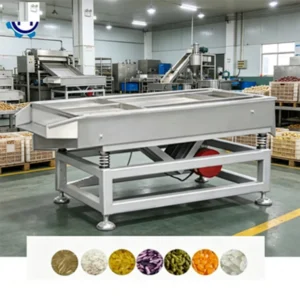
Energy Saving Automatic Twin Screw Extruder Floating Sinking Aquatic Fish Feed Industrial Production Processing Line
¥65.00 Select options This product has multiple variants. The options may be chosen on the product page -
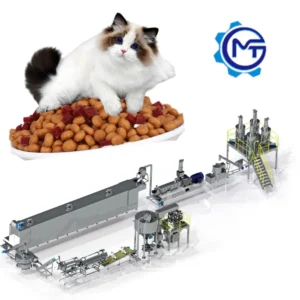
MT70 200-250kg/h Dog Cat Pet Food Processing Line 380V 50HZ Three Phase 45KW
¥35,000.00 Select options This product has multiple variants. The options may be chosen on the product page