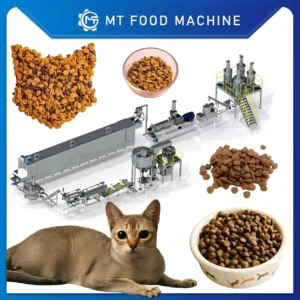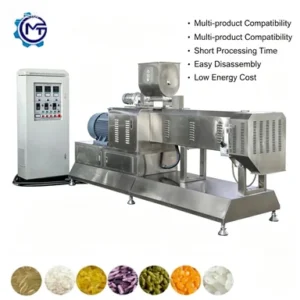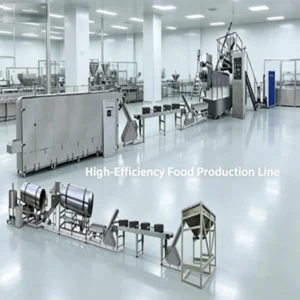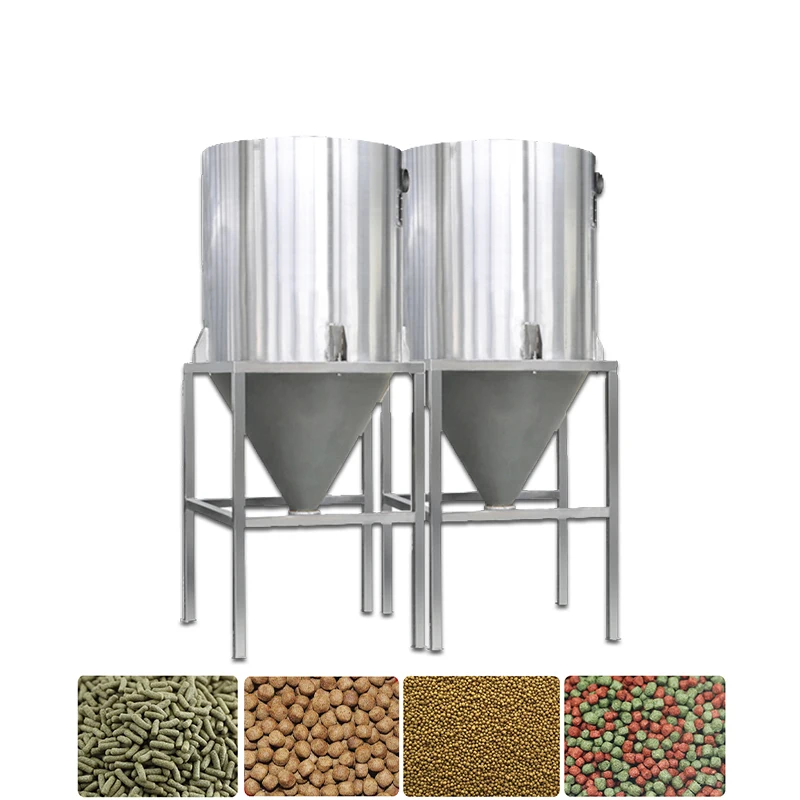

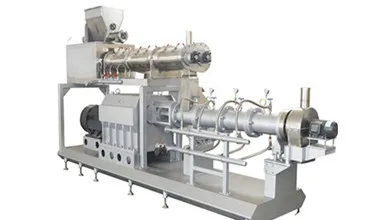

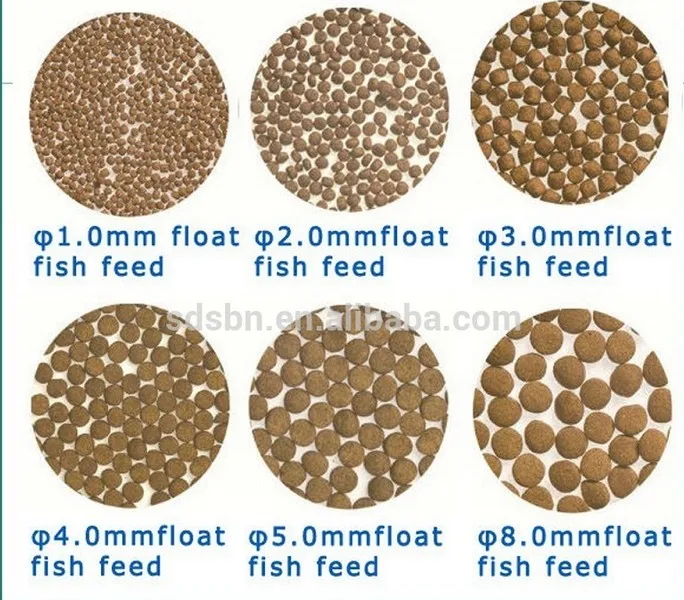
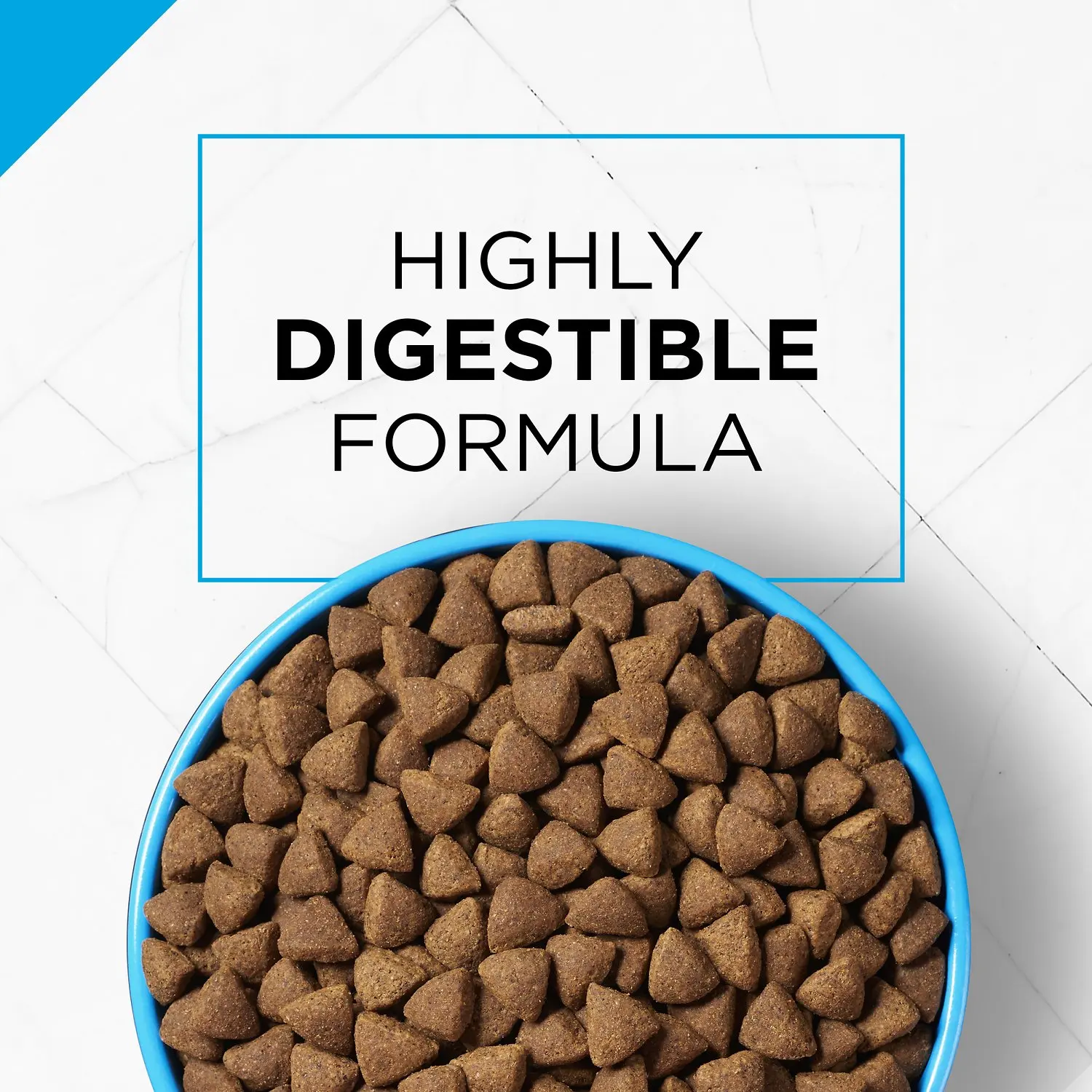
Pet Food Production Line, Up to 3 Tons/Hour Output, Dry Kibble & Aquatic Feed — engineered as a turnkey extrusion project where layout, throughput matching between stations, utility planning, and phased commissioning are managed under one responsible supplier. Screw configuration and die design are specified to your raw material and target kibble density, with in-house trial runs validating output before shipment.
- Throughput-matched stations from batching through extrusion, drying, coating, and packing
- PLC and MCC automated control for consistent process parameters
- Trial run on customer raw material completed before dispatch
- Electrical schematic with voltage and frequency confirmed for your market
Description
Throughput-Matched Line Design — every station from batching to packing is sized against the buyer’s actual recipe, so the extruder never waits on a dryer or a coater falls behind.
Technical Specifications
| Parameter | Value |
|---|---|
| Product Type | Pet Food Extrusion Production Line |
| Applications | Dry dog and cat kibble; floating and sinking fish feed |
| Output Capacity | Up to 3 tons per hour (basis not stated in source — confirm raw material, moisture content, and product format) |
| Warranty | 1 year |
| Process Documentation | Fish feed process drawing included |
| Control System | Available with PLC and MCC control (confirm scope) |
| Screw Type | Single or twin screw (specify based on formulation) |
| Voltage & Frequency | Configurable to target market (basis to be confirmed) |
| Line Stations | Mixing, extrusion, drying, flavouring, coating, cooling, packing (scope to be confirmed) |
Application Suitability
| Application | Material or Output |
|---|---|
| Dry dog kibble production | Corn, wheat, rice, meat meal, poultry by-product meal, fats, and vitamin premix |
| Dry cat kibble production | Higher-protein blends with fish meal, chicken meal, taurine premix, and animal fats |
| Floating fish feed | Soybean meal, fish meal, wheat flour, and starch binders requiring controlled buoyancy |
| Sinking fish feed | Denser formulations for bottom-feeding species with adjusted starch gelatinisation |
Why Your Quoted Capacity May Not Survive Your Own Recipe
A rated output only matters if it was measured on material that resembles yours.
I remember a project in the Middle East where the client ordered a pet feed line based on a headline capacity number. Their recipe leaned heavily on fish meal and added fat well above typical ranges. The screws could not feed cleanly, and real output dropped to roughly half of what was on the quotation. The fix was not a bigger motor — it was a screw profile and die geometry matched to a high-fat, high-protein mix. That pet food production line turnkey lesson stuck with me: always verify capacity on the buyer’s actual recipe before the metal is cut [NEED_CITE: extrusion throughput variance across raw material compositions].
Matching Every Station to the Real Recipe
A pet food production line turnkey project fails the moment one station runs faster than the next. The extruder may push product into a dryer that cannot remove enough moisture in the residence time available, forcing the operator to slow the whole line down. We size the dryer belt area, the flavouring drum volume, and the cooler length against the specific moisture curve and kibble density that your recipe produces, not against a generic throughput table.
Trial Runs Before the Crate Is Nailed Shut
Our testing workshop runs your actual raw material through the configured screw and die set before the line ships. The goal is a trial report that documents real output, kibble density, expansion ratio, and moisture at the dryer exit. If the numbers miss your target, we adjust screw elements or die land length at the factory — not on your floor with a production deadline breathing down your neck [NEED_CITE: pre-shipment extrusion trial protocols for food machinery].
Reading the Specs That Actually Matter
Screw type determines how well the line handles fibrous or high-fat ingredients: a twin-screw setup self-wipes and tolerates wider formulation swings, while a single-screw design suits simpler, starch-rich recipes. Die geometry and land length control kibble shape and expansion, which directly affects bulk density and the bag fill weight the market expects. Moisture at the preconditioner and barrel temperature profile govern starch gelatinisation; under-cooked kibble crumbles in the coating drum, while over-cooked kibble loses palatability. PLC and MCC control keeps these variables locked across shifts, so the tenth batch of the day matches the first.
The Cost of Skipping the Configuration Conversation
Buyers who treat the extruder as a standalone purchase often discover downstream problems only after commissioning. A dryer sized for a lighter recipe cannot pull enough moisture from dense, meat-heavy kibble, leaving the coating drum to handle wet product that clumps seasoning unevenly. A cooler that is too short lets residual heat trigger condensation inside the bag, inviting mould within weeks. Every one of these failures traces back to a line that was quoted on nominal capacity instead of real formulation [NEED_CITE: downstream bottlenecks in extrusion-based food lines].
Why Source the Full Line Here
We design the entire pet food production line turnkey scope under one responsibility, so the extruder output, dryer capacity, and coating drum volume are calculated together rather than negotiated with three separate vendors. Screw and die configurations are specified against your raw material data sheet, not copied from a catalogue build. The testing workshop gives you a signed trial report before the line leaves Jinan. Documentation arrives complete — from line layout drawings to electrical schematics matched to your local voltage. After installation, our team stays through operator training and the first production runs.
Documentation & Verification
- Line layout and capacity calculation based on your raw material and recipe
- Screw and die configuration record matched to target kibble density
- Trial run report on your raw material generated before shipment
- Electrical schematic with voltage and frequency confirmed for your market
- Wear parts list with recommended first-order quantities included at dispatch
Installation, Commissioning & Support
- Foundation plan accounts for extruder weight and dryer belt length
- Dedicated circuit sized to confirmed motor and heating loads
- Line arrives in numbered modules for sequenced uncrating and assembly
- First-run parameter setting covers barrel zones, screw speed, and die pressure
- Operator training addresses recipe changeover and screw cleaning procedures
- Wear parts inventory covers screws, dies, and cutter blades for the initial run
What We Need to Quote the Right Line
Send your target product format — kibble shape, size range, and whether you need floating or sinking aquatic feed. Include a raw material breakdown with protein, fat, and starch percentages, plus the local voltage and frequency. If you have an existing mixer or packing system that must integrate, share the model and throughput so we can match the upstream and downstream interfaces.
Frequently Asked Questions
Q: How is the line capacity verified against my actual raw material and recipe?
A: We run your raw material in our testing workshop with the configured screw and die set. The resulting trial report documents real output, kibble density, expansion ratio, and moisture levels. If the numbers fall short, we adjust the screw profile or die geometry before the line ships, so capacity is verified on your formulation — not a generic benchmark.
Q: How do you ensure throughput is matched between the extruder, dryer, and coating stations?
A: Each station is sized using your recipe’s moisture curve and target kibble density. The dryer belt area, flavouring drum volume, and cooler length are all calculated against the extruder’s verified output on your material. This prevents the common situation where one station forces the entire line to slow down.
Q: Can a trial run be done on my raw material before the line ships?
A: Yes. Our in-house testing workshop performs production trials using your supplied raw material and the exact screw and die configuration planned for your line. You receive a signed trial report covering throughput, product density, expansion, and moisture data, giving you confidence before the equipment leaves the factory.
Q: What voltage, frequency, and control language options are confirmed before production?
A: We collect your site electrical specification — voltage, phase, frequency, and plug standard — before the electrical schematic is finalised. Control language and HMI text are set to your preference so operators can navigate recipes and alarms in their working language from day one.
Q: What does on-site installation, commissioning, and operator training include?
A: Our engineers supervise uncrating, module assembly, and utility connections. Commissioning covers barrel temperature profiling, screw speed tuning, and die pressure checks across your recipe range. Operator training addresses daily start-up, recipe changeover, screw and die cleaning, and wear-part replacement procedures so your team runs independently after handover.
Related products
-
4-5t/h High Capacity Multi-Species Fish Feed Processing Line to Produce Fish Food
¥65,000.00 Select options This product has multiple variants. The options may be chosen on the product page -
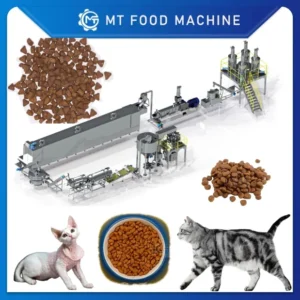
MT100 Brand 1.5-2.0t/h PLC Controlled Multi-Species Cat Food Processing Line
¥45,000.00 Select options This product has multiple variants. The options may be chosen on the product page -
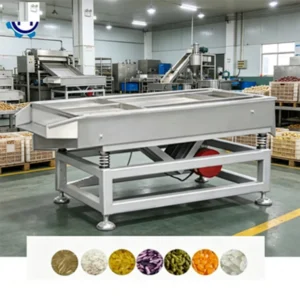
Energy Saving Automatic Twin Screw Extruder Floating Sinking Aquatic Fish Feed Industrial Production Processing Line
¥65.00 Select options This product has multiple variants. The options may be chosen on the product page -
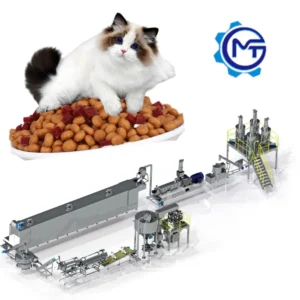
MT70 200-250kg/h Dog Cat Pet Food Processing Line 380V 50HZ Three Phase 45KW
¥35,000.00 Select options This product has multiple variants. The options may be chosen on the product page