

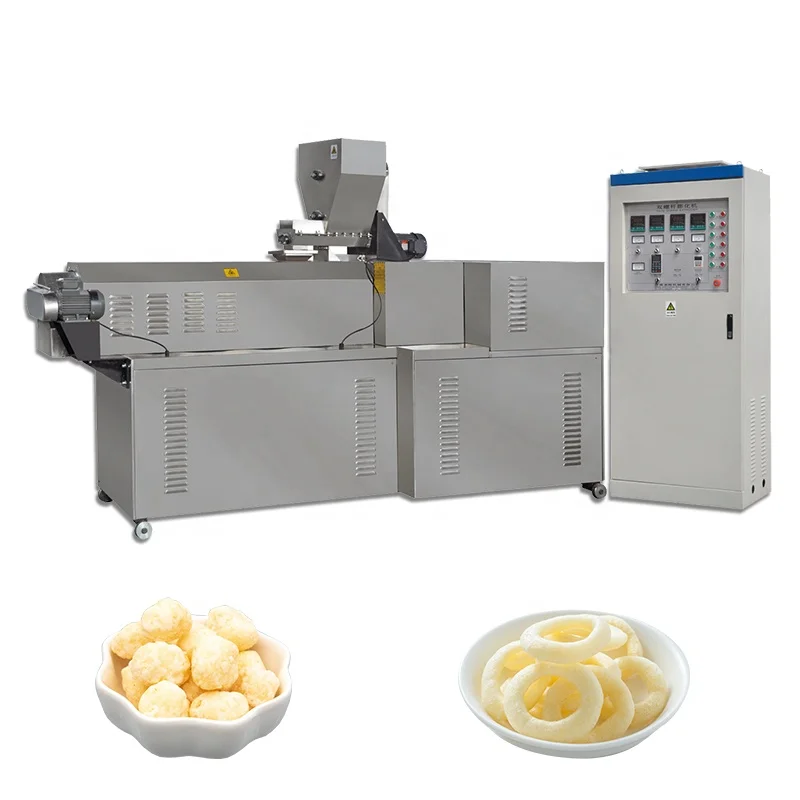
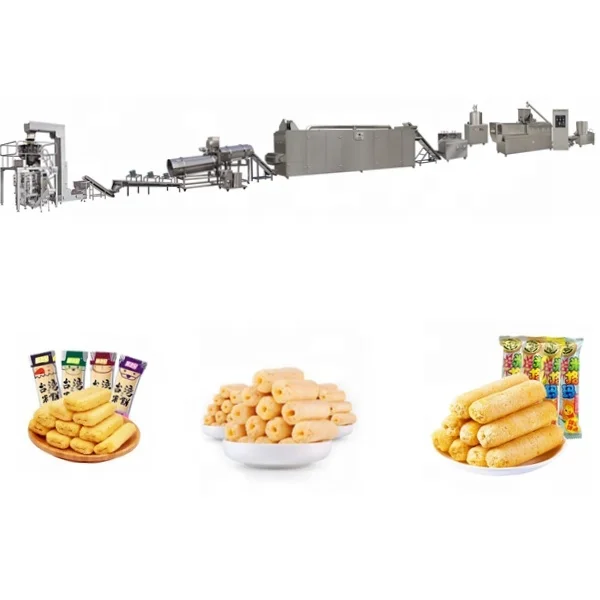
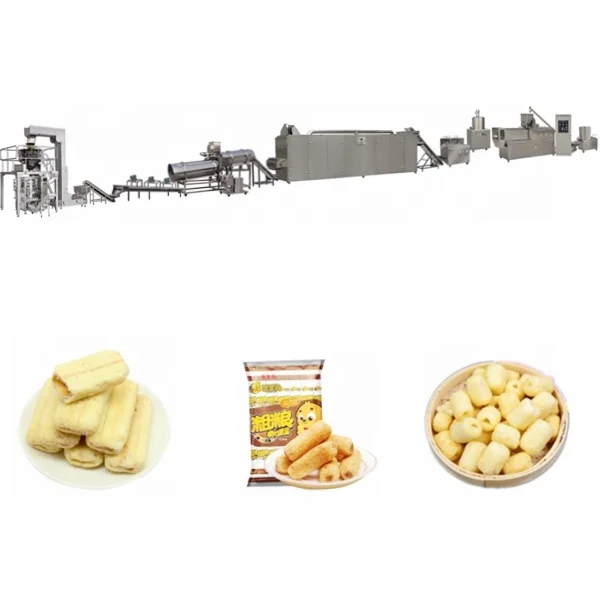
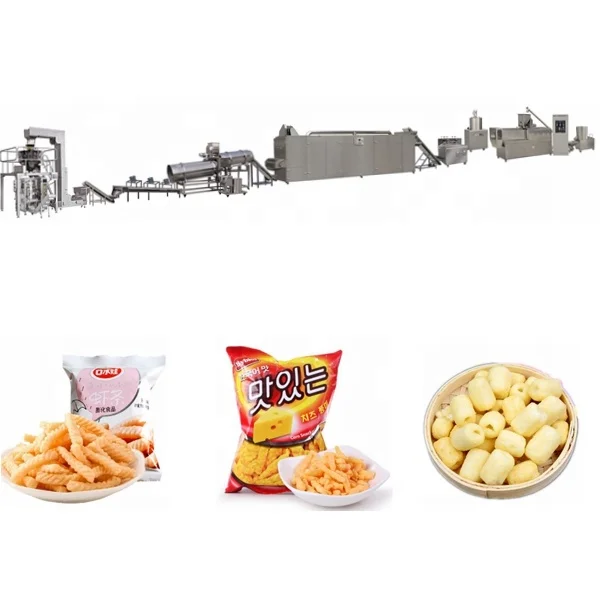
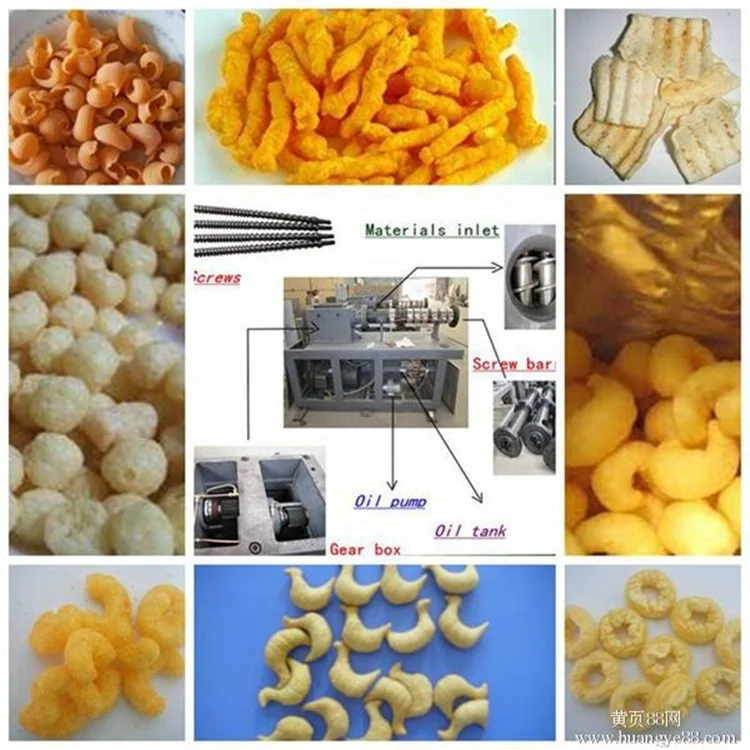
MT70 / MT85 / MT75 Twin Screw Corn Puff Snack Extrusion Line, 130–220 kW, Gas or Electric Dryer — configured as a complete turnkey project from batching through extrusion, drying, coating and packing, with every station throughput-matched to eliminate bottlenecks. Interchangeable dies enable quick changeover across ball, tube, ring and shaped puff formats on corn, rice or wheat flour blends.
- Screw configuration and die design specified to buyer’s raw material and target texture
- In-house trial runs on customer-supplied raw material before shipment
- Line layout and capacity calculation documented per buyer’s actual production conditions
Description
Throughput-Matched Integration — every station from batching to packing is specified as one coordinated system, eliminating the dryer and coater bottlenecks that typically appear when a turnkey corn puff snack extrusion line is assembled from separate vendors.
Technical Specifications
| Parameter | Value |
|---|---|
| Model | MT70 / MT85 / MT75 |
| Product Type | Twin Screw Corn Puff Snack Extrusion Line |
| Screw Type | Twin Screw |
| Rated Power (MT70) | 130 kW |
| Rated Power (MT85) | 180 kW |
| Rated Power (MT75) | 220 kW |
| Power Consumption (MT70) | 95 kW |
| Power Consumption (MT85) | 120 kW |
| Power Consumption (MT75) | 130 kW |
| Output Capacity (MT70) | 100–120 kg/h (basis not stated in source — confirm raw material type and moisture content) |
| Output Capacity (MT85) | 200–300 kg/h (basis not stated in source — confirm raw material type and moisture content) |
| Output Capacity (MT75) | 300–500 kg/h (basis not stated in source — confirm raw material type and moisture content) |
| Overall Dimensions (MT70) | 21 × 1.5 × 2.2 m |
| Overall Dimensions (MT85) | 25 × 1.5 × 2.2 m |
| Overall Dimensions (MT75) | 28 × 1.5 × 2.2 m |
| Line Stations | Mixing → Extruding → Drying → Sugar Coating / Flavouring → Cooling → Packing |
| Dryer Heating Source | Gas or Electric |
| Die Configuration | Interchangeable moulds (ball, tube, stick, ring, fruit loop, star, wheel, flower, heart) |
| Assembly State | Complete turnkey line from batching to packing |
| Certification | CE, ISO (certificate scope to be verified for this line configuration) |
Application Suitability
| Application | Material or Output |
|---|---|
| Cheese ball and ring production | Corn flour, rice flour with cheese powder coating |
| Fruit loop and shaped puff manufacturing | Wheat flour, oat flour with sugar coating |
| Tube and stick snack processing | Corn grits, barley flour with seasoning blends |
| Fried-style puffed snack formats (Nik Naks, Cheetos, Kurkure profiles) | Corn meal, rice meal with oil and flavour application |
| Multi-shape snack line changeover | Single line producing ball, star, wheel and heart formats via die swap |
Why "Rated Capacity" Without a Material Baseline Misleads Buyers
A turnkey corn puff snack extrusion line should never be quoted on a capacity number detached from the buyer’s actual raw material and moisture content.
I have watched snack producers install a line that hit its rated output during the factory test on corn grits, only to discover their local corn flour blend ran noticeably slower because of different starch gelatinisation behaviour. The extruder was not the problem — the mismatch between the quoted basis and the production reality was. Before any capacity figure becomes part of your purchasing decision, confirm the raw material type, moisture percentage and die shape the number was measured against [NEED_CITE: raw material moisture impact on extruder throughput].
Barrel Zone Layout and Starch Gelatinisation Control
A twin screw extruder processes corn-based snack dough through distinct barrel zones where temperature and shear build progressively from the feed section to the die. Starch gelatinisation in corn flour typically requires the material to reach a specific thermal and mechanical energy threshold before it can expand properly at the die face. The screw configuration determines how much shear energy is imparted relative to external barrel heating, and this balance shifts when raw material composition changes.
Die Geometry, Expansion Ratio and Final Snack Density
The interchangeable mould system on this line allows shape changeover across ball, tube, ring, star and fruit loop formats. Each die geometry produces a different expansion ratio because the aperture shape and land length control how the superheated moisture flashes off at the moment of exit. A ring die with a thin cross-section will yield a lighter, crispier puff, while a solid stick die retains more internal moisture and produces a denser bite. Matching the die selection to the target snack specification is part of the line configuration, not an afterthought [NEED_CITE: die land length effect on extrudate expansion].
Reading the Power and Dimension Data Across Three Models
The MT70, MT85 and MT75 share a common twin screw architecture but differ meaningfully in rated power, power consumption and line footprint. The MT70 draws 130 kW rated and occupies roughly 21 metres in line length, while the MT75 pulls 220 kW and stretches to 28 metres. These differences reflect screw diameter, barrel length and the downstream dryer and cooler sizing needed to handle higher mass flow. Power consumption values — 95 kW, 120 kW and 130 kW respectively — are noticeably lower than rated figures, indicating that motors are sized with headroom rather than running at their limit. For buyers planning utility infrastructure, the gap between rated and consumed power affects transformer sizing and peak demand charges.
What Happens When Stations Are Mismatched
An extruder running at full output feeds into a dryer that cannot remove moisture fast enough, and the entire line backs up. I have seen coating drums specified too small for the extruder’s throughput, meaning half the product passes through unseasoned and has to be re-run. When the dryer and coating station are selected from different vendors, nobody owns the throughput balance. In a coordinated turnkey corn puff snack extrusion line, every station is matched to the extruder’s actual output on the buyer’s specific material, so bottlenecks are caught at the layout stage, not on the factory floor [NEED_CITE: line throughput balancing in food extrusion projects].
Why Procurement Teams Choose This Configuration
The line is designed as one integrated project rather than assembled from individual machine purchases. Screw configuration and die design are specified to the buyer’s raw material and target puff shape before production begins, not copied from a generic build. An in-house testing workshop runs trial production on the buyer’s actual flour blend before shipment, so product development starts at the factory, not after installation. Electrical schematics confirm voltage, frequency and control language for the target market before the panel is wired. CE and ISO certification documentation is provided with scope matched to the line configuration.
Documentation & Verification
- Line layout and capacity calculation matched to your raw material and target puff shape
- Screw and die configuration record specific to your product, not a generic template
- Trial run report on your flour blend conducted in the testing workshop before shipment
- Electrical schematic with voltage and frequency confirmed for your market
- CE declaration of conformity with certificate scope verified for this line
- Wear parts list covering screws, dies and seals with replacement intervals
Installation, Commissioning & Support
- Floor plan review for the MT75’s 28-metre line length and 2.2-metre height clearance
- Dedicated power circuit sized to the MT85’s 180 kW rated draw with voltage confirmation
- Dryer heating source — gas or electric — configured to your utility supply before dispatch
- First-run parameter setting including barrel temperature profile and screw speed calibration
- Operator training on die changeover across the full mould set from ball to fruit loop
- Spare screw elements and dies shipped with the line to cover the first replacement cycle
What to Include in Your Inquiry
To configure the right extruder model and line length, share your raw material type, typical moisture content and the puff shapes you plan to produce. Confirm the local voltage and frequency standard, and let us know whether gas or electric heating is available for the dryer. If you can send a sample of your flour blend, we can run a trial in the testing workshop and include the results with your quotation.
Frequently Asked Questions
Q: How is the output capacity of this line verified against my raw material?
A: Output capacity figures listed for the MT70, MT85 and MT75 are measured under specific conditions that may differ from your flour blend and moisture content. We run a trial on your actual raw material in our testing workshop before shipment and document the achieved throughput, expansion ratio and product density so you have a verified baseline before the line arrives at your facility.
Q: How are the dryer and coating drum sized relative to the extruder?
A: Each station on this turnkey corn puff snack extrusion line is selected to match the extruder’s mass flow on your specific material. The dryer length and heating capacity are calculated to reduce moisture to your target level at full extruder output, and the coating drum diameter and dwell time are set so every piece receives an even seasoning layer.
Q: What electrical and control details are confirmed before production starts?
A: Voltage, frequency and control panel language are confirmed during the specification stage and documented in the electrical schematic. This ensures the motor ratings, heating elements and PLC interface match your facility’s power supply and operator requirements, avoiding delays during commissioning.
Q: Can I see the line run on my own material before it ships?
A: Yes. We conduct a trial run using your raw material in our in-house testing workshop and provide a written report covering throughput, product geometry and expansion behaviour. This allows you to approve the screw configuration and die selection before the line leaves the factory.
Q: What does on-site commissioning cover once the line is delivered?
A: Commissioning includes mechanical assembly of the full station sequence, electrical connection verification against the confirmed schematic, first-run parameter tuning on your material and operator training on die changeover, cleaning and daily maintenance. A wear parts list with replacement guidance is handed over at the end of the commissioning period.
Related products
-

Full Automatic Crispy Maize Chocos Corn Flakes Breakfast Cereals Processing Production Line Industrial Equipment
¥1,000.00 Select options This product has multiple variants. The options may be chosen on the product page -

Full Automatic Puffed Corn Snack Food Extruder Puffed Snack Corn bar Making Machine
¥8,500.00 Select options This product has multiple variants. The options may be chosen on the product page -

New Stainless Steel Automatic Snack Food Machinery Extruder Puffed Corn Maize Puff Processing Line for Food Industry High
¥12,350.00 Select options This product has multiple variants. The options may be chosen on the product page -

Automatic Corn Flake Processing Line Corn Coco Pops Breakfast Cereals Snacks Making Machinery
¥7,500.00 Select options This product has multiple variants. The options may be chosen on the product page


