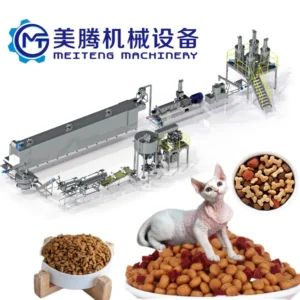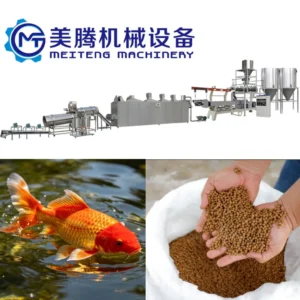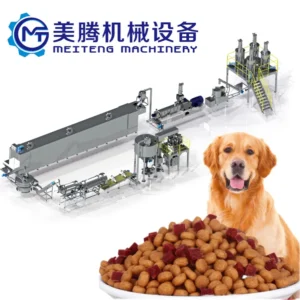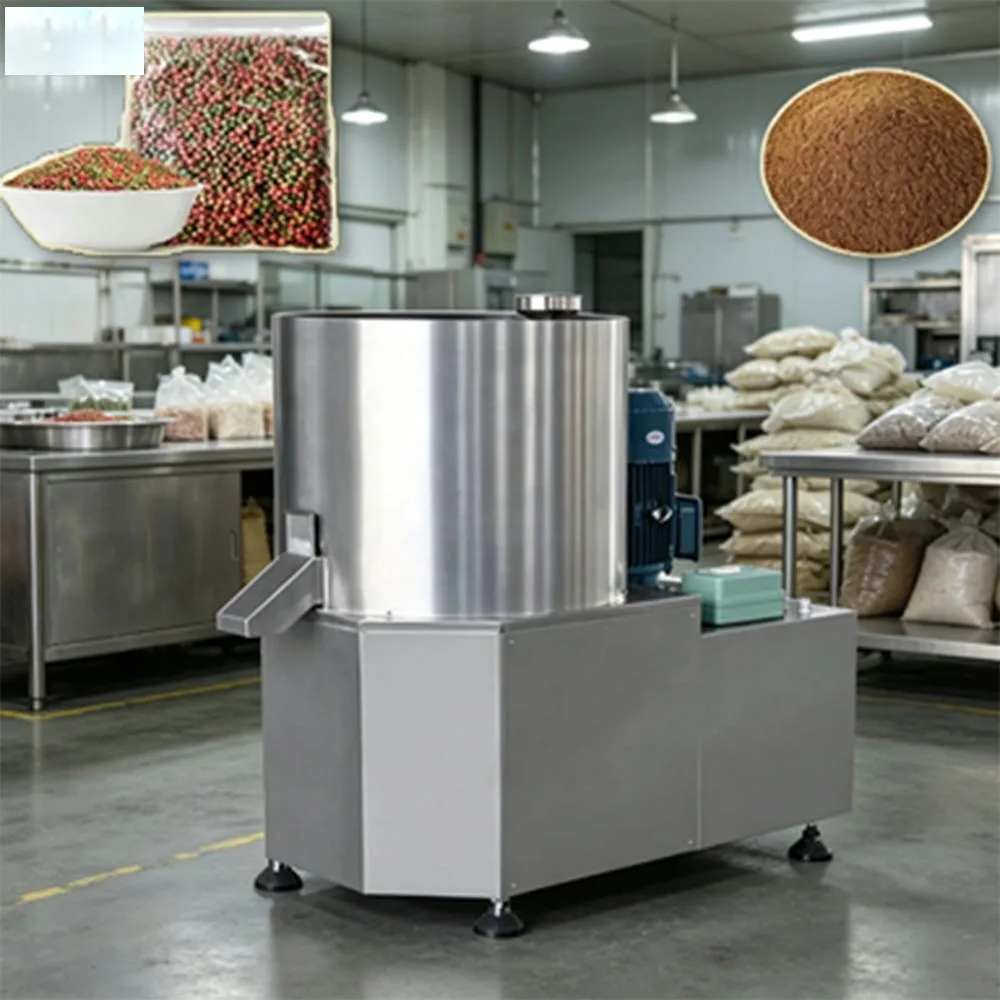


Twin Screw Pet Food Making Machine, 500 kg/h output, 0.5–12 mm pellet range — engineered for floating fish feed and dry kibble production with interchangeable die plates and stainless steel contact parts.
- Full-line throughput matching from batching through extrusion, drying, coating to packing, laid out as one coordinated turnkey project
- Screw configuration and barrel temperature profile specified to your raw material formulation, controlling expansion and pellet density for target market expectations
Delivered with an in-house trial run report on your actual raw material before shipment, so quoted capacity reflects real production conditions.
Description
Turnkey Line Integration — Every station from batching through extrusion to packing is throughput-matched and laid out as a single coordinated project for this floating fish feed extruder turnkey production line.
Technical Specifications
| Parameter | Value |
|---|---|
| Product Type | Twin Screw Extruder for Floating Fish Feed and Pet Food |
| Screw Type | Twin screw |
| Output Capacity | 500 kg/h (basis not stated in source — confirm raw material formulation, moisture content, pellet size) |
| Pellet Size Range | 0.5 mm to 12 mm (adjustable via interchangeable dies) |
| Control System | Simple control panel (PLC / MCC availability to be confirmed) |
| Construction Material | Stainless steel (main contact parts) |
| Line Integration | Feeding, mixing, extruding, pelletizing integrated in one line |
| Automation Level | Fully automatic, continuous operation |
| Die Configuration | Interchangeable dies for 0.5–12 mm pellet sizes |
| Operating Mode | Long-time continuous production with minimal manual supervision |
| Voltage & Frequency | To be confirmed before quotation |
| Certification | CE & ISO held at company level (line-level certification to be confirmed) |
Application Suitability
| Application | Material or Output |
|---|---|
| Floating aquaculture feed | Catfish, tilapia, and shrimp formulations using fish meal, soybean meal, starch binders, and vitamin premix |
| Dry pet kibble | Dog and cat food recipes based on poultry meal, corn, wheat, and meat slurry with fat coating |
| Sinking aquatic pellets | Higher-density formulations for bottom-feeding species, adjusted through screw speed and moisture |
| Diversified pellet sizes | Starter feed at 0.5–2 mm through grower and finisher pellets up to 12 mm, matched to animal growth stages |
Why the Nominal Capacity Figure on a Floating Fish Feed Extruder Turnkey Production Line Rarely Tells the Full Story
Real output is set by your raw material formulation, not by a brochure number.
Early in my career sourcing extrusion lines across the Pearl River Delta, I watched a pet food startup take delivery of a line rated at a certain throughput on standard corn-based recipes. Their actual recipe carried a high fresh meat slurry ratio, and the screws could not feed fast enough — actual output dropped by more than half and the entire line rhythm fell apart. That same risk applies to any floating fish feed extruder turnkey production line: the capacity plate on the extruder says nothing about how the dryer, coater, or packing station will keep up when the real recipe runs [NEED_CITE: common causes of throughput mismatch in extrusion lines]. The only way to prevent that mismatch is to run your exact formulation through the machine before it leaves the factory.
Layout and Throughput Matching Across the Full Line
When a feed factory or a contractor specifies a floating fish feed extruder turnkey production line, the extruder is only one node. Batching feeders must deliver at a rate the twin-screw barrel can accept; the dryer must have enough belt length and residence time to bring pellet moisture down to safe storage levels; the coating drum must apply fat or flavour evenly without creating a bottleneck. If any station is under-sized, the whole line slows to match the weakest link. Engineering the layout as a single project, rather than sourcing each machine separately, is how you keep throughput consistent from the mixer inlet to the packing scale.
Screw Configuration Tuned to Feed Density Targets
Floating feed demands a specific expansion ratio so pellets stay buoyant on the water surface, while sinking feed for species like shrimp requires higher density and lower expansion. The twin-screw profile, barrel temperature zones, and die geometry all work together to control how much the starch gelatinises and how the pellet expands at the die face. A screw configuration that is copied from a generic build will produce the wrong texture or density, meaning floating pellets may sink or kibble may be too hard for the target pet [NEED_CITE: relationship between screw profile and pellet buoyancy in twin-screw extrusion]. The screw profile and die design must be specified against the buyer’s actual raw material and the density the market expects.
Reading the Core Parameters for Feed Production
The 0.5 mm to 12 mm pellet size range is achieved by swapping die plates, but each die diameter changes the pressure at the die face and therefore the expansion behaviour — smaller dies generate higher shear and finer pellet structure, suitable for fry and starter feed, while larger dies produce the coarser pellets used in grower and finisher stages. Stainless steel on the main contact parts resists the salt and fat content typical in aquaculture recipes and simplifies wash-down between recipe changeovers, which matters when a plant runs both fish feed and pet kibble on the same line. The simple control panel handles temperature and screw speed adjustment; whether the buyer needs PLC or MCC integration depends on how many recipe changeovers the plant expects per shift and how much data logging the quality team requires.
The Hidden Cost of Specifying Stations Independently
I have seen contractors assemble an extruder from one supplier, a dryer from another, and a coater from a third, each quoted on its own nominal capacity. On paper every station hits the target. On the factory floor, the dryer cannot remove moisture fast enough because the extruder output carries more water than the dryer was designed for, and the coater drum overflows because its throughput assumes a drier pellet. The result is a line that never reaches the combined output any single vendor promised [NEED_CITE: throughput imbalance effects in multi-vendor extrusion lines]. Downtime accumulates, energy costs climb as the dryer runs longer, and the contractor faces penalty claims from the plant owner.
What Sets This Procurement Path Apart
Every station on this line — batching, extrusion, drying, coating, cooling, and packing — is sized and sourced under one supplier, so throughput is matched across the board rather than left to chance. Screw configuration and die design are documented against your raw material and target pellet density before production starts. The in-house testing workshop runs your actual formulation so you see real output and pellet quality before the line ships. Pre-sales engineering covers the full layout, utility planning, and phased installation schedule, and on-site commissioning includes operator training so the crew can run the line independently from day one.
Documentation & Verification
- Line layout and capacity calculation report confirming station-by-station throughput matching
- Trial run report produced on your raw material formulation in the testing workshop before dispatch
- Screw and die configuration record documenting the exact profile matched to your pellet density target
- Electrical schematic with voltage, frequency, and control language confirmed for your site
- CE declaration of conformity and ISO certificate at company level with packing photographs for customs
Installation, Commissioning & Support
- Foundation and floor-space plan aligned to the integrated line footprint and utility connections
- Dedicated power circuit sized to the extruder motor and dryer heating load confirmed before shipment
- Assembly sequence and rigging plan for the twin-screw barrel, dryer modules, and coating drum
- First-run parameter setting on your recipe with screw speed, barrel temperature, and moisture logged
- Operator training covering die changeover for the full 0.5–12 mm range and daily cleaning procedures
- Wear parts list covering screws, die plates, and barrel liners with recommended replacement intervals
Preparing Your Inquiry
To move from a general concept to a firm line proposal, share your target product format — floating fish feed, sinking pellet, or dry kibble — along with the raw material formulation and moisture content you plan to run. Specify the daily output you need and the pellet size range your market requires. Include your workshop dimensions, ceiling height, and local voltage and frequency so the electrical design matches your grid from the start.
Frequently Asked Questions
Q: How is the 500 kg/h output capacity verified, and on what raw material formulation is it based?
A: The 500 kg/h figure is a reference value whose basis is not stated in the source data. We verify actual throughput by running your specific formulation — including protein level, starch content, and moisture — in our in-house testing workshop before shipment. The trial run report you receive documents the real output achieved on your recipe and pellet size.
Q: How do you ensure throughput matching between the extruder and downstream stations?
A: Every station on this floating fish feed extruder turnkey production line is sized under a single project layout. We calculate mass and energy balance from the mixer through the extruder, dryer, coater, and packing scale so that no station creates a bottleneck. The capacity calculation report is shared with you for review before production begins.
Q: What is included in the turnkey installation and commissioning schedule?
A: The schedule covers foundation guidance, mechanical assembly, electrical connection, and first-run trials on your raw material. Our engineer stays on-site to set parameters, fine-tune screw speed and barrel temperatures, and train your operators on die changeover, daily cleaning, and routine maintenance. Operator training is completed before handover.
Q: Can the screw configuration and die design be adjusted after installation to switch products?
A: Yes. The twin-screw elements are modular and the die plates are interchangeable across the 0.5–12 mm range. Switching from floating fish feed to denser sinking pellets or to dry pet kibble involves adjusting the screw profile, barrel temperature zones, and die selection. We document the baseline configuration so your team can replicate results on every run.
Q: What documentation is provided for customs clearance and local regulatory compliance?
A: You receive a CE declaration of conformity, ISO certificate, factory test record, commercial invoice, packing list, and packing photographs. If your market requires additional compliance documents, we prepare the customs documentation support package to match the import requirements of the destination country.
Related products
-
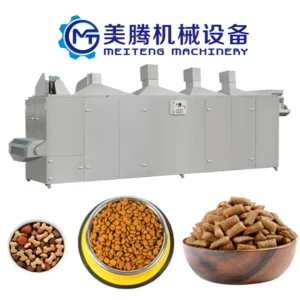
MT85 500kg/h Multi-Purpose Pet Food Processing Line for Dogs Cats Birds Fish & More-380V 50Hz Three Phase 45KW
¥65,000.00 Select options This product has multiple variants. The options may be chosen on the product page -
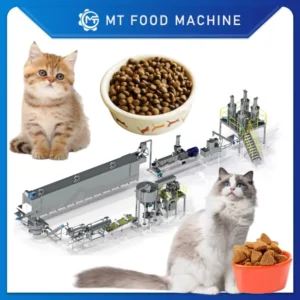
MT Brand 450-550kg/h PLC Controlled Multi-Species Pet Food Processing Line
¥40,000.00 Select options This product has multiple variants. The options may be chosen on the product page -
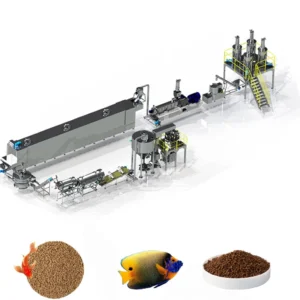
Automatic Fish Feed Production Line Machine Floating Sinking Pellet Manufacturing High Capacity Energy Saving Design
¥9,500.00 Select options This product has multiple variants. The options may be chosen on the product page -
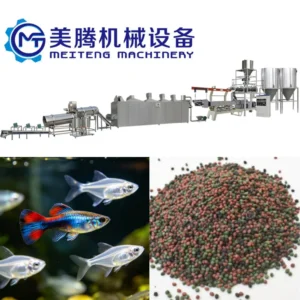
200-300kg/h Capacity Multi-Species Fish Feed Processing Line to Produce Fish Food
¥34,000.00 Select options This product has multiple variants. The options may be chosen on the product page