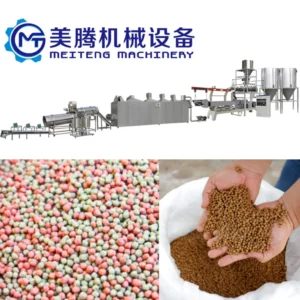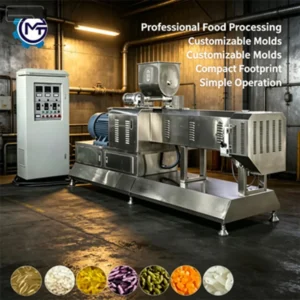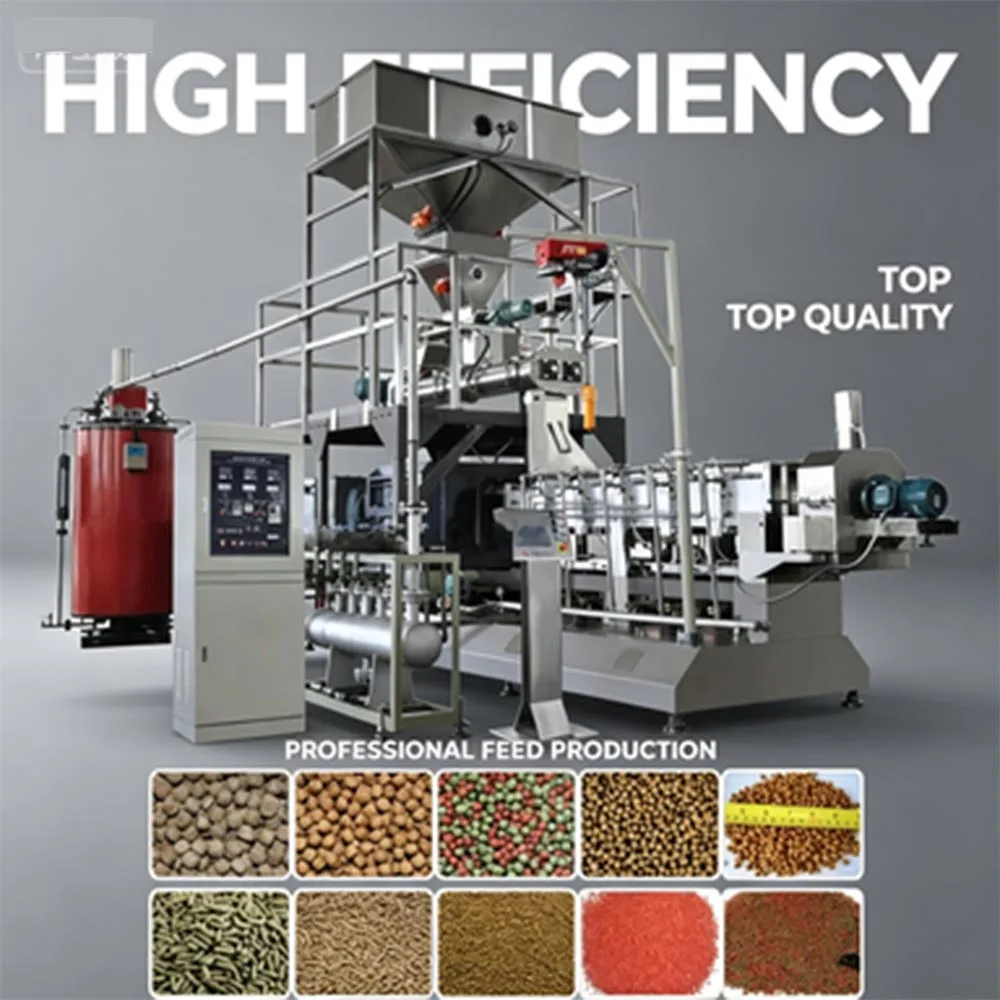

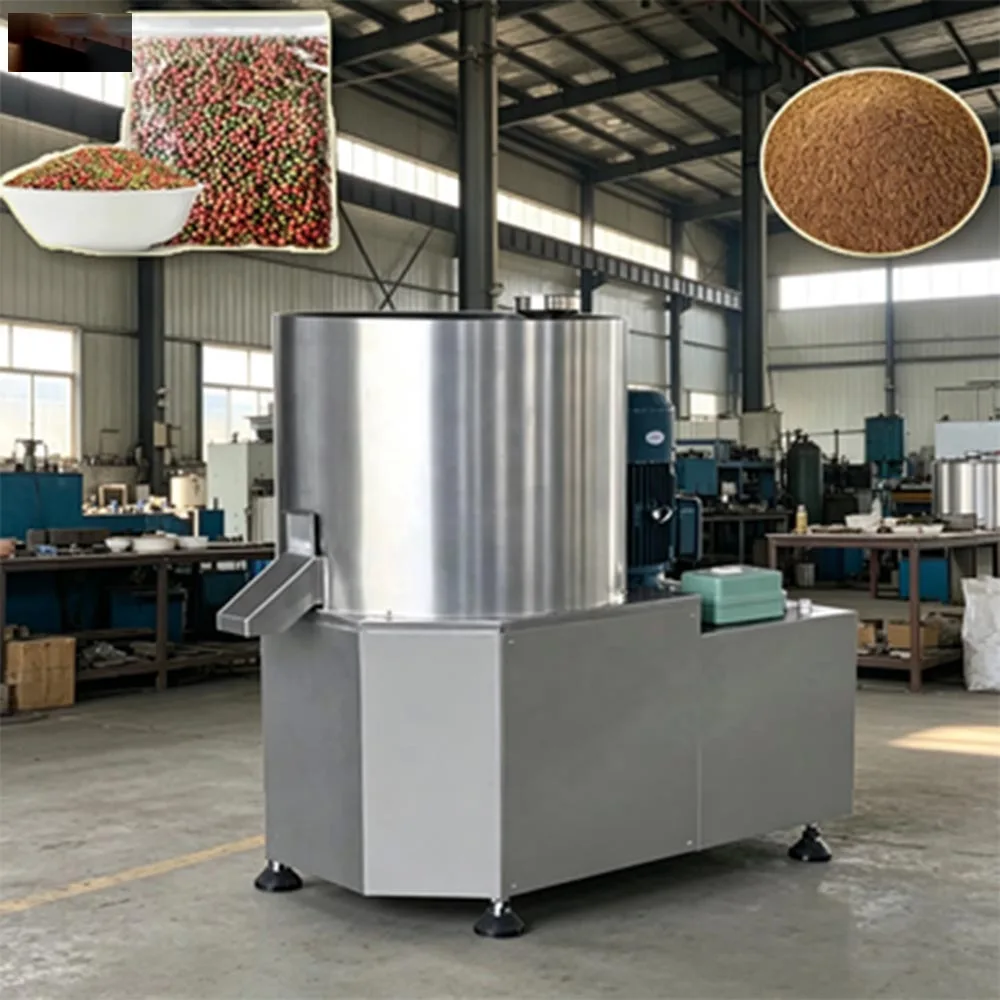


Twin Screw Extrusion Fish Feed Production Line, PLC Automatic Control, Food-Grade 304 SS Contact Parts — configured for floating and sinking pellet production from fish meal, soybean meal, corn powder and compound additives.
- Complete turnkey layout with matched throughput across mixing, extrusion, drying, seasoning and screening stations to avoid line bottlenecks
- Screw configuration and die design specified to the buyer’s raw material formulation and target pellet buoyancy, density and size
Delivered as a coordinated project from one supplier — line capacity calculation, in-house trial run on customer raw material before shipment, and on-site commissioning with operator training included.
Description
Throughput-Matched Engineering — Every station from batching through extrusion to packing is sized against the same raw material formulation, so the line holds its rated output without bottlenecking at the dryer or coating drum.
Technical Specifications
| Parameter | Value |
|---|---|
| Product Type | Aquatic Feed Extrusion Production Line |
| Screw Type | Twin Screw |
| Control System | PLC automatic control |
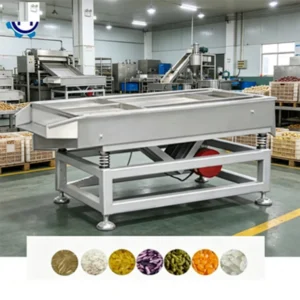
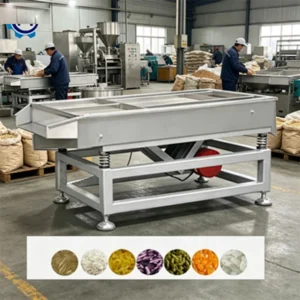
| Line Stations | Raw material mixer, extruder, dryer, seasoning/coating machine, vibrating sieve, conveyor equipment |
| Material Contact Parts | Food-grade 304 stainless steel |
| Product Types Supported | Floating and sinking fish feed pellets |
| Pellet Adjustability | Size, hardness, buoyancy |
| Raw Materials Processed | Fish meal, soybean meal, corn powder, compound additives |
| Operation Mode | Continuous automatic production |
| Assembly State | Complete matched production configuration |
| Energy Feature | Optimized energy-saving transmission structure and heating system |
| Output Capacity | Large stable processing capacity for medium-to-large scale production (basis to be confirmed: raw material formulation, pellet size, moisture content) |
| Standards | CE, ISO |
Application Suitability
| Application | Material or Output |
|---|---|
| Commercial floating fish feed manufacturing | Fish meal, soybean meal, corn powder, compound additives |
| Commercial sinking fish feed manufacturing | Fish meal, soybean meal, corn powder, compound additives |
| Koi and goldfish feed production | Formulated aquatic feed blends |
| Tropical fish feed production | Specialty aquatic formulations with micro-nutrient additives |
| Freshwater aquaculture feed processing | Standard aquaculture feed formulations at scale |
Why the Dryer Question Should Come Before the Extruder Price
A mismatched dryer turns a high-output extruder into an expensive bottleneck.
I have walked through feed mills in Europe and North America where the extruder pushes material faster than the dryer can handle, forcing operators to throttle back the entire line. The extruder runs below capacity, energy consumption per kilogram of finished pellet climbs, and the promised throughput never materializes. When an aquatic feed production line turnkey project is scoped, the drying station must be calculated against the same moisture reduction target and pellet density the extruder is set to produce [NEED_CITE: drying capacity calculation methods for extruded aquatic feed]. Sinking pellets and floating pellets exit the die at different moisture levels, which means the dryer load changes with the product type — a detail frequently overlooked in generic line quotations.
Line Layout That Prevents Station-Level Bottlenecks
An aquatic feed production line turnkey configuration starts with mapping every station’s throughput against the slowest link in the chain. The mixer must feed the extruder continuously without surge or starvation, the dryer must handle peak moisture load from the die output, and the coating drum must apply fat or palatant at the rate the downstream packing station can receive. When all stations are specified by a single supplier, the interface points — belt widths, transfer chutes, buffer hoppers — are designed together rather than adapted on-site after installation.
How Raw Material Formulation Drives Every Station
The ratio of fish meal to starch-based binder affects gelatinisation inside the barrel, which determines pellet density and, consequently, whether the pellet floats or sinks. A formulation change ripples through the dryer residence time, the cooling conveyor length, and the coating absorption rate. Specifying an aquatic feed production line turnkey solution without confirming the buyer’s exact formulation means every downstream calculation rests on an assumption [NEED_CITE: starch gelatinisation and pellet buoyancy relationship in twin-screw extrusion]. That is why a trial run on the buyer’s actual raw material in the testing workshop anchors the line design to reality before any equipment ships.
Reading the Spec Sheet Beyond Marketing Claims
The twin-screw configuration matters because it provides positive conveying for sticky, high-protein formulations like fish meal blends that single-screw extruders often struggle to feed consistently. The PLC control system coordinates barrel temperature zones, screw speed, and feeder rate so that pellet density stays within the floating or sinking specification across long production runs. Food-grade 304 stainless steel on all contact surfaces prevents corrosion from the salts and oils typical in aquatic feed formulations, extending the interval between component replacements. The continuous automatic production mode depends on the vibrating sieve removing undersized and oversized pellets before they reach the coating drum, where off-spec material would absorb coating unevenly and waste expensive fat or palatant additives.
The Hidden Cost of Skipping the Configuration Conversation
When a line is quoted on nominal extruder capacity without matching the dryer, cooler, and coater to that output, the buyer discovers after commissioning that the line cannot sustain the quoted rate. Operators then spend weeks adjusting screw speed downward, which changes shear and temperature profile inside the barrel, producing pellets with different texture and buoyancy than the market specification requires [NEED_CITE: effects of screw speed reduction on extrudate density and expansion]. Retrofitting a larger dryer or adding a second coating pass after installation costs far more in downtime and re-engineering than specifying correctly at the quotation stage.
What Sets This Project Apart
Every station on this aquatic feed production line turnkey project is specified under a single supplier responsibility, eliminating finger-pointing between extruder and dryer vendors when throughput falls short. The screw configuration and die design are selected against the buyer’s confirmed raw material formulation, not copied from a generic build. An in-house machine testing workshop allows trial runs on the buyer’s actual ingredients before shipment, producing a documented report that anchors the installation parameters. Pre-sales consultation covers line layout, utility planning, and phased commissioning scheduling, so the buyer’s contractor knows exactly what foundation, power, and ventilation work is required before the first container arrives.
Documentation & Verification
- Line layout drawing with capacity calculation matched to your raw material formulation and target pellet specification
- Screw and die configuration record specific to your floating or sinking feed formula
- Factory trial run report on your supplied raw material confirming pellet density and moisture at die exit
- Electrical schematic with voltage, frequency, and control language confirmed for your destination market
- CE declaration of conformity and ISO certificate for customs and regulatory submission
- Operation and maintenance manual with wear parts list and recommended replacement intervals
Installation, Commissioning & Support
- Foundation and utility plan covering floor load, drainage, and ventilation for the dryer and extruder stations
- Power specification confirming voltage, frequency, and dedicated circuit requirements for the PLC control cabinet
- Modular delivery with station-by-station assembly sequence to fit your workshop access and overhead crane capacity
- First-run commissioning with screw speed, barrel temperature, and feeder rate tuned to your confirmed formulation
- Operator training on PLC interface, safety interlocks, and daily startup and shutdown procedures
- Wear parts supply covering screws, dies, and dryer screen panels with recommended stock quantities
Preparing Your Inquiry
To scope an aquatic feed production line turnkey project accurately, provide your target pellet types (floating, sinking, or both), the raw material formulation you plan to use, and the daily output you need the line to sustain. Confirm the local voltage and frequency standard along with your preferred control interface language so the electrical package matches your workshop. If you have existing upstream or downstream equipment such as silos or packing machines, share their specifications so the line interfaces correctly at both ends.
Frequently Asked Questions
Q: How is the actual production capacity confirmed before the line is built?
A: Capacity depends on your raw material formulation, target pellet size, and moisture content at the die exit. We run a trial on your supplied ingredients in our testing workshop and document the output rate, pellet density, and moisture levels. That report becomes the basis for sizing every downstream station.
Q: How do you match screw and die configuration to my specific feed formula?
A: Screw element arrangement, compression ratio, and die hole diameter are selected based on the protein-to-starch ratio in your formulation and whether the target pellet must float or sink. The configuration is recorded and tested on your material before shipment, not carried over from a generic build.
Q: How do you ensure the mixer, extruder, dryer, and coater run at the same throughput?
A: Each station is calculated against the same hourly mass flow derived from your confirmed formulation and pellet specification. Belt widths, transfer chutes, and buffer capacities are designed together so no single station forces the rest of the line to slow down.
Q: How are voltage, frequency, and control language confirmed for my market?
A: During the quotation stage we collect your local power standard and preferred operator language. The electrical schematic and PLC interface are then configured accordingly, and the confirmation is documented before production begins to avoid delays at commissioning.
Q: Can you run a trial with my actual raw materials before shipping?
A: Yes. Our in-house testing workshop performs a full trial on your supplied ingredients. The trial run report records pellet size distribution, buoyancy test results, moisture content, and extruder operating parameters, giving you a validated baseline before the line arrives at your facility.
Related products
-
MT70 200-250kg/h Dog Cat Pet Food Processing Line 380V 50HZ Three Phase 45KW
¥35,000.00 Select options This product has multiple variants. The options may be chosen on the product page -
1.0-1.5t/h High Capacity Multi-Species Fish Feed Processing Line to Produce Fish Food
¥45,000.00 Select options This product has multiple variants. The options may be chosen on the product page -
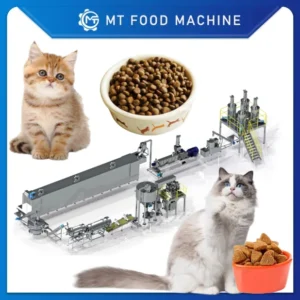
MT135 Brand 2.5-3.0t/h PLC Controlled Multi-Species Cat Food Processing Line
¥55,000.00 Select options This product has multiple variants. The options may be chosen on the product page -
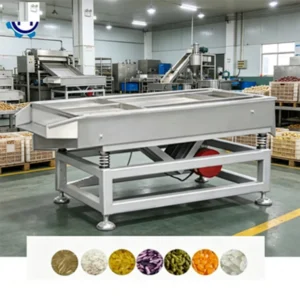
Energy Saving Automatic Twin Screw Extruder Floating Sinking Aquatic Fish Feed Industrial Production Processing Line
¥65.00 Select options This product has multiple variants. The options may be chosen on the product page